In October 2022, the Academy of European Law (ERA) in Trier celebrated its 30th anniversary with a congress devoted to the legal dimension of the European sovereignty. 1992 was not only the year in which the ERA was founded, but also a key moment in the history of European integration, as it marked the signing of the founding treaty of the European Union, the Treaty of Maastricht. While sovereignty was a highly controversial issue at the time, the (geo)political and economic challenges facing the Union in recent years have brought it back to the centre of the debate. This book brings together some of the papers presented at the Jubilee Congress and explores recent concepts such as ‘budgetary sovereignty’, ‘strategic sovereignty’, and ‘digital sovereignty’.
I’m overdue an update on this project, but while I’ve been working hard, I haven’t felt there has been much to say until now. I’ve also had some further health problems, leading to another shorter stay in hospital and the fitting of a pacemaker. It feels like a small setback, which I recovered from quickly, and I’m now back doing everything again.
Over the past couple of months I’ve been working on Benveniste for the most part, completing a draft of the chapter on the 1949-63 period which attempts to connect the Benveniste and Dumézil stories. Much of what I’ve done has concerned his teaching, and trying to show how his courses at the École Pratique des Hautes Études and at the Collège de France connect to his publications. Some pieces he published are directly the result of his teaching, and some of his publications find their way into his classes. This is appropriately much more the case with the Collège de France courses, since Professors there are supposed to report on their ongoing research, whereas at the EPHE there is a more pedagogical purpose. The Annuaires of both institutions give brief details of each year’s classes, and there are some materials in the archive which also help, as well as a few student notes in different places. Occasionally reading between the course and a publication of a similar time can help make sense of a cryptic remark in either a summary or text, though I’m sure I’ll find more connections as I continue this work.
In this draft chapter, the two key books by Benveniste I discuss are both very technical – Études sur la langue ossète and Hittite et indo-européen. But there are a number of shorter pieces too, many collected in Problems in General Linguistics and a few in Langues, Cultures, Religions. Others are harder to track down, but I’m trying to connect them to the teaching records. Benveniste worked on multiple projects in parallel, and trying to create a clear narrative is challenging.
I then continued with Benveniste’s final years, beginning to draft a chapter that will also cover his teaching and writing alongside Dumézil. Where Dumézil lived long enough to provide an ambitious summation of his life’s work, and then embarked on new projects in his last decade or so, Benveniste’s career was cut brutally short by a stroke which left him aphasic and unable to do any work for the last seven years of his life. The Last Lecturesvolume gives some idea of where he might have gone in one direction.
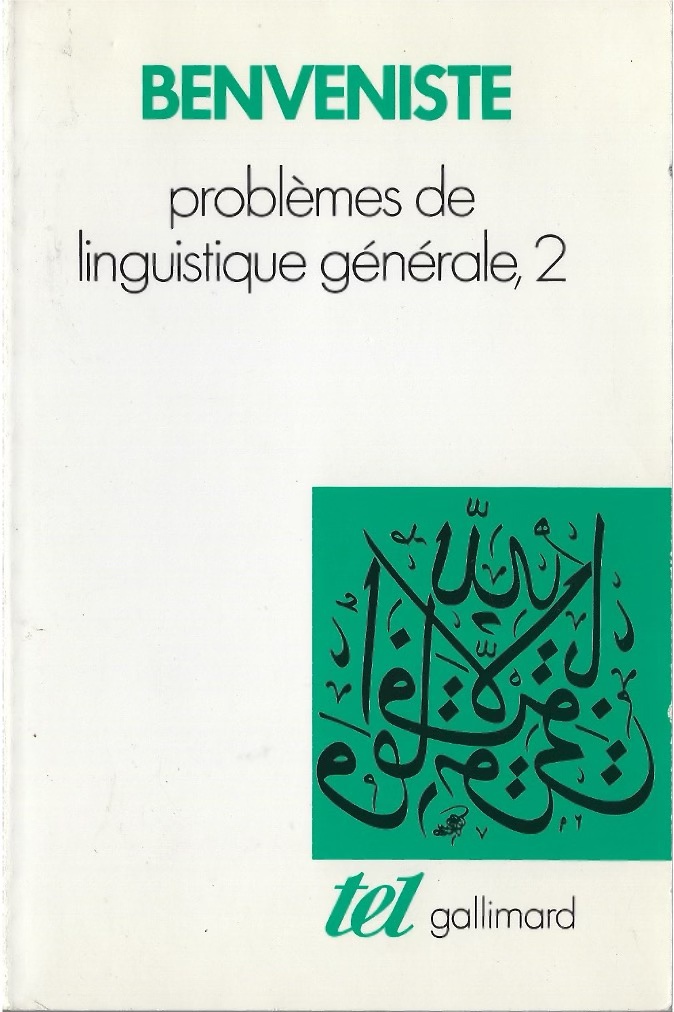
Many of the essays Benveniste wrote in this final period are collected in the second volume of his Problèmes, only a few of which are translated into English. (I’ve made a list of those I know about here.) The second volume of Problèmes was compiled by Mohammed Djafer Moïnfar and Michel Lejeune, and unlike the first which Benveniste selected across over two decades, it took texts from just a few years. Quite a few of the texts again directly relate to teaching, and I found it useful to be able to compare the reports to the published work. What is clear to me from the teaching records and these publications is how much else Benveniste planned to do – there are indications of much larger projects which his health prevented him from completing. Of course, his illness came as a sudden shock, but he left so many promises of things he planned to do. There are also two very late projects with some manuscript traces on Baudelaire and poetic language, published by Chloé Laplantine, and on axiology, partly published by Irène Fenoglio. The first has generated some secondary discussion, but the second is rather enigmatic and I’m not entirely sure what to make of it all. It sent me off looking at the work of the Chilean philosopher Auguste Salazar-Bondy to whom Benveniste was responding.
At the end of November I gave a seminar on the research to the University of St Andrews, to the Social Anthropology seminar, where I was kindly invited by Christos Lynteris. It was a good opportunity to try to shape some of the thoughts into a form I could share with others. I spoke about Dumézil and Benveniste’s careers at the Collège de France, picking a few themes from their work to show how I think exploring their teaching is helpful in reconstructing their careers. I expect I will give this talk again at some point, perhaps in a revised form.
In mid-December I was briefly back in Paris, where I finally completed a first pass through the Benveniste material at the Bibliothèque nationale, so I now have a good sense of where everything is. When I’m next back I can return to some material with a clearer sense of how it fits together. The boxes are not chronological, and not thematic, so looking at them in number sequence was a necessary first step, but a different order will hopefully make more sense of some material. I also went back to the Collège de France to look at some extra things and go over a couple of familiar files again. At the Bibliothèque nationale I also looked at two more boxes of the Tzvetan Todorov papers, which I thought might be useful for this project. One of those contained something I wasn’t expecting. It’s a document I knew existed, but which I thought I wouldn’t be able to see until I was able to get to the Roman Jakobson archive at MIT. It’s the transcript of a long interview with Jakobson for French television, and which it turns out Todorov was involved with writing the questions. This was shortly before Todorov edited a French collection of Jakobson’s work – Questions de poétique. The interview is very interesting and biographical, and touches upon, among many other themes, Jakobson’s friendship with Nicolai Trubetzkoy and his first meeting with Benveniste. As far as I can tell, this interview was never published.
Following this I also made a trip to Oxford which I found has some papers relating to Jakobson in the Second World War. Jakobson left Prague shortly before the Nazi invasion in early 1939, and spent time in Denmark, Norway and Sweden, before moving to New York in 1941. There are some published letters which shed some light on this. But there were attempts to get him to England, and there is quite a bit of correspondence about this attempt, less of which is published. The archive gave a lot more information than I’d seen before. Once he was in New York, he was introduced to Claude Lévi-Strauss by Alexandre Koyré, and all three taught at the École Libre des Hautes Études. This meeting was so important for Lévi-Strauss, and post-war French theory. That is fairly well-known, and I’d planned to say only a little about it. But I was also interested in his pre-war meeting with Benveniste, when Benveniste gave a talk in Prague to the linguistic circle. There is an interesting scrap of information about that talk, for which the manuscript was lost in the war. After the war, Benveniste and Jakobson met several more times, in the USA and Paris, and there was a correspondence between them. Their pre-war correspondence though is lost – Jakobson burned most of his papers before leaving Czechoslovakia; and most of Benveniste’s papers were destroyed when his apartment in Paris was occupied during the war.
The Paris trip is the last I will make there until June at the earliest, since I’ll be in the USA in early 2025. I’ll be in a visiting post at the Remarque Institute at New York University, and I’m looking forward to that very much. I’m not going to do many talks on this trip, except at NYU, and one in Buffalo, but am looking forward to less formal conversations. It’s also a chance to get to visit some archives – some in New York, and some a bit further away but accessible from there. I had hoped to go to New York with more of the book in draft, since work on Benveniste and Dumézil’s publications is actually easier at home, where I have almost all their books, more than in any library I know. But I think that I should have most of the Benveniste material drafted, and the Dumézil parts up to around 1963. The later parts of Dumézil’s career are possible to work on with good libraries, since those books are more easily accessible than some of the earlier ones. But part of the aim of being in New York is to research and write about some of the other figures in the wider story I want to tell, many of whom spent crucial years there. Lévi-Strauss, Jakobson and Koyré are some of those people, but there are others.
Previous updates on this project can be found here, along with links to some research resources and forthcoming publications. The re-edition of Georges Dumézil’s Mitra-Varunais now published. There is a lot more about the earlier Foucault work here. The final volume of the series is The Archaeology of Foucault,and the special issue of Theory, Culture & Society I co-edited on “Foucault before the Collège de France” has some important contributions on the earlier parts of Foucault’s career, and is currently available free to access. My article “Foucault and Dumézil on Antiquity” was recently published in the Journal of the History of Ideas (currently open access); “Alexandre Koyré and the Collège de France” is online first and open access.
Some nice news that because it is one of the most-read articles in the Journal of the History of Ideas this year, my piece “Foucault and Dumézil on Antiquity” is open access until the end of January 2025. The full list is below:
We are pleased to share some of 2024’s most-read articles from the Journal of the History of Ideas. We hope you will share these articles with colleagues, students, and anyone else that might have an interest in the journal. The articles are free to read through the end of January.
Thanks to Jordan K. Skinner, the editor of the forthcoming new edition of Problems for some new information. A translation of a chapter I didn’t know about, a new translation of one text, and a reprint. Any further information gratefully received.
Some more research resources linked to my Indo-European thought project – on Dumézil and Saussure – are listed here. Lots of other research resources, on Foucault, Sartre, Bataille, Lefebvre, etc. are listed here.
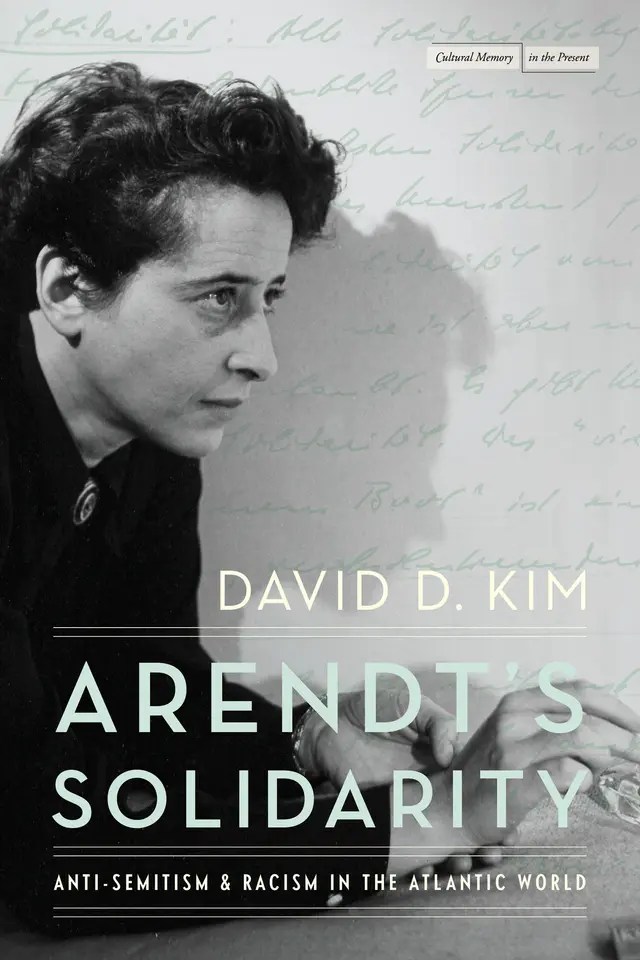
Hannah Arendt’s work inspires many to stand in solidarity against authoritarianism, racial or gender-based violence, climate change, and right-wing populism. But what if a careful analysis of her oeuvre reveals a darker side to this intellectual legacy? What if solidarity, as she conceives of it, is not oriented toward equality, freedom, or justice for all, but creates a barrier to intersectional coalition building?
In Arendt’s Solidarity, David D. Kim illuminates Arendt’s lifelong struggle with this deceptively straightforward yet divisive concept. Drawing upon her publications, unpublished documents, private letters, radio and television interviews, newspaper clippings, and archival marginalia, Kim examines how Arendt refutes solidarity as an effective political force against anti-Semitism, racial injustice, or social inequality. As Kim reveals, this conceptual conundrum follows the arc of Arendt’s forced migration across the Atlantic and is directly related to every major concern of hers: Christian neighborly love, friendship, Jewish assimilation, Zionism, National Socialism, the American republic, Black Power, revolution, violence, and the human world. Kim places these thoughts in dialogue with dissenting voices, such as Thomas Mann, Gershom Scholem, Jean-Paul Sartre, James Baldwin, Frantz Fanon, James Forman, and Ralph Ellison. The result is a full-scale reinterpretation of Arendt’s oeuvre.
A group portrait of six of the finest historians of the First World War
In Disputing Disaster, Perry Anderson picks out from the highly charged historiography on the First World War one leading historian from each of the major powers that survived the conflagration: Fritz Fischer, famous historian of German war guilt; Pierre Renouvin, a disabled serviceman and preeminent authority on the conflict in France; Luigi Albertini, the Italian newspaper tycoon who, unique among scholars of the Great War, played a part in pitching his country into it; Paul W. Schroeder, the American expert on the system of Europe – an interstate relations and its breakdown in 1914; Keith Wilson, the one radical deviant from a patriotic consensus about Britain’s role in the outbreak of the fighting; and, from Australia (summoned into the war as a dominion), Christopher Clark, acclaimed author of The Sleepwalkers.
Disputing Disaster offers a compelling analysis of the major competing versions of the genesis of the Great War; fresh light on the political background of its leading historians; and a novel synthesis of the determining pressures that brought the conflict to pass.
The academic field of international relations presents its own history as largely a project of elite white men. And yet women played a prominent role in the creation of this new cross-disciplinary field. In Erased, Patricia Owens shows that, since its beginnings in the early twentieth century, international relations relied on the intellectual labour of women and their expertise on such subjects as empire and colonial administration, anticolonial organising, non-Western powers, and international organisations. Indeed, women were among the leading international thinkers of the era, shaping the development of the field as scholars, journalists, and public intellectuals—and as heterosexual spouses and intimate same-sex partners.
Drawing on a wide range of archival sources, and weaving together personal, institutional, and intellectual narratives, Owens documents key moments and locations in the effort to forge international relations as a separate academic discipline in Britain. She finds that women’s ideas and influence were first marginalised and later devalued, ignored, and erased. Examining the roles played by some of the most important women thinkers in the field, including Margery Perham, Merze Tate, Eileen Power, Margaret Cleeve, Coral Bell, and Susan Strange, Owens traces the intellectual and institutional legacies of misogyny and racism. She argues that the creation of international relations was a highly gendered and racialised project that failed to understand plurality on a worldwide scale. Acknowledging this intellectual failure, and recovering the history of women in the field, points to possible sources for its renewal.
The book is now available for sale, in print or e-book via University of Chicago Press. HAU will make an open-access e-book available when they sell 200 copies. This is to recoup the costs of buying the rights to the translation (not to pay me as editor). If you’re in a position to buy the book or recommend to a library please do. The Introduction and Afterword are open access now.
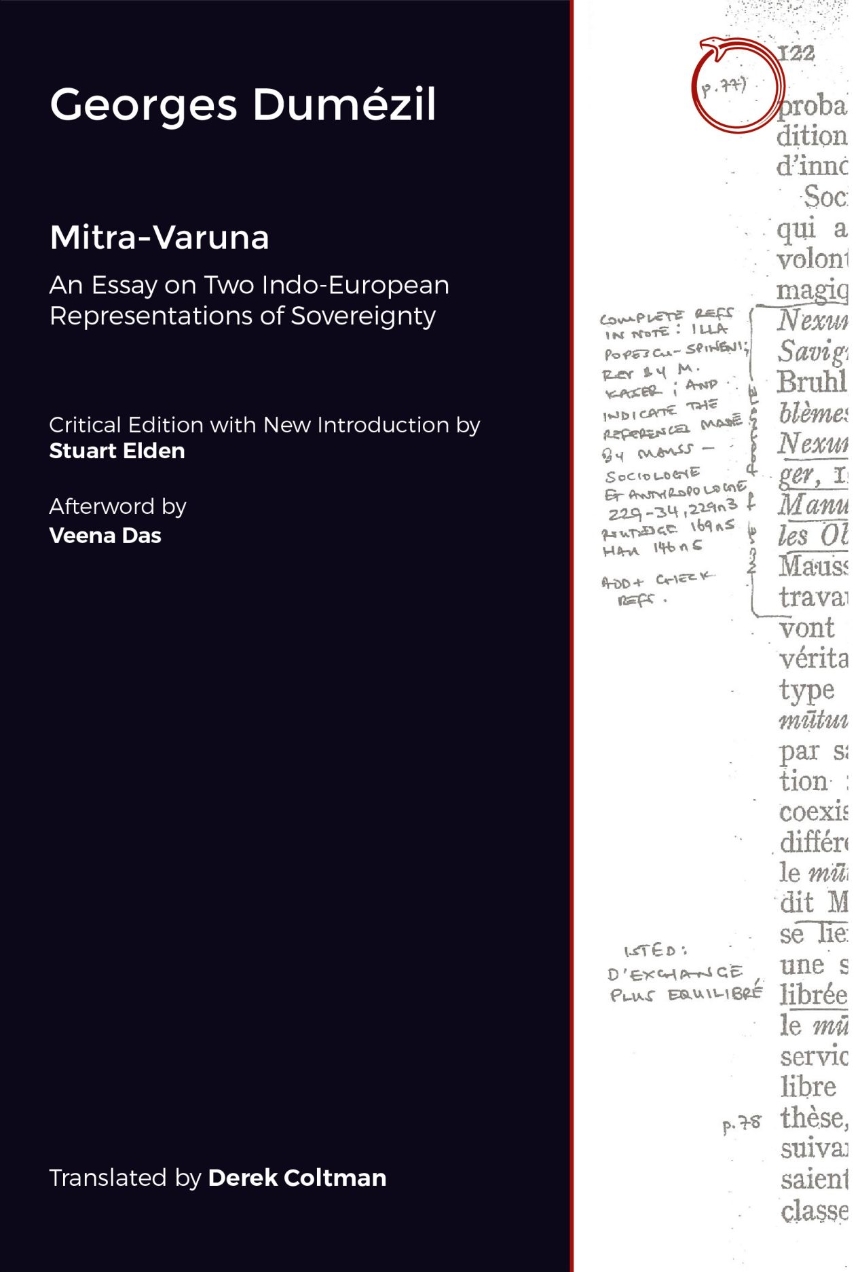
The edition uses the existing translation by Derek Coltman, long out of print, and has a new critical apparatus and Introduction by me. There is a discussion of the editing work here. This is part of the work of my Mapping Indo-European thought in twentieth-century France research project, funded by the Leverhulme Trust.
A classic text that develops one prong of Dumézil’s tripartite hypothesis of Indo-European tribes: the sacred sovereign.
Georges Dumézil’s fascination with the myths and histories of India, Rome, Scandinavia, and the Celts yielded an idea that became his most influential scholarly legacy: the tripartite hypothesis, which divides Indo-European societal functions into three classes: the sacred sovereign, the warrior, and the producer. Mitra-Varuna, originally published in 1940, concentrates on the first function, that of sovereignty. Dumézil identifies two types of rulers, the first judicial and worldly, the second divine and supernatural. These figures, both priestly, are oppositional but complementary. The title nods to these roles, referring to the gods Mitra, a rational mediator, and Varuna, an awesome religious figure.
Stuart Elden’s critical edition, based on the 1988 English translation by Derek Coltman, identifies variations between the first and second French editions and completes—and in places corrects—Dumézil’s references. The editor’s detailed introduction situates Mitra-Varuna within Dumézil’s career, outlines how his treatment of its themes developed over time, and relates the book to the political controversy around his ideas. Two new appendices contain passages that did not appear in the second French edition.
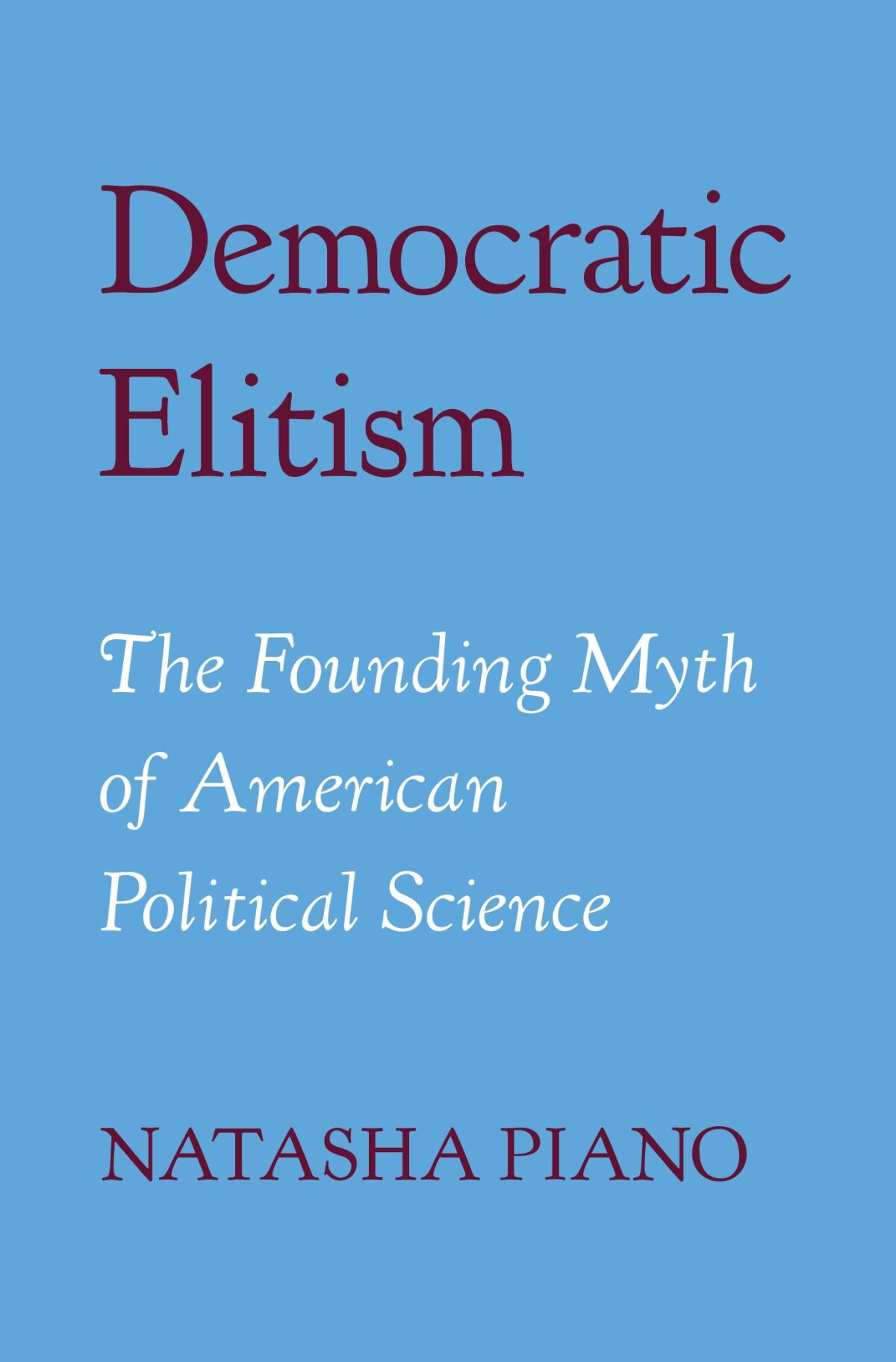
A searing argument—and work of meticulous scholarship—about how American political scientists misinterpreted the elite theory of democracy and in so doing made our political system vulnerable to oligarchic takeover.
Do competitive elections secure democracy, or might they undermine it by breeding popular disillusionment with liberal norms and procedures? The so-called Italian School of Elitism, comprising Vilfredo Pareto, Gaetano Mosca, and Robert Michels, voiced this very concern. They feared that defining democracy exclusively through representative practices creates unrealistic expectations of what elections can achieve, generating mass demoralization and disillusionment with popular government.
The Italian School’s concern has gone unheeded, even as their elite theory has been foundational for political science in the United States. Democratic Elitism argues that scholars have misinterpreted the Italians as conservative, antidemocratic figures who championed the equation of democracy with representative practices to restrain popular participation in politics. Natasha Piano contends not only that the Italian School’s thought has been distorted but also that theorists have ignored its main objective: to contain demagogues and plutocrats who prey on the cynicism of the masses. We ought to view these thinkers not as elite theorists of democracy but as democratic theorists of elitism.
The Italian School’s original writings do not reject electoral politics; they emphasize the power and promise of democracy beyond the ballot. Elections undoubtedly are an essential component of functioning democracies, but in order to preserve their legitimacy we must understand their true capacities and limitations. It is past time to dispel the delusion that we need only elections to solve political crises, or else mass publics, dissatisfied with the status quo, will fall deeper into the arms of authoritarians who capture and pervert formal democratic institutions to serve their own ends.
This book is the first to examine in minutiae the politics of Gottlob Frege (1848–1925), and his connections with various traditions of far-right and fascist thought.
Frege was a philosopher of logic, language, and mathematics. But he also believed that one could reconcile the politics of the far right with a firm commitment to reason-guided inquiry and scientific objectivity. The fundamental claim of the text is that Gottlob Frege was, from the early 1890s to the mid-1920s, an anti-democratic, nationalist political thinker and that his political thought eventually took on a fascist character. This book makes no attempt to vilify or demonize Gottlob Frege, nor does it try to rescue him from criticism. It simply seeks to tell the truth about Frege’s descent into fascism: to document it in hitherto unprecedented detail; to situate it in the context of intellectual and political debates in early Weimar-era Germany; and to explain how it could have happened that someone so intelligent and so manifestly devoted to reason and logic could have embraced fascism with such unreserved enthusiasm.
Frege and Fascism will be of interest to scholars of analytic philosophy, intellectual history, fascism, and anti-democratic thought.