Open access versions of my articles

Most of my publications are listed on my Warwick webpage, with links to the publisher pages

Warwick’s online repository is WRAP, and my page is here. This has preprints of pieces from 2014 onwards for open access compliance.

I keep a list of publications on this site, providing links to as many as I can – separate pages for articles and chapters, a couple of links to booksinterviewsaudio and video, and reading lists.

Some forthcoming pieces are listed here.

I also try to keep ResearchGate updated, with several pieces available there. I deleted my academia.edu account some time ago (I briefly say why here).

If you can’t find an article or chapter by one of those routes then you can email me, and I’ll try to help. But I don’t have pdf copies of absolutely everything, unfortunately.
Posted in Uncategorized | 1 Comment

Journal of the History of Ideas Virtual Issue: Recent Work in French Intellectual History

Journal of the History of Ideas Virtual Issue: Recent Work in French Intellectual History

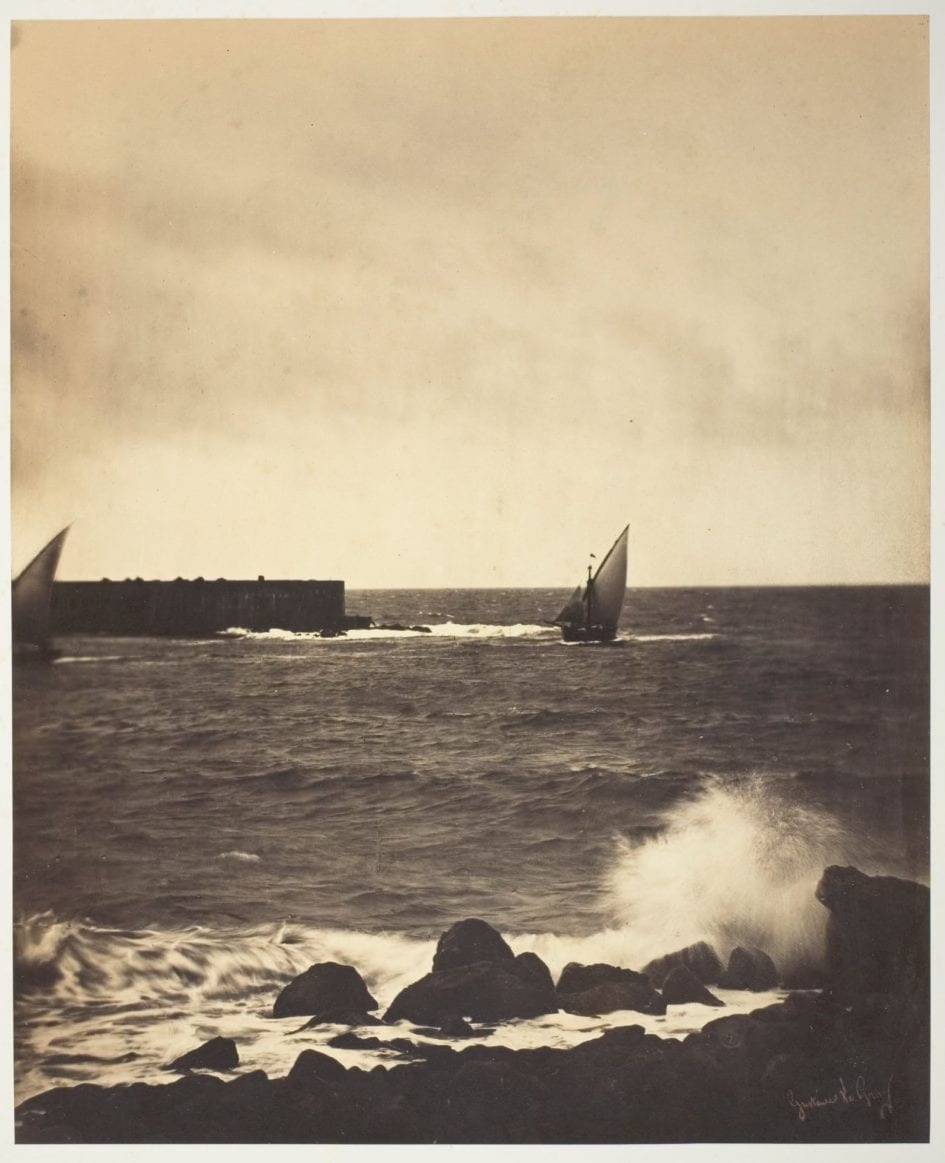
Featured image: Gustave Le Gray, The Breaking Wave, 1857, Hugh Edwards Fund, Art Institute Chicago, CCO.

This virtual issue highlights recent publications in the JHI of relevance to French intellectual history since the last quarter of the nineteenth century. The reason for compiling it is relatively simple—we hope that readers might enjoy it. This string of recent publications (roughly since 2016) indicates some significant turns in the field. “French” intellectual history is certainly no longer limited to the hexagon, nor to the existentialist, Marxist, structuralist and “liberal 1980s” storylines. It belongs squarely in transnational and postcolonial discussions; it is invested in close philological and theoretical work as much as in detailed contexts and sociological frames, some of which have long been underexamined; and it is far more genuinely transnational than it has been before. The research expected nowadays of articles on classic authors is both denser and broader in scope than it was even a decade ago. 

The essays in this set include work on the French Extreme Right, on classic figures like Deleuze and Foucault, on Black internationalism and anticolonialism, on Catholic theology, on the history of theory, and on a series of other topics. We also include texts which cut diagonally across the traditional field (like Asbrink’s “When Race was Removed from Racism,” whose second half considers Maurice Bardèche, ethnopluralism, and the New Right), Sarah C. Dunstan’s “The Capital of Race Capitals” (which considers Paris in the context of other sites of Black internationalism), and Nicolas Guilhot’s essay on the paranoid style (which brings Jacques Lacan’s early writings in conversation with the broader international discourse on the “paranoid style”). We as editors think that these are essential to seeing how to work transnationally on different registers. 

 —Stefanos Geroulanos, on behalf of the Executive Editors

Posted in Uncategorized | Leave a comment

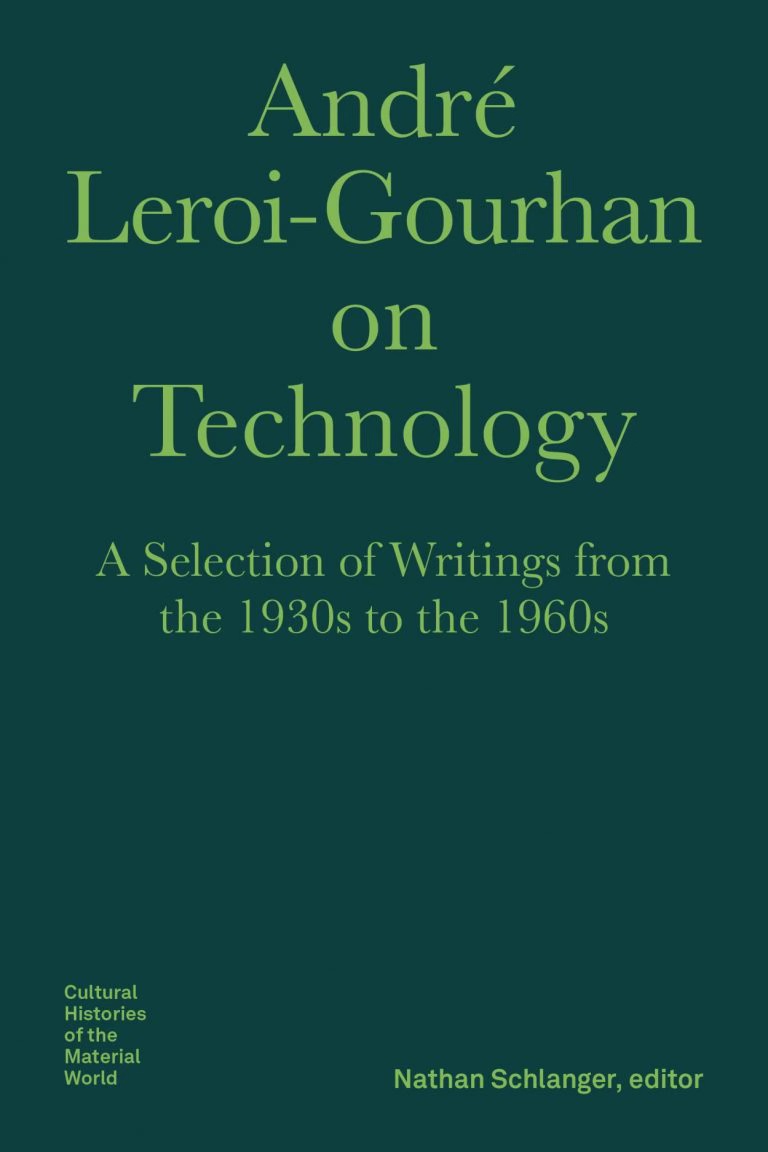
André Leroi-Gourhan on Technology: A Selection of Writings from the 1930s to the 1960s, ed. Nathan Schlanger, trans. Nils F. Schott – Hau Books, February 2025

André Leroi-Gourhan on Technology: A Selection of Writings from the 1930s to the 1960s, ed. Nathan Schlanger, trans. Nils F. Schott – Hau Books, February 2025

A selection of Leroi-Gourhan’s most important texts—many translated into English for the first time.

André Leroi-Gourhan is undoubtedly one of the most acclaimed figures of twentieth-century anthropology and archaeology. In France, his intellectual importance rivals that of the Claude Lévi-Strauss, yet Leroi-Gourhan’s major contributions are almost entirely unknown in the Anglophone world. This collection seeks to change that. This selection highlights some of his chief influences, such as elaborating a theory of technology, which argues that material culture focuses on the object in use and how use is a dynamic feature that has specific consequences for human evolution and human society. With serious ramifications for our understanding of material culture, putting Leroi-Gourhan’s thinking about technology into English will have an immediate and transformative impact on material culture studies.

Posted in Uncategorized | 1 Comment

Nedim Nomer and Kaya Șahin, Histories of Political Thought in the Ottoman World – Oxford University Press, March 2025

Nedim Nomer and Kaya Șahin, Histories of Political Thought in the Ottoman World – Oxford University Press, March 2025

This collection of papers is intended to provide a survey of the history of political ideas in the Ottoman world from its dawn around 1300 to its downfall in the early 20th century. It features fourteen original papers by some of the most prominent and innovative scholars of Ottoman history. The book sheds light on the complex role that ideas have played in all aspects of Ottoman social and political life throughout the history of the Ottoman world, across time, space, social class, and ethnic and religious identity. 

Histories of Political Thought in the Ottoman World takes exception to a common tendency, both among Ottoman historians and in the broader academic world, that considers Ottoman political life exclusively in terms of the political ideas of the Sunni Muslim governing elite. It makes clear that the non-elite, non-Sunni Muslim, non-Muslim, non-Turkish, and female members of the Ottoman society have also significantly contributed to the making of Ottoman political culture throughout its history.

Posted in Uncategorized | Leave a comment

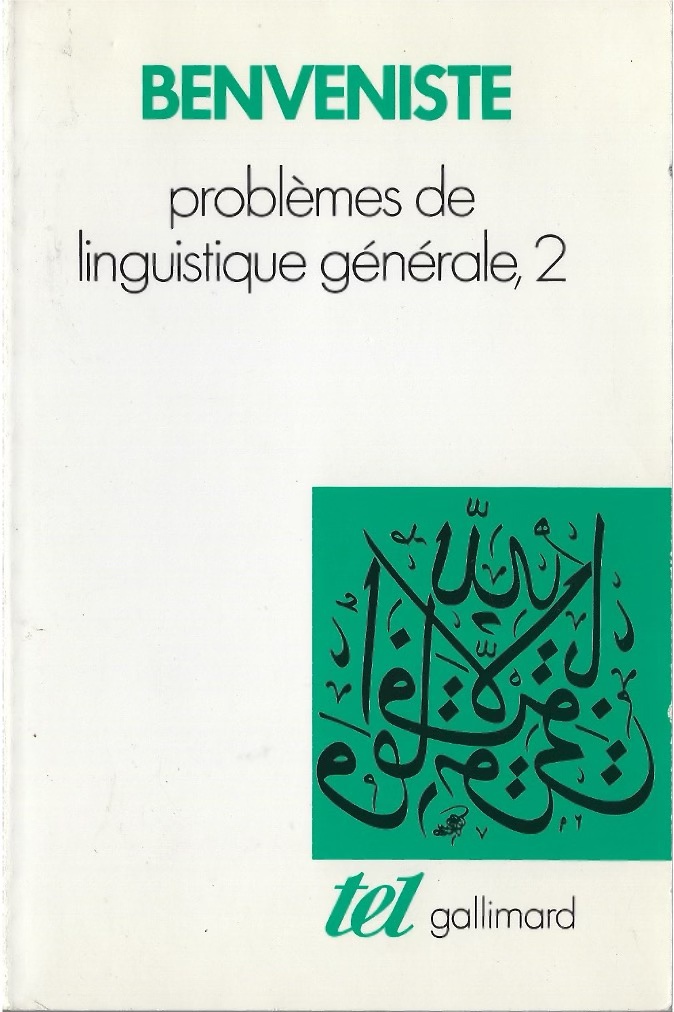
Émile Benveniste, Problèmes de linguistique générale – Problems in General Linguistics and other English translations

Émile Benveniste’s Problèmes de linguistique générale was published in two volumes in 1966 and 1974 by Gallimard, and later reprinted in the Tel series (volumes 1 and 2). The first volume brought together essays from 1939 to 1964, and was compiled by Benveniste himself. The second volume was compiled by Mohammed Djafer Moïnfar and Michel Lejeune after Benveniste’s 1969 stroke, and includes texts written between 1965 and 1969, though published as late as 1972.

The first volume was translated by Mary Elizabeth Meek in 1971 as Problems in General Linguistics. That text is long out of print. Fortunately there is a new and expanded edition forthcoming from Hau books, edited by Jordan K. Skinner, though it is long delayed.

The second volume has not been translated in full. Only a few of its essays are available in English translation, and I thought it might be useful to compile a short list. I’m happy to add any that I’ve missed. [Updated 19 December 2024 with a translation I’d missed and a bit more information.]

Benveniste is one of the main figures I discuss in my Mapping Indo-European Thought in Twentieth Century France project, on which more detail is here. As with the earlier Foucault work I’ve been sharing a few research resources – bibliographies, textual comparisons, sources, etc. as I’ve been doing the research. A few on Dumézil and one on Saussure are listed here. If you find these useful, please let me know – corrections and additions welcome. There are a lot of other research resources here.

Posted in Bartolus of Sassoferrato, Emile Benveniste, Ferdinand de Saussure, Georges Dumézil, Mapping Indo-European Thought in Twentieth Century France, Uncategorized | Leave a comment

Lynne Huffer, These Survivals: Autobiography of an Extinction – Duke University Press, May 2025

Lynne Huffer, These Survivals: Autobiography of an Extinction – Duke University Press, May 2025

A collage-style work in fragments, Lynne Huffer’s These Survivals brings together philosophy, memoir, poetry, and original multimedia artworks to articulate an ethics of living on a devastated planet. Focusing on climate change and mass species extinction, Huffer approaches ruination through assemblages rendered in sharp-edged prose, vibrant color images, and experimental features that include black-out poems, weather reports, and abecedarian essays. She considers her struggles with everyday life and confronts the immensity of extinction across the expanse of geological time, recognizing the self’s insignificance in the context of the planet’s 4.5-billion-year existence. As she moves across autobiographical, political, and literary registers, her abiding theme is the repeated phrase: the fragment remains while the whole crumbles. At every turn, Huffer insists on the fragmentary, provisional nature of anything taken to be whole as well as the impartial conditions under which we write, at times experienced as constraint and, at others, freedom. Reveling in interruption, obliquity, and layering, Huffer opens space for thought to emerge in unexpected and innovative ways—ways that are grounded in the material practices of writing and living.

Update: if you order direct from Duke, E25HUFFR gets 30% off.

Posted in Uncategorized | Leave a comment

Lynne Huffer, “Order and Archive: A Foucault Abecedary”, boundary 2, 2024

Lynne Huffer’s extraordinary essay, “Order and Archive: A Foucault Abecedary“, has just been published in boundary 2, Vol 51 No 4, 2024 (requires subscription unfortunately).

Update January 2025: Lynne is now on Instagram and has posted several tiles relating to this essay.

It’s a review article of my Foucault books, especially The Early Foucault and Foucault’s Last Decade. But saying that really doesn’t do justice to this wonderful text, which is beautifully written and does so much more than discuss my books. Enormous thanks to Lynne for writing this.

This essay reviews the first and last volumes of Stuart Elden’s four‐volume intellectual biography of Michel Foucault, The Early Foucault (2021) and Foucault’s Last Decade(2016). It borrows from Roland Barthes an abecedarian method to experiment with the play between order and archive that subtends Elden’s Foucault series. Like Foucault, Elden deploys an explicitly archival method for thinking philosophically. That method brings both historiographical and conceptual clarity to our understanding of Foucault within the chronological frame of his life. As a poetic order, the acrostic experimentation of abecedarian writing brings into view the nonchronological archival murmur that both shapes and exceeds Elden’s ordering of fragments in dossiers and the gaps between them.

Posted in Foucault's Last Decade, Foucault: The Birth of Power, Michel Foucault, The Archaeology of Foucault, The Early Foucault | 1 Comment

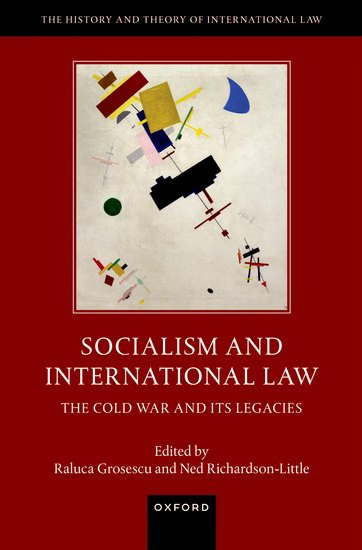
Raluca Grosescu and Ned Richardson-Little (eds.), Socialism and International Law: The Cold War and its Legacies – Oxford University Press, December 2024 

Raluca Grosescu and Ned Richardson-Little (eds.), Socialism and International Law: The Cold War and its Legacies – Oxford University Press, December 2024 

The contributions of socialist thinkers and states to the development of international law often go unrecognized. Socialism and International Law: The Cold War and Its Legacies explores how socialist individuals and governments from Eastern Europe, Africa, and Asia made vital contributions to international law as it is practiced today, and also brought ideas and initiatives that constituted important disruptive moments in its history. 

The socialist world of the 20th century was an ambiguous and fragile construct: there were clear divisions between the Soviet-led Eastern Bloc, which kept one foot in Western Eurocentric traditions, and the positions of the radical Third World, primarily post-colonial Afro-Asian states, which mounted a more fundamental challenge to the international order. Far from a monolith, the socialist world was an intricate and dynamic space, which still had many shared common understandings of global affairs and the meaning of the law within them.

By examining how different state socialist ideologies, legal principles, and realpolitik affected contemporary international law frameworks, this book contests existing linear and Western-dominated histories. It considers these state socialist engagements in conversation with liberal and Western approaches and underlines the divisions that existed between versions of socialism from different regions and across the North-South divide. The legacies of socialist international law are still with us today, as are the consequences of its failure.

With a focus on the Cold War and its aftermath, Socialist International Law features astute commentary on the history and present-day effects of socialist principles applied to international law, provided by an esteemed and diverse group of contributors from around the world.

Posted in Uncategorized | Leave a comment

Stefanie Gänger and Jürgen Osterhammel, Rethinking Global History, Cambridge University Press, November 2024 (open access and print)

Stefanie Gänger and Jürgen Osterhammel, Rethinking Global History, Cambridge University Press, November 2024 (open access and print)

Despite three decades of rapid expansion and public success, global history’s theoretical and methodological foundations remain under-conceptualised, even to those using them. In this collection of essays, leading historians provide a reassessment of global history’s most common analytical instruments, metaphors and conceptual foundations. Rethinking Global History prompts historians to pause and think about the methodology and premises underpinning their work. The volume reflects on the structure and direction of history, its relation to our present and the ways in which historians should best explain, contextualise and represent events and circumstances in the past. In chapters on fundamental concepts such as scale, comparison, temporality and teleology, this collection will guide readers to assess the extant literature critically and write theoretically informed global histories. Taken together, these essays provide a unique and much-needed assessment of the implications of history going global. This title is also available as open access on Cambridge Core.

Posted in Uncategorized | Leave a comment

Owen Ware, Indian Philosophy and Yoga in Germany – Routledge, October 2023 and New Books discussion

Owen Ware, Indian Philosophy and Yoga in Germany – Routledge, October 2023

There is a New Books discussion with Malcolm Keating. Thanks to dmf for the link.

This book sheds new light on the fascinating – at times dark and at times hopeful – reception of classical Yoga philosophies in Germany during the nineteenth century.

When debates over God, religion, and morality were at a boiling point in Europe, Sanskrit translations of classical Indian thought became available for the first time. Almost overnight India became the centre of a major controversy concerning the origins of western religious and intellectual culture. Working forward from this controversy, this book examines how early translations of works such as the Bhagavad Gītā and the Yoga Sūtras were caught in the crossfire of another debate concerning the rise of pantheism, as a doctrine that identifies God and nature. It shows how these theological concerns shaped the image of Indian thought in the work of Schlegel, Gunderrode, Humboldt, Hegel, Schelling, and others, lasting into the nineteenth century and beyond. Furthermore, this book explores how worries about the perceived nihilism of Yoga were addressed by key voices in the early twentieth century Indian Renaissance – notably Dasgupta, Radhakrishnan, and Bhattacharyya – who defended sophisticated counterreadings of their intellectual heritage during the colonial era.

Written for non-specialists, Indian Philosophy and Yoga in Germany will be of interest to students and scholars working on nineteenth-century philosophy, Indian philosophy, comparative philosophy, Hindu studies, intellectual history, and religious history.

Posted in Uncategorized | 1 Comment