Nikolina Bobic and Farzaneh Haghighi (eds.), The Routledge Handbook of Architecture, Urban Space and Politics, Volume II: Ecology, Social Participation and Marginalities- Routledge, November 2024

Nikolina Bobic and Farzaneh Haghighi (eds.), The Routledge Handbook of Architecture, Urban Space and Politics, Volume II: Ecology, Social Participation and Marginalities – Routledge, November 2024

The Introduction is available open access. Volume I was published in 2022.

Architecture and the urban are connected to challenges around violence, security, race and ideology, spectacle and data. The first volume of this handbook extensively explored these oppressive roles. This second volume illustrates that escaping the corporatized and bureaucratized orders of power, techno-managerial and consumer-oriented capitalist economic models is more urgent and necessary than ever before. Herein lies the political role of architecture and urban space, including the ways through which they can be transformed and alternative political realities constituted. The volume explores the methods and spatial practices required to activate the political dimension and the possibility for alternative practices to operate in the existing oppressive systems while not being swallowed by these structures. Fostering new political consciousness is explored in terms of the following themes: Events and Dissidence; Biopolitics, Ethics and Desire; Climate and Ecology; Urban Commons and Social Participation; Marginalities and Postcolonialism. Volume II embraces engagement across disciplines and offers a wide range of projects and critical analyses across the so-called Global North and South. This multidisciplinary collection of 36 chapters provides the reader with an extensive resource of case studies and ways of thinking for architecture and urban space to become more emancipatory.

Posted in Uncategorized | 1 Comment

Sonia Lavaert, Democratic Thought from Machiavelli to Spinoza: Freedom, Equality, Multitude – trans. Albert Gootjes, Edinburgh University Press, October 2024

Sonia Lavaert, Democratic Thought from Machiavelli to Spinoza: Freedom, Equality, Multitude – trans. Albert Gootjes, Edinburgh University Press, October 2024

Prohibitively priced hardback and e-book only

In the latter half of the seventeenth century, Spinoza effected a reversal in the relationship between philosophy, politics, and religion, thereby laying the foundation for modern democracy. This shift, and his plea for philosophical critique, did not pass unchallenged. The idea that there is no equality without freedom, and no freedom without equality, was maligned by those who insisted it would lead to rebellion and anarchy. Still, Spinoza was no solitary figure, but formed part of a larger European movement. Inspired by several anonymous clandestine treatises, the republican writings of his contemporary De la Court, the democratic ideas of his former teacher Van den Enden, and the subversive criticism of his friend Koerbagh, Spinoza continued the trajectory established by Machiavelli. The resistance which his work encountered played a role in the radicalization of his ideas, the return to Machiavelli’s revolutionary principles, and the recognition of the multitude’s crucial role.

Posted in Uncategorized | Leave a comment

Georges Canguilhem et l’écologie – 3-5 December 2024, Université Paris 8

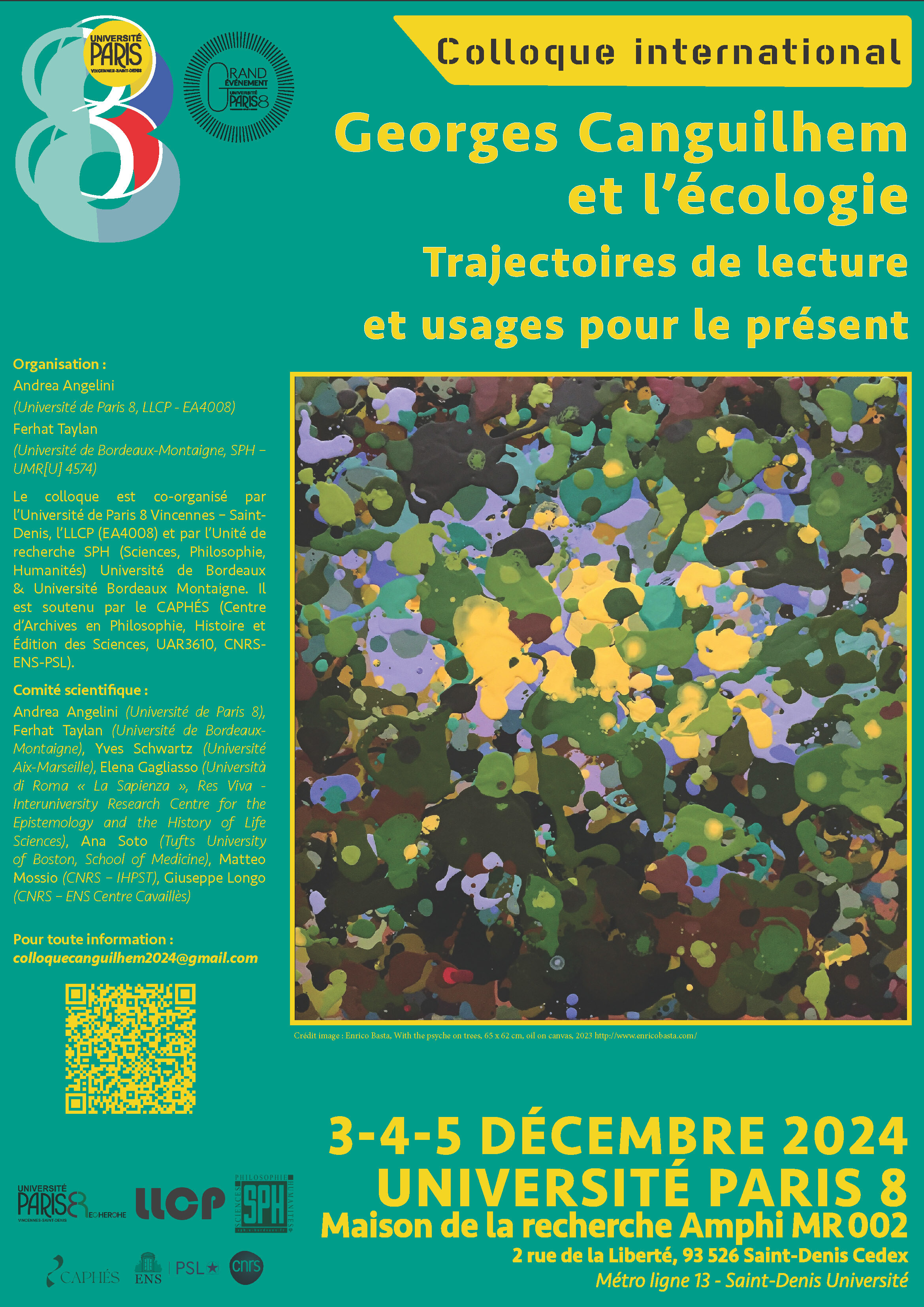
Georges Canguilhem et l’écologie – 3-5 December 2024, Université Paris 8

Posted in Conferences, Georges Canguilhem | Leave a comment

“Indo-European Thought at the Collège de France”, Social Anthropology Seminar, University of St Andrews, 29 November 2024 (online)

Indo-European Thought at the Collège de France“, Social Anthropology Seminar, University of St Andrews, 29 November 2024, 2pm (online)

On Friday I’ll be speaking about my current research.

Emile Benveniste and Georges Dumézil both lost their teaching positions under the Vichy regime, but for different reasons and with different outcomes. Benveniste was Jewish, had been captured shortly before the Armistice, and when he escaped, he went into exile in Switzerland. Before being deployed to Turkey, Dumézil had briefly been a Freemason and was excluded due to the laws on secret societies. He got his position back, remained in Paris, and published throughout the war with Gallimard. At the Liberation he was under suspicion of collaboration, and temporarily lost his position again. Benveniste returned to the Collège de France, and in 1949 proposed Dumézil for a chair in Indo-European civilisation. For the next two decades Benveniste and Dumézil taught there in parallel – Benveniste usually teaching one course on linguistics, and another on vocabulary; Dumézil teaching on mythology but also his interest in Caucasian languages and folklore. Some of their most important publications, including Dumézil’s Myth and Epic and Benveniste’s Vocabulary of Indo-European Institutions, were originally presented in their classes. Using teaching records, publications, archival materials and correspondence, this talk will discuss the period when Indo-European thought was at the centre of one of France’s elite institutions.

Posted in Emile Benveniste, Georges Dumézil, Mapping Indo-European Thought in Twentieth Century France, Uncategorized | 2 Comments

Books received – Moyn, Pérez, Herring, Vatulescu, Marx, Foucault

Some books bought recently. Samuel Moyn, Liberalism Against Itself: Cold War Intellectuals and the Making of Our Times; Amín Pérez, Bourdieu and Sayad Against Empire: Forging Sociology in Anticolonial Struggle, trans. Andrew Brown; Emily Herring, Herald of a Restless World: How Henri Bergson Brought Philosophy to the People; Cristina Vatulescu, Reading the Archival Revolution: Declassified Stories and their Challenges; the new translation of Marx’s Capital Volume I ed. and trans. by Paul Reitter and Paul North, and Michel Foucault, Entretiens radiophoniques 1961-1983, ed. Henri-Paul Fruchaud. Now for the time to read them.

Posted in Karl Marx, Michel Foucault, Pierre Bourdieu | Leave a comment

Marc-William Palen, Pax Economica: Left-Wing Visions of a Free Trade World – Princeton University Press, February 2024 

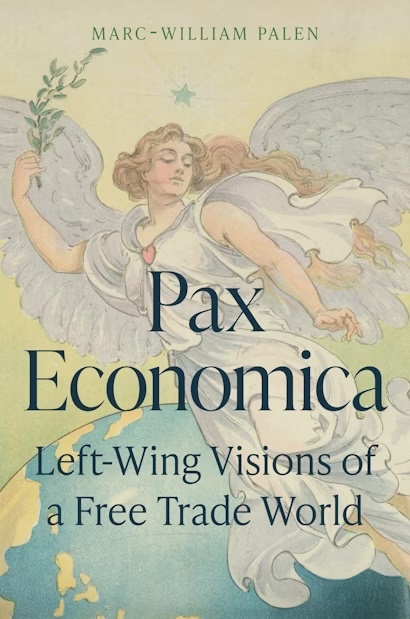
Marc-William Palen, Pax Economica: Left-Wing Visions of a Free Trade World – Princeton University Press, February 2024 

Today, free trade is often associated with right-wing free marketeers. In Pax Economica, historian Marc-William Palen shows that free trade and globalisation in fact have roots in nineteenth-century left-wing politics. In this counterhistory of an idea, Palen explores how, beginning in the 1840s, left-wing globalists became the leaders of the peace and anti-imperialist movements of their age. By the early twentieth century, an unlikely alliance of liberal radicals, socialist internationalists, feminists, and Christians envisioned free trade as essential for a prosperous and peaceful world order. Of course, this vision was at odds with the era’s strong predilections for nationalism, protectionism, geopolitical conflict, and colonial expansion. Palen reveals how, for some of its most radical left-wing adherents, free trade represented a hard-nosed critique of imperialism, militarism, and war.

Palen shows that the anti-imperial component of free trade was a phenomenon that came to encompass the political left wing within the British, American, Spanish, German, Dutch, Belgian, Italian, Russian, French, and Japanese empires. The left-wing vision of a “pax economica” evolved to include supranational regulation to maintain a peaceful free-trading system—which paved the way for a more liberal economic order after World War II and such institutions as the United Nations, the European Union, and the World Trade Organization. Palen’s findings upend how we think about globalisation, free trade, anti-imperialism, and peace. Rediscovering the left-wing history of globalism offers timely lessons for our own era of economic nationalism and geopolitical conflict.

Posted in Uncategorized | Leave a comment

Marie-Eve Loiselle, Building Walls, Constructing Identities: Legal Discourse and the Creation of National Borders – Stanford University Press, November 2024

Marie-Eve Loiselle, Building Walls, Constructing Identities: Legal Discourse and the Creation of National Borders – Stanford University Press, November 2024

States are erecting walls at their borders at a pace unmatched in history, and the wall between the United States and Mexico stands as an icon among these dividing structures. Much has been said about the US-Mexico border wall in the last few decades, yet American walling projects have a much longer history, dating back almost a century. Building Walls, Constructing Identities offers a rich account of this legal history, informed by two episodes of wall-building—the Act of August 19, 1935, and the Secure Fence Act of 2006. These two legislative periods illustrate that today’s wall imprints onto the landscape a grammar of racial inequality underpinned by a settler colonial rationality. Marie-Eve Loiselle argues in favor of an account of the law that considers its material translation into space and identifies discursive processes by which the law and the wall come together to communicate legal knowledge about territory and identity.

Posted in Uncategorized | Leave a comment

Adam Warren, Julia E. Rodriguez and Stephen T. Casper (eds.), Empire, Colonialism and the Human Sciences: Troubling Encounters in the Americas and Pacific – Cambridge University Press, October 2024 (print and open access)

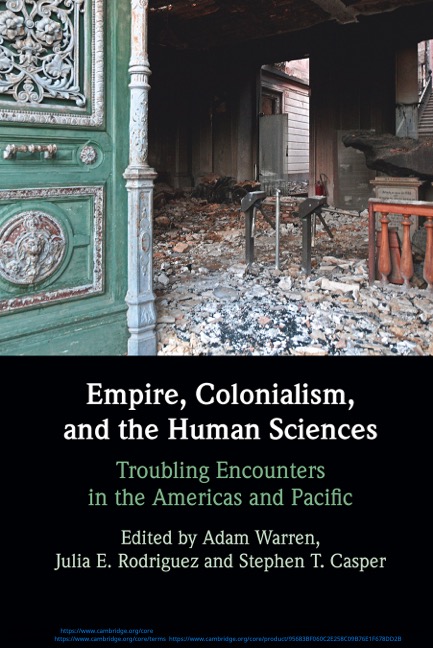
Adam Warren, Julia E. Rodriguez and Stephen T. Casper (eds.), Empire, Colonialism and the Human Sciences: Troubling Encounters in the Americas and Pacific – Cambridge University Press, October 2024 (print and open access)

In this bold reconsideration of the human sciences, an interdisciplinary team employ an expanded theoretical and geographical critical lens centering the notion of the encounter. Drawing insights from Indigenous and Latin American Studies, nine case studies delve into the dynamics of encounters between researchers, intermediaries, and research subjects in imperial and colonial contexts across the Americas and Pacific. Essays explore ethical considerations and knowledge production practices that prevailed in field and expedition science, custodial institutions, and governance debates. They reevaluate how individuals and communities subjected to research projects embraced, critiqued, or subverted them. Often, research subjects expressed their own aspirations, asserted sovereignty or autonomy, and exercised forms of power through interactions or acts of refusal. This book signals the transformative potential of Indigenous Studies and Latin American Studies for shaping future scholarship on the history of the human sciences. This title is also available as Open Access on Cambridge Core.

Posted in Uncategorized | Leave a comment

Bruno Leipold, Citizen Marx: Republicanism and the Formation of Karl Marx’s Social and Political Thought – Princeton University Press, November 2024

Bruno Leipold, Citizen Marx: Republicanism and the Formation of Karl Marx’s Social and Political Thought – Princeton University Press, November 2024

In Citizen Marx, Bruno Leipold argues that, contrary to certain interpretive commonplaces, Karl Marx’s thinking was deeply informed by republicanism. Marx’s relation to republicanism changed over the course of his life, but its complex influence on his thought cannot be reduced to wholesale adoption or rejection. Challenging common depictions of Marx that downplay or ignore his commitment to politics, democracy, and freedom, Leipold shows that Marx viewed democratic political institutions as crucial to overcoming the social unfreedom and domination of capitalism. One of Marx’s principal political values, Leipold contends, was a republican conception of freedom, according to which one is unfree when subjected to arbitrary power.

Placing Marx’s republican communism in its historical context—but not consigning him to that context—Leipold traces Marx’s shifting relationship to republicanism across three broad periods. First, Marx began his political life as a republican committed to a democratic republic in which citizens held active popular sovereignty. Second, he transitioned to communism, criticizing republicanism but incorporating the republican opposition to arbitrary power into his social critiques. He argued that although a democratic republic was not sufficient for emancipation, it was necessary for it. Third, spurred by the events of the Paris Commune of 1871, he came to view popular control in representation and public administration as essential to the realization of communism. Leipold shows how Marx positioned his republican communism to displace both antipolitical socialism and anticommunist republicanism. One of Marx’s great contributions, Leipold suggests, was to place politics (and especially democratic politics) at the heart of socialism.

Posted in Uncategorized | Leave a comment

Reiner Schürmann, Selected Writings and Lecture Notes – Diaphenes, 2019-

Reiner Schürmann, Selected Writings and Lecture Notes – Diaphenes, 2019-

I hadn’t realised this project was ongoing… five volumes already and two more in December.

Posted in Uncategorized | Leave a comment