Felice Cimatti and Carlo Salzani (eds.), The Biopolitical Animal – Edinburgh University Press, November 2024

Felice Cimatti and Carlo Salzani (eds.), The Biopolitical Animal – Edinburgh University Press, November 2024

No description on the EUP website, so here’s the table of contents – shame about the price.

Introduction: What is a Biopolitical Animal? – Felice Cimatti and Carlo Salzani

Part I: The Animal of Biopolitics

Chapter 1: Turning Back to Nature: Foucault and the Practice of Animality – Matthew Calarco

Chapter 2: Community and Animality in the Ancient Cynics – Vanessa Lemm

Chapter 3: Biopolitics of COVID-19 and the Space of Animals: A Planetary Perspective – Miguel Vatter

Chapter 4: How to Chirp like a Cricket: Agamben and the Reversal of Anthropogenesis – Sergei Prozorov

Chapter 5: Animality and Inoperativity: Interspecies Form-of-Life – Sherryl Vint

Part II: Tales of Biopolitics and Animality

Chapter 6: Restraining Biopolitics: On Dino Buzzati’s Living Animals – Timothy Campbell

Chapter 7: Cages and Mirrors: Mr. Palomar and the Albino Gorilla – Serenella Iovino

Chapter 8: Bunnies and Biopolitics: Killing, Culling and Caring for Rabbits – David Redmalm and Erica von Essen

Chapter 9: Deading Life and the Undying Animal: Necropolitics After the Factory Farm – James K. Stanescu

Chapter 10: Factory Farms for Fishes: Aquaculture, Biopolitics and Resistance – Dinesh Wadiwel

Part III: Reconceptualising Biopolitics

Chapter 11: Imagining Liberation beyond Biopolitics: The Biopolitical ‘War against Animals’ and Strategies for Ending It – Zipporah Weisberg

Chapter 12: Animal Magnetism: (Bio)Political Theologies Between the Creature and the Animal – Diego Rossello

Chapter 13: Creaturely Biopolitics – Carlo Salzani

Chapter 14: A Dog’s Life: From the Biopolitical Animal to the Posthuman – Felice Cimatti

Afterword: Locating Race and Animality amidst the Politics of Interspecies Life – Neel Ahuja
Posted in Uncategorized | Leave a comment

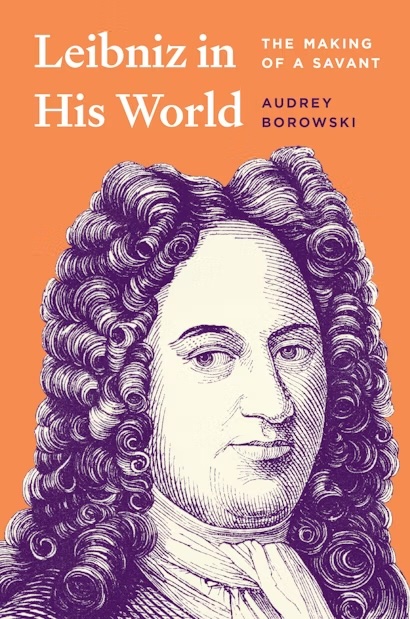
Audrey Borowski, Leibniz in His World: The Making of a Savant – Princeton University Press, November 2024

Audrey Borowski, Leibniz in His World: The Making of a Savant – Princeton University Press, November 2024

Described by Voltaire as “perhaps a man of the most universal learning in Europe,” Gottfried Wilhelm Leibniz (1646–1716) is often portrayed as a rationalist and philosopher who was wholly detached from the worldly concerns of his fellow men. Leibniz in His World provides a groundbreaking reassessment of Leibniz, telling the story of his trials and tribulations as an aspiring scientist and courtier navigating the learned and courtly circles of early modern Europe and the Republic of Letters.

Drawing on extensive correspondence by Leibniz and many leading figures of the age, Audrey Borowski paints a nuanced portrait of Leibniz in the 1670s, during his “Paris sojourn” as a young diplomat and in Germany at the court of Duke Johann Friedrich of Hanover. She challenges the image of Leibniz as an isolated genius, revealing instead a man of multiple identities whose thought was shaped by a deep engagement with the social and intellectual milieus of his time. Borowski shows us Leibniz as he was known to his contemporaries, enabling us to rediscover him as an enigmatic young man who was complex and all too human.

An exhilarating work of scholarship, Leibniz in His World demonstrates how this uncommon intellect, torn between his ideals and the necessity to work for absolutist states, struggled to make a name for himself during his formative years.

Thanks to John Raimo for the link.

Posted in Gottfried Leibniz, Uncategorized | Leave a comment

Call for Abstracts – Michel Foucault and Phenomenology: The Southern Journal of Philosophy Workshop March 27-28, 2025, The University of Memphis

Call for Abstracts: Michel Foucault and Phenomenology

The Southern Journal of Philosophy Workshop March 27-28, 2025, The University of Memphis

Keynote Speakers: Philippe Sabot, Elisabetta Basso, Christophe Bouton

The Southern Journal of Philosophy
https://foucault40.info

How is Michel Foucault’s thought related to the tradition of phenomenology? Studies addressing this question have been overshadowed by scholarship that considers Foucault’s work in relation to other movements in continental philosophy such as critical theory, Marxism, structuralism, and post-structuralism. When the question has been broached, scholars have straightaway had to confront Foucault’s sometimes dismissive, if not hostile, attitude towards phenomenological approaches. For instance, in a 1967 interview (“Who are you, Professor Foucault?”), Foucault describes phenomenology as a totalizing method whose universalist claims seek to account for meaning and knowledge formation through an analysis limited to the lived experience of the transcendent subject. Later, he describes his method of archaeology as aiming “to free history from the grip of phenomenology” (The Archaeology of Knowledge [1969]). However, the basis for well-founded replies to the question has very recently been significantly augmented by the publication of three early Foucault texts. These works represent Foucault’s richest engagement with this tradition and demonstrate a remarkable depth and precision to his early study of phenomenology that were not apparent from his previously published work:

Binswanger et l’analyse existentielle (Binswanger and Existential Analysis), edited by Elisabetta Basso, Seuil/Gallimard, May 2021;

Phénoménologie et psychologie, 1953-1954 (Phenomenology and Psychology, 1953-1954), edited by Philippe Sabot, Seuil/Gallimard, November 2021;

La constitution d’un transcendantal historique dans la Phénoménologie de l’esprit de HegelMémoire du diplôme d’études supérieures de philosophie (The Constitution of a Historical Transcendental in Hegel’s Phenomenology of Spirit. Graduate Degree Philosophy Thesis), edited by Christophe Bouton, Vrin, February 2024.

These texts are crucial sources for re-evaluating Foucault’s relation to phenomenology. Our hope is that an event which examines these writings, with keynote addresses from the editors of these three volumes, will help to cultivate exchanges and dialogues that may have previously been stymied by the prominence of Foucault’s more pointed objections to phenomenological approaches.

The Southern Journal of Philosophy workshop aims to provide a timely forum to take the measure of Foucault’s thought on phenomenology, broadly speaking, and to expand and develop a dialogue between Foucault’s philosophy and phenomenology that is both retrospective and prospective. We invite papers that focus on the three recent publications listed above, or on the relationship between Foucault’s thought and phenomenology in general. Papers delivered at the conference will also be published in a peer-reviewed special issue of The Southern Journal of Philosophy (see below for details).

Full details here; thanks to Foucault News for the alert.

Posted in Ludwig Binswanger, Michel Foucault | Leave a comment

Michael Hardt, The Subversive Seventies – Oxford University Press, September 2023 and New Books discussion

Michael Hardt, The Subversive Seventies – Oxford University Press, September 2023

Discussion with Hardt at the New Books Network with Morteza Hajizadeh.

Thanks to Dave Beer for the links.

A thought-provoking reconsideration of how the revolutionary movements of the 1970s set the mold for today’s activism.

The 1970s was a decade of “subversives”. Faced with various progressive and revolutionary social movements, the forces of order—politicians, law enforcement, journalists, and conservative intellectuals—saw subversives everywhere. From indigenous peasant armies and gay liberation organizations, to anti-nuclear activists and Black liberation militants, subversives challenged authority, laid siege to the established order, and undermined time-honored ways of life. Every corner of the left was fertile ground for subversive elements, which the forces of order had to root out and destroy—a project they pursued with zeal and brutality. 

In The Subversive Seventies, Michael Hardt sets out to show that popular understandings of the political movements of the seventies—often seen as fractious, violent, and largely unsuccessful—are not just inaccurate, but foreclose valuable lessons for the political struggles of today. While many accounts of the 1970s have been written about the regimes of domination that emerged throughout the decade, Hardt approaches the subversive from the perspectives of those who sought to undermine the base of established authority and transform the fundamental structures of society. In so doing, he provides a novel account of the theoretical and practical projects of liberation that still speak to us today, too many of which have been all but forgotten. 

Departing from popular and scholarly accounts that focus on the social movements of the 1960s, Hardt argues that the 1970s offers an inspiring and useful guide for contemporary radical political thought and action. Although we can still learn much from the movements of the sixties, that decade’s struggles for peace, justice, and freedom fundamentally marked the end of an era. The movements of the seventies, in contrast, responded directly to emerging neoliberal frameworks and other structures of power that continue to rule over us today. They identified and confronted political problems that remain central for us. The 1970s, in this sense, marks the beginning of our time. Looking at a wide range of movements around the globe, from the United States, to Guinea Bissau, South Korea, Chile, Turkey, and Italy, The Subversive Seventies provides a reassessment of the political action of the 1970s that sheds new light not only on our revolutionary past but also on what liberation can be and do today.

Posted in Uncategorized | Leave a comment

Cristina Vatulescu, Reading the Archival Revolution: Declassified Stories and their Challenges – Stanford University Press, November 2024

Cristina Vatulescu, Reading the Archival Revolution: Declassified Stories and their Challenges – Stanford University Press, November 2024

The opening of classified documents from the Soviet era has been dubbed the “archival revolution” due to its unprecedented scale, drama, and impact. With a storyteller’s sensibility, Cristina Vatulescu identifies and takes on the main challenges of reading in these archives.

This transnational study foregrounds peripheral Eastern European perspectives and the ethical stakes of archival research. In so doing, it contributes to the urgent task of decolonizing the field of Eastern European and Russian studies at this critical moment in the region’s history. Drawing on diverse work ranging from Mikhail Bakhtin to Tina Campt, the book enters into broader conversations about the limits and potential of reading documents, fictions, and one another. Pairing one key reading challenge with a particularly arresting story, Vatulescu in turn investigates Michel Foucault’s traces in Polish secret police archives; tackles the files, reenactment film, and photo albums of a socialist bank heist; pits autofiction against disinformation in the secret police files of Nobel Prize laureate Herta Müller; and takes on the digital remediation of Soviet-era archives by analyzing contested translations of the Iron Curtain trope from its 1946 origins to the current war in Ukraine. The result is a bona fide reader’s guide to Eastern Europe’s ongoing archival revolution.

Posted in Uncategorized | Leave a comment

Jenny Turner reviews Gillian Rose, Marxism Modernism and Love’s Work at London Review of Books

Jenny Turner reviews Gillian Rose, Marxism Modernism and Love’s Work at London Review of Books

Posted in Gillian Rose, Uncategorized | Leave a comment

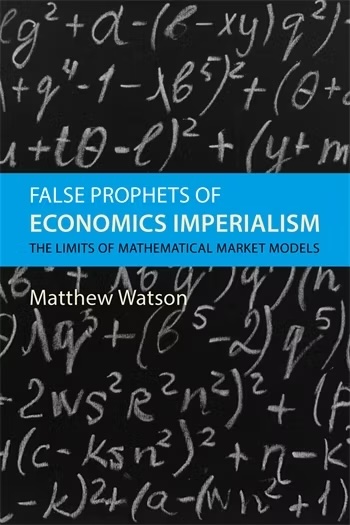
Matthew Watson, False Prophets of Economics Imperialism: The Limits of Mathematical Market Models – Agenda, November 2024

Matthew Watson, False Prophets of Economics Imperialism: The Limits of Mathematical Market Models – Agenda, November 2024

This book studies the methodological revolution that has resulted in economists’ mathematical market models being exported across the social sciences. The ensuing process of economics imperialism has struck fear into subject specialists worried that their disciplinary knowledge will subsequently count for less. Yet even though mathematical market models facilitate important abstract thought experiments, they are no substitute for carefully contextualised empirical investigations of real social phenomena. The two exist on completely different ontological planes, producing very different types of explanation.

In this deeply researched and wide-ranging intellectual history, Matthew Watson surveys the evolution of modern economics and its modelling methodology. With its origins in Jevons and Robbins and its culmination in Samuelson, Arrow and Debreu, he charts the escape from reality that has allowed economists’ hypothetical mathematical models to speak to increasingly self-referential mathematical truths. These are shown to perform badly as social truths, consequently imposing strict epistemic limits on economics imperialism.

The book is a formidable analysis of the epistemic limitations of modern-day economics and marks a significant counter to its methodology’s encroachment across the wider social sciences.

Posted in Uncategorized | Leave a comment

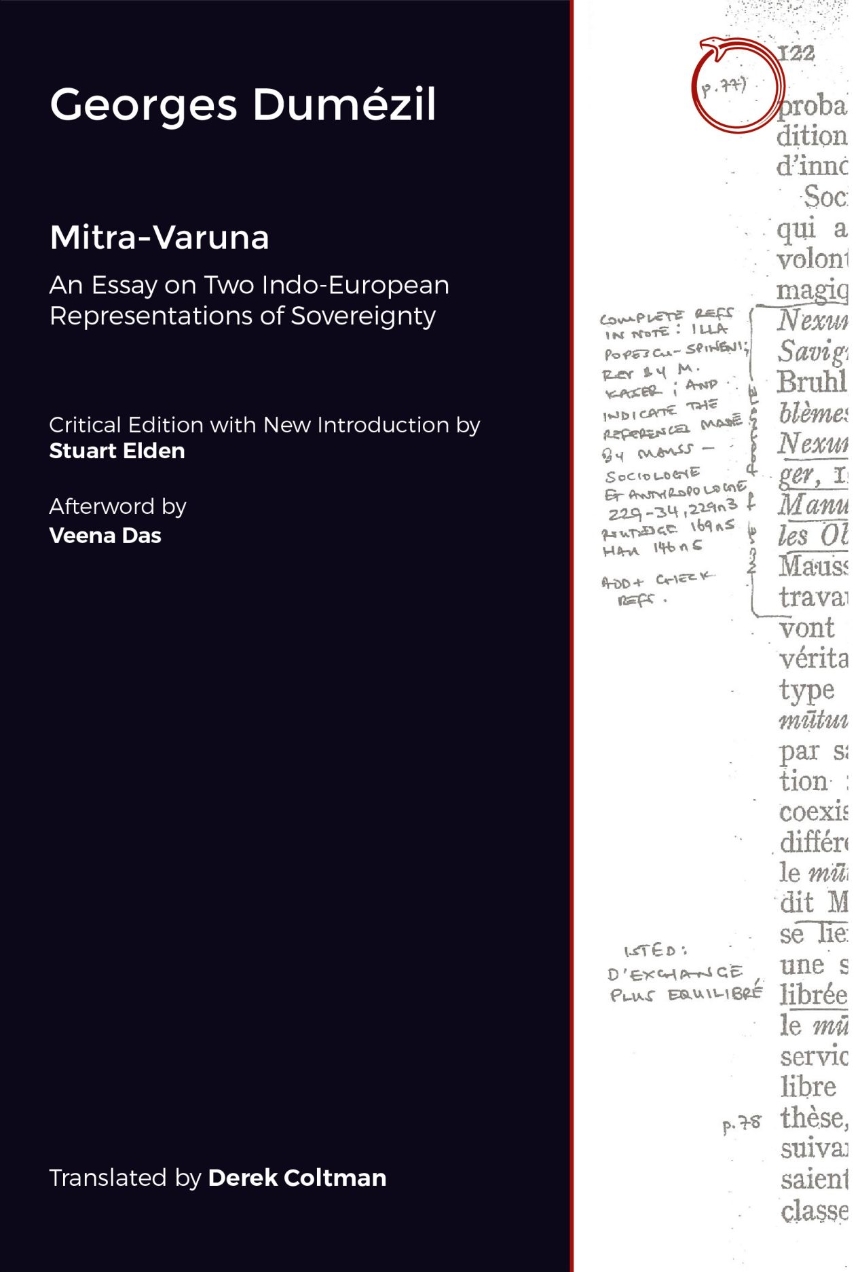
Georges Dumézil, Mitra-Varuna: An Essay on Two Indo-European Representations of Sovereignty, translated by Derek Coltman, edited by Stuart Elden, afterword by Veena Das – HAU books, December 2024

Georges Dumézil, Mitra-Varuna: An Essay on Two Indo-European Representations of Sovereignty, translated by Derek Coltman, edited by Stuart Elden, afterword by Veena Das – HAU books, December 2024

The book is now available for sale, in print or e-book via University of Chicago Press. HAU will make an open-access e-book available when they sell 200 copies. This is to recoup the costs of buying the rights to the translation (not to pay me as editor). If you’re in a position to buy the book or recommend to a library please do. The Introduction and Afterword are open access now.

The edition uses the existing translation by Derek Coltman, long out of print, and has a new critical apparatus and Introduction by me. There is a discussion of the editing work here. This is part of the work of my Mapping Indo-European thought in twentieth-century France research project, funded by the Leverhulme Trust.

A classic text that develops one prong of Dumézil’s tripartite hypothesis of Indo-European tribes: the sacred sovereign.
 
Georges Dumézil’s fascination with the myths and histories of India, Rome, Scandinavia, and the Celts yielded an idea that became his most influential scholarly legacy: the tripartite hypothesis, which divides Indo-European societal functions into three classes: the sacred sovereign, the warrior, and the producer. Mitra-Varuna, originally published in 1940, concentrates on the first function, that of sovereignty. Dumézil identifies two types of rulers, the first judicial and worldly, the second divine and supernatural. These figures, both priestly, are oppositional but complementary. The title nods to these roles, referring to the gods Mitra, a rational mediator, and Varuna, an awesome religious figure. 
 
Stuart Elden’s critical edition, based on the 1988 English translation by Derek Coltman, identifies variations between the first and second French editions and completes—and in places corrects—Dumézil’s references. The editor’s detailed introduction situates Mitra-Varuna within Dumézil’s career, outlines how his treatment of its themes developed over time, and relates the book to the political controversy around his ideas. Two new appendices contain passages that did not appear in the second French edition.

Posted in Georges Dumézil, Mapping Indo-European Thought in Twentieth Century France | 1 Comment

Amín Pérez, Bourdieu and Sayad Against Empire: Forging Sociology in Anticolonial Struggle – Polity Press, December 2023 and New Books Discussion

Amín Pérez, Bourdieu and Sayad Against Empire: Forging Sociology in Anticolonial Struggle – Polity Press, December 2023

New Books Discussion with Dave O’Brien – thanks to dmf for the link

Pierre Bourdieu and Abdelmalek Sayad met in their twenties in the midst of the Algerian war of independence. From their first meeting, a strong intellectual friendship was born between the French philosopher and the activist from the colony, nourished by the same desire to understand the world in order to change it.

The work of both men was driven by the necessity of putting knowledge to use, whether by unveiling the relations of domination that structured life in Algeria or by opening emancipatory perspectives for the Algerian people. Colonies were, of course, a customary site of ethnographic work, but Bourdieu and Sayad refused to sacrifice scientific rigor to political expediency, even as Algeria descended deeper into war. Indeed, the act of understanding as a political commitment to the transformation of society lay at the heart of their project.

Based on extensive interviews and deep archival work, Amín Pérez rediscovers the anticolonial origins of the pathbreaking social thought of these brilliant thinkers. Bourdieu and Sayad, he argues, forged another way of doing politics, laying the foundations of a revolutionary pedagogy, not just for anticolonial liberation but for true social emancipation.​

Posted in Pierre Bourdieu, Uncategorized | Leave a comment

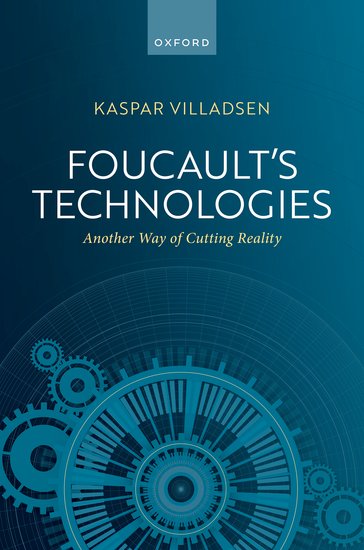
Kaspar Villadsen, Foucault’s Technologies – Oxford University Press, November 2024

Kaspar Villadsen, Foucault’s Technologies – Oxford University Press, November 2024

Shame about the prohibitive price…

Michel Foucault is rarely viewed as a philosopher of technology, yet academics and students routinely refer to his terms ‘technologies of power’, ‘governmental technologies’, and ‘technologies of the self’. This book is a response to the contradiction between the paucity of research into Foucault’s technological thought and the abundancy of technological vocabulary and metaphors in his own writings as well as in the commentary literature; it provides the most extensive examination of the role of technology in Foucault’s work so far. 

Villadsen argues that technology serves neither as an object of Foucault’s analysis nor as a convenient metaphor for making arguments, but as rather integral to his thinking and writing. As the book’s title, Foucault’s Technologies indicates, it explores not Foucault and modern technology understood as technical devices like television, smartphones, or industrial machines, but rather Foucault’s approach to the theme of technology and his use of technological terms. The book provides an extensive exploration of Foucault’s technological thought, arguing that he offers a distinct framework that confronts commonsensical understanding and other scientific approaches to technology. The reader will travel a route paved with discussions of how Foucault’s work intersects with that of other key thinkers, particularly Heidegger, Althusser, Nietzsche, and Deleuze. 

While presenting efforts in intellectual history, the book ultimately focusses on the analytical implications for ‘users’, showing how researchers can benefit from Foucault’s technological approach. As such, the book offers an analytical framework effective for the study of problems in present-day welfare states and the emergent world of data-capitalism.

Posted in Michel Foucault | 1 Comment