Georges Bataille, Critical Essays Volume 2: 1949-51 – ed. Benjamin Noys and Alberto Toscano, trans. Chris Turner – Seagull, December 2024

Georges Bataille, Critical Essays Volume 2: 1949-51 – ed. Benjamin Noys and Alberto Toscano, trans. Chris Turner – Seagull, December 2024

An introduction for English-language readers to Georges Bataille’s postwar philosophical and critical writings.

In the aftermath of World War II, French thinker and writer Georges Bataille forged a singular path through the moral and political impasses of his age. In 1946, animated by “a need to live events in an increasingly conscious way,” and to reject any compartmentalization of intellectual life, Bataille founded the journal Critique. Continuing the publication of his postwar writings, this second book in a three-volume collection of Bataille’s work collects his essays and reviews from the years 1949 to 1951.

In this period of intellectual isolation and intense reflection, Bataille developed and refined his genealogy of morality through a sustained reflection on the fate of the sacred in the modern world. He offered a critique of the limits of existing morality, especially in its denial of excess, while sketching the lineaments of a new hyper-morality. Bataille’s wide-ranging reflections are true to the intellectual mission of Critique, which he founded as a space open to the broadest considerations of the present. As well as discussing significant figures like Samuel Beckett, André Gide, and René Char, Bataille also offers fascinating reflections on American politics, Nazism, existentialism, materialism, and play.

The connecting thread in these diverse essays remains Bataille’s concern with the extremes of human experience and the possibilities of transcending the limits of societies founded on utility and restraint. His writings remain a provocative incitement to rethink the boundaries we impose on expression and existence.

I’ll update my bibliography of Bataille’s work and translations when I have a copy, but it looks like it will translate the first half of Oeuvres complètes Vol XII.

Posted in Georges Bataille | Leave a comment

‘Homage to the Hommage à Jean Hyppolite’ – Philosophy, Politics and Critique Vol 1 No 3 theme section

Homage to the Hommage à Jean Hyppolite’ – Philosophy, Politics and Critique Vol 1 No 3 theme section

Introduction and three essays – all require subscription, unfortunately:

Joe Hughes, Introduction

Christopher O’Neill, Error, Truth and Anxiety against Death: Reading Georges Canguilhem’s ‘On Science and Counter-Science’

Lachlan Wells, François Dagognet on Jean Hyppolite and the ‘Epistemology of Information’

Alice Nilsson, Dialectics, Mathematics and the Cavaillès-Hyppolite Encounter

Posted in Georges Canguilhem, Jean Hyppolite | Leave a comment

Nick Couldry, The Space of the World: Can Human Solidarity Survive Social Media and What If It Can’t? – Polity, October 2024

Nick Couldry, The Space of the World: Can Human Solidarity Survive Social Media and What If It Can’t? – Polity, October 2024

update: thanks to dmf for a link to a Cultural Studies podcast discussion of the book

Over the past thirty years, humanity has made a huge mistake. We handed over to big tech decisions that have allowed them to build what has become our “space of the world” – the highly artificial space of social media platforms where much of our social life now unfolds. This has proved reckless and has huge social consequences.

The toxic effects on social life, young people’s mental health, and political solidarity are well known, but the key factor underlying all this has been missed: the fact that humanity allowed business to construct our space of the world at all and then exploit it for profit. In the process, we ignored two millennia of political thought about the conditions under which a healthy or even a non-violent politics is possible. We endangered the one resource that is in desperately short supply in the face of catastrophic climate change: solidarity. Is human solidarity possible in a world of continuous digital connection and commercially managed platforms, and what if it isn’t?

In the first book of his trilogy, Humanising the Future, Nick Couldry offers a radical new vision of how to design our digital spaces so that they build, rather than erode, both solidarity and community. This trenchant and vividly written book stresses that we cannot afford not to care for our space of the world. We need to rebuild it together.

Posted in Uncategorized | 1 Comment

CFP: Foucault Studies special issue – Critique beyond criticism: Crisis and potentials of critique in critical times

Posted in Uncategorized | Leave a comment

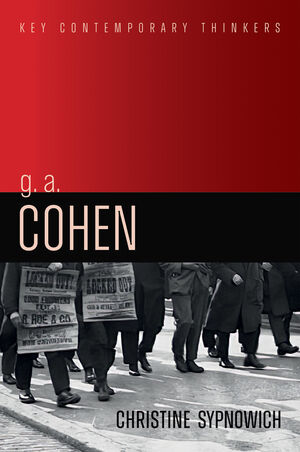
Christine Sypnowich, G. A. Cohen: Liberty, Justice and Equality – Polity, July 2024

Christine Sypnowich, G. A. Cohen: Liberty, Justice and Equality – Polity, July 2024

Part of the Key Contemporary Thinkers series

G. A. Cohen was one of the towering political philosophers of the late twentieth and early twenty-first centuries. His intellectual career was unusually wide-ranging, and he was celebrated internationally not only for his penetrating ideas about liberty, justice and equality, but also for his method, a highly original and influential combination of analytical philosophy and Marxism.

Christine Sypnowich guides readers through the rich body of Cohen’s work. By identifying five paradoxes in his thought, she explores the origins of his interest in analytical philosophy, his engagement with the ideas of right-wing libertarianism, his critique of John Rawls’s work, his late-career turn to conservatism, and the tension between his preoccupation with individual responsibility and the idea of a socialist ethos. Sypnowich acknowledges the strengths of Cohen’s positions as well as their tensions and flaws, and presents him as a thinker of startling insight.

This compelling introduction is a go-to resource for students and scholars of modern political philosophy.

Posted in Uncategorized | Leave a comment

Theory, Culture & Society special issue ‘Thinking with Latour’ – three papers open access

Theory, Culture & Society special issue ‘Thinking with Latour‘ – three papers open access.

Update: Thanks to dmf and others for the link to Steven Shapin’s piece at Journal of the History of Ideas blog

Posted in Bruno Latour, Theory, Culture and Society, Uncategorized | 1 Comment

On a Discourse that Might not Be a Semblance: The Seminar of Jacques Lacan, Book XVIII, trans. Bruce Fink – Polity, October 2024

On a Discourse that Might not Be a Semblance: The Seminar of Jacques Lacan, Book XVIII, trans. Bruce Fink – Polity, October 2024

The title is, at first glance, enigmatic. Clue: it concerns men and women—their most concrete, amorous, and sexual relations in everyday life, as well as in their dreams and fantasies. It has nothing to do with what biology studies under the heading of sexuality, of course. Must we leave this field to poetry, novels, and ideologies? Lacan attempts to provide a logic for it here—one that is quite cunning.

In the sexual realm, it is not enough to be; one must also exhibit. That is true of animals. Ethology has detailed the display behavior that precedes and conditions mating: it is, as a rule, the male who signals his intentions to a potential partner by exhibiting shapes, colors, and postures. These imaginary signifiers constitute what we call semblance. Similar exhibitions have been noted in human beings, and have served as grist for satire. In order to serve as grist for science, we must clearly distinguish them from the real that they veil and manifest at the same time—that of jouissance.

The latter is not the same for both sexes. Difficult to locate in women—and in fact, diffuse and unsituable—the real at stake for men is coordinated with a major semblance: the phallus. The upshot being that, as opposed to what commonsense would have us believe, men are slaves of the semblance they prop up, whereas, women are freer in this regard, and are also closer to the real; and that if a man is to sexually encounter a woman, he must put semblance to the test of the real, which is tantamount for him to the “moment of truth”; and that, if the phallus is suitable for signifying man as such—“every man”—feminine jouissance, because it is “not wholly” taken up in semblance, constitutes an objection to the universal.

A logic is, therefore, possible, if one has the audacity to write the phallic function as follows, F(x), and to formalize the two distinct ways in which a subject can be sexualized by inscribing himself in that function as a variable. This approach requires us to go beyond the myths invented by Freud, those of the Oedipus complex and of the father of the primal horde (Totem and Taboo); to mobilize Aristotle, Peirce, and the theory of quantification; and to elucidate the true nature of writing, including both Chinese and Japanese.

At the end of this trajectory, the reader will know how to elucidate Lacan’s aphorism, “There’s no such thing as a sexual relationship.”

Jacques-Alain Miller

Posted in Jacques Lacan, Uncategorized | Leave a comment

Jacques Lacan, First Writings, trans. Russell Grigg – Polity, October 2024

Jacques Lacan, First Writings, trans. Russell Grigg – Polity, October 2024

Before he became an analyst, Lacan was a psychiatrist. The articles in the present volume would not be being republished if they didn’t invite us to read them retroactively. What can they teach us about the formation of this future analyst? 

Lacan’s clinical approach is rooted in the uniqueness of each case, which is only ever chosen for its “singularity”. Each one must necessarily present an “original character” or be “atypical”. One might recognise from the outset an orientation towards the “one-by-one” required by the practice of psychoanalysis.

The singularity of each case re-occurs at the level of the clinical details, studied with a concern for precision that extends down to the smallest detail, to the point where the observation may seem labyrinthine to the reader. Lacan will later declare his taste for “fidelity to the symptom’s formal envelope”.

Three other features carry traces of the future. There is the use of the word “structure” to refer to the organisation of an entity that forms a whole, separate from other entities, and detached from the concept of development. There is the importance given to the analysis of the writings of patients. And then there is the related connection established between symptoms and literary creations.

Posted in Jacques Lacan | Leave a comment

Kevin Curran, Shakespeare’s Theater of Judgment: Six Keywords – Edinburgh University Press, September 2024 (print and open access)

Kevin Curran, Shakespeare’s Theater of Judgment: Six Keywords – Edinburgh University Press, September 2024

Available open access at the above link

Part of the Edinburgh Critical Studies in Shakespeare and Philosophy series.

Argues for the social and ethical importance of judgment in politics, law, art and everyday life, taking Shakespeare as a guide and travel companion

  • Reassess judgment as a positive, collaborative, and forward-looking act of social creation
  • Shows how Shakespeare’s plays contribute to the history and theory of judgment as it has developed between antiquity and the present day
  • Demonstrates the importance of theater for cultivating judgment and moral intelligence


Shakespeare’s Theater of Judgment makes a case for the social and ethical importance of judgment in politics, law, art, and everyday life. It delves deep into the intellectual culture of Renaissance England and the dynamics of Shakespearean theater to recover a positive, collaborative, and future-oriented understanding of judgment, something largely lacking in contemporary social and philosophical discourse. Presenting a series of chapters organized around single keywords, the book enlists the help of Shakespeare to assemble a new lexicon for judgment, one that allows us to think and talk about our capacity for discernment in cooperative and community-making terms. Readers of Shakespeare’s Theater of Judgment will come away with a clear and urgent sense of why judgment is an indispensable component of public life, and why theater offers a particularly powerful locale for cultivating it.

Posted in Uncategorized, William Shakespeare | Leave a comment

Virginia Mantouvalou and Jonathan Wolff (eds.), Structural Injustice and the Law – UCL Press, October 2024 (open access)

Virginia Mantouvalou and Jonathan Wolff (eds.), Structural Injustice and the Law – UCL Press, open access, October 2024

In developing her conception of structural injustice, Iris Marion Young made a strict distinction between large-scale collective injustice that results from the normal functions of a society, and the more familiar concepts of individual wrong and deliberate state repression. Her ideas have attracted considerable attention in political philosophy, but legal theorists have been slower to consider the relation between structural injustice and legal analysis. While some forms of vulnerability to structural injustice can be the unintended consequences of legal rules, the law also has potential instruments to alleviate some forms of structural injustice.

Structural Injustice and the Law presents theoretical approaches and concrete examples to show how the concept of structural injustice can aid legal analysis, and how legal reform can, in practice, reduce or even eliminate some forms of structural injustice. A group of outstanding law and political philosophy scholars discuss a comprehensive range of interdisciplinary topics, including the notion of domination, equality and human rights law, legal status, sweatshop labour, labour law, criminal justice, domestic homicide reviews, begging, homelessness, regulatory public bodies and the films of Ken Loach. Drawn together, they build an invaluable resource for legal theorists exploring how to make use of the concept of structural injustice, and for political philosophers looking for a nuanced account of the law’s role both in creating and mitigating structural injustice.

Posted in Uncategorized | Leave a comment