Michael Hughes, Feliks Volkhovskii: A Revolutionary Life – Open Book, 2024 (open access)

Michael Hughes, Feliks Volkhovskii: A Revolutionary Life – Open Book, now published and available open access as pdf

Feliks Volkhovskii (1846-1914) was a significant figure in the Russian revolutionary movement of the nineteenth and early twentieth centuries. He lived through pivotal changes ranging from the rise of ‘nihilism’ in the 1860s and the growth of populism in the 1870s, through to the creation of the Socialist Revolutionary Party in the early 1900s. Imprisoned three times before he turned thirty, he spent ten years in Siberian exile before fleeing abroad to join the fight against tsarist autocracy from western Europe.

Following Volkhovskii’s arrival in Britain in 1890, he played a central role in the campaign to win sympathy for the Russian revolutionary movement, editing newspapers and journals including Free Russia. He also helped to smuggle propaganda into Russia as well as becoming one of the most prominent figures in the émigré leadership of the Socialist Revolutionaries. Throughout his life, Volkhovskii was also a prolific writer of poetry and short stories, and was on good terms with many leading literary figures of the time including Ford Maddox Ford and Edward and Constance Garnett. 

Michael Hughes’s groundbreaking new biography provides a vivid history of this notable but hitherto neglected figure of both the political and literary worlds. Based on ten years of research in archives across the world and drawing on sources in multiple languages, this masterful biography explores how Volkhovskii’s life illuminates broader intellectual and historical questions about the Russian revolutionary movement. It is essential reading for anyone interested in late Imperial Russia and the Russian revolution.

Posted in Uncategorized | Leave a comment

James Martell, Beckett and Derrida – Cambridge University Press, December 2024

James Martell, Beckett and Derrida – Cambridge University Press, December 2024

Uncannily similar projects, Beckett’s and Derrida’s oeuvres have been linked by literary and philosophy scholars since the 1990s. Taking into consideration their shared historical and personal contexts as writers whose main language of expression was ‘adopted’ or ‘imposed’, this Element proposes a systematic reading of their main points of connection. Focusing on their engagement with the intricacies of beginnings and origins, on genetic grounds or surfaces analogous to the Platonic khôra, and on their similar critiques of the aporias of sovereignty, it exposes the reasons why multiple readers, like Coetzee, consider Derridean deconstruction a philosophical mirror of Beckett’s literary achievements.

Posted in Jacques Derrida | Leave a comment

Books received – Foucault, Rose, Machold, Hoffman, Miller

Some books sent by editors or publishers – Michel Foucault, Généalogies de la sexualité, Rhys Machold, Fabricating Homeland Security, Marcelo Hoffman, Foucault in Brazil and Paul Allen Miller (ed.), Truth in the Late Foucault – and Gillian Rose, Marxist Modernism, which I bought.

My review of Hoffman’s book is in Political Theory. As ever with articles or reviews, I’m happy to share a copy if you can’t access through an institution – just contact me.

Posted in Gillian Rose, Karl Marx, Michel Foucault | 1 Comment

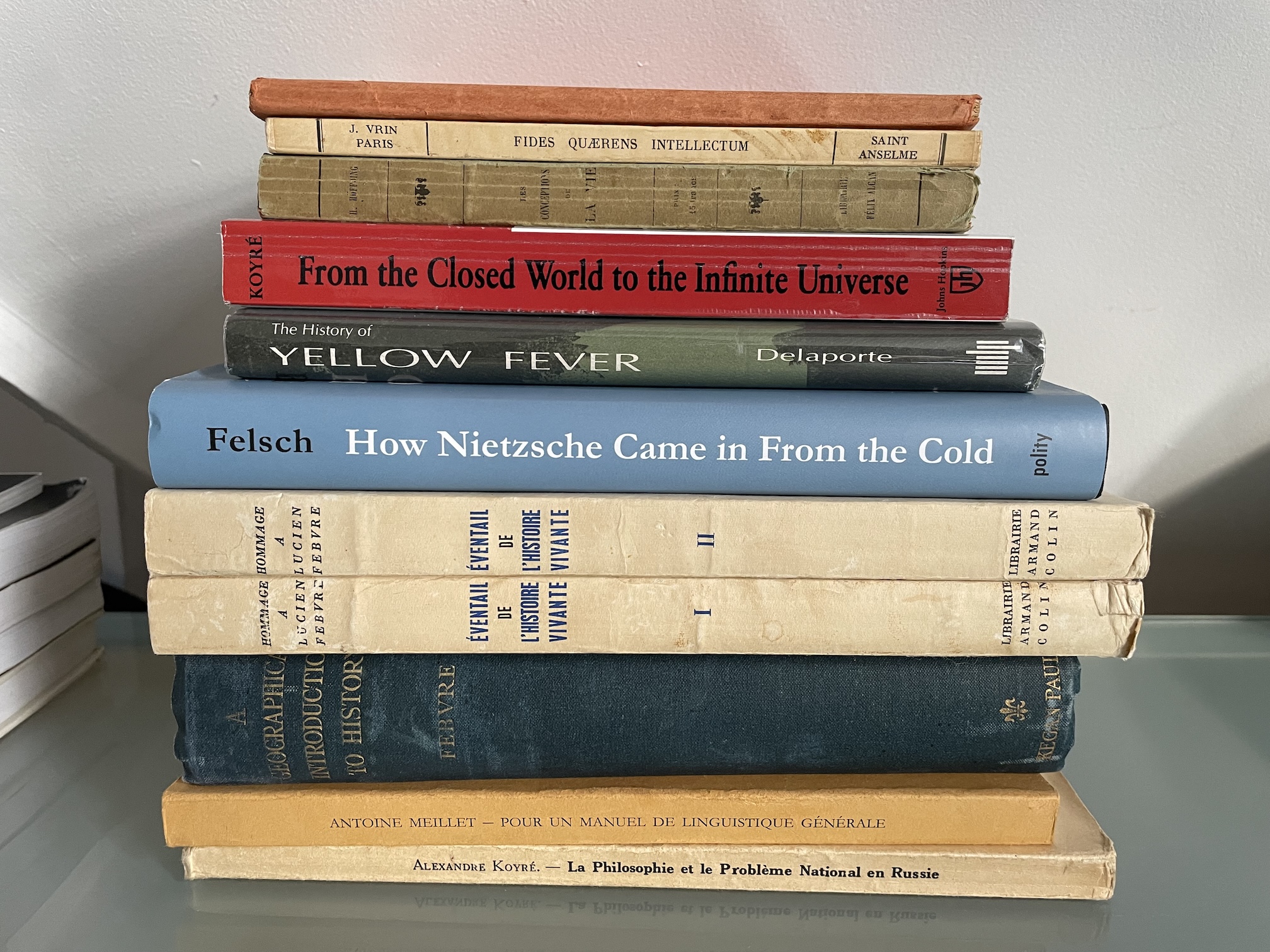
Books received – Dumézil, Koyré, Delaporte, Felsch, Febvre, Meillet

Some second-hand books by dead French men bought recently, and Philipp Felsch’s How Nietzsche Came in From the Cold, translated by Daniel Bowles.

The second and third books are translations by Alexandre Koyré, and the top book is a copy of Georges Dumézil’s Ouranos-Varuna, an early book from 1934 that was difficult to find.

Posted in Alexandre Koyré, Antoine Meillet, François Delaporte, Friedrich Nietzsche, Uncategorized | Leave a comment

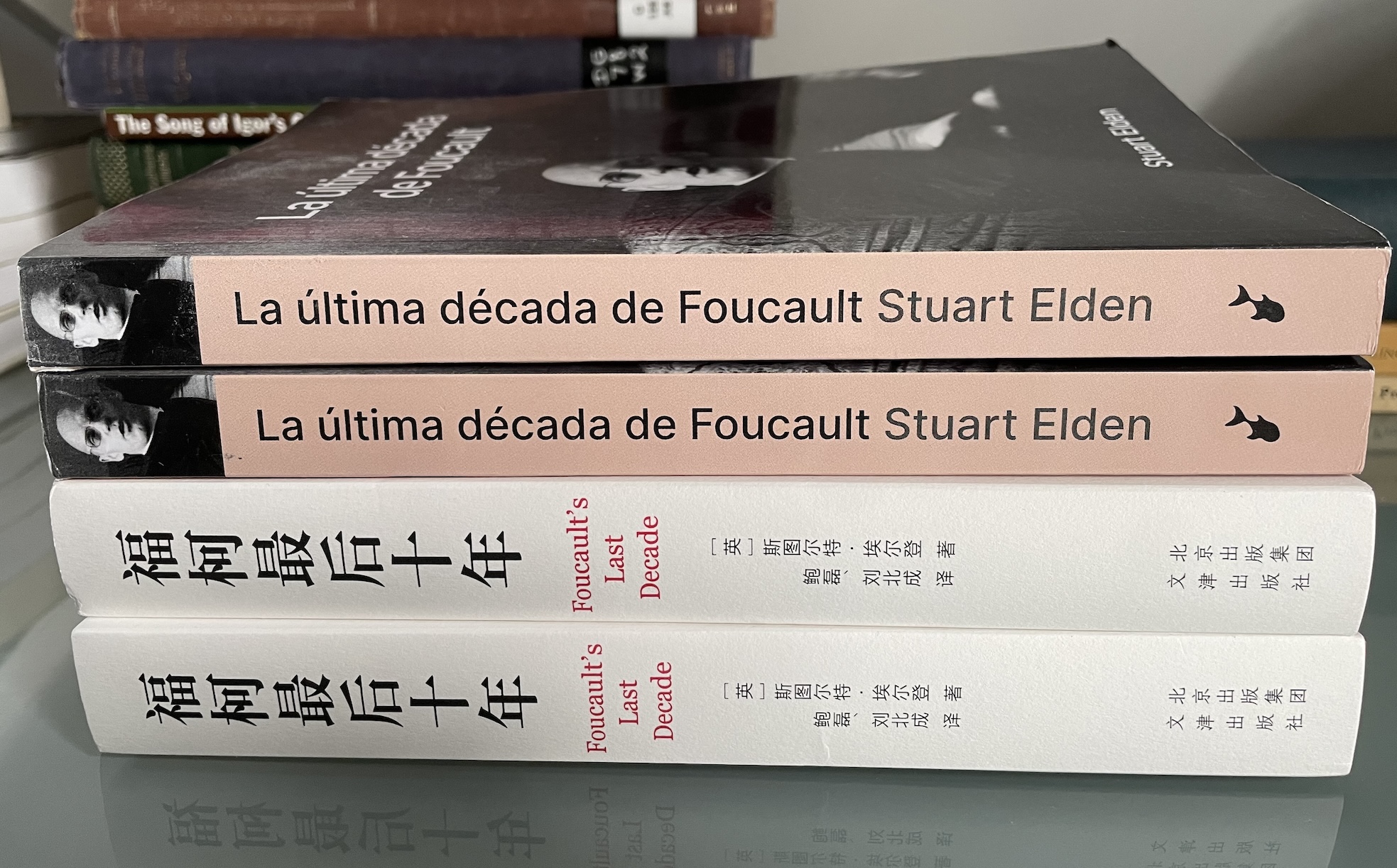
Spanish and Chinese translations of Foucault’s Last Decade

Pleased to receive copies of the Spanish and Chinese translations of Foucault’s Last Decade

La última década de Foucaulttrans. Albert Fuentes, Melusina, September 2004

福柯最后十年, Beijing Publishing Group, July 2024

Posted in Foucault's Last Decade, Michel Foucault | Leave a comment

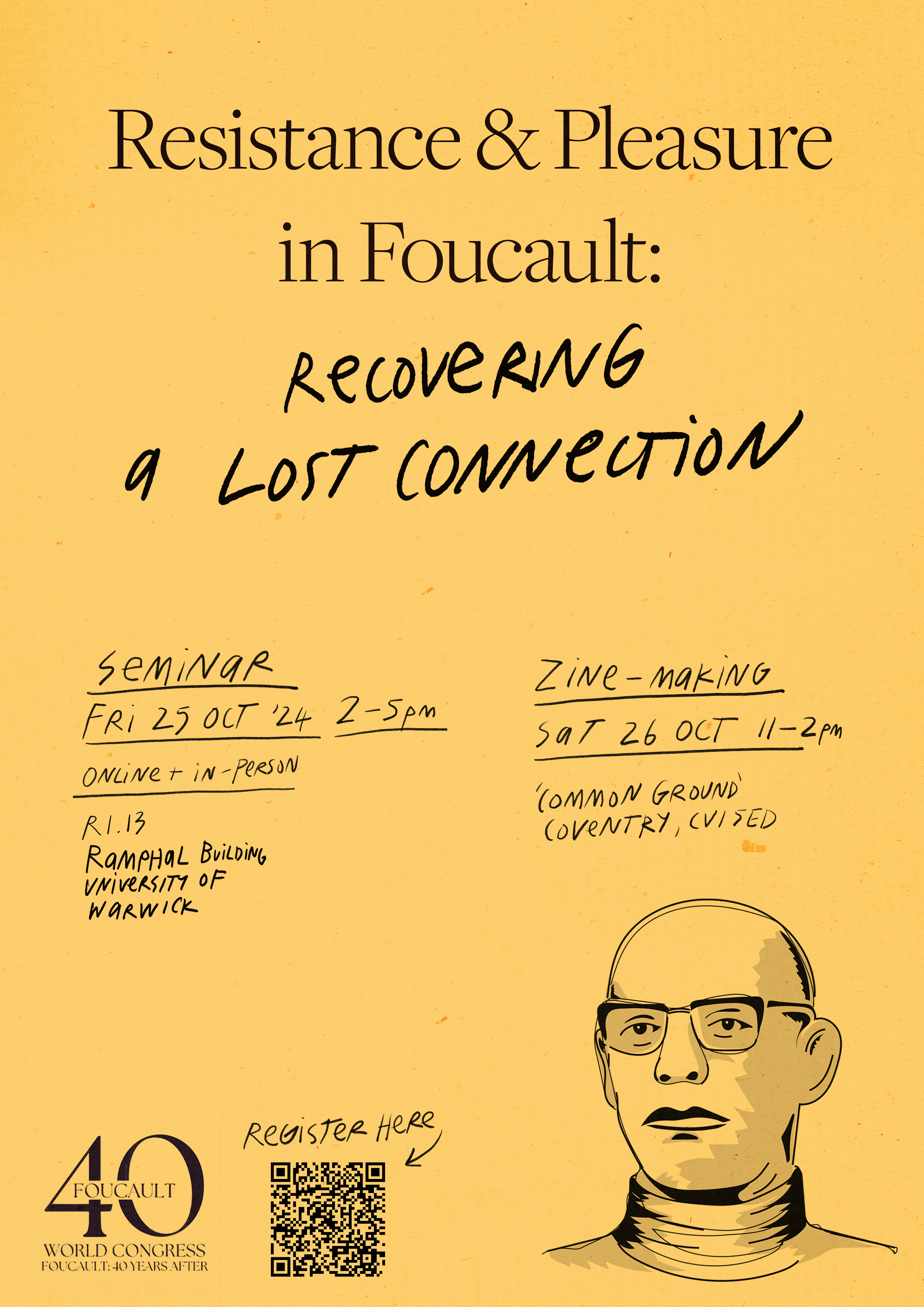
Resistance & Pleasure in Foucault: Recovering a lost connection – University of Warwick, 25 October 2024

Seminar: Resistance and Pleasure in Foucault: Recovering a Lost Connection?

The University of Warwick invites you to a two-day seminar exploring the connections between resistance and pleasure through Michel Foucault’s thought. This seminar is part of the World Congress Foucault: 40 Years After series.

Event Information

  • Date: Friday, October 25th 2024
  • Location: Ramphal Building R1.13, University of Warwick, and online
  • Time: 2:00 pm – 5:00 pm
  • Location: Common Ground, Coventry
  • Time: 11:00 am – 2:00 pm

Register to attend here

Posted in Uncategorized | Leave a comment

Gillian Rose, Marxist Modernism: Introductory Lectures on Frankfurt School Critical Theory – Afterword by Martin Jay, edited by James Gordon Finlayson and Robert Lucas Scott, Verso Books, September 2024 and review in Historical Materialism

Gillian Rose, Marxist Modernism: Introductory Lectures on Frankfurt School Critical Theory – Afterword by Martin Jay, edited by James Gordon Finlayson and Robert Lucas Scott, Verso Books, July 2024

I shared news of this book earlier this year, but it is now published and there is a review by Adrian Wilding in Historical Materialism (open access)

Lectures on art, Marxism, and critical theory by the legendary philosopher, collected for the first time

Marxist Modernism is a comprehensive yet concise and conversational introduction to the Frankfurt School. It is also a new resource from one of the twentieth century’s most important philosophers: Gillian Rose.

Her 1979 lectures on the Frankfurt School explore the lives and philosophies of a range of the school’s members and affiliates, including Adorno, Lukács, Brecht, Bloch, Benjamin, and Horkheimer, and outline the way each theorist developed Marx’s theory of commodity fetishism into a Marxist theory of culture.

Posted in Uncategorized | Leave a comment

Jo van Every – How do I know when my book is ready to submit?

Jo van Every – How do I know when my book is ready to submit?

Some good advice here – and not just for new authors.

There are a lot of other Writing and Publishing posts and links on this site – several linking to other people’s suggestions, and a few pieces by me about different parts of the process. As I say there: “The standard disclaimer – people work in different ways, and no one system or suggestion will suit everyone. But there might be some things in here which are useful for others.”

I am doing a session on writing practices for PhD researchers at Warwick later this year, with a colleague who works in a very different way to me. The point being is not to say you should do this – but that different approaches can each yield results that work for someone, and discussing a variety of practices might be useful. Or, as the title of the open access book Suzanne Conklin Akbar edited, and to which I contributed says How we Write – not How to write.

Posted in Uncategorized, Writing | Leave a comment

Michael J. Shapiro, Negotiating Civic Life: Literature, Film, Politics – Edinburgh University Press, May 2025

Michael J. Shapiro, Negotiating Civic Life: Literature, Film, Politics – Edinburgh University Press, May 2025

A politically-attuned textual journey through civic life

  • Contributes to thinking about civic life both thematically and methodologically
  • Features critical interventions into gender, race, sexuality, and clothing
  • Emphasises the historiographic contributions of artistic genres

Focused both thematically and methodologically on diverse aspects of civic life, this book elucidates the mentalities and forces involved in the way individuals and collectives negotiate ways of being in common. The chapters feature critical interventions into the civic lives of grief, of things, of Blackness, and of trans identity.

With an emphasis on the historiographic contributions of literature, film, objects and embodied memories of events, Shapiro’s textual analyses treat the way artistic genres supply the critical thinking needed to encourage a more egalitarian and convivial life world.

Posted in Uncategorized | Leave a comment

Banu Bargu, Disembodiment: Corporeal Politics of Radical Refusal – Oxford University Press, November 2024

Banu Bargu, Disembodiment: Corporeal Politics of Radical Refusal – Oxford University Press, November 2024

Disembodiment examines self-destruction, self-injury, and self-endangerment as actions that express the injustices and indignities of the life conditions of impoverished, dispossessed, and dominated peoples. Author Banu Bargu troubles the dominant approach that treats these acts as individual pathologies, cries for help, and signs of despair. Instead, she suggests that they should be read as unconventional performances of resistance and refusal that are erased, marginalized, and distorted by metanarratives of history as progress and of agency as freedom and intentionality. Situating these practices in a dialectic of desubjectivation and counter-subjectivation, Bargu argues that they dispel a western metaphysics of subjecthood and invoke alternative ways of being human and of relating to one’s body and the world. Pursuing philosophical questions about the meaning of agency, the direction of history, and the limits of the political generated by the forfeiture of the body, Bargu offers a stark and unforgiving critique of our present. 

As a work in global critical theory whose normative compass is the suffering body, Disembodiment brings together corporeal enactments of defiance and refusal from the global south with major thinkers of western modernity and prominent critical-theoretical traditions of the twentieth century. Bargu moves from such historical precedents as the suicides of enslaved Africans during the transatlantic crossing, the hunger strikes of woman suffragists in England’s prisons, and Gandhian fasting practices in the Indian anticolonial struggle to contemporary examples that include the hunger and thirst strikes in the Maze and Guantánamo, the self-incineration of Mohammed Bouazizi, and the lip-sewing practices of migrants and asylum seekers in detention centers and border zones of the global north today. She takes the reader on an unsettling journey that delineates the emergence of a corporeal repertoire of contention. Performed by the powerless who find themselves in crisis, this repertoire is built on the expressive agency of the body and its ability to irrupt, undoing its training in composure and radicalizing the meaning of dignity. 

Disembodiment presents a bold materialist theory of corporeal agency, which upholds the body’s powers as fundamentally rebellious and ultimately undomesticatable

Posted in Uncategorized | 1 Comment