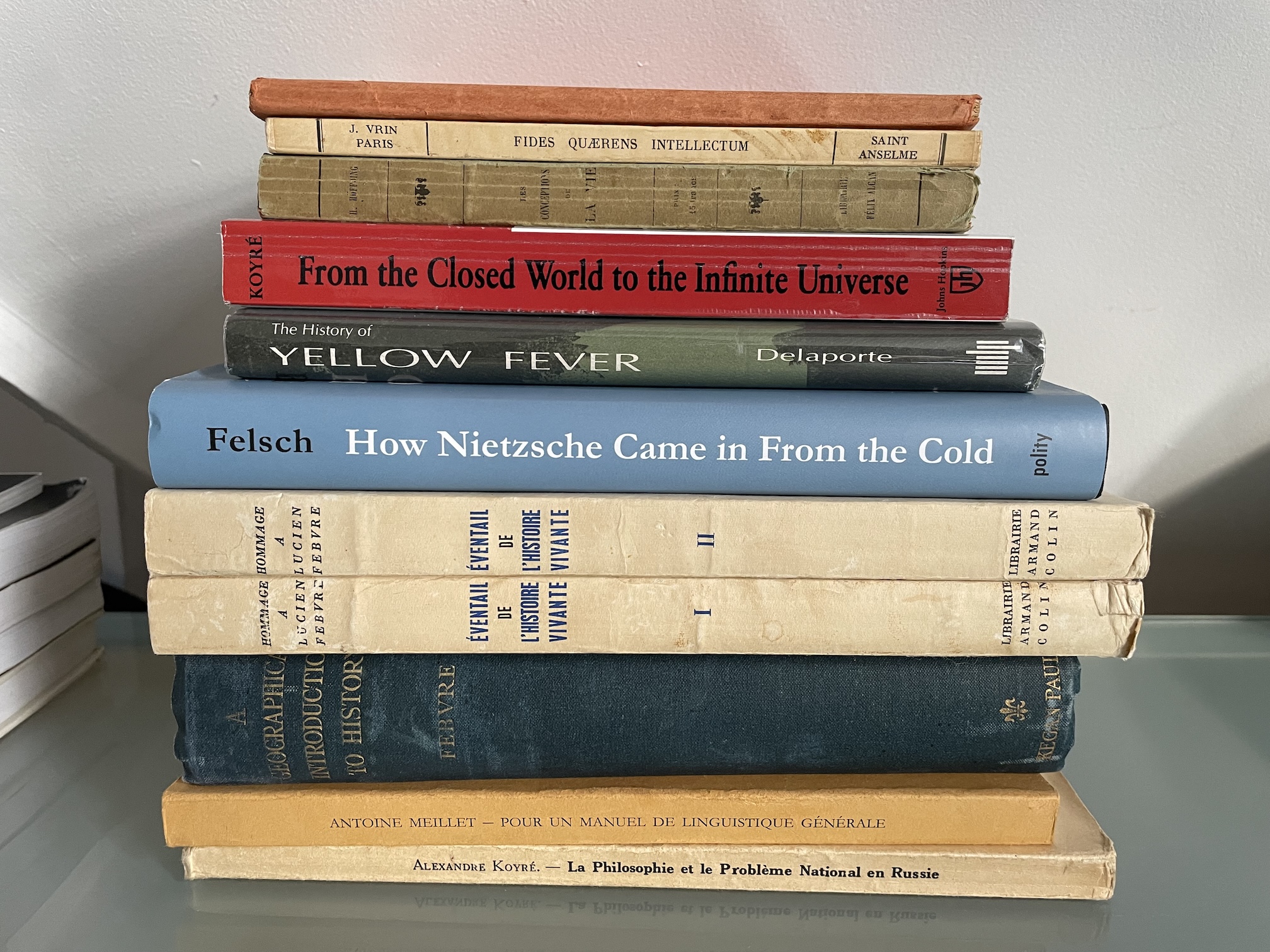
Some second-hand books by dead French men bought recently, and Philipp Felsch’s How Nietzsche Came in From the Cold, translated by Daniel Bowles.
The second and third books are translations by Alexandre Koyré, and the top book is a copy of Georges Dumézil’s Ouranos-Varuna, an early book from 1934 that was difficult to find.
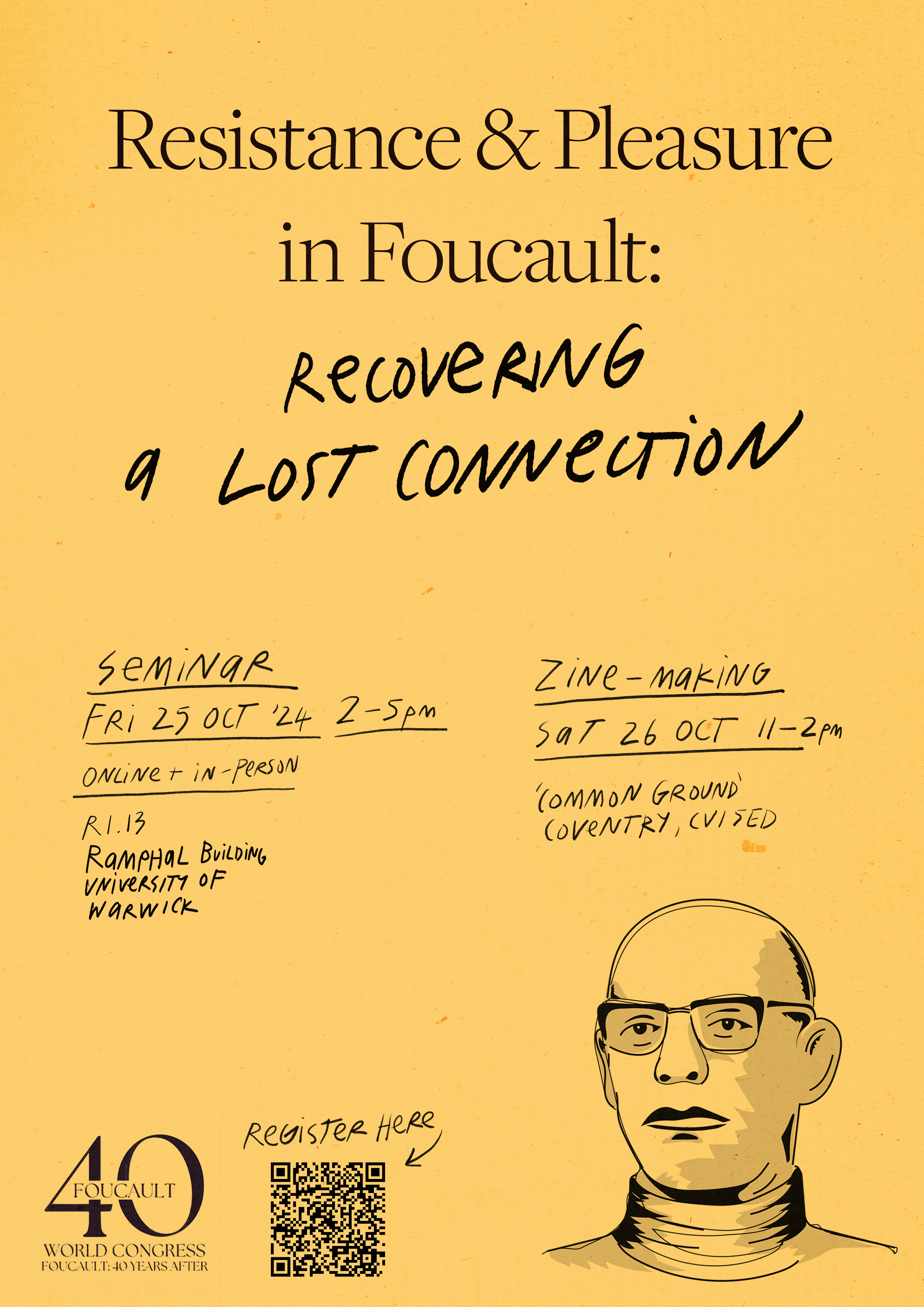
Seminar: Resistance and Pleasure in Foucault: Recovering a Lost Connection?
The University of Warwick invites you to a two-day seminar exploring the connections between resistance and pleasure through Michel Foucault’s thought. This seminar is part of the World Congress Foucault: 40 Years After series.
Event Information
Date: Friday, October 25th 2024
Location: Ramphal Building R1.13, University of Warwick, and online
I shared news of this book earlier this year, but it is now published and there is a review by Adrian Wilding in Historical Materialism (open access)
Lectures on art, Marxism, and critical theory by the legendary philosopher, collected for the first time
Marxist Modernism is a comprehensive yet concise and conversational introduction to the Frankfurt School. It is also a new resource from one of the twentieth century’s most important philosophers: Gillian Rose.
Her 1979 lectures on the Frankfurt School explore the lives and philosophies of a range of the school’s members and affiliates, including Adorno, Lukács, Brecht, Bloch, Benjamin, and Horkheimer, and outline the way each theorist developed Marx’s theory of commodity fetishism into a Marxist theory of culture.
Some good advice here – and not just for new authors.
There are a lot of other Writing and Publishing posts and links on this site – several linking to other people’s suggestions, and a few pieces by me about different parts of the process. As I say there: “The standard disclaimer – people work in different ways, and no one system or suggestion will suit everyone. But there might be some things in here which are useful for others.”
I am doing a session on writing practices for PhD researchers at Warwick later this year, with a colleague who works in a very different way to me. The point being is not to say you should do this – but that different approaches can each yield results that work for someone, and discussing a variety of practices might be useful. Or, as the title of the open access book Suzanne Conklin Akbar edited, and to which I contributed says How we Write– not How to write.
A politically-attuned textual journey through civic life
Contributes to thinking about civic life both thematically and methodologically
Features critical interventions into gender, race, sexuality, and clothing
Emphasises the historiographic contributions of artistic genres
Focused both thematically and methodologically on diverse aspects of civic life, this book elucidates the mentalities and forces involved in the way individuals and collectives negotiate ways of being in common. The chapters feature critical interventions into the civic lives of grief, of things, of Blackness, and of trans identity.
With an emphasis on the historiographic contributions of literature, film, objects and embodied memories of events, Shapiro’s textual analyses treat the way artistic genres supply the critical thinking needed to encourage a more egalitarian and convivial life world.
Disembodiment examines self-destruction, self-injury, and self-endangerment as actions that express the injustices and indignities of the life conditions of impoverished, dispossessed, and dominated peoples. Author Banu Bargu troubles the dominant approach that treats these acts as individual pathologies, cries for help, and signs of despair. Instead, she suggests that they should be read as unconventional performances of resistance and refusal that are erased, marginalized, and distorted by metanarratives of history as progress and of agency as freedom and intentionality. Situating these practices in a dialectic of desubjectivation and counter-subjectivation, Bargu argues that they dispel a western metaphysics of subjecthood and invoke alternative ways of being human and of relating to one’s body and the world. Pursuing philosophical questions about the meaning of agency, the direction of history, and the limits of the political generated by the forfeiture of the body, Bargu offers a stark and unforgiving critique of our present.
As a work in global critical theory whose normative compass is the suffering body, Disembodiment brings together corporeal enactments of defiance and refusal from the global south with major thinkers of western modernity and prominent critical-theoretical traditions of the twentieth century. Bargu moves from such historical precedents as the suicides of enslaved Africans during the transatlantic crossing, the hunger strikes of woman suffragists in England’s prisons, and Gandhian fasting practices in the Indian anticolonial struggle to contemporary examples that include the hunger and thirst strikes in the Maze and Guantánamo, the self-incineration of Mohammed Bouazizi, and the lip-sewing practices of migrants and asylum seekers in detention centers and border zones of the global north today. She takes the reader on an unsettling journey that delineates the emergence of a corporeal repertoire of contention. Performed by the powerless who find themselves in crisis, this repertoire is built on the expressive agency of the body and its ability to irrupt, undoing its training in composure and radicalizing the meaning of dignity.
Disembodiment presents a bold materialist theory of corporeal agency, which upholds the body’s powers as fundamentally rebellious and ultimately undomesticatable
Several of Derrida’s Seminars (and some related material) have been edited over the past several years (Galilée and then Seuil) and translated with University of Chicago Press. I’ve only looked at a few things at the IMEC archive – there are also papers at University of California, Irvine. Derrida’s library is in Princeton, and I’ve looked at a few things remotely (a planned trip was cancelled due to the pandemic, and I’ve not managed to get there since.) They are now digitising all the teaching material and making it available on this site. An extraordinary and extraordinarily useful project.
Here’s part of the explanation:
However, while this work of transcription, editing, and translation is ongoing, thanks to the collaboration of the UC Irvine Libraries and the Institut Mémoires des Éditions Contemporaines (IMEC), the Princeton University Library has made available a digital repository of Derrida’s seminar papers, hoping to increase access to these materials, and to make them as broadly and openly available as possible for students, scholars, and readers around the world. In this way students and scholars are able to follow the most intimate threads of Derrida’s thinking such as he caringly and meticulously wove for his audiences in the classroom.
The pages of this archive span more than 40 years of Derrida’s teaching career, offering the secrets and insights of a lifetime to be unpacked, nourished and contextualized, with the purpose of preserving Jacques Derrida’s memory, but also in the hope of enlarging the field of what it is possible to think.
Just a silly priced hardback at the moment, unfortunately.
Love and Sexuality in Social Theory considers the role that love and sexuality play in private and public life.
Drawing on both classical and contemporary social theory, this book presents both theoretical and empirical studies of love and sexuality as social factors, from the earliest reconstructions of modern emotional life to the most recent analyses of liquid love. With attention to the consequences that passions and desires have both on morals and behaviour, it departs from the analysis of society in terms of the division of labour and utilitarian mechanisms to consider how a society based on performances values human energy and emotional behaviour in a contradictory way. This book, therefore, presents and discusses classic authors, from Georg Simmel and Pitirim Sorokin to Marianne Weber and Simone De Beauvoir, through the work of Erving Goffman and ending with contemporary authors such as Michel Foucault, Anthony Giddens, Zygmunt Bauman, Ulrich Beck, and Eva Illouz.
By presenting love as the social foundation of altruism, an essential element in modern conceptions of subjectivity, and a force shaping intimacy and contemporary social life, this book will appeal to scholars of sociology, particularly those interested in social theory and the sociology of emotions.
I’ve posted about this book before, but it is reviewed by Joshua Fox at NDPR
A reappraisal of Ecce Homo and The Antichrist within Nietzsche’s oeuvre.
Nietzsche’s Legacy takes on the most challenging and misunderstood works in Nietzsche’s oeuvre to illuminate his view of what a philosopher is and what constitutes a philosophic life. Interpreting Ecce Homo and The Antichrist as twin books meant to replace the abandoned Will to Power project, Heinrich Meier recovers them from the stigma of Nietzsche’s late mental collapse, showing that these works are, above all, a lucid self-assessment. The carefully written pair contains both the highest affirmation—the Yes of the “revaluation of all values”—and the most resolute negation—the No to Christianity. How the Yes and the No go together, how the relation between nature and politics is to be determined, how Nietzsche’s intention is governing the political-philosophical double-face: this is the subject of Nietzsche’s Legacy, which opens up a new understanding of Nietzsche’s philosophy as a whole.