Indo-European Thought in Twentieth-Century France update 24: Emile Benveniste’s archives of teaching and publishing, the Festschrift, and the Alexandre Koyré side-project

Since the last update in September, I’ve continued working on the chapter of this project which looks at Benveniste and Dumézil’s parallel teaching careers at the Collège de France, through the 1950s and 1960s. This is the planned topic of an online Social Anthropology seminar at the University of St Andrews in November.

Much of the time recently has been spent in Paris, with shorter visits to archives and libraries in London and Cambridge. The main work in Paris was to continue working through Benveniste’s papers at the Bibliothèque nationale. A lot of these relate to journal articles or book chapters, where there was some combination of a manuscript, rough notes, a typescript, often with a lot of corrections, and then proofs. His typists were very good. Even though his handwriting is a lot better than some of the other people I’m working on, they would still have been challenging manuscripts to work with, especially the diacritics, transliterations and other alphabets. Occasionally there were letters to Benveniste, perhaps relating to the request to write something, or sending the proofs. Generally, these files related to published material, and were not especially revealing. More interesting, though harder to make sense of, are things relating to his teaching. Much has already been dated by the archivists, but having a list of his courses helps to situate them, between his annual courses at the EPHE and the Collège de France, and the year. The lack of a detailed online inventory for several boxes means I am not sure what is where – and there isn’t an obvious logic to the organisation. But I would probably want to work through everything myself anyway. Although I won’t need to look at every box again, I plan to return to some, and so one important task is making sufficiently detailed notes that I can find things again at some future point.

There is also a lot of material relating to Benveniste’s Vocabulaire book, some of which has caused me to rethink some of the assumptions I’d made about that project. I’m not sure how it all fits together quite yet, but it seems to me to be the most revealing part of the archive in terms of his publications. I also took a look at some of Tzvetan Todorov’s papers, also at the Bibliothèque nationale, for the material they have in relation to Benveniste, some of whose final courses Todorov attended.

One thing that really struck me, perhaps even more than in the similar work I’ve done with Dumézil’s archive, is just how many pieces Benveniste published were in Festschriften or other volumes celebrating another great scholar, perhaps for their 60th or 70th birthday. Dumézil does a lot of these too, and it’s very much a generational thing. Of the next generation, I’m struck that Foucault did almost none. There was a Hommage à Jean Hyppolite that he led, after Hyppolite’s death, to which he contributed the famous “Nietzsche, Genealogy, History” essay and a brief avertissement which is not included in Dits et écrits (a scan is here). He and Georges Canguilhem had earlier spoken at a memorial event for Hyppolite at the ENS, and those were also published. But these are not tributes to a living scholar. Foucault reworked his introduction to Canguilhem’s The Normal and the Pathological for a special issue of a journal on Canguilhem shortly before his death, which was in 1985, which is probably as close as he got (a comparison is here). But those are two exceptions, for people Foucault was enormously indebted to as a teacher and/or as a mentor. I can’t think of examples where he was writing a piece for a collection of someone he knew much less well. With the Hyppolite ENS tribute and Canguilhem he is also writing about the person being remembered or honoured, while with the Hommage volume it is a piece on a different topic – something that is more common in a Festschrift. With Benveniste and Dumézil there are large numbers of those kinds of pieces. When I shared these thoughts on social media, Philipp Kendar pointed out that Foucault also contributed to a special issue of Critique on Georges Bataille in 1964. I should have remembered that – I even bought a copy of the issue a few years ago, since I wanted to see Foucault’s piece in context. But, again, it’s a tribute to someone recently deceased, and it is about their work. 

The Festschrift as a literary form still endures, but it doesn’t seem to be nearly as common, or have nearly the same kind of status today as it once had. And while there were certainly problems with the model, they did include some interesting pieces that were probably quite difficult to place elsewhere – more than a review, not quite an article or more standard book chapter. But, they can be really difficult to track down if you are looking for a piece published in one. (My old thoughts on this, here.)

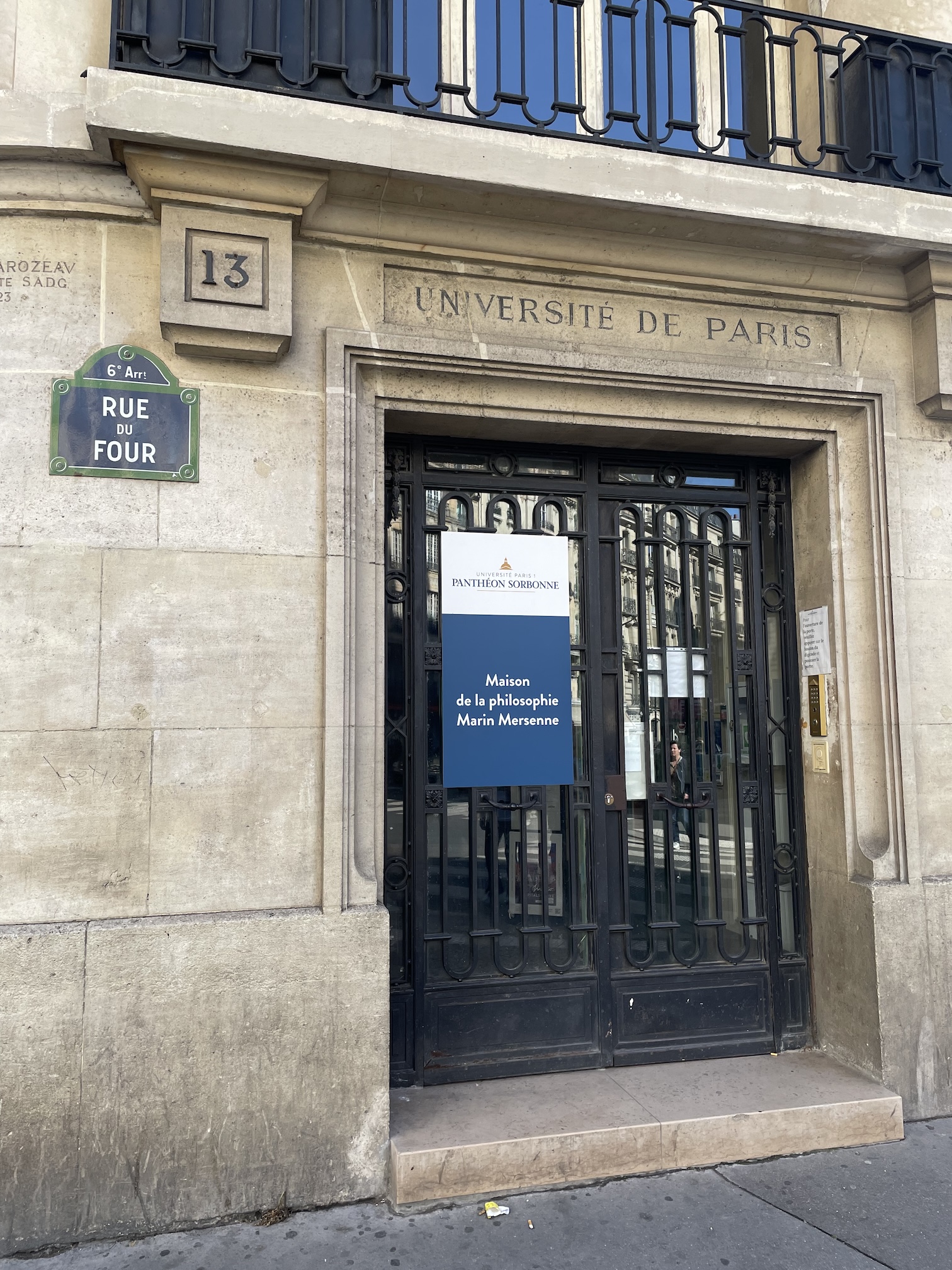
On the corner of the rue de Richelieu and the rue Colbert there is a rather dilapidated building which I understand now belongs to the BnF. It is the Hôtel Nevers, which once was the home of Cardinal Mazarin. But in 1958, it was where the Centre de recherches d’histoire des sciences et des techniques was established, directed by Alexandre Koyré, at the Centre International de Synthèse. It’s right next to the BnF Richelieu site. A little sign gives some of its history, but not what it was used for in the late 20th century. The Centre, now the Centre Alexandre Koyré, was relocated to the Museum of Natural History in the Jardin des Plantes in 1989, and is now at the Campus Condorcet. I’m interested in how much this Centre was an alternative centre in Paris to the Institut d’histoire des sciences et des techniques of the University of Paris, on the rue du Four, which Gaston Bachelard, Canguilhem and Suzanne Bachelard all directed.

The Koyré work is a parallel and growing side-project to the Indo-European work, although he is likely to feature as a minor character in the story I’m telling. As well as the article I wrote on his failure to get elected to the Collège de France (open access in History of European Ideas), I wrote a piece on Canguilhem and Koyré for a workshop on Canguilhem, and that paper opens up a wider discussion of his situation within a French tradition in the history of sciences, and beyond. An audio recording of my talk is here. Doing the research for that paper took me back to the Canguilhem archive at CAPHÉS at the École normale supérieure, and I also found that the Bibliothèque nationale has some correspondence between Koyré and the geographer Jean Gottmann, which I went to look at one afternoon. I say a bit more about those connections here. I also tried to find out a bit about Koyré’s visiting posts in Cairo, though as far as I can tell there are relatively few published sources for this part of his career. I also made a trip to the Archives nationales, which has some papers relating to Koyré and also to Dumézil’s teaching of Armenian. At the moment the last file I know I need to consult there is unavailable – there is apparently asbestos in one of the stores – and the date it might be accessible keeps getting put back. 

While I was in Paris, my MacBook starting crashing, and trying to recover it made it worse; a factory reset at the Apple Store didn’t resolve the problem; and the cost of repair was so high (and the laptop relatively old), that I had to replace it when I got home. What this meant was that for several days in Paris I was working with pencil and notebook, which was fine for taking notes – though there was a lot I needed to write up when I had a working system again. (And, at times, I was trying to decipher my own handwriting…) But it made me realise how reliant I am on being able to check files when I’m working in libraries and archives. I have lots of lists of things to check, colour-coded highlights in my draft chapters and papers, indicating to me why I need to look at something or how it fits with things I’ve already consulted. Or an archive file had a draft of a published text and I wanted to compare it to the published one, many of which I have as a pdf. I was pulling up those files on the iPad while in the libraries, but it wasn’t nearly as coordinated a work process as I was used to having. It did make me grateful that nothing was saved on the laptop alone, and that I could access everything online in some way. For reading that was manageable, much less so for writing. As it was, I was able to work through most of the archive files I wanted to on this visit, and I didn’t have a pressing writing deadline which would have caused more problems. Fortunately, I’d already written my paper for Bristol the week after I returned. Writing emails or comments on PhD work was much harder. All the people I work on did their initial work by hand, and then usually got someone else to type it up before they corrected it, often by hand. It’s not a model I’m keen to replicate again.

Back in England, I had a lot of things to catch up on and the Bristol conference, as well as some library work in London. One archive I’ve visited a few times before is the Ancient India and Iran Trust in Cambridge, which has the papers of Harold Bailey which include correspondence with many of the people I’m discussing. In particular, his correspondence with Benveniste – who examined his doctoral thesis – is extensive and covers many decades. But the Trust also has the papers of the Corpus Inscriptionum Iranicarum, and this shed some light on Benveniste’s planned volume on Old Persian Inscriptions, which was never completed. There is an interesting story here, I think, which I’ve been trying to reconstruct. There is some material relating to Benveniste’s progress there, but the draft parts of the text are missing, and I’m trying to find out where they might have ended up. The most recent reference I can find to them and their whereabouts is in 1994 – almost twenty years after Benveniste’s death – but thirty years ago now.

For various reasons I am unsure when I will next be able to get to these archives, but I feel I’ve made some good progress recently.

Previous updates on this project can be found here, along with links to some research resources and forthcoming publications. The re-edition of Georges Dumézil’s Mitra-Varuna is now scheduled for December 2024. There is a lot more about the earlier Foucault work here. The final volume of the series is The Archaeology of Foucault, and the special issue of Theory, Culture & Society I co-edited on “Foucault before the Collège de France” has some important contributions on the earlier parts of Foucault’s career, and is currently available free to access. My article “Foucault and Dumézil on Antiquity” is in the current issue of Journal of the History of Ideas; “Alexandre Koyré and the Collège de France” is online first and open access.

Posted in Alexandre Koyré, Emile Benveniste, Georges Canguilhem, Georges Dumézil, Jean Gottmann, Mapping Indo-European Thought in Twentieth Century France, Travel, Uncategorized | Leave a comment

Disalienation: Disha Karnad Jani Interviews Camille Robcis – Journal of the History of Ideas blog (audio)

Disalienation: Disha Karnad Jani Interviews Camille Robcis – Journal of the History of Ideas blog (audio)

In this latest episode of In Theory, Disha Karnad Jani interviews Camille Robcis, Professor of History and French at Columbia University about her recent book Disalienation: Politics, Philosophy, and Radical Psychiatry in Postwar France (University of Chicago Press, 2021). A revised edition was published in French this year: Désaliénation: Politique de la Psychiatrie. Tosquelles, Fanon, Guattari, Foucault (trans. Patrick Di Mascio, Seuil, 2024).

Robcis traces how the Catalan psychiatrist François Tosquelles, together with his colleagues and patients in the village of St-Alban-sur-Limagnole, transformed the practice and theory of psychiatry during and after the Second World War. They did this by turning towards the institution of the hospital itself, and considering how psychiatric care could be rooted in an ethical and political critique of social conditions. This resulted in a new movement called institutional psychotherapy, which Robcis traces between Spain, France, and Algeria, and in the work and legacies of influential thinkers such as Jean Oury, Frantz Fanon, Félix Guattari, and Michel Foucault.

Posted in Uncategorized | 1 Comment

Arthur Bradley, Staging Sovereignty: Theory, Theater, Thaumaturgy – Columbia University Press, November 2024

Arthur Bradley, Staging Sovereignty: Theory, Theater, Thaumaturgy – Columbia University Press, November 2024

To become sovereign, one must be seen as sovereign. In other words, a sovereign must appear—philosophically, politically, and aesthetically—on the stage of power, both to themselves and to others, in order to assume authority. In this sense, sovereignty is a theatrical phenomenon from the very beginning.

This book explores the relationship between theater and sovereignty in modern political theory, philosophy, and performance. Arthur Bradley considers the theatricality of power—its forms, dramas, and iconography—and examines sovereignty’s modes of appearance: thrones, insignia, regalia, ritual, ceremony, spectacle, marvels, fictions, and phantasmagoria. He weaves together political theory and literature, reading figures such as Plato, Aristotle, Montaigne, Leibniz, Kant, Hegel, Schmitt, Benjamin, Derrida, and Agamben alongside writers including Shakespeare, Cervantes, Schiller, Melville, Valéry, Kafka, Ionesco, and Genet. 

Formally inventive and deeply interdisciplinary, Staging Sovereigntyoffers a surprising and original narrative of political modernity from early modern political theology to the age of neoliberal capitalism.

Update August 2025: There is an interview about the book with Richard B. Gibson at the Blog of the APA. Thanks to dmf for this link. There is also a review by K. Daniel Cho at Theory, Culture & Society.

Posted in Uncategorized | 1 Comment

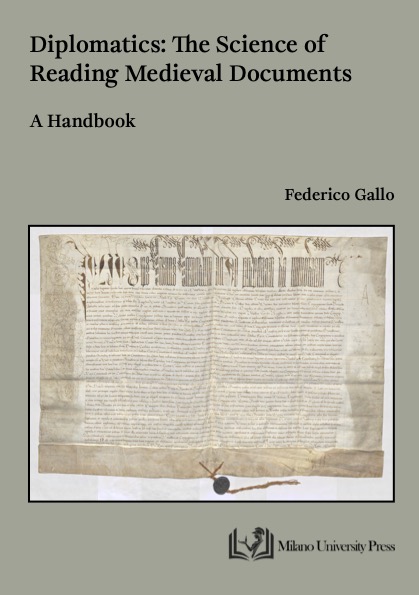
Federico Gallo, Diplomatics: the science of reading medieval documents A Handbook – Milano University Press, 2024 (open access)

Federico Gallo, Diplomatics: the science of reading medieval documents A Handbook – Milano University Press, 2024 (open access)

The book is in English, but I can only find this abstract:

La Diplomatica è la scienza che studia i documenti, in modo particolare quelli di epoca medioevale. La parola ‘Diplomatica’ non ha nulla a che vedere con la diplomazia: il termine deriva da ‘diploma’, ossia un testo scritto certificato, dal valore giuridico. Gli oggetti di studio della disciplina sono i documenti pubblici e privati, le loro caratteristiche esterne ed interne, il linguaggio, la cronologia, la produzione, la trasmissione, la registrazione, l’edizione. Questo manuale colma un vuoto notevole negli studi di Diplomatica perché fornisce finalmente al pubblico di lingua inglese la possibilità di conoscere l’affascinante universo della documentazione medievale.

Posted in Uncategorized | Leave a comment

Quinn Slobodian, Hayek’s Bastards: Race, Gold, IQ, and the Capitalism of the Far Right – Zone, April 2025

Quinn Slobodian, Hayek’s Bastards: Race, Gold, IQ, and the Capitalism of the Far Right – Zone, April 2025

Neoliberals should have seen the end of the Cold War as a total victory—but they didn’t. Instead, they saw the chameleon of communism changing colors from red to green. The poison of civil rights, feminism, and environmentalism ran through the veins of the body politic and they needed an antidote.

To defy demands for equality, many neoliberals turned to nature. Race, intelligence, territory, and precious metal would be bulwarks against progressive politics. Reading and misreading the writings of their sages, Friedrich Hayek and Ludwig von Mises, they articulated a philosophy of three hards—hardwired human nature, hard borders, and hard money—and forged the alliances with racial psychologists, neoconfederates, ethnonationalists, and goldbugs that would become known as the alt-right.

Following Hayek’s bastards from Murray Rothbard to Charles Murray to Javier Milei, we find that key strains of the Far Right emerged within the neoliberal intellectual movement not against it. What has been reported as an ideological backlash against neoliberal globalization in recent years is often more of a frontlash. This history of ideas shows us that the reported clash of opposites is more like a family feud.

“A creative and engaging intellectual detective story that cuts through the far right’s smoke-and-mirrors claims of rupture and novelty, tracing the movement’s deep neoliberal roots and exposing a shared set of supremacist beliefs about which lives have value and which lives do not. Ideas have consequences and very few scholars take the history of ideas as seriously as Slobodian, even when the ideas themselves are absurd, patently false, and deeply dangerous.” – Naomi Klein, author of Doppelganger and The Shock Doctrine

Posted in Uncategorized | Leave a comment

Andrew Hui, The Study: The Inner Life of Renaissance Libraries – Princeton University Press, December 2024

Andrew Hui, The Study: The Inner Life of Renaissance Libraries – Princeton University Press, December 2024

With the advent of print in the fifteenth century, Europe’s cultural elite assembled personal libraries as refuges from persecutions and pandemics. Andrew Hui tells the remarkable story of the Renaissance studiolo—a “little studio”—and reveals how these spaces dedicated to self-cultivation became both a remedy and a poison for the soul.

Blending fresh, insightful readings of literary and visual works with engaging accounts of his life as an insatiable bookworm, Hui traces how humanists from Petrarch to Machiavelli to Montaigne created their own intimate studies. He looks at imaginary libraries in Rabelais, Cervantes, Shakespeare, and Marlowe, and discusses how Renaissance painters depicted the Virgin Mary and St. Jerome as saintly bibliophiles. Yet writers of the period also saw a dark side to solitary reading. It drove Don Quixote to madness, Prospero to exile, and Faustus to perdition. Hui draws parallels with our own age of information surplus and charts the studiolo’s influence on bibliographic fabulists like Jorge Luis Borges and Umberto Eco.

Beautifully illustrated, The Study is at once a celebration of bibliophilia and a critique of bibliomania. Incorporating perspectives on Islamic, Mughal, and Chinese book cultures, it offers a timely and eloquent meditation on the ways we read and misread today.

Posted in Uncategorized | Leave a comment

Eliza Randazzo and Hannah Richter, Challenging Anthropocene Ontology: Modernity, Ecology and Indigenous Complexities – Bloomsbury, May 2024

Eliza Randazzo and Hannah Richter, Challenging Anthropocene Ontology: Modernity, Ecology and Indigenous Complexities – Bloomsbury, May 2024

Using the recent turn to ecology as a starting point, Hannah Richter and Elisa Randazzo bring ecological thinking into contact with Critical Indigenous Studies, in which awareness of the necessity for sustainable relations between humans and non-humans has long preceded Western Anthropocene discourse. Currently, the drastic ecological changes labelled as ‘the Anthropocene’ not only increasingly shape the political awareness and the priorities of citizens and governments, but also inform a large body of social scientific scholarship. 

Indigenous scholarship and practice, in particular ecological adaptability, is intrinsically related to power structures and political struggle – hence indigenous understanding of Anthropocene discourses are intertwined with discourses of colonialism and political contestation. This book problematises the depoliticising character of Western Anthropocene discourses in relation to indigenous ecologies. The authors reveal how the anti-colonial struggles of Indigenous communities and the unequal distribution of responsibilities for and suffering from ecological change, are concealed and devalued in Western discourses of the Anthropocene.

Posted in Uncategorized | 1 Comment

Damion Searls, The Philosophy of Translation – Yale University Press, October 2024

Damion Searls, The Philosophy of Translation – Yale University Press, October 2024

A deep dive into the nature of translation from one of its most acclaimed practitioners
 
Avoiding theoretical debates and clichéd metaphors, award‑winning translator Damion Searls has written a fresh, approachable, and convincing account of what translation really is and what translators actually do. As the translator of sixty books from multiple languages, Searls has spent decades grappling with words on the most granular level: nouns and verbs, accents on people’s names, rhymes, rhythm, “untranslatable” cultural nuances. Here, he connects a wealth of specific examples to larger philosophical issues of reading and perception. Translation, he argues, is fundamentally a way of reading—but reading is much more than taking in information, and translating is far from a mechanical process of converting one word to another. This sharp and inviting exploration of the theory and practice of translation is for anyone who has ever marveled at the beauty, force, and movement of language.

Posted in Uncategorized | 1 Comment

Lefebvre resources – page updated

I’ve done a bit of tidying up and made a few additions to the ‘Lefebvre resources‘ page on this site.

It includes Where to start with reading Henri Lefebvre? – my guide to his books in English, to a few untranslated ones, and major works on him. But there are a few other things on the page which may be of interest, including a couple of videos (one below) and audio, an unpublished text, and links to some posts on this site about him, and the translations of his in English I’ve been involved with.

There are a lot of other resource pages on this site, including a separate page for resources on Foucault (lots of links, some images, translations, a bibliography of his collaborative projects, audio and video links, etc.) – but also things on Althusser, Axelos, Bataille, Binswanger, Sartre, and others, and a little on some political issues around Ebola, Boko Haram and covid-19, and some writing and publishing advice.

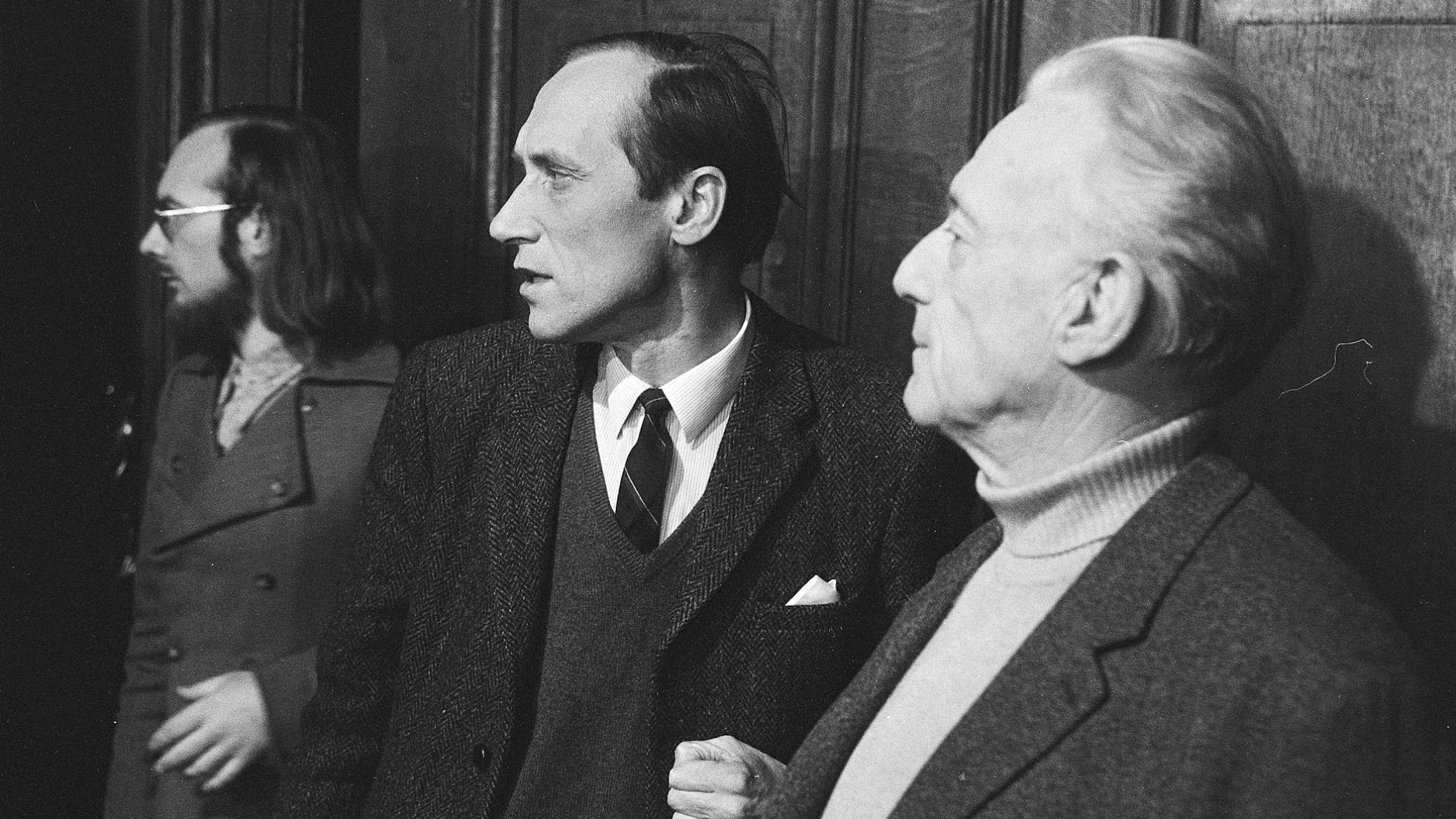
Fons Elders, Leszek Kolakowski and Henri Lefebvre, before their TV discussion in 1971 – available at https://www.youtube.com/watch?v=WySY8412Lfk; image from https://www.right2city.org/news/the-philosopher-who-anticipated-may-68/
Posted in Uncategorized | Leave a comment

Emily Herring, Herald of a Restless World: How Henri Bergson Brought Philosophy to the People – Basic Books, October 2024

Emily Herring, Herald of a Restless World: How Henri Bergson Brought Philosophy to the People – Hachette, October 2024

Two short excerpts are on Herring’s Substack – first excerpt and Metaphysics to die for.

update January 2025: New Books discussion with Morteza Hajizadeh

The first English-language biography of Henri Bergson, the French philosopher who defined individual creativity and transformed twentieth-century thought  
 
At the dawn of the twentieth century, Henri Bergson (1859–1941) became the most famous philosopher on earth. Where prior thinkers sketched out a deterministic, predictable universe, he asserted the transformative power of individual consciousness and creativity. An international celebrity, he made headlines around the world debating luminaries like Bertrand Russell and Albert Einstein about free will and time. The vision of creative evolution and freedom he presented was so disruptive that the New York Times branded him “the most dangerous man in the world.”   
 
In Herald of a Restless World, Emily Herring recovers how Bergson captivated a society in flux. She shows how his celebration of the time-bending uniqueness of individual experience struck a chord with those shaken by modern technological and social change. Long after he faded from public view, his insights into memory, time, laughter, and the creative continue to shape how we see the world around us.  
 
Herald of a Restless World is an electrifying portrait of a singular intellect. Bergson’s extraordinary insight into life’s fundamental questions remains urgent and relevant to this day. 

Posted in Uncategorized | Leave a comment