Meet French philosopher Jacques Rancière in conversation with Professor Oliver Davis (University College Cork).
A leading philosopher and specialist of Marxist political philosophy and aesthetics, Jacques Rancière significantly contributed to 20th century political theories with major works including La Nuit des prolétaires (1981; The Nights of Labor: The Workers’s Dream in Nineteenth-Century France), Partage du sensible: esthétique et politique (2000; The Politics of Aesthetics: The Distribution of the Sensible), and Le Spectateur émancipé (2008; The Emancipated Spectator).
In conversation with Professor Oliver Davis (University College Cork), Rancière will give special insight into the universe of post-68 philosophy, his contributions to modern political theory, his conception of emancipation, and his understanding of the relationship between art and politics.
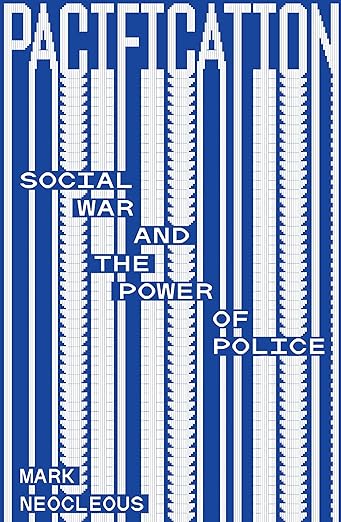
In his new book, critical theorist Mark Neocleous engages in a sustained critique of the theory and practice of pacification. Combining philosophical analysis with historical detail, Neocleous analyses the development of pacification as a key concept through which capitalist modernity has been organised, offering readers the first book that treats pacification as an important concept in the history of state power and capitalism. Neocleous’s approach is fourfold, examining pacification as social warfare carried out through the ideology of peace; as a form of social police carried out through mechanisms of security; as law and order exercised through the permanent wars of class society; and as the myriad practices of power designed to counter insurgency.
Making use of official documents of state, the writings of counterinsurgency thinkers and the ideas perpetuated by practitioners of counterrevolution, the book unravels the complex ways through which pacification generates new forms of social war and new modes of policing that reproduce capitalist order and fabricate obedient subjects.
Through expansive accounts of war and police, and engaging with a range of topics from debt to death, from stasis to civil war, and from the police kettle to the politics of fear, the book offers a provocative analysis of the ways in which state and capital combine to build a pacified social order.
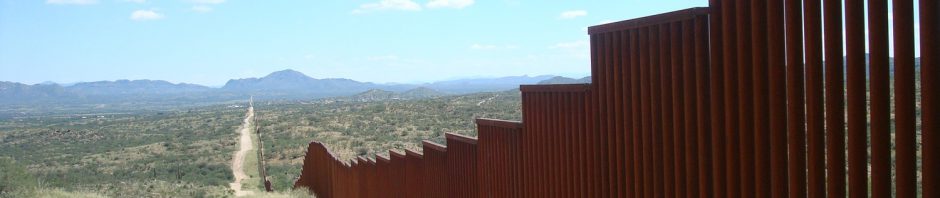
Klaus Dodds is Executive Dean and Professor of Geopolitics at Royal Holloway, University of London, and a Fellow of the Academy of Social Sciences. He completed his PhD at the University of Bristol in 1994 and took up a position at the University of Edinburgh. Thereafter he joined Royal Holloway. He has held a Visiting Erskine Fellowship at Gateway Antarctica, University of Canterbury (2002) and been a Visiting Fellow at St Cross College, University of Oxford (2010-11) and St Johns College, University of Oxford (2017-18). In 2005 he was awarded the Philip Leverhulme Prize for Geography and a Major Research Fellowship by the Leverhulme Trust (2017-2020) for a project concerned with the ‘Global Arctic’. He has published many books and articles concerned with the geopolitics and governance of the Polar Regions, as well as the cultural politics of ice and border geopolitics. These include The Scramble for the Poles (2016), Ice: Nature and Culture (2018) and Border Wars (2022). His latest book, co-written with Mia Bennett is provisionally titled Unfrozen: The Battle for the Future of the Arctic (Yale University Press 2025).
This book traces the contributions of the Lévy-Bruhl family to social and political thought and expertise in 20th-century France, shaping the anticipation of economic and health crises.
How French Moderns Think tells the story of the French sociological tradition through four generations of the Lévy-Bruhl family: Lucien, who founded the Institute of Ethnology at the University of Paris; his son Henri, who founded the Institute of Roman Law; his grandson Raymond, who took part in the creation of the National Institute of Statistics and Economic Studies; and his great-grandson Daniel, a vaccine specialist at the Institute of Public Health. This family history casts a new light on the philosophical debates about “primitive mentality” and the “savage mind.” By drawing on the expert knowledge inherent in this family genealogy, the articulation between the logical and the “pre-logical” is not a cognitive question but rather a problem of anticipating unpredictable events. By relating Lévy-Bruhl’s engagements from the Dreyfus Affair to the Minister of Armaments during the First World War, Keck narrates the confrontation of the socialist ideal of justice and truth with the French colonial experience and its transformations in global technologies preparing for pandemics.
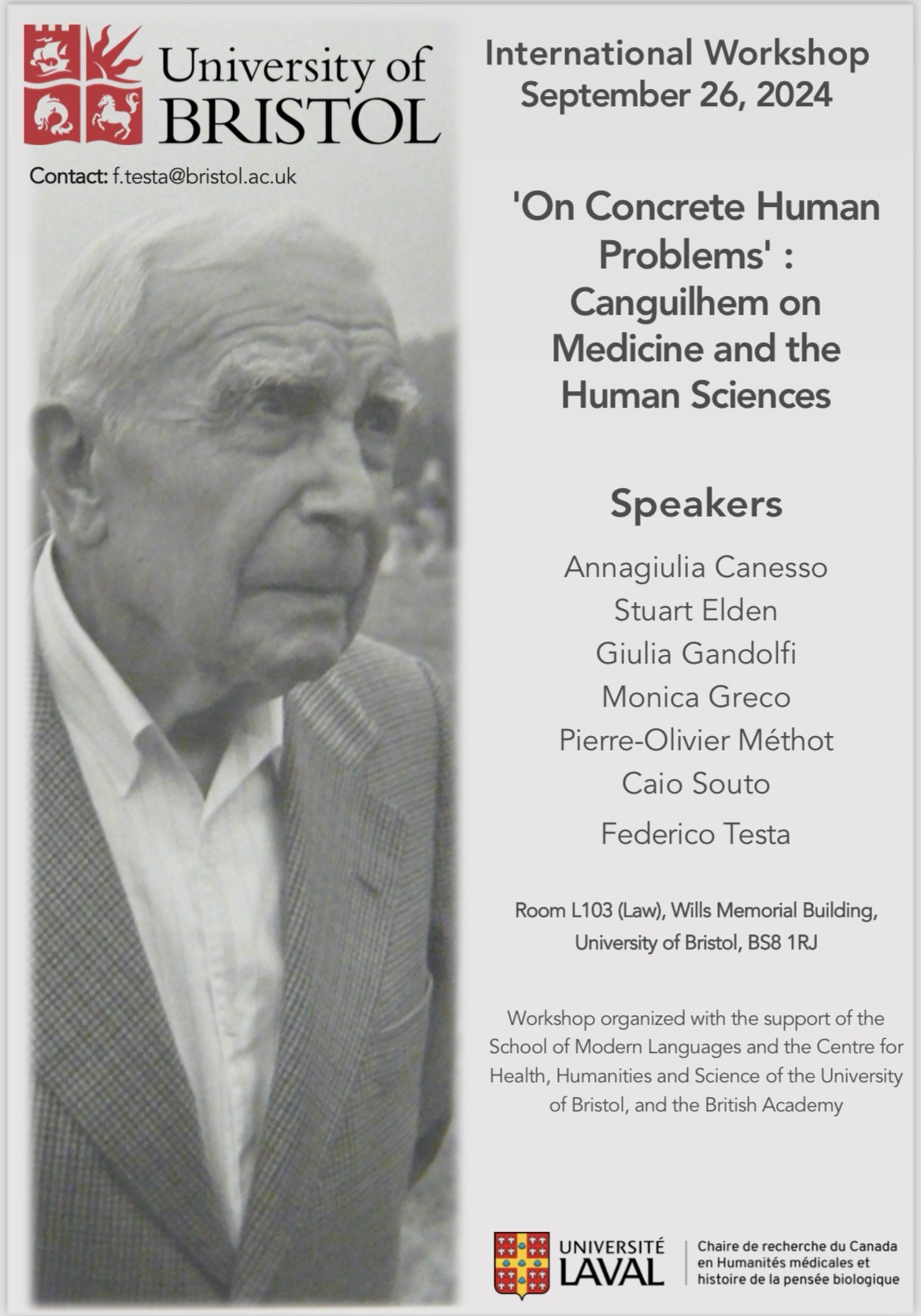
Thanks to Federico Testa and Pierre-Olivier Méthot for the invitation. I don’t think the other papers were recorded, but I think the plan is for at least some of them to be published.
I wrote about Canguilhem in a book of that title published by Polity in 2019. This piece, though, is a continuation of some work I’ve been doing on Koyré over the past year.
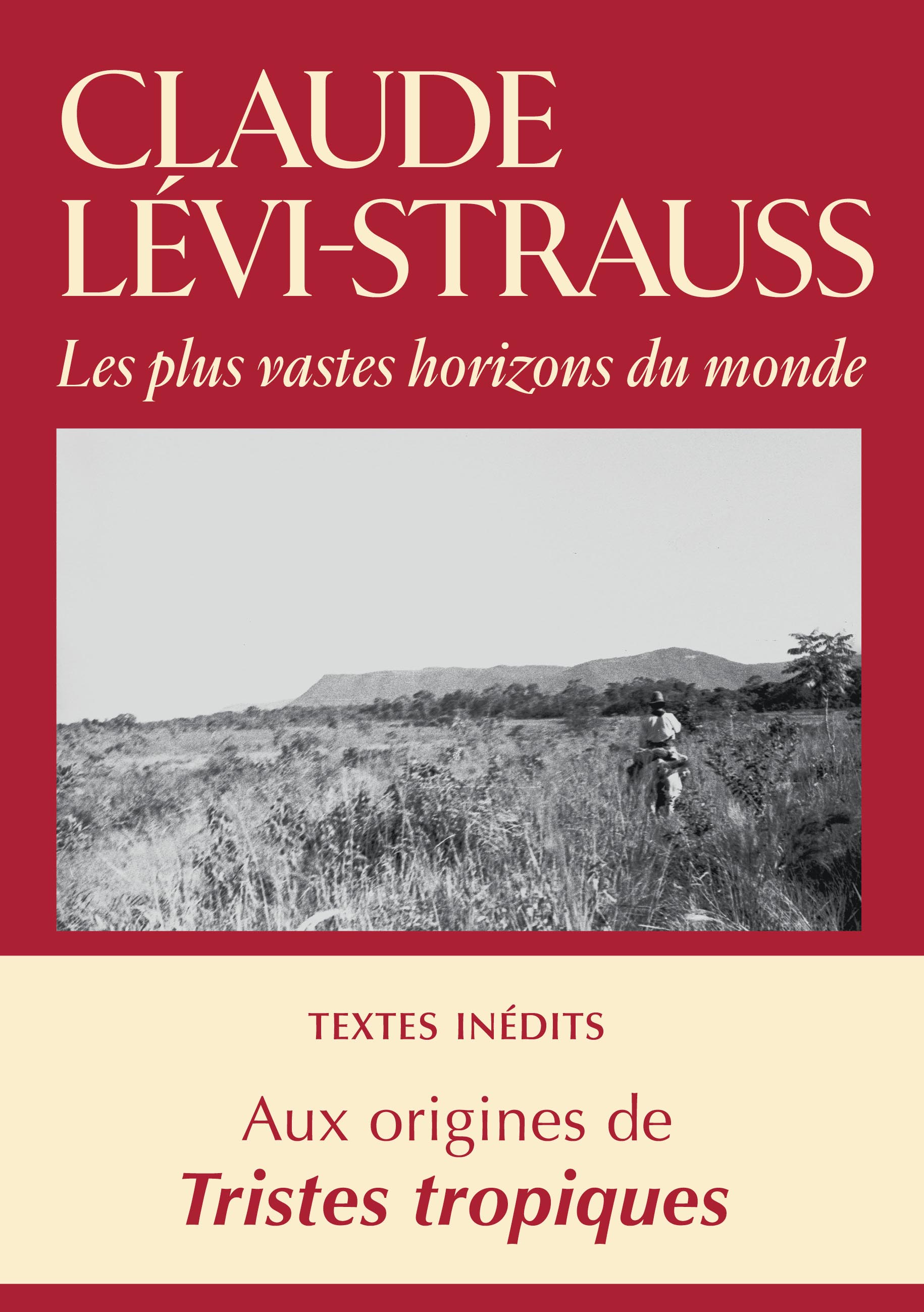
Les plus vastes horizons du monde rassemblent dix textes de Claude Lévi-Strauss pour la plupart inédits en français.
Publiés entre 1935 et 1942 en traduction portugaise dans diverses revues au Brésil ou délibérément relégués à l’oubli par l’auteur mûr, ces écrits se lisent ensemble pourtant comme un vrai roman de formation du grand maître de l’anthropologie du XXe siècle. Sa volonté de prendre le large, son ouverture sur le monde et vers l’autre sont formidablement présents dans ce recueil.
Cet ouvrage exceptionnel est illustré de nombreux documents iconographiques, dont certains méconnus du grand public, ainsi que de cinq films ethnographiques co-réalisés avec sa première épouse, Dina Dreyfus, et restaurés spécialement pour cette édition.
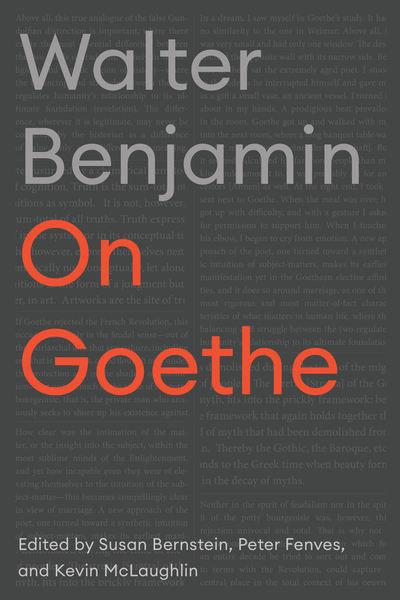
Walter Benjamin, On Goethe – ed. Susan Bernstein, Peter Fenves and Kevin McLaughlin, Stanford University Press, April 2025
On Goethe contains the full range of Walter Benjamin’s reflections on the central figure in modern German culture. The writings in this volume—newly translated, fully annotated, and framed by an extensive introduction—display a variety of styles and cover a vast array of topics. The collection revolves around two strikingly different essays. Whereas “Goethe’s Elective Affinities” develops a theory of critique in which a work is illuminated wholly from within itself, an article Benjamin wrote on Goethe for the Soviet Encyclopedia represents his first large-scale attempt to elaborate an historical-materialist methodology. The other thirty translations stand in similarly productive tension with one another. Some are concerned with concepts of beauty and categories of the aesthetic, others with the relation of art to politics and the status of “classical authors” in contemporary culture, and still others with what remains of humanistic traditions in the wake of their disappearance under fascist regimes and what synthesis is required for the construction of an historical object. The volume provides a glimpse into the laboratory of Benjamin’s thought, while granting readers a series of insights into the epochal phenomena that gather around the name “Goethe.”
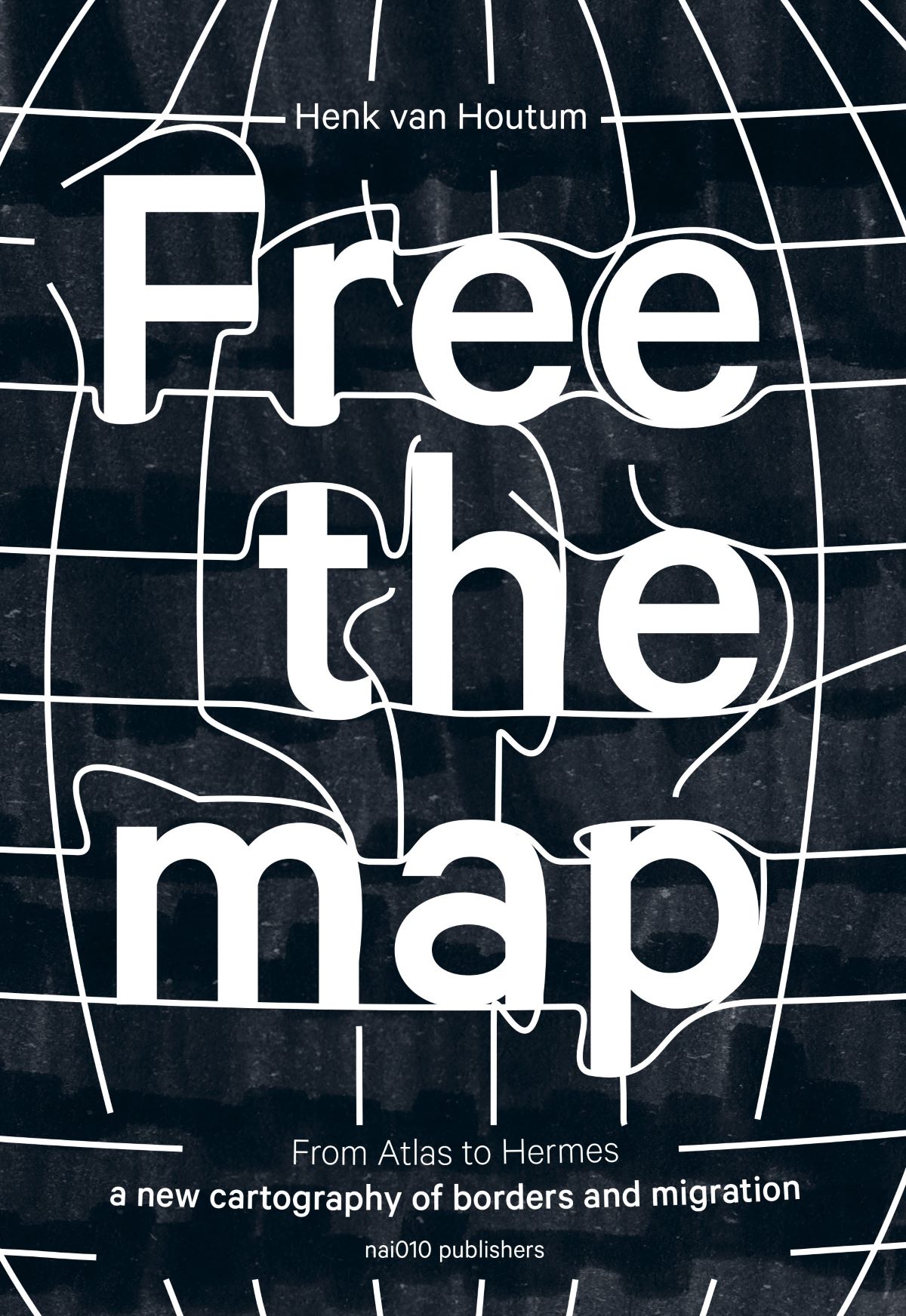
‘Map attack! In Free the Map, a new publication by Henk van Houtum, traditional maps are challenged and new cartographic stories and representations are discussed and encouraged. A must for our readership.’ Defactoborders
> An innovative cartography on borders and migration > With exciting mapping assignments for Maplabs and education > On counter-maps showing human relations, experiences, and connections
A map is a visual story of the world. It feeds our imagination and shapes our view of the world. A standard atlas, however, predominantly tells only one story, that of the nation-state. It depicts a world in which people are uniformly packed into national containers, enclosed by borders, and in which migration is often represented as threatening invasion arrows.
Free the Map goes beyond this narrow, state-centric cartography. The book argues for a new cartographic story: a Hermes – the grandson of Atlas and the god of mobility and human connections. To this end, it discusses several visually compelling, alternative cartographic representations of borders and migration.
Free the Map ends with a call to action. Various artists and cartographers offer exciting ready-to-use Hermes challenges for education and public Maplabs.
Cette édition présentée et annotée des textes publiés par Éric Weil dans la revue Critique, revue générale des publications françaises et étrangères fondée par Georges Bataille en 1946, complète le corpus déjà vaste de l’œuvre philosophique de Weil. Elle situe son activité dans le cadre de la politique éditoriale de la revue et des rapports riches et complexes entre Weil et Bataille. Elle met en évidence la singularité de la pratique philosophique de Weil, entre les grands livres théoriques – Logique de la philosophie, Philosophie politique, Philosophie morale – et les analyses historiques et politiques concrètes des Essais et conférences. Partant de comptes rendus d’ouvrages qui témoignent de la vie intellectuelle de l’après-guerre, Weil traite en profondeur de l’Allemagne, des États-Unis, de l’URSS, de l’Angleterre, de l’avenir de l’Europe, de l’éducation en démocratie … Ses articles et notes critiques ouvrent sur une passionnante diversité de sujets et d’auteurs, connus ou moins connus.
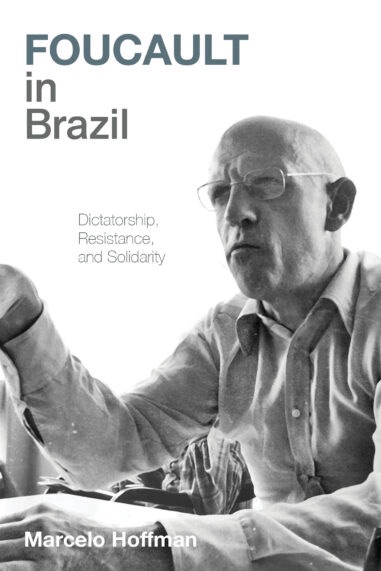
My review of Marcelo Hoffman’s remarkable book Foucault in Brazil is scheduled to appear in Political Theory next year, but is now available online first. Many thanks to Verena Erlenbusch-Anderson for asking me to write the review, and Marcelo for such a good book to discuss.
The review is subscription only, but if you want to read it and you can’t get a copy another way, email me or request on ResearchGate. Here are the first two paragraphs:
Michel Foucault made five visits to Brazil—one in 1965 and four in the mid-1970s. All took place under the military dictatorship that lasted from 1964 until 1985. Each time, Foucault delivered important lectures, some of which were published in his lifetime while others have remained largely unknown. In 1965, he gave a course on his book-in-progress, Les mots et les choses, translated as The Order of Things. The course manuscript is an early draft of the book itself and is due to be edited by Philippe Sabot for the new series of “Cours et travaux” (“Courses and Works”) that precede Foucault’s time at the Collège de France. In 1973, Foucault gave five lectures in Rio de Janeiro, which have been translated as “Truth and Juridical Forms.” In 1974, he gave a number of lectures on social medicine and public health, of which three have been published. In 1975, he gave a course on sexuality, which preceded the first volume of The History of Sexuality the following year and which gave valuable insight into the originally envisioned plan for its subsequent unpublished volumes. It is due to be published in Généalogies de la sexualité. In 1976, his last visit, he gave lectures of which “The Meshes of Power” is the key published source. During these visits, he spent time with academics and students, activists and friends. There were some important interviews with Brazilian interlocutors and discussions following some of the lectures.
In his remarkable book, Foucault in Brazil: Dictatorship, Resistance, and Solidarity, Marcelo Hoffman adds significantly to our understanding of this period of Foucault’s career. It comes after two other important contributions—Heliana de Barros Conde Rodrigues’s Ensaios sobre Michel Foucault no Brasil (2016; translated into French in 2020) and an issue of the Carceral Notebooks on “Foucault and the Politics of Resistance in Brazil,” edited by Hoffman himself in 2017. The lectures that have been published from Foucault’s visits have also been discussed in various works. Hoffman suggests that previous discussions of the lectures have missed the specifically Brazilian context in which they were delivered and that Conde Rodrigues provides a great deal of context but relatively little on the content of the lectures (6). Hoffman’s aim, and his major contribution, is to resituate the intellectual projects Foucault outlines within the specifics of the place in which and the audience to which they were delivered. The political context is brought, importantly, to the fore.