Paula Landerreche Cardillo and Rachel Silverbloom (eds.), Political Bodies: Writings on Adriana Cavarero’s Political Thought – SUNY Press, 2024

Paula Landerreche Cardillo and Rachel Silverbloom (eds.), Political Bodies: Writings on Adriana Cavarero’s Political Thought – SUNY Press, 2024

The Editors’ Introduction is open access
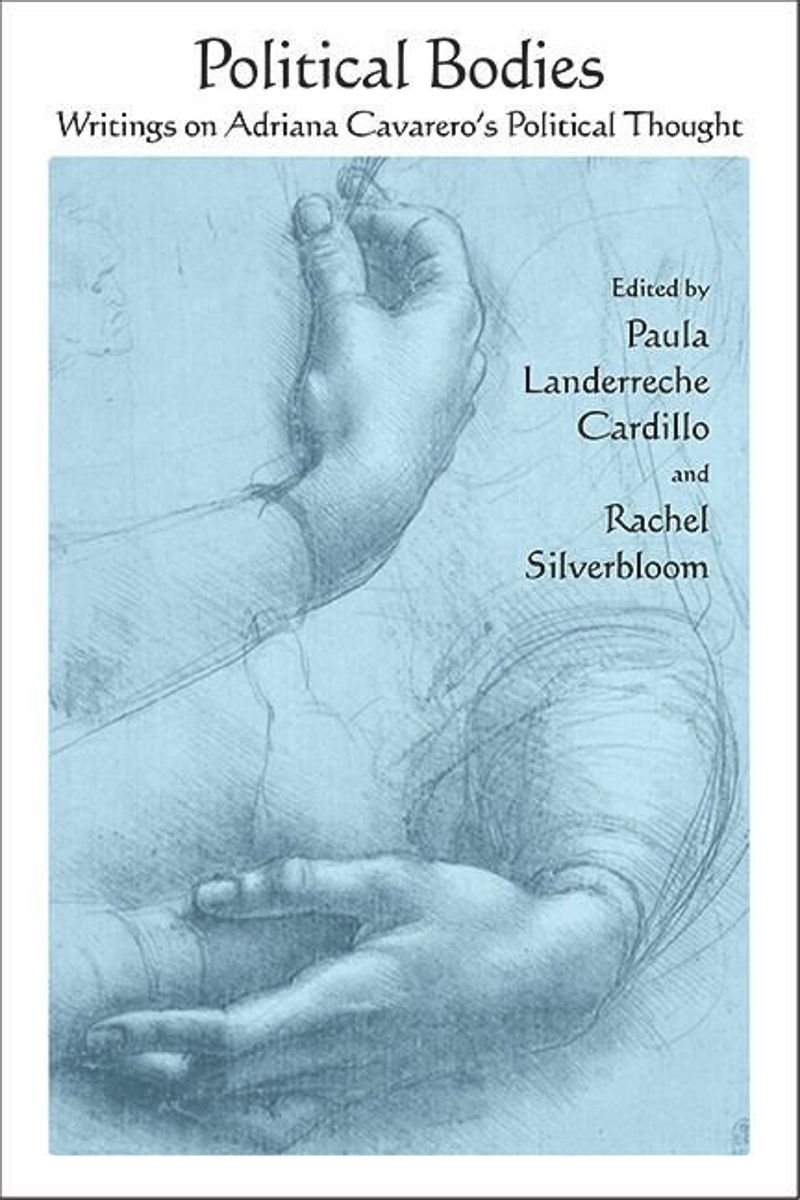
The first edited volume solely dedicated to the philosophy of Adriana Cavaero.


“Landerreche Cardillo and Silverbloom are right to hold that Cavarero has reached ‘critical acclaim’ in the ‘Italian and English-speaking world.’ I would broaden this audience to include the rest of Europe, Latin America, and very likely other areas of the world. Cavarero’s areas of expertise—philosophy, political science, women’s and gender studies, feminist theory, musicology, literature, modern languages, queer theory, and the arts—demand a common theme to link them together within the pages of a single volume. The editors have chosen Cavarer’s political philosophy in response to that demand. Their choice is wise because the political area is central to Cavarero’s many books and of great interest to interdisciplinary as well as to philosophical thinkers and academics. Political Bodies constitutes an exciting inaugural contribution to what might be called the field of ‘Cavarero studies.'” — Fred Evans, author of Public Art and the Fragility of Democracy: An Essay in Political Aesthetics
Posted in Uncategorized | Leave a comment

Andrew Krinks, White Property, Black Trespass: Racial Capitalism and the Religious Function of Mass Criminalisation – NYU Press, August 2024

Andrew Krinks, White Property, Black Trespass: Racial Capitalism and the Religious Function of Mass Criminalisation – NYU Press, August 2024

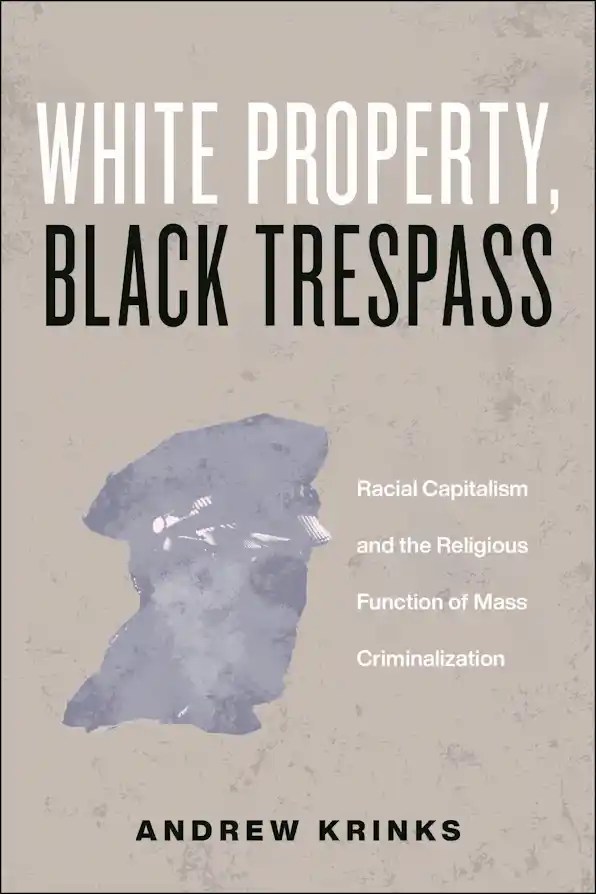
Uncovers the inherently religious structure of the criminalization of Black, Indigenous, and dispossessed peoples

Most popular critical accounts of mass criminalization interpret police and prisons as purely social or political phenomena. While such accounts have been indispensable in moving millions into collective action and resistance, the carceral state remains as pervasive as ever.

White Property, Black Trespass argues that understanding why we have police and prisons, and building a world of safety and abundance beyond them, requires that we acknowledge the inherently religious function that criminalization fulfills for a colonial and racial capitalist order that puts its faith in cops and cages to save it from the existential threat of disorder that its own structural violence creates.

The story of criminalization, Krinks shows, begins with the eurochristian aspiration to become God at the expense of all others—an aspiration that gives rise to the pseudo-sacred powers of whiteness and property, and, by extension, the police power that exists to serve and protect them. Tracing the historical continuity and religiosity of the color line, the property line, and the thin blue line, Krinks reveals police power as the pseudo-divine power to exile nonwhite and dispossessed trespassers to carceral hell. 

At once incisive and expansive, this groundbreaking work deepens understanding of racial capitalism and mass criminalization by illuminating the religious mythologies that animate them. It concludes with thoughts on what might be entailed in a religion rooted in rejection of the religious idolatry of mass criminalization—a religion of abolition.

Posted in Uncategorized | Leave a comment

Shakespeare and the Reactionary Mind: Counterrevolution Fascism Militarism – Garrick’s Temple to Shakespeare, 31 August 2024

Shakespeare and the Reactionary Mind: Counterrevolution, Fascism, Militarism – Garrick’s Temple to Shakespeare, 31 August 2024

Coming up soon…

Garrick’s Temple to Shakespeare, Hampton Court Road, Hampton, TW12 2EJ, United Kingdom

Speakers – John Gillies, Amy Lidster, Björn Quiring, Jennifer Rust and Richard Ashby.

Booking via Eventbrite

Conservatives have always tended to claim Shakespeare as one of their own. In the 1950s, E. M. W. Tillyard developed the influential thesis that
Shakespeare’s plays uphold the traditional social hierarchies and suggest that these hierarchies are embedded in nature. Ulysses’ speech on “degree”
in ‘Troilus and Cressida’ serves as one of the key witnesses in this context. Since Tillyard’s time, scholars have persistently pointed out elements of Shakespeare’s plays that do not fit this assumption: the actions on stage persistently seem to contradict and subvert the noble proclamations of Ulysses and his peers. In the histories and tragedies, the persons on top of the hierarchy mostly seem to end up there by a combination of luck, political manipulation and, first and foremost, the effective use of violence, rather than by any apparent inborn excellence.

Accordingly, Shakespeare’s plays represent a volatile social order in which communal life unfolds as perpetual warfare between interest groups – sometimes open, sometimes covert. With Corey Robin and others, one might venture the hypothesis that this apparent discrepancy between words and deeds delineates a symptomatic ambivalence that characterizes the reactionary worldview: while reactionaries claim to be conservative, their enforcement of traditional hierarchies often takes on the form of a violent interruption of these very traditions. In the name of nature and of “real life”, they voice unprecedented demands that those who are destined to rule may finally be allowed to rule as they must and to keep their inferiors in the subjugated position they deserve. The most extreme form these demands can take is that of fascism, a militant movement of
revolutionary conservatism that, according to Hannah Arendt, has the inherent tendency to destroy everything it ostensibly holds sacred (such as the family, the state and the nation). Shakespeare’s plays (first and foremost, ‘Coriolanus’, ‘Julius Caesar’, ‘King Lear’ and ‘Hamlet’) have been used to explore this ambivalence, by reactionaries and fascists as well as by their opponents. This one-day symposium aims to investigate this complex relationship.

Posted in Uncategorized | Leave a comment

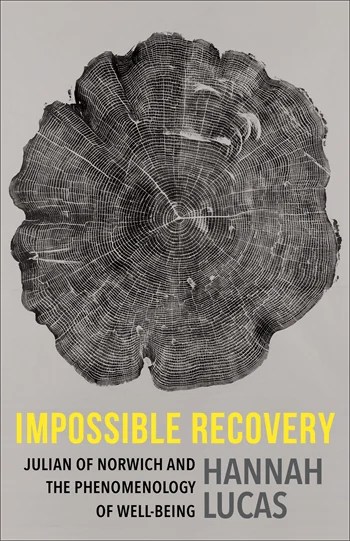
Hannah Lucas, Impossible Recovery: Julian of Norwich and the Phenomenology of Well-Being – Columbia University Press, January 2025 

Hannah Lucas, Impossible Recovery: Julian of Norwich and the Phenomenology of Well-Being – Columbia University Press, January 2025 

The medieval mystic Julian of Norwich (1342–after 1416) is the first known woman to author a book in the English language, recognized today for her strikingly optimistic claim that “all shall be well.” Her visionary text Revelations of Divine Love is the product of many years of contemplation, written and revised after a life-changing event of near-fatal illness and divine revelation.

Hannah Lucas explores the entanglement of illness and revelation in Julian’s writings, illuminating the unexpected commonalities between the medical and the mystical and their significance for philosophies of health. Framed by an original application of post-Heideggerian philosophy, Impossible Recovery offers a vivid new interpretation of the medieval mystic as crafting a proto-phenomenological theology of well-being. Lucas’s careful readings pay close attention to Julian’s mystical language and poetics, revealing the surprising resonances of her writings with modern and postmodern thought. Refracted through Julian’s Revelations, this book advances a powerful existential query about the possibilities of recovery—of well-being, and of medieval history.

Posted in Uncategorized | Leave a comment

Working on the proofs of the critical edition of Georges Dumézil, Mitra-Varuna – forthcoming in December 2024 with HAU books

It has taken a long time to get to this stage, but I’m now working on the proofs of the critical edition of Georges Dumézil, Mitra-Varuna: An Essay on Two Indo-European Representations of Sovereignty – forthcoming in December 2024 with HAU books.

The new edition uses the translation by Derek Coltman as the basis, but also has notes with all the first edition variants, updated, completed and sometimes corrected notes, a new Introduction by me and an Afterword by Veena Das.

A photo of the proofs of the new, critical edition, the 1988 original English translation, and the French second edition of 1948
Posted in Georges Dumézil, Mapping Indo-European Thought in Twentieth Century France | Leave a comment

Books received – The Anti-Security Collective, Barthes, de Beistegui, Duchesne-Guillemin, Nabokov, JHI, Barua, Dumézil

A pile of recently bought or sent books including The Anti-Security Collective, The Security Abolition Manifesto, Miguel de Beistegui, Lacan: A Genealogy, Jacques Duchesne-Guillemin, Zoroastre, Vladimir Nabokov’s translation of The Song of Igor’s Campaign, the most recent issue of the Journal of the History of Ideas, Maan Barua, Plantation Worlds, and a somewhat battered first edition of Georges Dumézil’s La Religion romaine archaïque.

One of the collective sent the manifesto, and Barthes and de Beistegui were in recompense for review work. Duke University Press kindly sent the copy of Plantation Worlds. I have an essay in the journal –  “Foucault and Dumézil on Antiquity” – and the first edition of Dumézil’s text will be useful as I continue working through his books in detail (I already have the second, revised edition and translation). The article is behind a paywall, but email me if you don’t have institutional access and would like to see a copy.

Posted in Georges Dumézil, Jacques Lacan, Mapping Indo-European Thought in Twentieth Century France, Michel Foucault, Roland Barthes, Uncategorized | Leave a comment

Tamara Caraus, Militant Cosmopolitics: Another World Horizon – Edinburgh University Press, May 2024 (paperback)

now in paperback – Tamara Caraus, Militant Cosmopolitics: Another World Horizon – Edinburgh University Press, May 2024

Maps the radical cosmopolitan dimension of global protests and social movements from recent decades

  • Rethinks the foundations, practices and institutions of cosmopolitanism from a radical perspective
  • Reads the first cosmopolitan stance of the Ancient Cynics as a militant cosmopolitics 
  • Argues for conceiving the idea of World Republic as the institution of critique
  • Formulates a sustained critique of political philosophy’s reluctance to view human beings as citizens of the world
  • Works across the disciplines of political theory, critical theory, continental philosophy, poststructuralism and deconstruction

This book explores cosmopolitanism’s radical dynamic as expressed in the struggles from below, all over the world, against exclusion and domination, pointing to the horizon of another world that appears possible. It shows that cosmopolitanism emerges negatively through disaffiliation from the given forms of belonging and by questioning of the existing meanings and unjust practices. Through a radical critique, cosmopolitanism goes to the roots of the existing world order based on the nation-state, exposes its exclusionary structure, and brings instead the idea of a World Republic where No One Is Illegal and where all are equal citizens of the world.

Posted in Uncategorized | Leave a comment

Ianir Milevski (ed.), Marxist Archaeology Today – Historical Materialist Perspectives in Archaeology from America, Europe and the Near East in the 21st Century – Brill, September 2023

Ianir Milevski (ed.), Marxist Archaeology Today – Historical Materialist Perspectives in Archaeology from America, Europe and the Near East in the 21st Century – Brill, September 2023

With this series, usually paperbacks follow 12 months after publication with Haymarket.

This volume gathers papers written by archaeologists utilising the methods of historical materialism, attesting not only to what Marxism has contributed to archaeology, but also to what archaeology has contributed, and can contribute, to Marxism as a method for interpreting the history of humanity. The book’s contributors consider the question of what archaeology can contribute to a historical perspective on the overcoming of present-day capitalism, synthesising developments in world archaeology, and supplying concrete case studies of the archaeology of the Americas, Europe and the Near East.

Contributors are: Guillermo Acosta Ochoa, Marcus Bajema, Bernardo Gandulla, Alex Gonzales-Panta, Pablo Jaruf, Vicente Lull, Savas Michael-Matsas, Rafael Micó, Ianir Milevski, Patricia Pérez Martínez, Cristina Rihuete Herrada, Roberto Risch, Steve Roskams, Henry Tantaleán, Marcelo Vitores, and LouAnn Wurst.

Posted in Uncategorized | Leave a comment

Renea Frey, The Theory, History, and Practice of Parrhesia: The Rhetoric of Resistance – Palgrave, September 2024

Renea Frey, The Theory, History, and Practice of Parrhesia: The Rhetoric of Resistance – Palgrave, September 2024

This book examines the theory, history, and practice of parrhesia—the act of speaking truth to power, when doing so is risky for the rhetor—and argues for a networked rhetorical approach to parrhesia that has not been considered previously by any other theorist. The goal of this book is to offer a reader-friendly explanation of this networked rhetorical approach to parrhesia, provide a genealogical account of the origins of parrhesia in the Classical age, and to show how parrhesia manifests today. This book is meant to give readers a functional manual for understanding, recognizing, analyzing, articulating, and using parrhesia.


Posted in Uncategorized | 1 Comment

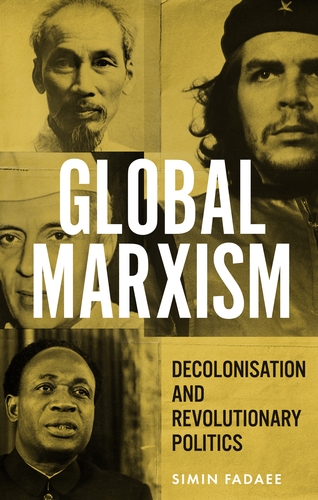
Simin Fadaee, Global Marxism: Decolonisation and revolutionary politics – Manchester University Press, September 2024

Simin Fadaee, Global Marxism: Decolonisation and revolutionary politics – Manchester University Press, September 2024

A cutting-edge exploration of how Marx’s ideas have been adopted and adapted by revolutionary thinkers in the Global South.

For much of the twentieth century, the ideas of Karl Marx provided the backbone for social justice around the world. But today the legacy of Marxism is contested, with some seeing it as Eurocentric and irrelevant to the wider global struggle.

In Global Marxism, Simin Fadaee argues that Marxism remains a living tradition and the cornerstone of revolutionary theory and practice in the Global South. She explores the lives, ideas and legacies of a group of revolutionaries who played an exceptional role in contributing to counter-hegemonic change. Figures such as Ho Chi Minh, Kwame Nkrumah, Ali Shariati and Subcomandante Marcos did not simply accept the version of Marxism that was given to them – they adapted it to local conditions and contexts. In doing this they demonstrated that Marxism is not a rigid set of propositions but an evolving force whose transformative potential remains enormous.

This global Marxism has much to teach us in the never-ending task of grasping the changing historical conditions of capitalism and the complex world in which we live.

Posted in Uncategorized | Leave a comment