Offering a political epistemology of collective mourning
Focusing on forms of improper burial in Turkey and Latin America, Ege Selin Islekel argues that a political technology of mourning is fundamental to contemporary politics. This technology of necrosovereignty shapes not only individuals’ and populations’ lives but also their epistemic and political afterlives. Local practices of mourning, however, contain resistant capacities, opening alternative ways of knowing, remembering, and assembling. “Nightmare knowledges,” Islekel posits, are resistant modes of knowing tied up with grief that challenge the contemporary politics of death and those politics’ archival boundaries. Seen in mothers’ movements across the globe, from the Mothers of the Plaza de Mayo of Argentina to the Saturday Mothers of Turkey, nightmare knowledges produce counterarchives that mobilize traditionally ignored epistemic categories.
Nightmare Remains forges a new dialogue between post-Foucauldian political theory and decolonial thought and brings a fresh critical perspective to the theoretical discourse of enforced disappearances.
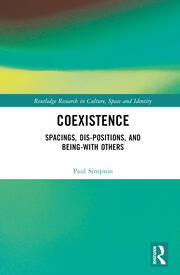
This book aims to develop an account of living together with difference which recognises the tension that we are inescapably with others – both human and non-human – but at the same time are always differing from and with those with whom we find ourselves.
A concern for coexistence and questions over how we might live together have been raised and approached from a host of conceptual starting points in recent times, including via calls for a rethinking of communism today, the articulation of forms of ‘cosmopolitics’ or ‘pluralism’, the re-figuring of understandings of ecology as dark or feminist, amongst others. This book responds to such questions of coexistence by developing what it calls a ‘co-existential analytic’. In doing so, this book introduces a range of post-phenomenological thought which offers means for thinking about such questions of living together with difference. The thought of Emanuel Levinas on the face of the other, Jean-Luc Nancy on being as being-with, Roberto Esposito on the munis, and Michel Henry on pathic auto-affection are introduced and critically reflected upon in terms of what they offer for thinking about such coexistence. Alongside these conceptual starting points, a series of encounters – with cinema, everyday life, politics, and literature – are used to animate and illustration the discussion. Ultimately, the book argues for a ‘spacing’ of subjectivities with that world and those encountered within it.
This book is intended primarily for researchers and postgraduate students interested in questions of identity, difference, and subjectivity. It will be of interest to those in the fields of social and cultural geography, sociology, social theory, and cultural studies.
Jacques Rancière is almost unique amongst contemporary thinkers in his consistent hostility to sociologically informed modes of interpretation. This hostility is not limited to his detailed critiques of Pierre Bourdieu—it characterises his thinking about politics, emancipation, democracy, history, aesthetics, and social class; it extends into a rejection of Marxist or marxisant modes of analysis. For Rancière’s harshest critics, this hostility to sociology reflects an interpretative negligence on his part, an intellectual, political, or moral flaw. Even his more favorable commentators typically upbraid him for failing to specify the historical conditions of possibility of democratic emancipation.
This book argues that such reactions are fundamentally mistaken and fail to grasp what is at stake in Rancière’s rejection of sociological modes of enquiry. This rejection is attributable neither to his negligence nor to some moral flaw, and nor is it merely incidental to his thought. On the contrary, Rancière understands sociology to constitute a problematic, a set of assumptions and interpretative procedures whose blind spots must be identified and thought through in order that the possibility of intellectual and political emancipation, of democracy, and of history can be thought at all. Rancière’s thought thus represents a counter-sociology and his rejection of the sociological problematic serves as the positive condition of possibility of his theory of democracy, equality, and emancipation. This new study both clarifies the nature of Rancière’s critique of the sociological problematic and shows what his counter-sociology allows him to think in the domains of politics, history, and education.
Developing a new political thought to address today’s planetary crises
What is “planetary thinking” today? Arguing that a new approach is urgently needed, Yuk Hui develops a future-oriented mode of political thought that encompasses the unprecedented global challenges we are confronting: the rise of artificial intelligence, the ecological crisis, and intensifying geopolitical conflicts.
Machine and Sovereignty starts with three premises. The first affirms the necessity of developing a new language of coexistence that surpasses the limits of nation-states and their variations; the second recognizes that political forms, including the polis, empire, and the state, are technological phenomena, which Lewis Mumford terms “megamachines.” The third suggests that a particular political form is legitimated and rationalized by a corresponding political epistemology. The planetary thinking that this book sketches departs from the opposition between mechanism and organism, which characterized modern thought, to understand the epistemological foundations of Hegel’s political state and Schmitt’s Großraum and their particular ways of conceiving the question of sovereignty. Through this reconstruction, Hui exposes the limits of the state and reflects on a new theoretical matrix based on the interrelated concepts of biodiversity, noodiversity, and technodiversity.
Arguing that we are facing the limit of modernity, of the eschatological view of history, of globalization, and of the human, Hui conceives necessary new epistemological and technological frameworks for understanding and rising to the crises of our present and our future.
Homo Temporalis focuses on the importance of temporal concepts for four German Jewish thinkers who profoundly shaped twentieth-century intellectual history: Martin Buber, Walter Benjamin, Hannah Arendt, and Paul Celan. By analyzing the concept of time, Nitzan Lebovic explores Buber’s stress on the temporality of the dialogue between I and Thou; Benjamin’s now-time and “dialectics in standstill”; Arendt’s understanding of democracy as “natality” or a “permanent revolution”; and the “breathturn” that informs Celan’s poetry. Framing the reception of German Jewish thinking in the second half of the twentieth century as a parallel story to the rise of the modern humanities, Homo Temporalis also highlights how these foundational temporal concepts illuminate the causes of the present crisis in the humanities and its disciplinary limitations in the age of biopolitics and the Anthropocene.
A form of life that keeps itself in relation to a poetic practice, however that might be, is always in the studio, always in its studio.
Its—but in what way do that place and practice belong to it? Isn’t the opposite true—that this form of life is at the mercy of its studio?
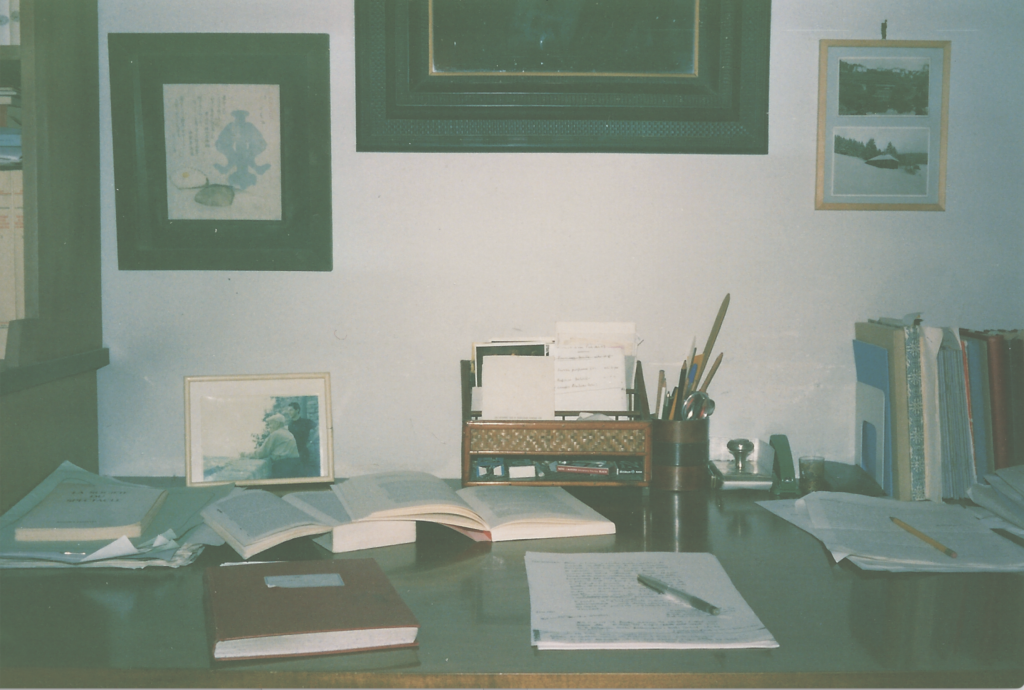
In the mess of papers and books, open or piled upon one another, in the disordered scene of brushes and paints, canvases leaning against the wall, the studio preserves the rough drafts of creation; it records the traces of the arduous process leading from potentiality to act, from the hand that writes to the written page, from the palette to the painting. The studio is the image of potentiality—of the writer’s potentiality to write, of the painter’s or sculptor’s potentiality to paint or sculpt. Attempting to describe one’s own studio thus means attempting to describe the modes and forms of one’s own potentiality—a task that is, at least on first glance, impossible.
How does one have a potentiality? One cannot have a potentiality; one can only inhabit it.
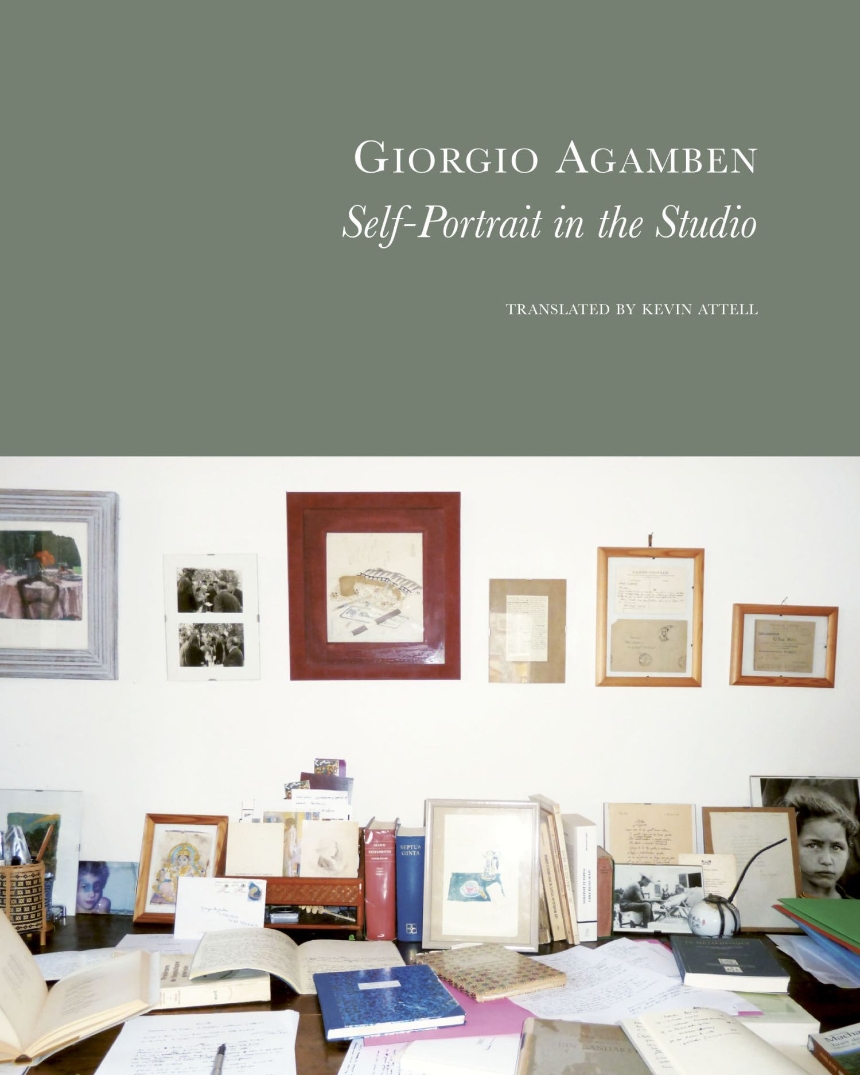
A rare autobiographical glimpse into the life and influences of one of Europe’s greatest living philosophers.
This book’s title, Self-Portrait in the Studio—a familiar iconographic subject in the history of painting—is intended to be taken literally: the book is a self-portrait, but one that comes into view for the reader only by way of patient scrutiny of the images, photographs, objects, and paintings present in the studios where the writer has worked and still works. That is to say, Giorgio Agamben’s wager is to speak of himself solely and uniquely by speaking of others: the poets, philosophers, painters, musicians, friends, passions—in short, the meetings and encounters that have shaped his life, thought, and writing, from Martin Heidegger to Elsa Morante, from Herman Melville to Walter Benjamin, from Giorgio Caproni to Giovanni Urbani. For this reason, images are an integral part of the book, images that—like those in a rebus that together form another, larger image—ultimately combine with the written text in one of the most unusual self-portraits that any writer has left of himself: not an autobiography, but a faithful and timeless auto-heterography.
The chapter I’m currently working on for the Mapping Indo-European Thought project is a study of the two decades Benveniste and Dumézil were teaching in parallel at the Collège de France. I’ve been concentrating on Dumézil so far, but I plan to treat them in parallel.
In the 1950s, Dumézil keeps up a regular programme of books, which for most people would be remarkable productivity, but for him was actually a bit of slower than the previous decade. Beyond the pamphlet of his inaugural lecture, there were eight books, but only one was over 150 pages, and several were summarising previously treated themes. In the first part of the 1960s he doesn’t publish a book on Indo-European mythology, but concentrates on his second parallel career on Caucasian and Anatolian languages. This focus changes with his ‘bilan’ period of consolidation and reassessment, beginning with Archaic Roman Religion in 1966, and the volumes of Mythe et épopée that follow. (Of course, he was clearly working on those massive books earlier.) I’m planning to discuss the Caucasian material in a separate chapter, and certainly the ‘bilan’ period requires fuller treatment. But for the 1950s and early 1960s regarding his work on mythology it feels an easier array of work to treat than the 1938-49 period I discussed in an earlier chapter.
So many of Dumézil’s publications come from lectures that I’ve been weaving the treatment of teaching and publishing together as much as I can, rather than doing each separately. Here, I’m working with the course summaries published in the Annuairedu Collège de France and the Annuaire of the EPHE, as well as my notes on the archival remains of these courses. When I first proposed this project, I thought that there would be a lot more unpublished material from the teaching, but I’m now largely convinced that nearly all the worthwhile content found its way into print in some form. But it is not always obvious where and how, and some of the publications are in some very obscure outlets that are taking a bit of tracking down.
I’ll be speaking about both Benveniste and Dumézil in this period as “Indo-European Thought at the Collège de France” in November in an online Social Anthropology seminar at the University of St Andrews, and I’m grateful to Christos Lynteris for the invitation. I share details when they are available. The abstract reads:
Emile Benveniste and Georges Dumézil both lost their teaching positions under the Vichy regime, but for different reasons and with different outcomes. Benveniste was Jewish, had been captured shortly before the Armistice, and when he escaped, he went into exile in Switzerland. Before being deployed to Turkey, Dumézil had briefly been a Freemason and was excluded due to the laws on secret societies. He got his position back, remained in Paris, and published throughout the war with Gallimard. At the Liberation he was under suspicion of collaboration, and temporarily lost his position again. Benveniste returned to the Collège de France, and in 1949 proposed Dumézil for a chair in Indo-European civilisation. For the next two decades Benveniste and Dumézil taught there in parallel – Benveniste usually teaching one course on linguistics, and another on vocabulary; Dumézil teaching on mythology but also his interest in Caucasian languages and folklore. Some of their most important publications, including Dumézil’s Myth and Epic and Benveniste’s Vocabulary of Indo-European Institutions, were originally presented in their classes. Using teaching records, publications, archival materials and correspondence, this talk will discuss the period when Indo-European thought was at the centre of one of France’s elite institutions.
I had thought that the argument between Georges Dumézil and Nicolai Trubetzkoy in the 1930s was one of the more preposterous displays of academic petulance. As discussed in this great article by Stefanos Geroulanos and Jamie Philips, Dumézil took exception to Trubetzkoy’s review of one of his books, and had a privately-printed pamphlet of 50 pages circulated to respond. Later in his career there are on-going feuds with other scholars, such as the British classicist Herbert Jennings Rose, and the German Indologist Paul Thieme, who taught at Yale for a while. André Mazon’s unsuccessful attempt to block Dumézil’s election to the Collège de France and his successful opposition to Claude Lévi-Strauss’s first attempts seems to have been linked to his feud with Roman Jakobson (partly over the status of an Old Russian epic) and anyone deemed close to him. But I have now come across another one. Dumézil disputed Henrik Wagenvoort’s reading of the Latin terms maiestas and gravitas. He did this across eight lectures – the poor students! – and then in a book and an article (in French). Wagenvoort, who was Dutch, but often published in English and German, responded in a 20-page article, in Latin. I don’t know what’s more ridiculous – that Wagenvoort thought this was appropriate, or that a journal indulged him in this.
In some previous updates on this project I’ve mentioned I was working on a piece about Alexandre Koyré’s failure to get elected to the Collège de France. Initially it was intended to be a shorter piece, but the story seemed interesting to me and the archives revealed more than I expected, so it became a full-length article. I’m pleased to say that it was accepted by the History of European Ideas journal, and is available online first and open access here. In the twenty-five years since my first journal article, I don’t think I have ever had a piece where both referees recommended acceptance with no changes, and the editor agreed. I say a bit more about the piece here. I’ll be speaking about Koyré and Canguilhem at a workshop on Canguilhem and the Human Sciences in Bristol on 26 September, organised by Federico Testa. While Koyré is only a minor figure in the Indo-European project, since his interests are in other areas, he connects to it in various ways, and I have long been interested in his work. There are some other aspects of his career which I hope to research in the future.
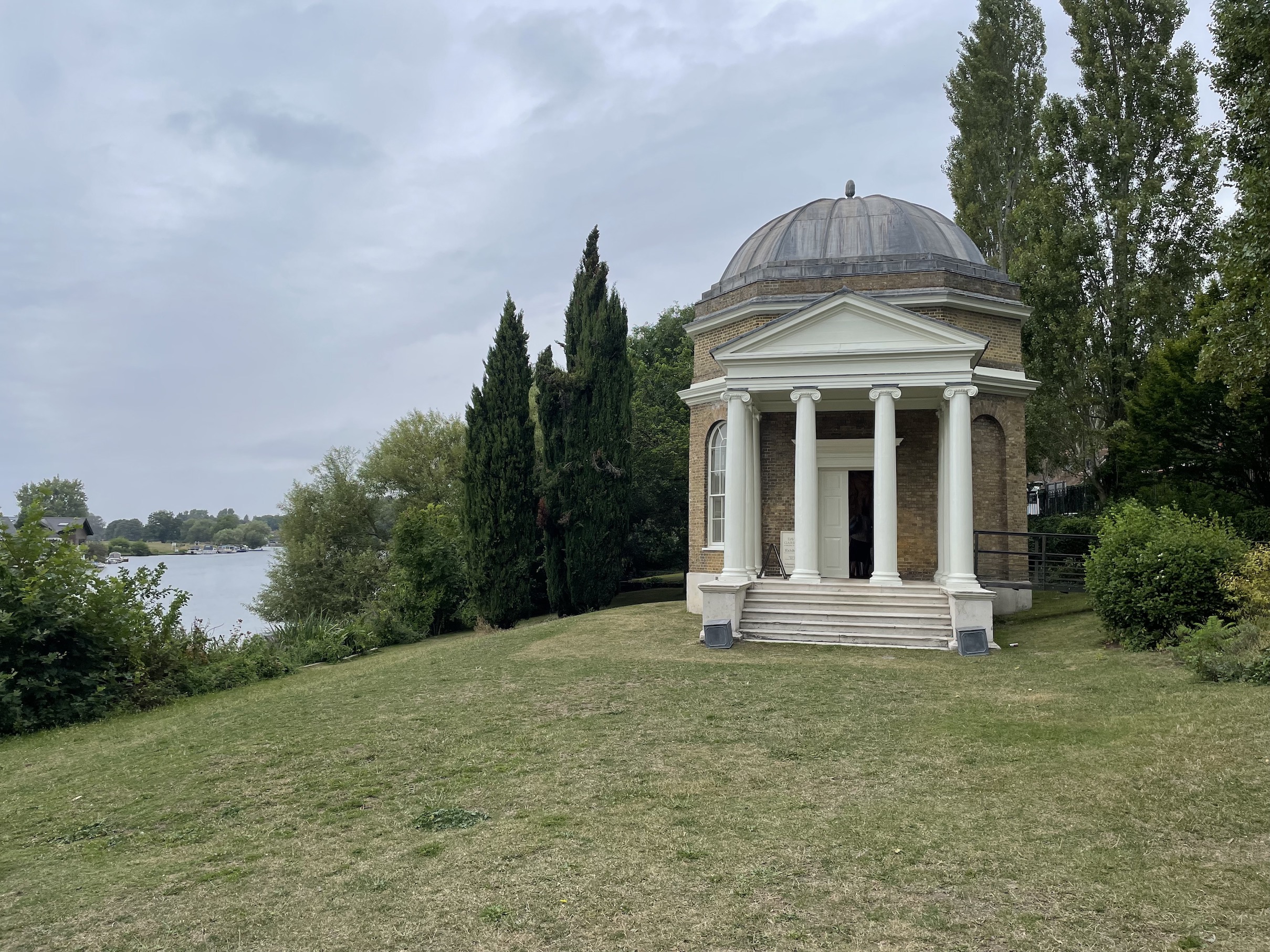
I’ve also been working on the proofs of Dumézil’s Mitra-Varuna. It’s taken a while to reach this stage, as the manuscript was completed in 2022. I had to resist any temptation to rewrite the Introduction or add more notes – I know a lot more than I did when I did this work initially. it is now due for publication in December. And for the first time in several years, I was able to visit Garrick’s Temple to Shakespeare for the conference on “Shakespeare and the Reactionary Mind”. It was good to catch up with old friends there.
Garrick’s Temple to Shakespeare, on the banks of the River Thames at Hampton
I’m Paris for another visit soon, planning to continue work on the Benveniste archive at the Bibliothèque nationale, as well as doing a little in some other archives. I’ve also been working through a long list of odd things to check in London’s libraries. Just recently, I discovered that some unpublished material by Benveniste is in Cambridge, so I’ll be making another trip there soon to take a look at this.
Previous updates on this project can be found here, along with links to some research resources and forthcoming publications. The re-edition of Georges Dumézil’s Mitra-Varunais now scheduled for December 2024. There is a lot more about the earlier Foucault work here. The final volume of the series is The Archaeology of Foucault, and the special issue of Theory, Culture & Society I co-edited on “Foucault before the Collège de France” has some important contributions on the earlier parts of Foucault’s career, and is currently available free to access. My article “Foucault and Dumézil on Antiquity” is in the current issue of Journal of the History of Ideas; “Alexandre Koyré and the Collège de France” is online first and open access.