
Blog Stats
- 3,657,042 hits
-
Join 11.8K other subscribers
-
Recent Posts
- Georges Redard and the Linguistic Atlas of Iranian Speakers
- Harriet Hawkins, “Lithic Lives: Earth Stories from Cambodia’s Land of the Gemstones”, 9th Cosgrove Lecture, Royal Holloway, 11 May 2026
- A Scholarly Edition of Leibniz’s Philosophical Papers – first three volumes, Oxford University Press, April 2026
- Tiphaine Samoyault, Translation and Violence, trans. Alexander Hertich, Princeton University Press, September 2026
- Two dedications from Georges Dumézil – to Alfred Ernoux and Luc Estang
Archives
- April 2026
- March 2026
- February 2026
- January 2026
- December 2025
- November 2025
- October 2025
- September 2025
- August 2025
- July 2025
- June 2025
- May 2025
- April 2025
- March 2025
- February 2025
- January 2025
- December 2024
- November 2024
- October 2024
- September 2024
- August 2024
- July 2024
- June 2024
- May 2024
- April 2024
- March 2024
- February 2024
- January 2024
- December 2023
- November 2023
- October 2023
- September 2023
- August 2023
- July 2023
- June 2023
- May 2023
- April 2023
- March 2023
- February 2023
- January 2023
- December 2022
- November 2022
- October 2022
- September 2022
- August 2022
- July 2022
- June 2022
- May 2022
- April 2022
- March 2022
- February 2022
- January 2022
- December 2021
- November 2021
- October 2021
- September 2021
- August 2021
- July 2021
- June 2021
- May 2021
- April 2021
- March 2021
- February 2021
- January 2021
- December 2020
- November 2020
- October 2020
- September 2020
- August 2020
- July 2020
- June 2020
- May 2020
- April 2020
- March 2020
- February 2020
- January 2020
- December 2019
- November 2019
- October 2019
- September 2019
- August 2019
- July 2019
- June 2019
- May 2019
- April 2019
- March 2019
- February 2019
- January 2019
- December 2018
- November 2018
- October 2018
- September 2018
- August 2018
- July 2018
- June 2018
- May 2018
- April 2018
- March 2018
- February 2018
- January 2018
- December 2017
- November 2017
- October 2017
- September 2017
- August 2017
- July 2017
- June 2017
- May 2017
- April 2017
- March 2017
- February 2017
- January 2017
- December 2016
- November 2016
- October 2016
- September 2016
- August 2016
- July 2016
- June 2016
- May 2016
- April 2016
- March 2016
- February 2016
- January 2016
- December 2015
- November 2015
- October 2015
- September 2015
- August 2015
- July 2015
- June 2015
- May 2015
- April 2015
- March 2015
- February 2015
- January 2015
- December 2014
- November 2014
- October 2014
- September 2014
- August 2014
- July 2014
- June 2014
- May 2014
- April 2014
- March 2014
- February 2014
- January 2014
- December 2013
- November 2013
- October 2013
- September 2013
- August 2013
- July 2013
- June 2013
- May 2013
- April 2013
- March 2013
- February 2013
- January 2013
- December 2012
- November 2012
- October 2012
- September 2012
- August 2012
- July 2012
- June 2012
- May 2012
- April 2012
- March 2012
- February 2012
- January 2012
- December 2011
- November 2011
- October 2011
- September 2011
- August 2011
- July 2011
- June 2011
- May 2011
- April 2011
- March 2011
- February 2011
- January 2011
- December 2010
- November 2010
- October 2010
- September 2010
- August 2010
- July 2010
- June 2010
- May 2010
- April 2010
Categories
- Achille Mbembe
- Adam David Morton
- Adam Tooze
- Adrian Johnston
- Adriana Cavarero
- Alain Badiou
- Albert Camus
- Alberto Toscano
- Alexander B. Murphy
- Alexandre Kojève
- Alexandre Koyré
- Allen Scott
- Alphonso Lingis
- André Leroi-Gourhan
- Andreas Knichen
- Andrew Barry
- Andy Merrifield
- Ann Laura Stoler
- Anthony Giddens
- Antoine Meillet
- Antonio Gramsci
- Antonio Negri
- Arlette Farge
- arundhati roy
- Ash Amin
- Aurel Stein
- Axel Honneth
- Étienne Wolff
- Babette Babich
- Baldus de Ubaldis
- Bartolus of Sassoferrato
- Baruch Spinoza
- Bernard E. Harcourt
- Bernard Stiegler
- Bill Martin
- Bob Jessop
- Bogislaw Philipp von Chemnitz
- Books
- Boris Porshnev
- Boundaries
- Bradley Garrett
- Bruno Latour
- C.L.R. James
- Canguilhem (book)
- Caren Kaplan
- Carl Schmitt
- Carlo Ginzburg
- Catherine Malabou
- China Mieville
- Chris Philo
- Christian Parenti
- Clarence J. Glacken
- Claude Lévi-Strauss
- Claude Raffestin
- Clémence Ramnoux
- Colin Gordon
- Conferences
- Cornel West
- Couze Venn
- Cricket
- Cycling
- Daniel Defert
- Daniel Heller-Roazen
- David Byrne
- David Campbell
- David Farrell Krell
- David Harvey
- David Lachterman
- David N. Livingstone
- Deborah Cowen
- Derek Gregory
- Derek Parfit
- Don Mitchell
- Doreen Massey
- E. P. Thompson
- Ebola
- Edgar Allan Poe
- Edmund Husserl
- Eduardo Mendieta
- Edward Casey
- Edward Gibbon
- Edward Said
- Edward Soja
- Elizabeth Grosz
- Ellen Meiksins Wood
- Emile Benveniste
- Emmanuel Levinas
- Engin Isin
- Enrique Dussel
- Eric Hobsbawm
- Ernesto Laclau
- Ernst Cassirer
- Ernst Kantorowicz
- Erwin Panofsky
- Etienne Balibar
- Eugen Fink
- Events
- Eyal Weizman
- Felix Guattari
- Ferdinand de Saussure
- Fernand Braudel
- Football
- Fossils
- Foucault's Last Decade
- Foucault: The Birth of Power
- François Delaporte
- François Ellenberger
- Francisco de Vitoria
- Franco Moretti
- Frantz Fanon
- Franz Kafka
- Fredric Jameson
- Friedrich Engels
- Friedrich Nietzsche
- Friedrich Wilhelm Joseph Schelling
- Gaston Bachelard
- Gaston Gordillo
- Geographica Helvetica
- Georg Lukács
- Georg Wilhelm Friedrich Hegel
- George Lawson
- Georges Bataille
- Georges Canguilhem
- Georges Dumézil
- Giacomo Marramao
- Gilles Deleuze
- Gillian Rose
- Giorgio Agamben
- Giovanni Botero
- Gottfried Leibniz
- Graham Harman
- Grégoire Chamayou
- Gunnar Olsson
- Guy Debord
- H.P. Lovecraft
- Haim Yacobi
- Hannah Arendt
- Henri de Boulainviller
- Henri Lefebvre
- Herbert Marcuse
- Hugo Grotius
- Ian Bogost
- Ian Hacking
- Immanuel Kant
- Institute of Advanced Study
- Irnerius
- Isaac Newton
- Isabelle Stengers
- Italo Calvino
- J.G.A. Pocock
- Jacob Klein
- Jacob Taubes
- Jacques Derrida
- Jacques Lacan
- Jacques Rancière
- Jakob von Uexküll
- James Harrington
- Jane Bennett
- Jürgen Habermas
- jean baudrillard
- Jean Bodin
- Jean Cavaillès
- Jean Gottmann
- Jean Hyppolite
- Jean Jacques Rousseau
- Jean-Luc Nancy
- Jean-Paul Sartre
- Jeff Malpas
- Jeffrey Jerome Cohen
- Jenny Edkins
- Jeremy Bamber
- Jeremy Bentham
- Jeremy Crampton
- Jodi Dean
- Johannes Althusius
- Johannes Hertius
- John Agnew
- John Locke
- John Protevi
- John Rawls
- John Sallis
- John Urry
- Jonathan Simon
- Journal of Urban Cultural Studies
- Judith Butler
- Julia Kristeva
- Juliet Fall
- Karl Jaspers
- Karl Marx
- Klaus Theweleit
- Kostas Axelos
- Lauren Berlant
- Léopold Lambert
- Lee Braver
- Levi Bryant
- Louis Althusser
- Louise Amoore
- Luce Irigaray
- Lucien Febvre
- Ludwig Binswanger
- Luiza Bialasiewicz
- Maja Zehfuss
- Manuel deLanda
- Mapping Indo-European Thought in Twentieth Century France
- Mapping the Present
- Marc Bloch
- Marc Crépon
- Marcel Detienne
- Marcel Mauss
- Marie-Eve Morin
- Marie-Madeleine Davy
- Mark Neocleous
- Martin Heidegger
- Martin Luther
- Mary Beard
- Massimo Cacciari
- Matthew Hannah
- Matthias Stephani
- Maurice Blanchot
- Maurice Merleau-Ponty
- Maximilien Robespierre
- Medieval Studies
- Mehdi Belhaj Kacem
- Michael Dillon
- Michael Hardt
- Michael Mann
- Michael Watts
- Michel Foucault
- Michel Serres
- Mircea Eliade
- Music
- My Publications
- Naomi Klein
- Nathan Widder
- Neil Brenner
- Neil Smith
- Niccolò Machiavelli
- Nicholas Blomley
- Nicholas of Cusa
- Nicos Poulantzas
- Nigel Thrift
- Nina Power
- Noam Chomsky
- Novels read
- Paolo Virno
- Paul Veyne
- Paul Virilio
- People
- Peter Brown
- Peter Gratton
- Peter Hallward
- Peter Sloterdijk
- Philip Steinberg
- Philipp Melanchthon
- Pierre Bourdieu
- Pierre Hadot
- Pierre Klossowski
- Pierre Macherey
- Politics
- Publishing
- Quentin Meillassoux
- Quentin Skinnner
- Ralph Miliband
- Ray Brassier
- Raymond Ruyer
- Raymond Williams
- Reinhart Koselleck
- Remarkable Research
- René Descartes
- René Girard
- Revista Urban
- Robert Filmer
- Roberto Esposito
- Roger Caillois
- Roland Barthes
- Roman Jakobson
- Samuel Pufendorf
- Sara Ahmed
- Saskia Sassen
- Setha Low
- Shakespearean Territories
- Sigmund Freud
- Simon Critchley
- Simon Schama
- Simone de Beauvoir
- Simone Weil
- Slavoj Zizek
- Society and Space
- Speaking Against Number
- Stanley Cavell
- Stefanos Geroulanos
- Stephen Graham
- Stephen Greenblatt
- Stuart Hall
- Sunday Histories
- Tariq Ali
- teaching
- terrain
- Territory
- Terror and Territory
- Terry Eagleton
- The Archaeology of Foucault
- The Birth of Territory
- The Early Foucault
- The Space of the World
- Theodor Reinking
- Theory
- Theory, Culture and Society
- Thomas Hobbes
- Thomas Pynchon
- Timothy Morton
- Travel
- Trevor Paglen
- Tristan Garcia
- Troy Davis
- Udalricus Zasius
- Umberto Eco
- Uncategorized
- Understanding Henri Lefebvre
- Universities
- urban/urbanisation
- Vladimir Nabokov
- Walter Benjamin
- Walter Ralegh
- Wendy Brown
- William E Connolly
- William Shakespeare
- Writing
- Wu Ming
Meta
-
Nouvelle revue/new journal : Les Temps qui restent après/after Les Temps Modernes (2024)
Posted in Uncategorized
Leave a comment
Manon Mathias, Gut, Brain, and Environment in Nineteenth-Century French Literature and Medicine – Routledge, April 2024
Manon Mathias, Gut, Brain, and Environment in Nineteenth-Century French Literature and Medicine – Routledge, April 2024

Gut, Brain, and Environment in Nineteenth-Century French Literature and Medicine offers a new way of conceptualizing food in literature: not as social or cultural symbol but as an agent within a network of relationships between body and mind and between humans and environment. By analysing gastrointestinal health in medical, literary, and philosophical texts, this volume rethinks the intersections between literature and health in the nineteenth century and triggers new debates about France’s relationship with food. Of relevance to scholars of literature and to historians and sociologists of science, food, and medicine, it will provide ideal reading for students of French Literature and Culture, History, Cultural Studies, and History of Science and Medicine, Literature and Science, Food Studies, and the Medical Humanities. Readers will be introduced to new ways of approaching digestion in this period and will gain appreciation of the powerful resources offered by nineteenth-century French writing in understanding the nature of connections between gut, mind, and environment and the impact of these connections on our status as human beings.
Posted in Uncategorized
Leave a comment
Luke O’Sullivan, Categories: A Study of a Concept in Western Philosophy and Political Thought – Edinburgh University Press, July 2024
Luke O’Sullivan, Categories: A Study of a Concept in Western Philosophy and Political Thought – Edinburgh University Press, July 2024
Just an expensive hardback and e-book at the moment.

Establishes an enduring relationship between theories of categories and ideas about knowledge, politics, and history
- Explores the concept of a category and contemporary debates on category politics, category mistakes and the imperialism of categories
- Shows how the ideas of classic thinkers on categories, including Plato, Aristotle, Kant and Hegel, have informed three distinct modern schools of thought on the subject including thinkers in both analytical and continental traditions
- Explains modern thought on categories as a tension between a desire for a single dominant perspective, whether scientific (as in logical empiricism) or phenomenological (as in Heidegger), and a belief in irretrievable fragmentation (as in Nietzsche and later post-modern thought), with a minority of thinkers (like Cassirer and Ricoeur) trying to find a middle ground
- Addresses debates on categories in wide range of different fields in the humanities including the history of philosophy, political philosophy, critical theory, phenomenology, and the philosophy of history
In ancient and modern Western thought, the problem of the nature of categories has been inseparable from arguments about the nature of selfhood; about how knowledge is organised; about how power should be distributed; and about how history should be understood. For Plato, Forms belonging to a timeless order of being played the role of categories or fundamental concepts; for Aristotle categories were immanent in things; for Kant they were a priori logical structures of our consciousness; and for Hegel they were dynamic, dialectical inter-related ideas. In Categories, O’Sullivan shows how these answers have gone forward into the contemporary era, and identifies three key schools of thought that have developed since Hegel in particular. He explains modern thought as a tension between a desire for a single dominant perspective, whether scientific or phenomenological; a belief in irretrievable fragmentation; and an effort to find a middle ground.
Posted in Uncategorized
Leave a comment
‘Foucault Before the Collège de France’, Theory, Culture & Society special issue – all papers currently free to access

If you missed the 2023 Special Issue of Theory, Culture & Society on ‘Foucault Before the Collège de France‘, which I edited with Daniele Lorenzini and Orazio Irrera…
All papers are open access or free access at the moment
Papers include ones by most of the editors of the early courses and manuscripts by Foucault, currently being published and in the process of being translated.
Some video abstracts are here
While the open access papers will remain that way, I’m not sure how long the others will be free access.
Posted in Michel Foucault
Leave a comment
Maan Barua, Plantation Worlds – Duke University Press, August 2024
Maan Barua, Plantation Worlds – Duke University Press, August 2024
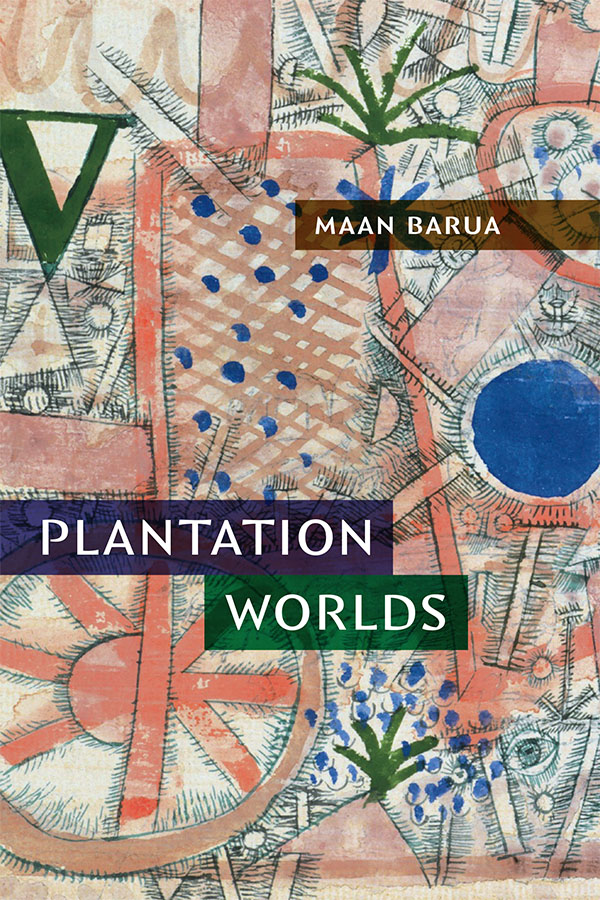
The Introduction is open access at this link
In Plantation Worlds, Maan Barua interrogates debates on planetary transformations through the histories and ecologies of plantations. Drawing on long-term research spanning fifteen years, Barua presents a unique ethnography attentive to the lives of both people and elephants amid tea plantations in the Indian state of Assam. In the nineteenth and early twentieth centuries, nearly three million people were brought in to Assam’s plantations to work under conditions of indenture. Plantations dramatically altered the region’s landscape, plundered resources, and created fraught worlds for elephants and people. Their extractive logics and colonial legacies prevail as durations, forging the ambit of infrastructures, labor, habitability, and conservation in the present. And yet, as the perspectives of the Adivasi plantation worker community and lifeworlds of elephants show, possibilities for enacting a decolonial imaginary of landscape remain present amid immiseration. From the margins of the Global South, Barua offers an alternative grammar for articulating environmental change. In so doing, he prompts a rethinking of multispecies ecologies and how they are structured by colonialism and race.
Posted in Uncategorized
1 Comment
Paula Landerreche Cardillo and Rachel Silverbloom (eds.), Political Bodies: Writings on Adriana Cavarero’s Political Thought – SUNY Press, 2024
Paula Landerreche Cardillo and Rachel Silverbloom (eds.), Political Bodies: Writings on Adriana Cavarero’s Political Thought – SUNY Press, 2024
The Editors’ Introduction is open access
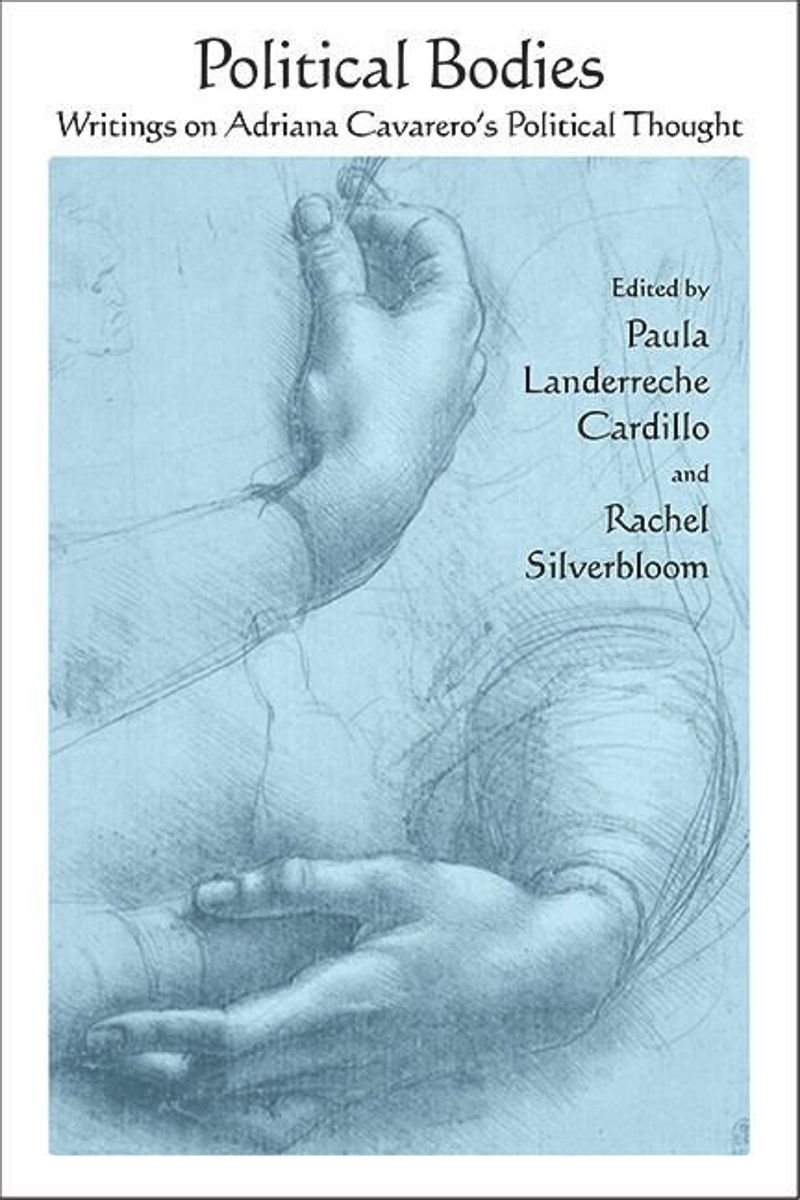
The first edited volume solely dedicated to the philosophy of Adriana Cavaero.
“Landerreche Cardillo and Silverbloom are right to hold that Cavarero has reached ‘critical acclaim’ in the ‘Italian and English-speaking world.’ I would broaden this audience to include the rest of Europe, Latin America, and very likely other areas of the world. Cavarero’s areas of expertise—philosophy, political science, women’s and gender studies, feminist theory, musicology, literature, modern languages, queer theory, and the arts—demand a common theme to link them together within the pages of a single volume. The editors have chosen Cavarer’s political philosophy in response to that demand. Their choice is wise because the political area is central to Cavarero’s many books and of great interest to interdisciplinary as well as to philosophical thinkers and academics. Political Bodies constitutes an exciting inaugural contribution to what might be called the field of ‘Cavarero studies.'” — Fred Evans, author of Public Art and the Fragility of Democracy: An Essay in Political Aesthetics
Posted in Uncategorized
Leave a comment
Andrew Krinks, White Property, Black Trespass: Racial Capitalism and the Religious Function of Mass Criminalisation – NYU Press, August 2024
Andrew Krinks, White Property, Black Trespass: Racial Capitalism and the Religious Function of Mass Criminalisation – NYU Press, August 2024
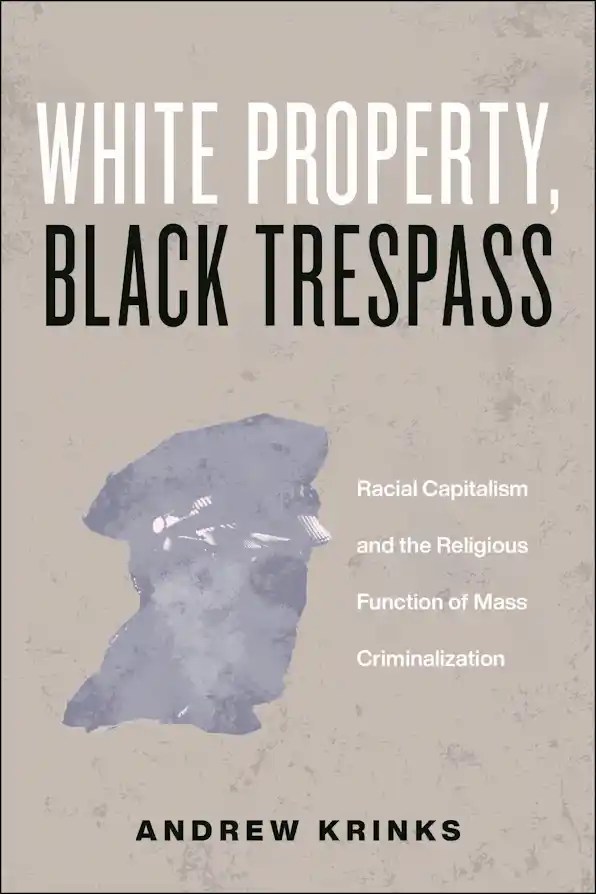
Uncovers the inherently religious structure of the criminalization of Black, Indigenous, and dispossessed peoples
Most popular critical accounts of mass criminalization interpret police and prisons as purely social or political phenomena. While such accounts have been indispensable in moving millions into collective action and resistance, the carceral state remains as pervasive as ever.
White Property, Black Trespass argues that understanding why we have police and prisons, and building a world of safety and abundance beyond them, requires that we acknowledge the inherently religious function that criminalization fulfills for a colonial and racial capitalist order that puts its faith in cops and cages to save it from the existential threat of disorder that its own structural violence creates.
The story of criminalization, Krinks shows, begins with the eurochristian aspiration to become God at the expense of all others—an aspiration that gives rise to the pseudo-sacred powers of whiteness and property, and, by extension, the police power that exists to serve and protect them. Tracing the historical continuity and religiosity of the color line, the property line, and the thin blue line, Krinks reveals police power as the pseudo-divine power to exile nonwhite and dispossessed trespassers to carceral hell.
At once incisive and expansive, this groundbreaking work deepens understanding of racial capitalism and mass criminalization by illuminating the religious mythologies that animate them. It concludes with thoughts on what might be entailed in a religion rooted in rejection of the religious idolatry of mass criminalization—a religion of abolition.
Posted in Uncategorized
Leave a comment
Shakespeare and the Reactionary Mind: Counterrevolution Fascism Militarism – Garrick’s Temple to Shakespeare, 31 August 2024
Shakespeare and the Reactionary Mind: Counterrevolution, Fascism, Militarism – Garrick’s Temple to Shakespeare, 31 August 2024
Coming up soon…

Garrick’s Temple to Shakespeare, Hampton Court Road, Hampton, TW12 2EJ, United Kingdom
Speakers – John Gillies, Amy Lidster, Björn Quiring, Jennifer Rust and Richard Ashby.
Booking via Eventbrite
Conservatives have always tended to claim Shakespeare as one of their own. In the 1950s, E. M. W. Tillyard developed the influential thesis that
Shakespeare’s plays uphold the traditional social hierarchies and suggest that these hierarchies are embedded in nature. Ulysses’ speech on “degree”
in ‘Troilus and Cressida’ serves as one of the key witnesses in this context. Since Tillyard’s time, scholars have persistently pointed out elements of Shakespeare’s plays that do not fit this assumption: the actions on stage persistently seem to contradict and subvert the noble proclamations of Ulysses and his peers. In the histories and tragedies, the persons on top of the hierarchy mostly seem to end up there by a combination of luck, political manipulation and, first and foremost, the effective use of violence, rather than by any apparent inborn excellence.Accordingly, Shakespeare’s plays represent a volatile social order in which communal life unfolds as perpetual warfare between interest groups – sometimes open, sometimes covert. With Corey Robin and others, one might venture the hypothesis that this apparent discrepancy between words and deeds delineates a symptomatic ambivalence that characterizes the reactionary worldview: while reactionaries claim to be conservative, their enforcement of traditional hierarchies often takes on the form of a violent interruption of these very traditions. In the name of nature and of “real life”, they voice unprecedented demands that those who are destined to rule may finally be allowed to rule as they must and to keep their inferiors in the subjugated position they deserve. The most extreme form these demands can take is that of fascism, a militant movement of
revolutionary conservatism that, according to Hannah Arendt, has the inherent tendency to destroy everything it ostensibly holds sacred (such as the family, the state and the nation). Shakespeare’s plays (first and foremost, ‘Coriolanus’, ‘Julius Caesar’, ‘King Lear’ and ‘Hamlet’) have been used to explore this ambivalence, by reactionaries and fascists as well as by their opponents. This one-day symposium aims to investigate this complex relationship.
Posted in Uncategorized
Leave a comment
Hannah Lucas, Impossible Recovery: Julian of Norwich and the Phenomenology of Well-Being – Columbia University Press, January 2025
Hannah Lucas, Impossible Recovery: Julian of Norwich and the Phenomenology of Well-Being – Columbia University Press, January 2025
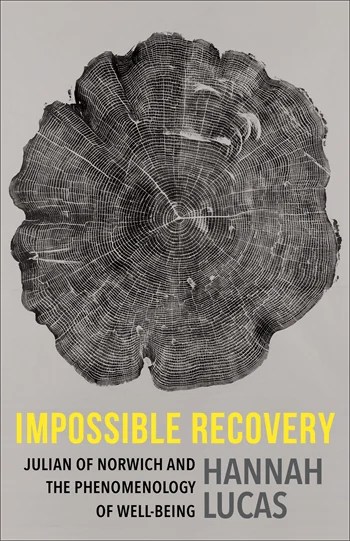
The medieval mystic Julian of Norwich (1342–after 1416) is the first known woman to author a book in the English language, recognized today for her strikingly optimistic claim that “all shall be well.” Her visionary text Revelations of Divine Love is the product of many years of contemplation, written and revised after a life-changing event of near-fatal illness and divine revelation.
Hannah Lucas explores the entanglement of illness and revelation in Julian’s writings, illuminating the unexpected commonalities between the medical and the mystical and their significance for philosophies of health. Framed by an original application of post-Heideggerian philosophy, Impossible Recovery offers a vivid new interpretation of the medieval mystic as crafting a proto-phenomenological theology of well-being. Lucas’s careful readings pay close attention to Julian’s mystical language and poetics, revealing the surprising resonances of her writings with modern and postmodern thought. Refracted through Julian’s Revelations, this book advances a powerful existential query about the possibilities of recovery—of well-being, and of medieval history.
Posted in Uncategorized
Leave a comment
Working on the proofs of the critical edition of Georges Dumézil, Mitra-Varuna – forthcoming in December 2024 with HAU books
It has taken a long time to get to this stage, but I’m now working on the proofs of the critical edition of Georges Dumézil, Mitra-Varuna: An Essay on Two Indo-European Representations of Sovereignty – forthcoming in December 2024 with HAU books.
The new edition uses the translation by Derek Coltman as the basis, but also has notes with all the first edition variants, updated, completed and sometimes corrected notes, a new Introduction by me and an Afterword by Veena Das.


