Rhys Machold, Fabricating Homeland Security: Police Entanglements across India and Palestine/Israel – Stanford University Press, September 2024

Rhys Machold, Fabricating Homeland Security: Police Entanglements across India and Palestine/Israel – Stanford University Press, September 2024

Homeland security is rarely just a matter of the homeland; it involves the circulation and multiplication of policing practices across borders. Though the term “homeland security” is closely associated with the United States, Israel is credited with developing the first all-encompassing approach to domestic surveillance and territorial control. Today, it is a central node in the sprawling global homeland security industry worth hundreds of billions of dollars. And in the wake of 2008 Mumbai terrorist attacks, India emerged as a major growth market. Known as “India’s 9/11” or simply “26/11,” the attacks sparked significant public pressure to adopt “modern” homeland security approaches. Since 2008, India has become not only the single largest buyer of Israeli conventional weapons, but also a range of other surveillance technology, police training, and security expertise.

Pairing insights from science and technology studies with those from decolonial and postcolonial theory, Fabricating Homeland Security traces 26/11’s political and policy fallout, concentrating on the efforts of Israel’s homeland security industry to advise and equip Indian city and state governments. Through a focus on the often unseen and overlooked political struggles at work in the making of homeland security, Rhys Machold illustrates how homeland security is a universalizing project that seeks to remake the world in its image, and tells the story of how claims to global authority are fabricated and put to work.
Posted in Uncategorized | Leave a comment

Martin Paul Eve, Some personal notes on the REF OA mandate for books

Martin Paul Eve, Some personal notes on the REF OA mandate for books

Some interesting thoughts about the proposed change for open access for books in UK research assessment. It’s part a response to the British Academy call for a pause to the plan.

Posted in Publishing | Leave a comment

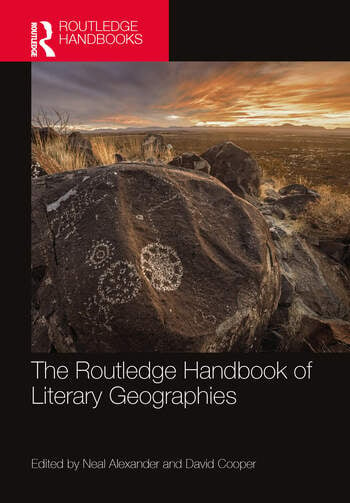
Neal Alexander and David Cooper (eds.), The Routledge Handbook of Literary Geographies – Routledge, August 2024

Neal Alexander and David Cooper (eds.), The Routledge Handbook of Literary Geographies – Routledge, August 2024

The Routledge Handbook of Literary Geographies provides a comprehensive overview of recent research and a range of innovative ways of thinking literature and geography together. It maps the history of literary geography and identifies key developments and debates in the field.

Written by leading and emerging scholars from around the world, the 38 chapters are organised into six themed sections, which consider: differing critical methodologies; keywords and concepts; literary geography in the light of literary history; a variety of places, spaces, and landforms; the significance of literary forms and genres; and the role of literary geographies beyond the academy. Presenting the work of scholars from different disciplinary backgrounds, each section offers readers new angles from which to view the convergence of literary creativity and geographical thought. Collectively, the contributors also address some of the major issues of our time including the climate emergency, movement and migration, and the politics of place.

Literary geography is a dynamic interdisciplinary field dedicated to exploring the complex relationships between geography and literature. This cutting-edge collection will be an essential resource for undergraduate and postgraduate students in both Geography and Literary Studies, and scholars interested in the evolving interface between the two disciplines.

Posted in Uncategorized | Leave a comment

Foucault’s lectures at the Collège de France – audio recordings being posted online

Today is the fortieth anniversary of Foucault’s death. The Collège de France are putting the surviving audio recordings of his lectures onlineLe Pouvoir psychiatrique is up now, with others to follow.

I’ve previously listed audio and video recordings of Foucault, which included some of these lectures, but this seems like a more systematic editing project – and I hope the links remain stable.

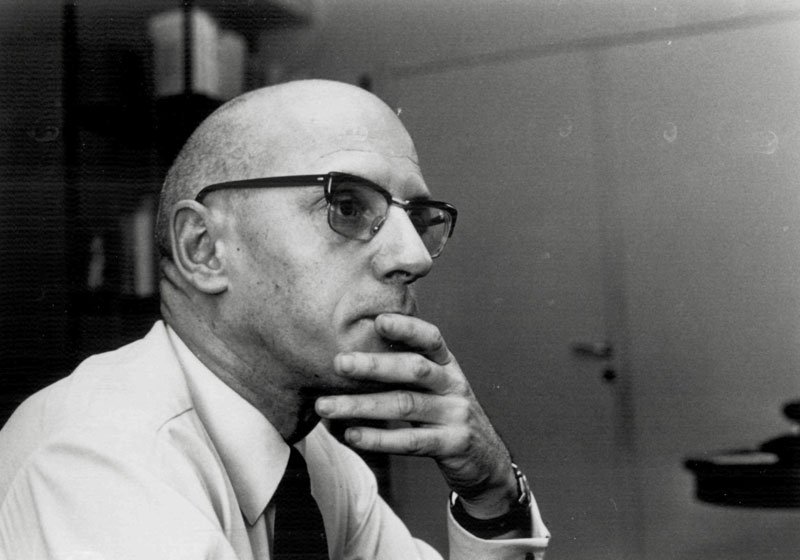
Portrait de Michel Foucault – Fonds d’archives du Collège de France

À l’occasion du quarantième anniversaire de la disparition de Michel Foucault, le 25 juin 1984, le Collège de France met en ligne à disposition du public les enregistrements de certains de ses cours au Collège de France, effectués par les auditeurs et confiés au service des archives de l’établissement.

Si ces documents sont connus et ont fait l’objet d’une édition critique au Seuil, cette mise en ligne des enregistrements est aujourd’hui possible avec l’aimable autorisation des ayants droit de Michel Foucault et des éditions du Seuil.

Les enregistrements correspondants au cours de l’année 1973-1974 sur Le Pouvoir psychiatrique sont d’ores et déjà disponibles sur la page de la chaire de Michel Foucault.

There are no known surviving recordings of the first three courses – though a course elsewhere was recently rediscovered, so it’s not impossible they are out there somewhere. For the early courses they used Foucault’s manuscripts, or a transcription made at the time, as the basis for publication; with the later courses they were transcribed from these recordings, with the course manuscript used to a greater or lesser extent – manuscripts were used less for the first courses published, and progressively more over time. The courses are now being reedited for the Points series.

Much less is known about what happened in the parallel seminars Foucault ran for his first decade teaching at the Collège. Although some publications developed from these, I still think more work could be done on these. There are rumours of some recordings of these too. For a list of the pre-announced titles see here.

Posted in Michel Foucault | 2 Comments

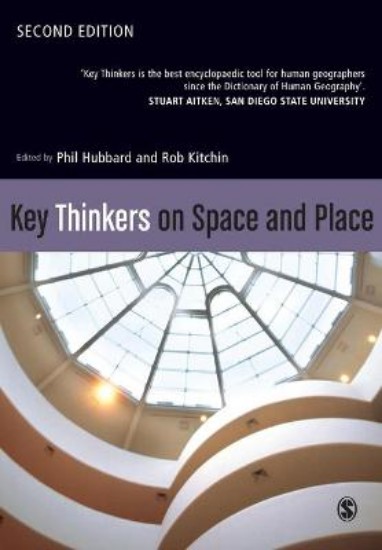
Archived Key Thinkers from 2nd Edition of Key Thinkers on Space and Place (open access)

This is a good innovation. The third edition of Key Thinkers on Space and Place updates many entries from earlier editions, removes some and adds many entirely new ones. The editors have made the removed entries available online open access.

Archived Key Thinkers from 2nd Edition of Key Thinkers on Space and Place

Posted in Uncategorized | Leave a comment

Books received – Sartre, Koyré, Meillet, Gilmartin, Hubbard, Kitchin and Roberts, and Foucault

Jean-Paul Sartre’s Modern Times, older second-hand books by Alexandre Koyré and Antoine Meillet, the new edition of Key Thinkers on Space and Place, and Foucault, l’indiscipliné – Sciences Humaines, Les Essentiels hors-série 16, April-May 2024.

I am one of the new people included in this edition of Key Thinkers on Space and Place – a great honour to be in this important text. Many thanks to the editors for including me, and Rachael Squire and Kimberley Peters for writing a generous and thoughtful discussion of my work – mainly the parts on territory, volume and terrain.

A photograph of the books described in this post
Posted in Alexandre Koyré, Jean-Paul Sartre, terrain, Territory | Leave a comment

Uday Chandra, Resistance as Negotiation: Making States and Tribes in the Margins of Modern India – Stanford University Press, June 2024

Uday Chandra, Resistance as Negotiation: Making States and Tribes in the Margins of Modern India – Stanford University Press, June 2024

“Tribes” appear worldwide today as vestiges of a pre-modern past at odds with the workings of modern states. Acts of resistance and rebellion by groups designated as “tribal” have fascinated as well as perplexed administrators and scholars in South Asia and beyond. Tribal resistance and rebellion are held to be tragic yet heroic political acts by “subaltern” groups confronting omnipotent states. By contrast, this book draws on fifteen years of archival and ethnographic research to argue that statemaking is intertwined inextricably with the politics of tribal resistance in the margins of modern India.

Uday Chandra demonstrates how the modern Indian state and its tribal or adivasi subjects have made and remade each other throughout the colonial and postcolonial eras, historical processes of modern statemaking shaping and being shaped by myriad forms of resistance by tribal subjects. Accordingly, tribal resistance, whether peaceful or violent, is better understood vis-à-vis negotiations with the modern state, rather than its negation, over the past two centuries. How certain people and places came to be seen as “tribal” in modern India is, therefore, tied intimately to how “tribal” subjects remade their customs and community in the course of negotiations with colonial and postcolonial states. Ultimately, the empirical material unearthed in this book requires rethinking and rewriting the political history of modern India from its “tribal” margins.

Posted in Uncategorized | Leave a comment

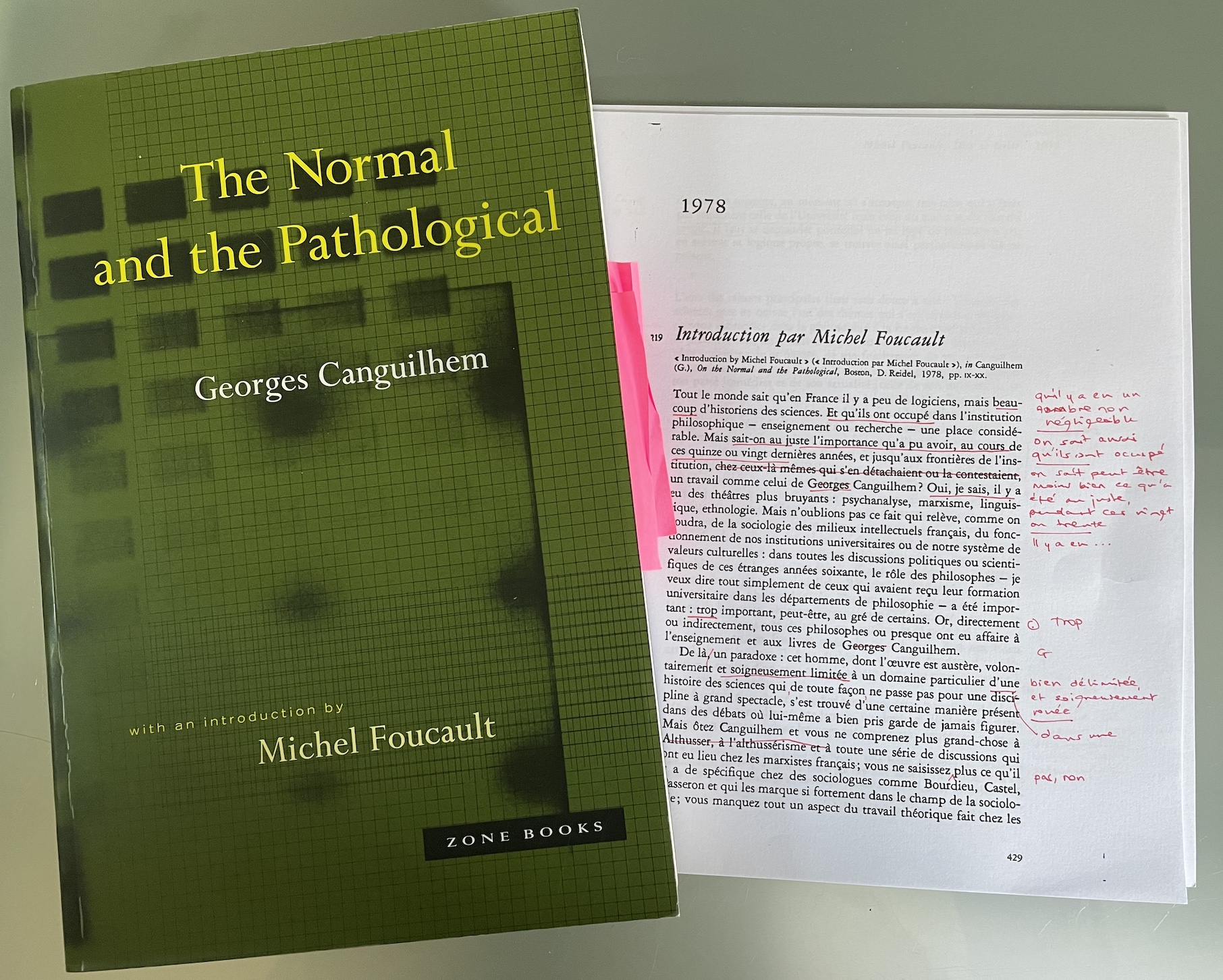
A detailed comparison of Michel Foucault’s Two Texts on Georges Canguilhem

The Zone books re-edition of Canguilhem’s The Normal and the Pathological, along with a marked up copy of the French text of Foucault’s Introduction.

In 1978, Foucault contributed an introduction to the English translation of Georges Canguilhem’s The Normal and the Pathological. The French version is included in Dits et écrits as text 219. (No translator is indicated, which suggests the editors had access to the original French text.) Right at the end of his life, Foucault revised the text for a theme issue of Revue de métaphysique et de morale, published after his death and reprinted as Dits et écrits text 364. An online version of the latter is here. The second text was translated in Essential Works as “Life: Experience and Science”, Vol 2, 465-78.

In an editorial note Dits et écrits says “Épuisé, il ne put que modifier la préface… Il remit ce texte fin avril 1984; ce fut donc le dernier auquel il donna son imprimatur [Exhausted, he could only modify the preface… He submitted this text at the end of April 1984; it was therefore the last he approved for publication]”.

As far as I know, nobody has compared the two texts to see the modifications Foucault made. The full analysis is here.

Many changes are minor, but some are more interesting. Minor changes to punctuation, Georges replaced by G., etc. are not noted, but I hope all the other changes are. Corrections and additions are of course welcome.

There are lots of other resources on this site relating to Foucault – bibliographies, audio and video files, some other textual comparisons, some short translations, etc. They are listed here. There are resources relating to other thinkers and topics listed here.

Posted in Georges Canguilhem, Michel Foucault, Uncategorized | Leave a comment

Cary J Nederman & Guillaume Bogiaris (eds.), Research Handbook on the History of Political Thought – Edward Elgar, 2024

Cary J Nederman & Guillaume Bogiaris (eds.), Research Handbook on the History of Political Thought – Edward Elgar, 2024

This insightful Handbook reviews the key frameworks guiding political scientists and historians of political thought. Comprehensive in scope, it covers historical methodology, traditions, epochs, and classic authors and texts, spanning from ancient Greece until the nineteenth century.

Elucidating the evolution and current state of the field, the Handbook emphasizes the value of studying the history of political ideas to gain a critical perspective on our own embedded cultural predispositions. Authors analyze various intellectual schools, such as Stoicism, Christianity, Islam, Liberalism, Republicanism, and Libertarianism, and discuss hermeneutical strategies to reading historical texts, including approaches from the Cambridge School and the Straussians. Providing a broad overview of Western political ideas, an international range of contributors also demonstrate cognizance of global theoretical movements and their significance for historical inquiry. They reexamine the standard canon of political thinkers in light of topics such as gender, colonization, and race, exploring the ideas of, amongst others, Plato, Aristotle, Cicero, Machiavelli, Hobbes, Locke, Wollstonecraft, and Marx.

Accessible to undergraduate and postgraduate students as well as established scholars, this Handbook is a crucial resource for academics in political science, philosophy, intellectual history, and economics, as well as scholars who study economic thought, law and politics. It will also appeal to scholars seeking a clear understanding of the key concepts that continue to influence contemporary theory and research across the social sciences.

Posted in Uncategorized | 1 Comment

Peter E. Gordon, A Precarious Happiness: Adorno and the Sources of Normativity – University of Chicago Press, January 2024 (and podcast interview)

Peter E. Gordon, A Precarious Happiness: Adorno and the Sources of Normativity – University of Chicago Press, January 2024

A strikingly original account of Theodor Adorno’s work as a critique animated by happiness.

“Gordon’s confidently gripping and persistently subtle interpretation brings a new tone to the debate about Adorno’s negativism.”—Jürgen Habermas
 
Theodor Adorno is often portrayed as a totalizing negativist, a scowling contrarian who looked upon modern society with despair. Peter E. Gordon thinks we have this wrong: if Adorno is uncompromising in his critique, it is because he sees in modernity an unfulfilled possibility of human flourishing. In a damaged world, Gordon argues, all happiness is likewise damaged but not wholly absent. Through a comprehensive rereading of Adorno’s work, A Precarious Happiness recovers Adorno’s commitment to traces of happiness—fragments of the good amid the bad. Ultimately, Gordon argues that social criticism, while exposing falsehoods, must also cast a vision for an unrealized better world.

Marvin Esler interviews Peter Gordon at the Critical Theory in Context podcast. Thanks to dmf for this link.

Posted in Uncategorized | 1 Comment