
Over the past several weeks I’ve been working hard on the final stages of revision of The Birth of Territory manuscript. Some of this has been responding to referee reports; some to my own thoughts on returning to the manuscript after almost nine months of distance (the time it took to get all three reader reports); references to a few pieces of good secondary literature to appear in the meantime; and a few other minor things I spotted along the way.
I finally tracked down some of the last references, though a few books I had on my ‘to read’ list eluded me. At this stage if the books are not in a northern English university library, the British Library, the Warburg Institute or any other London libraries and an inter-library loan can’t get them then I’m going to have to admit defeat. This is only a few pieces of secondary literature I’d have liked to have looked at. But I think I can say I managed to avoid any ‘X cited by Y’ type references where I have not checked X myself.
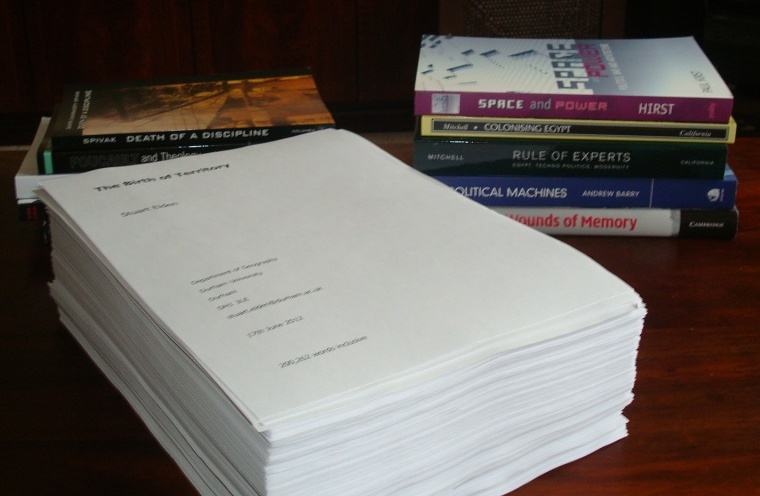 There are a few strange elements of this stage of a book. This is a book that has material I first drafted in 2000 and 2001, and so much of this book I’ve lived with for over a decade. There is a strange sense of finality and a difficulty in letting go. But on the other hand, new sentences or formulations I add now will appear – to the reader – to be the same as material written years ago. And while I’ve thought about, and in many cases spoken about, those earlier elements, the new bits are untested and appear raw. The trick will be – and long has been – to try to smooth all this over and ensure no-one else can see the joins. I was also struck, especially in the notes, at just how much work was embedded in this book. I had to keep the length to 200,000 words inclusive which took a bit of editing – at its longest this book was almost 250,000 words.
It’s also been a lot of work with images. Getting good quality images to have scanned or photographed is one element. For example, Durham has three first editions of Hobbes’s Leviathan, from which I wanted to include the iconic frontispiece. It’s surprising how poor-quality most reproductions of this are, especially for the bottom half. All of these books had to come from the stores of the special collection. The first two had damaged images, and were no use at all. They couldn’t bring me the third one as it was being lent out for an exhibition. I explained the reason I needed it, and they enquired a bit further, fortunately discovering it was actually awaiting repair before it went to the exhibition. They were able to locate it, brought it to me and the frontispiece was near perfect. They kindly agreed to have the image photographed before it went back to repair.
Most of the images in the book are of things that are out of copyright, but the photographs of them often are not. So Hans Holbein’s Ambassadors, for instance, is claimed by the National Gallery, especially if you want a high-quality reproduction of it. And the costs of getting permission to use that can be quite expensive. The cost can sometimes be waived for academic purposes, but electronic editions bring it back. I had to drop a couple I wanted but couldn’t get permission for. This is a complicated business and I have to hope that the dossier of information I put together will be sufficient.
I also had to clear permission to reuse material I had previously published. Very little of this book falls into this category – I estimate maybe 10% – but it required contact with four journals. Fortunately this was reasonably straight-forward, but it’s more a case of documenting things for the press so they know there will be no later problems.
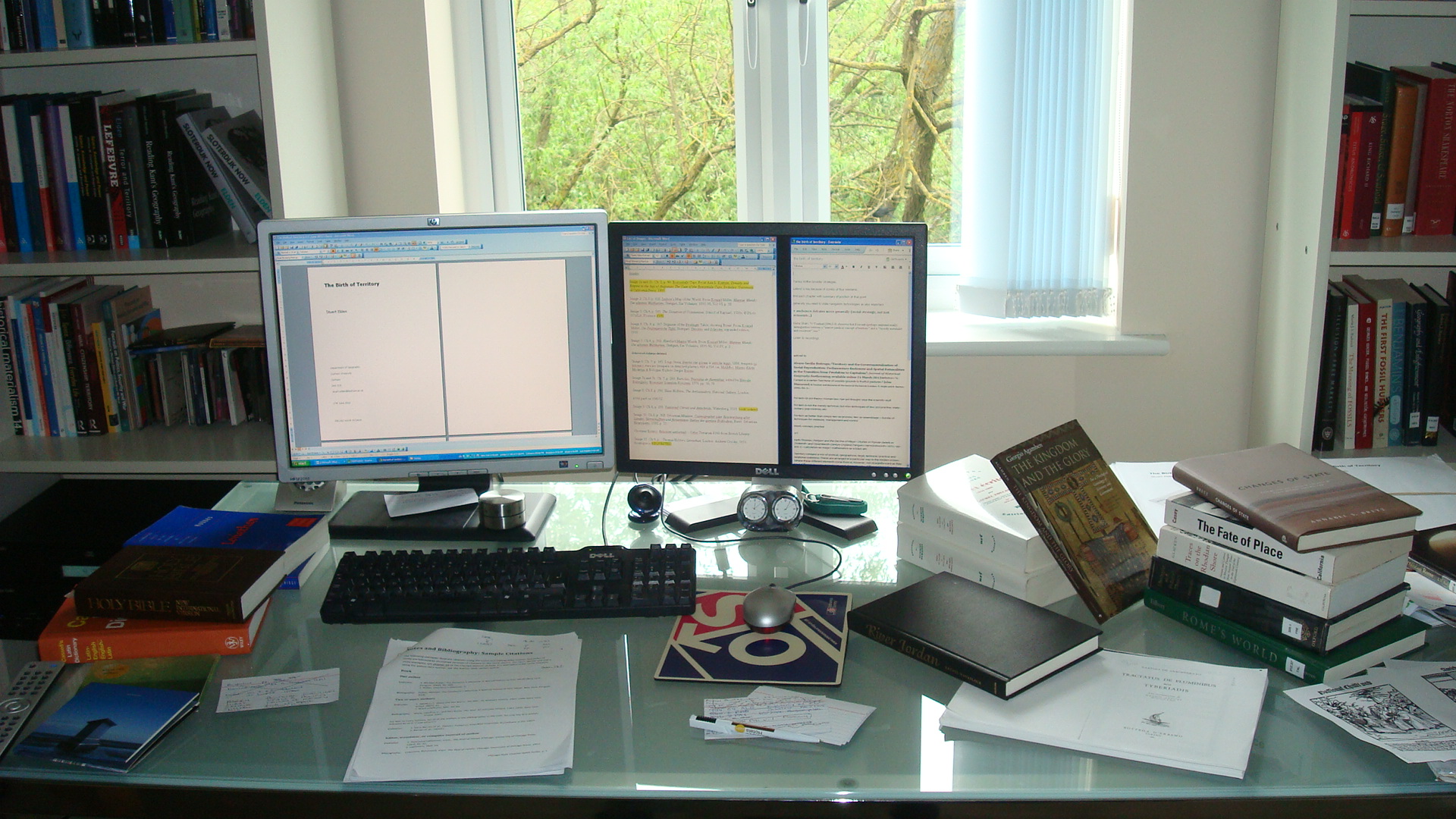
I’m now at the stage where I have printed the entire manuscript for one final read through on paper. The top photo is of that manuscript. The bottom one the state of my desk as I completed the last few changes today.
Discover more from Progressive Geographies
Subscribe to get the latest posts sent to your email.


