


In the last update on this project, I talked about the Paris archival work I’d done in early February. There were a few loose ends of references when I got back from Paris, most of which I was able to resolve at Warwick or Oxford libraries. The notes I’d taken from the Fonds Lucien Tesnière helped with situating a couple of discussions of Benveniste’s Origines, published in the Bulletin de la Faculté des Lettres de Strasbourg in 1937. A few letters in the Fonds Alexandre Kojève, one of which was from Henri Lefebvre, spurred me to write a very short piece on a collaborative project that never was. It doesn’t really have a connection to this project, but I wrote a little piece setting out what I could find here. I’ve also started writing another only tangentially connected piece, about Alexandre Koyré’s unsuccessful attempt to get elected to the Collège de France, based on archival materials, which will need a bit more work.
I’ve followed up a few leads about Benveniste’s exclusion from the Collège de France during the war, because of the 1940 Vichy law on Jewish people not holding certain professions. I know this is also going to need a bit more digging. Other Jewish professors took early retirement, including Marcel Mauss, but Benveniste was only in his mid-thirties at the time. The prohibition was rescinded after the liberation, but I’m somewhat amazed by the idea that he could just return and work with people, particularly the administrator, who had put this exclusion into practice. Benveniste’s movements in the war is a fascinating topic, and while the sources I’m drawing on, at least so far, have been used by others, I think I’m able to join some dots in an interesting way.
Although Benveniste didn’t publish anything for four years during the war, and lost his working notes when his apartment was ransacked during the Occupation, he quickly resumed writing in the second half of the 1940s. His essay on the first, second and third persons of the verb was reprinted in his Problems of General Linguistics in 1966, and some other essays from this period are in the posthumous Langues, cultures, religions collection. “Le jeu comme structure [Play as structure]” and some on Indo-European social relations – medicine, social classes and the oath – are perhaps the most interesting of these. When Noms d’agent et noms d’action en indo-européen was published in 1948, the Avant-Propos briefly acknowledges the author’s delay due to “other publications, the interruption of the war, the loss of all his working manuscripts and the need to reconstitute the entire documentation” (p. 5 n. 1).
I also did a bit of work on Benveniste’s 1947 fieldtrip to Persia and Afghanistan, which is mentioned in accounts of his life and his teaching record. A day-by-day account was published by Mohammad Nabi Kohzad, who accompanied Benveniste on the trip. Benveniste’s notebooks from this work are in the archives, and there were plans for a book on the topic of vocabulary across dialects, which he never completed. Georges Redard planned to edit the material after Benveniste’s death, and listed the book as forthcoming. It never appeared, though there are some indications in Redard’s hand of what it could have contained. There is a report on the fieldwork in his archives, which I don’t think was ever published.
I then went back in Paris for two more weeks, working on quite a lot of different things. I looked at a few letters in the Fonds Raymond Aron, some of Georges Bataille’s working notes for lectures on religion, which show his engagement with Mircea Eliade, and a few manuscripts in the Fonds Roland Barthes which discuss Benveniste, all at the Bibliothèque nationale. Some of those Barthes texts are published, but there are a couple of lectures in courses which are not. I’m not sure what I will do with this material, but it was interesting to look at. I also looked at the manuscript of one of Foucault’s Collège de France courses; one of the first to be published, for which they just used the recordings. The manuscript is quite different in places, and has some interesting moments, though much is missing. In particular, I found it interesting for having material he presented in the parallel seminar. As I’ve said before, when providing a list of the topics of Foucault’s seminars, we still know relatively little about what they did in those sessions – with the exception of the Pierre Rivière dossier, and some individual pieces in, for example, The Foucault Effect.
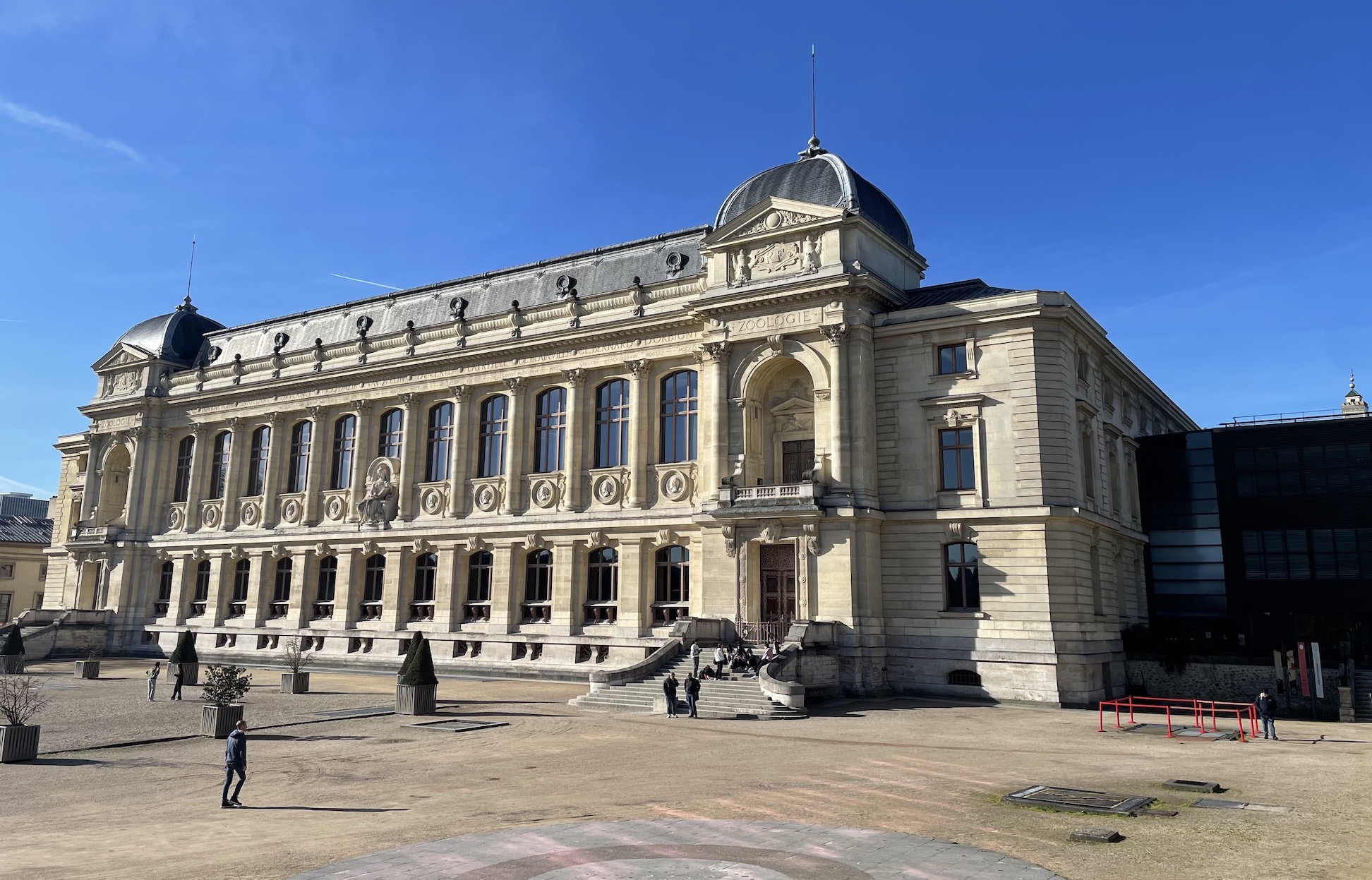
At the Muséum national d’Histoire naturelle I looked at some things in the Paul Rivet papers, including Claude Lévi-Strauss’s extensive letters to him, and some letters from Dumézil to Marcel Mauss. I had discovered that they had some of the Mauss archive there by chance – the other and much larger part is at the Collège de France, along with the Henri Hubert papers. (The latter collection comprises the papers which, like those of Dumézil and some other Collège de France professors, used to be at IMEC.) I also got a card for the fairly new Humathèque Condorcet, which has some records from the EPHE and the EHESS. I took an initial look at some of the EPHE papers, which include a few student notes from Benveniste courses for which I don’t think there is another record beyond the brief reports in the Annuaire.
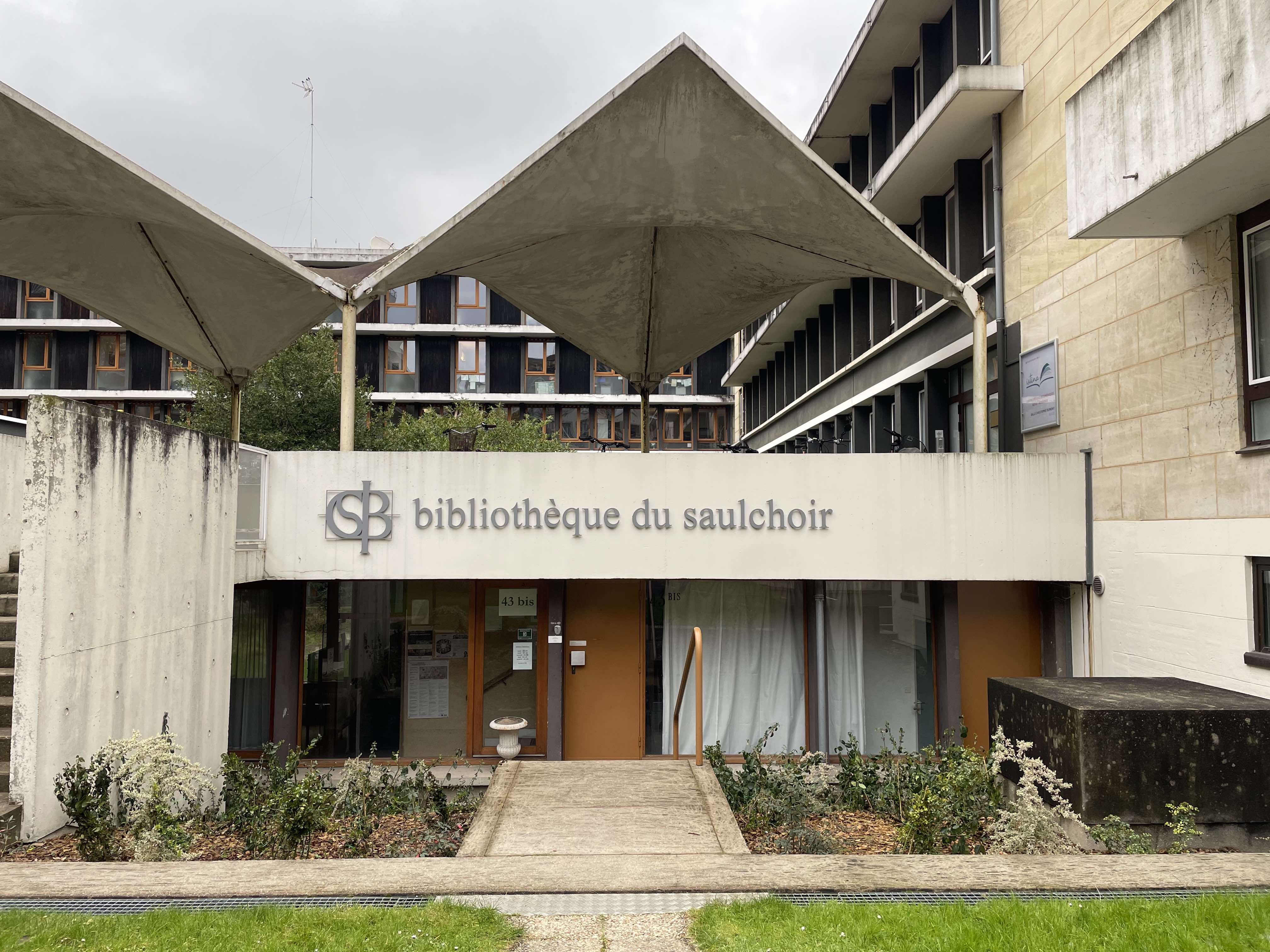
I also made a visit to the Bibliothèque du Saulchoir, a Dominican library which Foucault used for his research on antiquity in the last five years of his life. I’d never had a reason to go before – it once held the collection of the Centre Michel Foucault, but that moved to IMEC a long time ago. There is a short piece about Foucault’s use of the library by the former librarian Frère Michel Albaric here. It’s a nice quiet place to work, looking onto a little garden. I was there to look at some letters from Dumézil and, especially, Benveniste, to Jean de Menasce. As the last update said, other parts of de Menasce’s archive are at the Bibliothèque universitaire des langues et civilisations (BULAC), which I’ve also consulted. There are other things at the Saulchoir which I might request to look at on a future visit.
I also continued work on the Benveniste and Dumézil archives at the Collège de France, and have completed an initial survey of most of the material they have. I also went through some of the administrative papers for the Assemblies of Professors when key decisions were taken, such as elections. As I usually do, I also made use of the main Bibliothèque nationale site to look at some things which are hard to find in the UK. Across the last three trips to Paris I’ve managed to complete a lot of the work I wasn’t able to do last year. I should be back next in late May. There are a few things at the Archives Nationales for which I’ve requested authorisation, and one file is in a store which is being treated for asbestos, so isn’t currently accessible.
The main thing in Paris which I haven’t even begun to work with is the Benveniste archive at the Bibliothèque nationale, though as far as I can tell, most of that material relates to later parts of his career. I haven’t yet looked at other potentially interesting archives held at the Collège de France, including the Mauss-Hubert, Paul Pelliot and Antoine Meillet ones. I’m going to need to have a plan for a targeted approach with these, given the scale of what they hold, and how much time it would require to even do an initial survey. (The Meillet inventory I have is 300 pages long; the Mauss-Hubert over 1000.) There is some work I’d like to do in Switzerland, and at some point I’d like to get to IMEC for a few things. I’m not sure if I’ll get to places further afield – there are small things which might be interesting to do in several other European cities, but in such a range of places it’s hard to think of a way to do this that isn’t a lot of individual trips. There are other archives in and around Paris, or elsewhere in France which might hold some interesting things. There is always more, of course, but I feel in a few areas I am actually finishing tasks, rather than what has often felt like completing one thing only meant there were four more to do.
I am grateful to Ian Klinke and Jean-François Drolet for an invitation to respond to Ishan Ashutosh’s paper at the “Geopolitics and the Critique of Liberal Order” workshop at St. John’s College, Oxford. While the focus was the contemporary far-right, it was thoroughly informed by the history of ideas and led to some very helpful conversations.
I am now very close to completing a draft of the chapter on Benveniste in the 1930s and 1940s, which has taken far longer than I planned, and is very long. I might have to split this chapter or move material elsewhere. There are a few unresolved things for which I need to consult archives in Switzerland, but I really need to leave Benveniste behind for now and turn back to Dumézil in the 1930s and 1940s for the parallel chapter.
Previous updates on this project can be found here, along with links to some research resources and forthcoming publications, including the still-delayed reedition of Georges Dumézil’s Mitra-Varuna. There is a lot more about the earlier Foucault work here. The final volume of the series, The Archaeology of Foucault, and the special issue of Theory, Culture & Society I co-edited on “Foucault before the Collège de France” are both now published.
Discover more from Progressive Geographies
Subscribe to get the latest posts sent to your email.


Fanon as flaneur?
Thanks for the info on Mauss. The correspondence between Mauss and Hubert has been published in 2021, you can check the book before the archive. https://classiques-garnier.com/correspondance-1897-1927.html
Thank you – yes, that’s a useful volume I’ve used a little. The Mauss-Durkheim letters are also published. The archive though is vast. https://salamandre.college-de-france.fr/archives-en-ligne/ead.html?id=FR075CDF_00CDF0057&c=FR075CDF_00CDF0057_e0000019&qid=eas1706973082701
Pingback: Indo-European Thought in Twentieth-Century France update 19: back to Dumézil, politics, and Benveniste in Persia and Afghanistan | Progressive Geographies
Pingback: “Alexandre Koyré and the Collège de France”, forthcoming in History of European Ideas; and a talk on Canguilhem and Koyré in Bristol | Progressive Geographies