
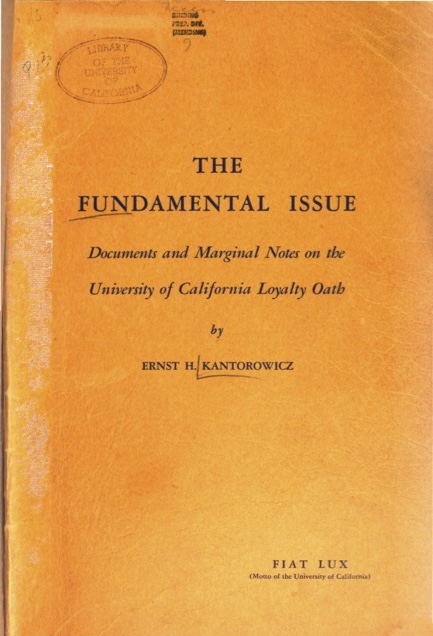
In 1950, the medieval historian Ernst Kantorowicz privately published, at his own expense, a short book entitled The Fundamental Issue. It cost him $425 – perhaps about $5000 today. It concerned a loyalty oath at the University of California, first proposed in 1949, which he had refused to sign.

The oath in its initial form, from the Constitution of State of California, read:
I do solemnly swear (or affirm, as the case may be) that I will support the Constitution of the United States and the Constitution of the State of California, and that I will faithfully discharge the duties of my office according to the best of my ability.
To this was added, on 25th March 1949 the requirement to swear that:
I do not believe in, and am not a member of, nor do I support any party or organisation that believes in, advocates or teaches the overthrow of the United States Government by force or violence.
This was revised on 24th June 1949 to be the Constitutional oath, plus the addition:
: that I am not a member of the Communist Party, or under any oath, or a party to any agreement, or under any commitment that is in conflict with my obligations under this oath (taken from Stewart, The Year of the Oath).
As Kantorowicz recalled in his ‘Prefatory Note’ to The Fundamental Issue:
If you are not a Communist, why can’t you sign the oath?” How often has this question been asked and still is asked? The answer is that from the very beginning it was true that “The issue is not Communism; it is the welfare and dignity of our University” (Alumni Letter, August 17, 1950). The forcibly imposed oath with its economic sanctions and encroachments on tenure, rejected almost unanimously by the Faculties of the University of California, was at first one of the most thoughtless and wanton, later one of the most ruthless attacks on the academic profession at large.
… Why I did not sign the oath—although, or because, I am not and never have been a Communist, and although, or because, I am genuinely conservative and never have been taken for anything else—I shall indicate in the following pages.
… What the fundamental issue is has been obvious to me from the minute the controversy started. Perhaps I have been sensitive because both my professional experience as an historian and my personal experience in Nazi Germany have conditioned me to be alert when I hear again certain familiar tones sounded. Rather than renounce this experience, which is indeed synonymous with my “life,” I shall place it, for what it is worth, at the disposal of my colleagues who are fighting the battle for the dignity of their profession and their university (p. 1).
The Fundamental Issue contains three documents – a speech and a letter by Kantorowicz, and one by Walter Horn, acting Chairman of the Department of Art – and then a long set of ‘Marginal Notes’ by Kantorowicz, together with some further documents in appendices.
At the beginning of the first document, a speech he gave to the Academic Senate, Northern Section, on June 14th 1949, Kantorowicz proclaims:
As a historian who has investigated and traced the histories of quite a number of oaths, I feel competent to make a statement indicating the grave dangers residing in the introduction of a new, enforced oath, and to express, at the same time, from a professional and human point of view, my deepest concern about the steps taken by the Regents of this University.
Both history and experience have taught us that every oath or oath formula, once introduced or enforced, has the tendency to develop its own autonomous life. At the time of its introduction an oath formula may appear harmless, as harmless as the one proposed by the Regents of this University. But nowhere and never has there been a guaranty that an oath formula imposed on, or extorted from, the subjects of an all-powerful state will, or must, remain unchanged. The contrary is true. All oaths in history that I know of, have undergone changes. A new word will be added. A short phrase, seemingly insignificant, will be smuggled in. The next step may be an inconspicuous change in the tense, from present to past, or from past to future. The consequences of a new oath are unpredictable. It will not be in the hands of those imposing the oath to control its effects, nor of those taking it, ever to step back again (p. 4).
“Both history and experience have taught us…”. The history was his vocation, but the experience was important too. Kantorowicz’s Jewish identity had become an issue when the Nazi party seized power in Germany in 1933. Kantorowicz was initially allowed to continue teaching at the University of Frankfurt because of his military service in World War One. On 20th April 1933 he sent a letter to the Minister of Education, protesting strongly about restrictions, and countering the idea that his Jewish and German identity were at odds (the letter is in Ralph E. Giesey, “Ernst H. Kantorowicz”). But two weeks into the Winter Semester of 1933, students protested against his lectures and boycotted them, ignoring the military service exception. This led Kantorowicz to spend the rest of that academic year in Oxford, as a senior research fellow at New College. He returned to Frankfurt in July 1934, but this coincided with a requirement that all functionaries swear an oath of loyalty to “the head of the Empire and the German Peoples, Adolf Hitler”. Kantorowicz refused, and requested a transfer to Professor Emeritus status – he was only 39 at the time – which would allow him to be exempt from the oath, but of course he had to stop teaching. He remained in Germany until December 1938, working mainly at the Monumenta Germaniae Historica in Berlin. His work there led to the book Laudes Regiae: A Study in Liturgical Acclamations and Mediaeval Ruler Worship. Largely completed in 1938, it was not published in Germany, due to restrictions on Jewish publication. Kantorowicz rewrote Laudes Regiae in English, and published it in 1946. The final spur to end to his time in Germany came with Kristallnacht in November 1938. He held a temporary post at the Johns Hopkins University before moving to Berkeley in 1939, initially in a one-year post. In these positions the Universities received support from the Emergency Committee in Aid of Displaced Foreign Scholars and the Oberlaender Trust of the Carl Schurz Memorial Foundation.
The oath in California in 1949, therefore, had links back to his experience fifteen years before in Germany. In retrospect, the incremental nature of the Nazi oppression of Jewish people is clear, even if the outcome was impossible to predict at the time. With the benefit of that historical experience, his reaction to the oath in the USA perhaps become easier to understand. As his biographer Alain Boureau notes, even in the USA the “imposition of an oath was not a novelty; already in 1942, the university, imitating a practice created in New York in 1937, required its members to take an oath of allegiance to the state and nation. But this earlier oath had none of the repressive tones present in that of 1949” (p. 82). Indeed, as his most recent biographer, Robert Lerner indicates, Kantorowicz would have already “sworn that he had never been a Communist during his naturalization procedures in 1945” (p. 321).
Kantorowicz took the lead in opposing the oath in California, right from the start, alongside colleagues. Kantorowicz was unusual in his resistance because it was not from the perspective of militancy, or even progressive politics. It was because of a conservative sense of hierarchy and order. It was the challenge to the tenure system and university autonomy from the state, an objection to the process rather than the content. The final section of Kantorowicz’s address to the Senate is striking in this regard:
I am not talking about political expediency or academic freedom, nor even about the fact that an oath taken under duress is invalidated the moment it is taken, but wish to emphasize the true and fundamental issue at stake: professional and human dignity.
There are three professions which are entitled to wear a gown: the judge, the priest, the scholar. This garment stands for its bearer’s maturity of mind, his independence of judgment, and his direct responsibility to his conscience and to his God. It signifies the inner sovereignty of those three interrelated professions: they should be the very last to allow themselves to act under duress and yield to pressure.
It is a shameful and undignified action, it is an affront and a violation of both human sovereignty and professional dignity that the Regents of this University have dared to bully the bearer of this gown into a situation in which— under the pressure of a bewildering economic coercion—he is compelled to give up either his tenure or, together with his freedom of judgment, his human dignity and his responsible sovereignty as a scholar (p. 6).
The juxtaposition of the judge, the priest and the scholar is striking, especially when we think of his interest in political theology.
His speech to the Senate was followed by a letter sent to President Robert Gordon Sproul on October 4th, 1949. This is the second text in The Fundamental Issue. This letter has a striking beginning:
Dear President Sproul:
Dante, quoting Aristotle, has remarked that ‘every oblique action of government turns good men into bad citizens’ … (p. 6).
Quite apart from how we might analyse this remark, and the conceptual shifts between Greek, Latin or proto-Italian and modern English, who among us would begin a letter to our institutional head today, perhaps especially one trained as an engineer, with these two historical figures?
As is fairly well known, Kantorowicz was among a list of non-signers dismissed by the Board of Regents on August 25th, 1950. The outbreak of the Korean war in June 1950 did not help things: “The fact that the country now was literally at war with communism did not bode well for the future of the nonsigners” (Lerner, p. 322). Kantorowicz spent one year at the Dumbarton Oaks Foundation research library but while there in December 1950 was offered a post at the Institute for Advanced Study in Princeton by its director, Robert Oppenheimer. He did not formally resign from Berkeley so as not to jeopardise proceedings against them, but told Oppenheimer he would accept, but for the moment only informally (4 January 1951).
Your letter of December 29th has certainly lit up the otherwise so gloomy outlook for 1951, at least within the purely personal sphere, and after the low of the paralysing ‘Year of the Oath’ this invitation fills my spirits again with new buoyancy and gives my desire to work a new impetus.
In fact, I am looking forward impatiently to settling down peacefully in Princeton. The terms you have outlined to me open up a new perspective of my life as a scholar, and it seems almost unbelievable to me that in future no classwork or semester routine shall compel me to break off my own work in the midst of a sentence and that instead I shall be able to finish all my unfinished studies and sail, once more, freely and like a young adventurer on that vast ocean of historical problems (Kantorowicz to Oppenheimer, 4 January 1951).
He later wrote to Oppenheimer that he had informed Berkeley he was “unavailable” from 30 June 1951.
This rather clumsy formulation was chosen by our lawyer in order to avoid the word “resignation” which might jeopardize my further participation in the still pending law-suit, the first hearing of which before the Supreme Court of California was very promising (Kantorowicz to Oppenheimer, 28 June 1951).
It was in Princeton that he completed The King’s Two Bodies, the book for which he is best known today. Retrospectively, Kantorowicz won a case for unfair dismissal from California, and the offer of reinstatement, but remained at Princeton until his death in 1963.
References
Alain Boureau, Kantorowicz: Stories of a Historian, translated by Stephen G. Nichols and Gabrielle M. Spiegel, Baltimore: Johns Hopkins University Press, 2001.
Bob Blauner, Resisting McCarthyism: To Sign or Not to Sign California’s Loyalty Oath, Stanford: Stanford University Press, 2009.
Stuart Elden, “Beyond the King’s Two Bodies”, Berfrois, 21 February 2017, (review of Robert E. Lerner, Ernst Kantorowicz: A Life) – archived here
David P. Gardner, The California Oath Controversy, Berkeley and Los Angeles: University of California Press, 1967.
Ernst H. Kantorowicz, Laudes Regiae: A Study in Liturgical Acclamations and Mediaeval Ruler Worship, Berkeley: University of California Press, 1946.
Ernst Kantorowicz, The Fundamental Issue: Documents and Marginal Notes on the University of California Loyalty Oath, San Francisco: Parker Printing, 1950. Online at https://babel.hathitrust.org/cgi/pt?id=uc1.$b114073&seq=5
Ernst H. Kantorowicz, The King’s Two Bodies: A Study in Mediaeval Political Theology, Princeton: Princeton University Press, 1957.
Robert E. Lerner, Ernst Kantorowicz: A Life, Princeton, NJ: Princeton University Press, 2017.
George R. Stewart, The Year of the Oath: The Fight for Academic Freedom at the University of California, New York: Doubleday & Company, Inc., 1950.
Ralph E. Giesey, “Ernst H. Kantorowicz: Scholarly Triumphs and Academic Travails in Weimar Germany and the United States”, The Leo Baeck Institute Year Book 30, 1985, 191–202.
Archives
Ernst Kantorowicz faculty files, Institute for Advanced Study archives, Princeton
Ernst Kantorowicz collection, Leo Baeck Institute, Center for Jewish History, New York, https://archives.cjh.org//repositories/5/resources/13319
Monumenta Germaniae Historica, digital edition of the letters of Ernst Kantorowicz, https://www.mgh.de/en/blog/post/mgh-digital-edition-letters-ernst-kantorowicz-goes-online
Emergency Committee in Aid of Displaced Foreign Scholars records, New York Public Library, special collections, https://archives.nypl.org/mss/922
This is a revised and updated version of part of an unpublished paper I gave in 2019 at a workshop on Ernst Kantorowicz and Shakespeare. It is the seventh post of an occasional series, where I try to post short essays with some indications of further reading and sources, but which are not as formal as something I’d try to publish more conventionally. They are usually tangential to my main writing focus, a home for spare ideas, asides, dead-ends and possible futures. I hope there is some interest in them. They are provisional and suggestions are welcome. The other posts so far are:
Benveniste, Dumézil, Lejeune and the decipherment of Linear B – 5 January 2025
Foucault’s 1972 visit to Cornell University – 12 January 2025 (updated 14 January)
Benveniste and the Linguistic Circle of Prague – 19 January 2025
Marie-Louise Sjoestedt (1900-1940): an important scholar of Celtic languages and mythology – 26 January 2025
Thomas Sebeok, Umberto Eco and the Semiotics of Nuclear Waste – 2 February 2025
Vladimir Nabokov, Roman Jakobson, Marc Szeftel and The Song of Igor – 9 February 2025
Discover more from Progressive Geographies
Subscribe to get the latest posts sent to your email.


Pingback: Benveniste, Dumézil, Lejeune and the decipherment of Linear B | Progressive Geographies
Pingback: Thomas Sebeok, Umberto Eco and the Semiotics of Nuclear Waste | Progressive Geographies
Pingback: Marie-Louise Sjoestedt (1900-1940): an important scholar of Celtic languages and mythology | Progressive Geographies
Pingback: Foucault’s 1972 visit to Cornell University | Progressive Geographies
Pingback: Vladimir Nabokov, Roman Jakobson, Marc Szeftel and The Song of Igor | Progressive Geographies
Pingback: Benveniste and the Linguistic Circle of Prague | Progressive Geographies
Pingback: Sunday histories – short essays on Progressive Geographies | Progressive Geographies
Pingback: Walter B. Henning, Robert Oppenheimer, Ernst Kantorowicz, the Institute for Advanced Study and the Khwarezmian Dictionary Project | Progressive Geographies
Pingback: The Friendship between Hannah Arendt and Alexandre Koyré | Progressive Geographies
Pingback: Alexandre Koyré’s Wartime Teaching at the École Libre des Hautes Études and the New School | Progressive Geographies
Pingback: Indo-European Thought in Twentieth-Century France update 27: more archive work on Saussure, Blanchot, Foucault, Jakobson and Koyré, two recordings, and a talk at the University at Buffalo | Progressive Geographies
Pingback: Indo-European Thought in Twentieth-Century France update 27: more archive work on Saussure, Blanchot, Foucault, Jakobson and Koyré, two recordings, and a talk at the University at Buffalo | Progressive Geographies
Pingback: Books received – Febvre, Hiltebeitel, Comaroff, Kantorowicz, Glyph 7, Gadoffre, Eliade & Couliano, Harvey | Progressive Geographies