
Amar Thorton and Katherine Harloe, Women Working the Past: Archaeology, History and Heritage in Britain, 1870–1950 – University of London Press, December 2026
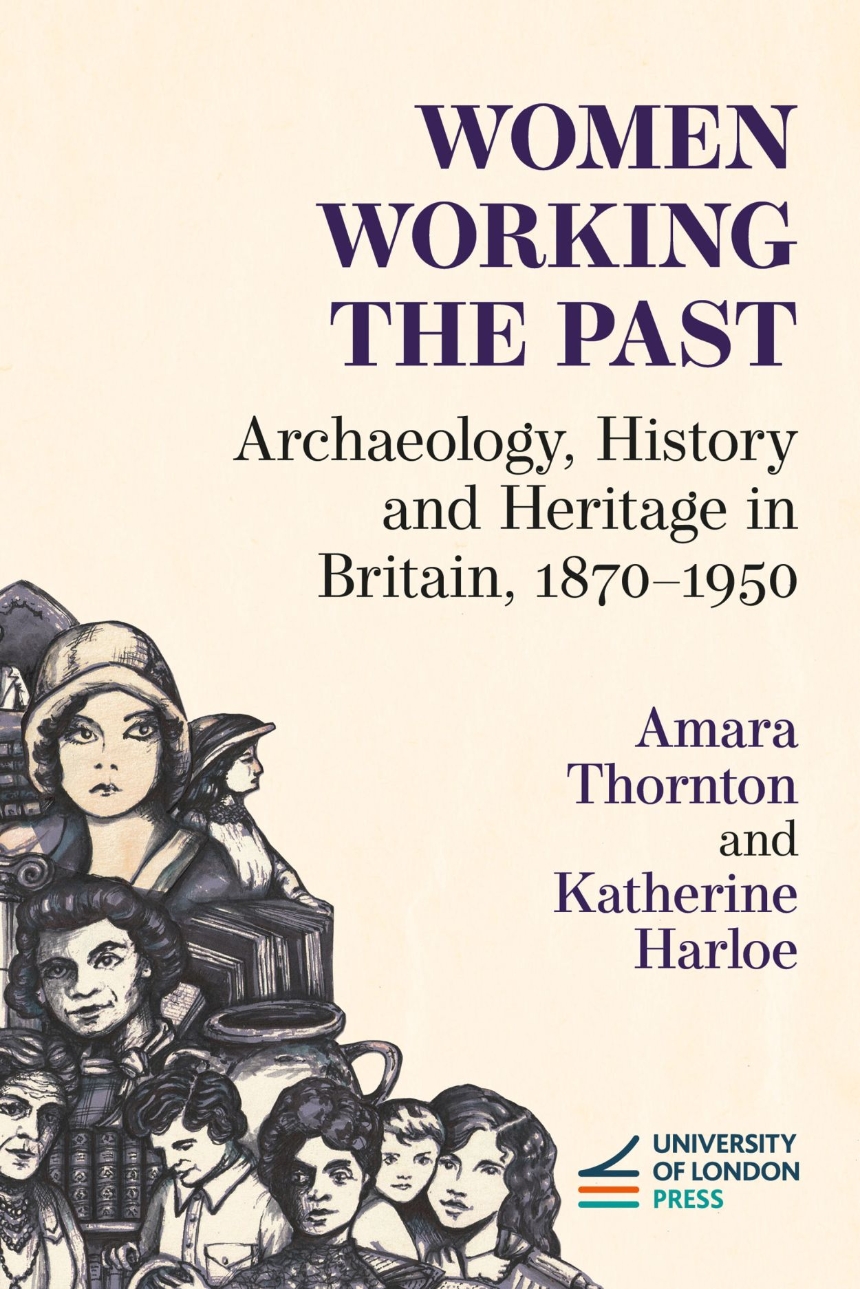
This book offers a new history of women’s integral contribution to archaeology, history, and heritage in nineteenth- and twentieth-century Britain and beyond.
Born out of the Beyond Notability project, the book draws on the project’s openly accessible database to reveal how hundreds of previously forgotten women saved, presented, excavated, researched, analyzed, and promoted the past. Using cutting-edge digital methods, the Beyond Notability team has reconstructed the lives and work of these women from fragments of information held in major UK cultural heritage institution archives. Juxtaposing broad overviews of work and education, family and empire, with focused case studies on lecturing, history-making, excavations, and folklore collecting, the book presents macro and micro histories in parallel, while centering women’s experiences and trajectories, as well as their voices. In this way, it is a major contribution to the histories of women’s work. By interweaving practice with analysis, it offers a valuable critical and reflexive model for revealing archives’ wealth of historical information on marginalized individuals and groups.
Discover more from Progressive Geographies
Subscribe to get the latest posts sent to your email.


https://www.jhiblog.org/2026/03/02/on-the-aggregate-in-intellectual-history/
“The relationship between investigations into political economy and those into culture was often dramatized as a clash between Marx and Foucault, in which class and subjectivity were entirely at odds and demanded explicit reconciliation. While Marxists tracked struggle and economic change, Foucauldians tracked discourse and knowledge, but they were both in pursuit of “power.” Taking this split between analytical tasks seriously, the generation of historians that entered the field during or after the “linguistic turn” took great pains to suture together the connective tissues of capital and text. Narrating the “historically specific dialectic between the universalizing drive of capitalism and the multiple forms of unevenness that are its internal supplement” would require methodological heterodoxy of one kind or another (Goswami 2004, 204). For instance, in his 1990 work, Bonded Histories: Genealogies of Labor Servitude in Colonial India, Gyan Prakash developed a complex methodology that would interrelate the subjective aspects of texts and the material conditions of their production:
If textual description affected and constituted the very object of description, colonial texts were also traces left by historical practices—in Michel Foucault’s terms, ‘archaeological’ monuments erected by history. But because historical practices made this inscription, these monuments stand as archaeological remains of the process by which a bourgeois political economy was installed as the hegemonic discourse. (11)
Here, the colonial text is at once a repository of concrete political practices and a trace of linguistic mediation, made meaningful where the two intersect. Prakash’s attention to the simultaneous operation of class, colonialism, and language in an explicit labor history is both a sign of the new synthesis of the 1990s and an influential model of this sort of win-win scenario.
As self-professed Marxist or Foucauldian approaches fell off the field’s cutting edge (and off syllabi), the implicit methodological traces of each approach lingered via revisions and critiques”