
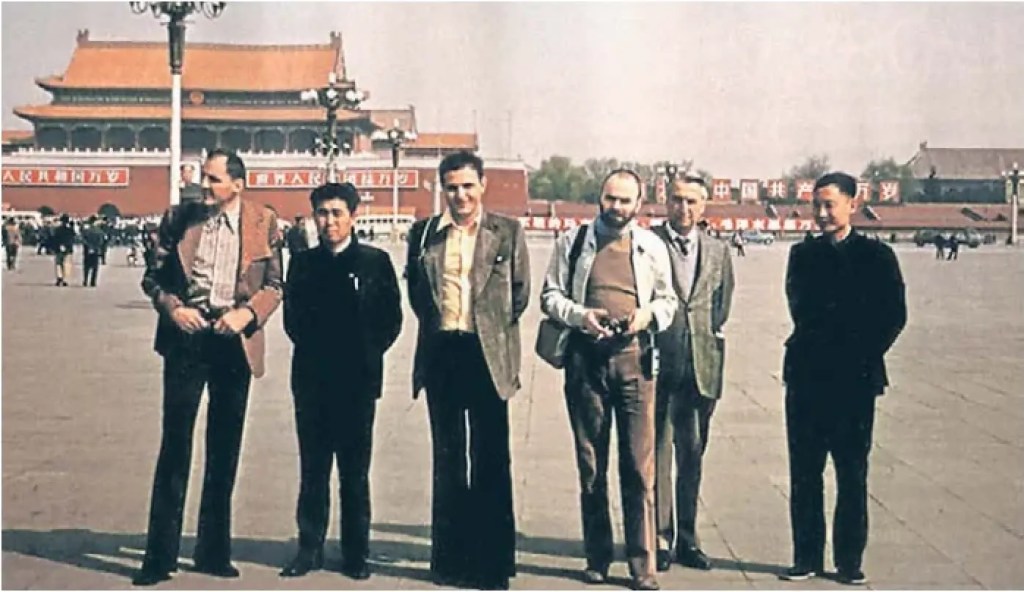
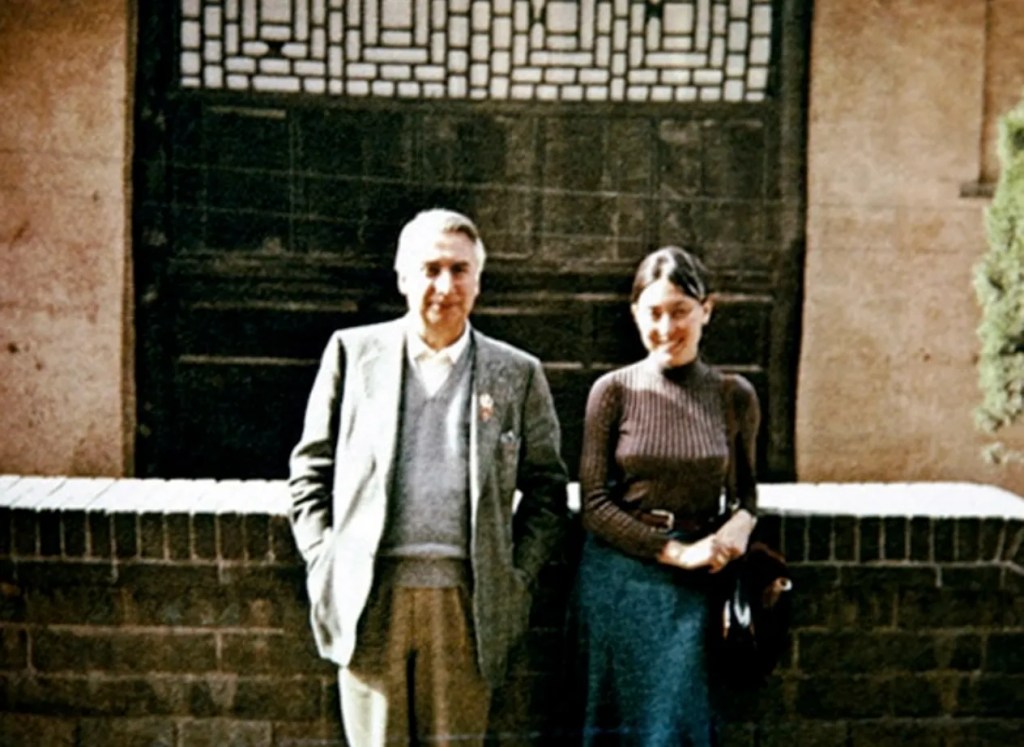
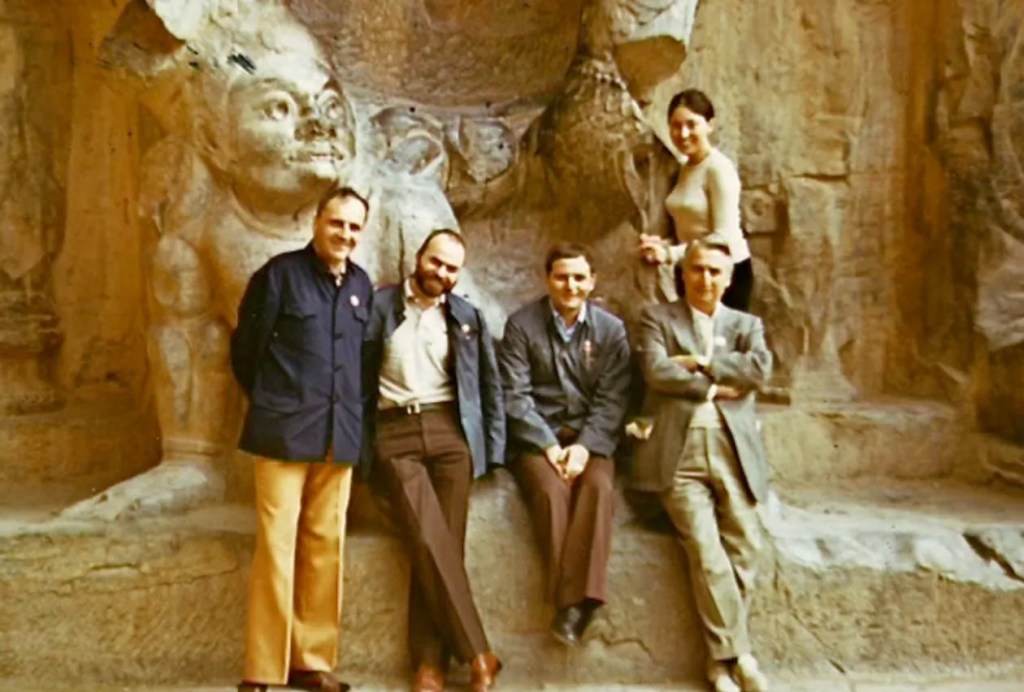
Tel Quel famously went to China in 1974. Tel Quel was an important literary journal founded in 1960, to which many of the major names of ‘French theory’ contributed, including Michel Foucault, Maurice Blanchot and Jacques Derrida. The journal was edited by Philippe Sollers, who along with Julia Kristeva, Roland Barthes, Marcelin Pleynet and the Éditions du Seuil editor François Wahl made the group for the China trip. Jacques Lacan was supposed to go but decided against at the last minute, according to Sollers using the pretext that his mistress had been unable to get a visa. They spent three weeks there, from 11 April to 4 May. The group were invited by the Chinese Embassy, through the mediation of Italian journalist and communist politician Maria Antonietta Macciocchi (on whom more in a future piece), but they paid for their own travel. It was an organised tour by the Luxingshe Travel Agency, with a planned itinerary including visits to schools, factories, farms, a hospital, museums and historical sites, dance and theatre performances, and political lectures. They visited Beijing, Shanghai, Nanjing, Luoyang, Xi’an and then returned to Beijing. A planned visit to Yan’an was abandoned due to bad weather. They had no contact with non-approved Chinese people.
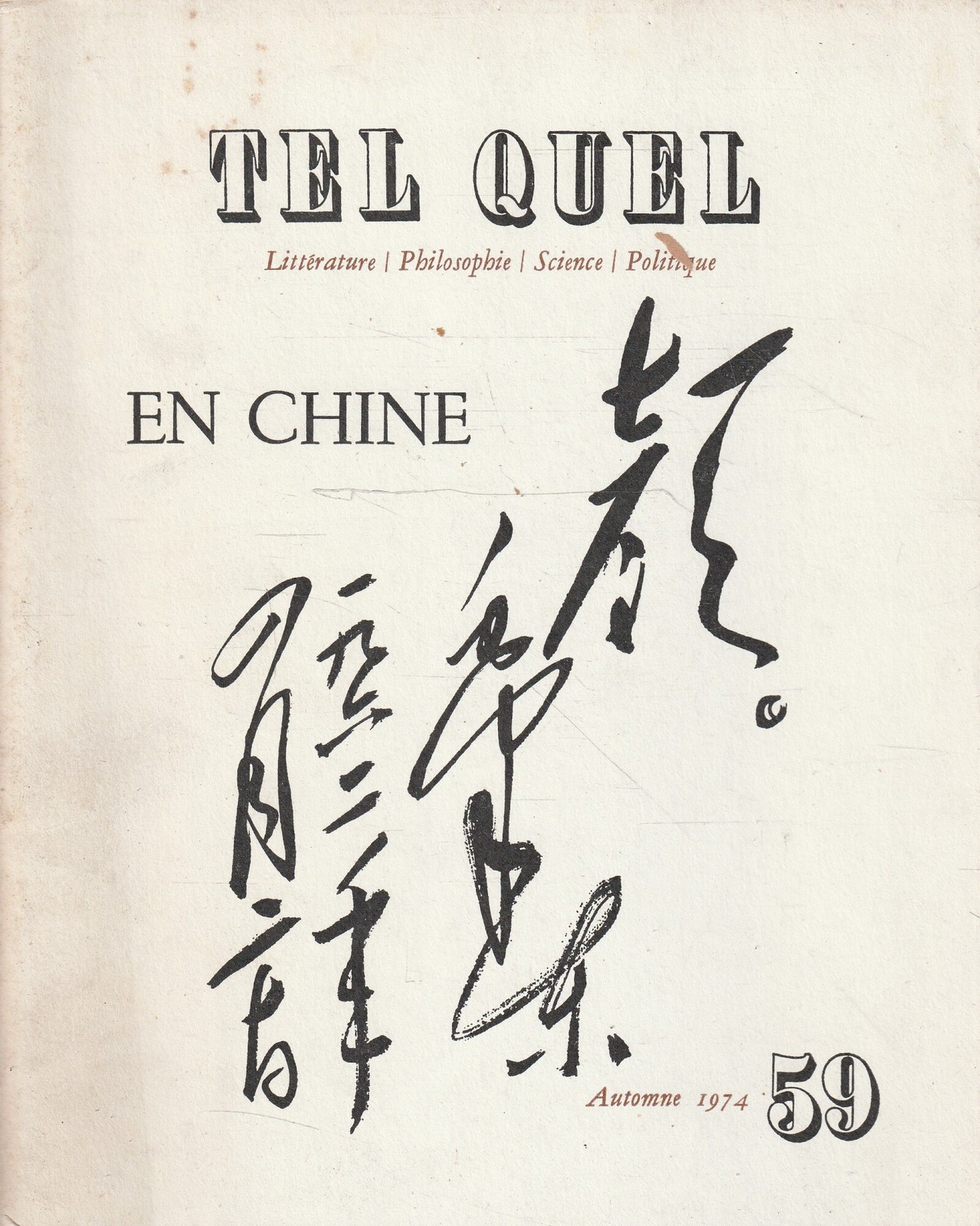
All of the group subsequently wrote about the trip and China more generally – Tel Quel was going through a brief Maoist phase after breaking with the French Communist Party. Wahl’s articles appeared in four parts in Le Monde, between 15 and 19 June 1974. The journal devoted their autumn 1974 issue to the trip, “En Chine”, in which they criticised Wahl’s essays as reactionary. Pleynet contributed to that issue, and also published a piece in the next one. The second article says that it was an extract of a forthcoming book, Pourquoi la Chine to appear in the 10/18 series, though this never appeared (“Du discours sur la Chine”, 12 n. *). Not long afterwards, Kristeva wrote a book De Chinoises, published in October 1974. It was translated a few years later as About Chinese Women. It has been commissioned and written in a rush on her return:
These notes do not make up a book. They are simply a journal of facts and inquiries inspired by a trip… Women: the women of China. These notes have their origin in my attempt to deal with the tremendous and rapid changes in their condition. That is indeed the reason I wrote them, in such haste… Neither a scholarly book nor a subjective essay. This work leaves something to be desired (p. 5/p. 7).
This book was severely criticised by Gayatri Chakravorty Spivak in an essay included in In Other Worlds.
Kristeva would also discuss the trip in some autobiographical pieces (such as “My Memory’s Hyberbole”, and her 1990 novel The Samurai has thinly disguised portraits of many of the people around the journal and dramatizes this trip. I believe at least parts of it are, however, fully fictional (Liliane Lazar is good on the novel generally, and I write about her portrayal of Émile Benveniste in it here). In place of his planned book, Pleynet published excerpts from his diary in 1980, with a preface from 1979 which reflects on the experience from a position of subsequent political disenchantment. There are reports that Barthes was often unhappy on the trip, staying in the minibus on one excursion, and spending the train journey to Nanjing reading Flaubert’s Bouvard et Péchuchet instead of looking at the scenery or talking to the rest of the group (Pleynet, Le Voyage en Chine, p. 51). With that book as his reading matter it feels like there is a joke to be made about people blundering into areas of knowledge they are little suited to comprehending fully, before moving onto another topic when they become disillusioned with it.
After a previous trip to Asia, Barthes had written a short book about Japan, The Empire of Signs. His editor Anne Herschberg Pierrot says he planned to do similar here: “Right from the start, Barthes had been thinking of bringing back a text from China. He filled three notebooks on this theme, in blue biro or felt-tip” (Carnets, 8; Travels, p. viii). He also made an index of those notebooks, presumably as a next step to turning the notes into a more thematic treatment. The Empire of Signs is made up of a series of short texts and images, rather than presenting an overall argument. But in his lifetime, Barthes published only a short piece about his experience in China – “Alors, la Chine?” “So, how was China?” It first appeared in Le Monde and was reprinted as a small brochure in October 1975, with a brief additional afterword. Among other themes, Barthes indicates the ‘briques’ of discourse, of pre-prepared political speeches, a “series of commonplaces (topoi and clichés) analogous to those sub-routines that cybernetics refers to as briques”, bricks, modules or building blocks (“Alors, la Chine?” p. 14; “So, how was China?” p. 100). At the time of the Cultural Revolution, this was often the campaign against Lin Biao and Confucius, or “Pi Lin Pi Kong”. Barthes also briefly mentions the trip in an interview with Bernard-Henri Levy in 1977 (“A Quoi sert un intellectuel”, pp. 369-70; “Of What Use is an Intellectual?”, pp. 264-65).
From early in his notebooks Barthes realised he was struggling to find a purpose to writing about the trip:
All these notes will probably attest to the failure, in this country, of my writing (in comparison with Japan). In fact, I can’t find anything to note down, to enumerate, to classify (Carnets, 73; Travels, p. 57).
[For a week, I haven’t felt any opening up in my writing, any jouissance in it. Dry. Sterile.] (Carnets, 92;Travels, p. 75).
One possibility for a text on China would be to sweep across it [balayer], from the most serious, the most structured (the burning political issues) to the subtlest, most futile things (chilli, peonies). (Carnets, 111;Travels, p. 95).
In the end he abandoned the idea, and the published version is of course fragmentary and thematically disparate. It is interesting and revealing, although private and unguarded.
A few pages of Barthes’s notebooks were reproduced in the catalogue of a Centre Pompidou exhibition in 2002 – R/B: Roland Barthes (pp. 208-25). The notebooks were transcribed and published in full in 2009, and translated into English in 2011. It is sometimes remarked that the English title Travels in China misses the notebook aspect of the Carnets du voyage en Chine, making it seem a bit more like a finished work. A report he had made to his students at the EPHE was also included in Le Lexique de l’auteur in 2010. In his notebooks he spends a lot of time complaining, about boredom, insomnia, migraines, the weather and the ideological limits placed on the Chinese and their access to them. He did like the food and calligraphy but found other aspects less appealing. He was disturbed by the “complete absence of fashion. Clothing degree zero” (Carnets, 23; Travels, p. 9). He was troubled by the lack of any sexual sensibility and bored of the endless political lectures. When they were published, Barthes’s notebooks were discussed by both China experts and Barthes scholars – see, for example, Harold Swindall’s review and the special issue of Textual Practice. A piece by Dora Zhang also appeared in the Los Angeles Review of Books. While the Textual Practice issue has articles on other parts of Barthes’s journals, notably the Mourning Diary he kept after the loss of his mother, it includes three pieces on the China notebooks: Lucy O’Meara, “Barthes and Antonioni in China: The Muffling of Criticism”; Andy Stafford, “Roland Barthes’s Travels in China: Writing a Diary of Dissidence within Dissidence?” and Neil Badmington, “Bored with Barthes: Ennui in China”. Ottmar Ette, “Roland Barthes ou la multiplication des paysages de l’Est”, discusses it in terms of a wider intellectual geography of Barthes’s work. Swindell sees the notebooks as a valuable insight into a specific historical moment, revealing both for what they say of China but also for the perspective of a Westerner, “a record of a highly unusual East-West encounter that took place in a bygone era” (p. 423).
It’s hardly an unknown story, and the trip has been discussed in lots of other places including Patrick ffrench’s study of Tel Quel, The Time of Theory, the books on Tel Quel by Danielle Marx-Scouras, Niilo Kauppi and Philippe Forest, the biographies of Barthes and Kristeva… Some of the other references I know include Lisa Lowe, Critical Terrains: French and British Orientalisms, chapter 5; Eric R.J. Hayot, Chinese Dreams: Pound, Brecht, Tel Quel, chapter 3; Alex Hughes’s article “Bodily Encounters with China: On Tour with Tel Quel”. Chapter 6 of Richard Wolin’s The Wind from the East criticises the wider political issues around the group’s Maoism; Catherine Dossin looks at the wider interest in Maoism, particularly the work of Macciocchi and the painter Gérard Fromanger, who visited China shortly after the Tel Quel group. The wider phenomenon of Western visits to China during the Cultural Revolution is discussed by Paul Hollander in Political Pilgrims, Chapter 7, and in Gavin Healy’s forthcoming book A Guide to Mao’s China: Showing the Nation to Foreign Guests (Cornell University Press, June 2026).
In 2019 Qingya Meng wrote a book about the trip, L’échec du voyage en Chine (1974), de Sollers, Kristeva, Pleynet et Barthes, based on a thesis from 2017. It’s a useful discussion of the different sources for information about the trip. Most recently, Jean Berthier has written about this visit in a book-length study: Voyage tranquille au pays des horreurs: Sollers, Barthes, Kristeva, Pleynet, Wahl… en Chine. It’s described as a novel, but it is so documentary that it reads almost as a history. Of course, the dialogue has had to be imagined, but it matches with most of what the voyagers recorded and the other accounts.
The photographs above are taken from Threads; there are some others on Philippe Sollers’s website. There are some of Chinese women in Kristeva’s book.
References
Marianne Alphant and Nathalie Léger eds. R/B: Roland Barthes, Paris: Centre Pompidou, 2002.
Neil Badmington, “Bored with Barthes: Ennui in China”, Textual Practice 30 (2), 2016, 305-25.
Roland Barthes, L’Empire des signes, Geneva: Skira, 1970, reprinted in Œuvres complètes, ed. Eric Marty, Paris: Seuil, five volumes, 2002, Vol III, 347-444; Empire of Signs, trans. Richard Howard, New York: Hill and Wang, 1982.
Roland Barthes, “Alors, la Chine?” Le Monde, 24 May 1974, 1, 14; republished with postface as Alors la Chine? Christian Bourgois, 1975; reprinted in Œuvres complètes, ed. Eric Marty, Paris: Seuil, five volumes, 2002, Vol IV, 516-20; “So, How Was China?” in ‘The “Scandal” of Marxism’ and Other Writings on Politics, trans. Chris Turner, Calcutta: Seagull Books, 2015, 94-104.
Roland Barthes, “A Quoi sert un intellectuel”, Œuvres complètes, ed. Eric Marty, Paris: Seuil, five volumes, 2002, Vol V, 364-82; “Of What Use is an Intellectual?” in The Grain of the Voice: Interviews 1962- 1980, trans. Linda Coverdale, Berkeley and Los Angeles: University of California Press, 1991, 258-80.
Roland Barthes, Carnets du voyage en Chine, ed. Anne Herschberg Pierrot, Paris: Christian Bourgois/IMEC, 2009; Travels in China, trans. Andrew Brown, Cambridge: Polity, 2011.
Roland Barthes, “Compte rendu du voyage en Chine”, in Le Lexique de l’auteur: Séminaire à l’École pratique des hautes études 1973–1974, ed. Anne Herschberg Pierrot, Paris: Seuil, 2010, 227-45.
Roland Barthes, Journal de deuil: 26 octobre 1977—15 septembre 1979, ed. Nathalie Léger, Paris: Seuil/IMEC, 2009; Mourning Diary: October 26, 1977—September 15, 1979, trans. Richard Howard, New York: Hill and Wang, 2010.
Jean Berthier, Voyage tranquille au pays des horreurs: Sollers, Barthes, Kristeva, Pleynet, Wahl… en Chine, Le Cherche Midi, 2026.
Catherine Dossin, “«Alors la Chine?» The Journeys of Parisian Intellectuals to China in 1974”, in Zheng Yangwen ed. The Chinese Chameleon Revisited: From the Jesuits to Zhang Yimou, Newcastle-Upon-Tyne: Cambridge Scholars, 2013.
Ottmar Ette, “Roland Barthes ou la multiplication des paysages de l’Est”, Revue belge de Philologie et d’Histoire 94 (3), 2016, 583-95.
Patrick ffrench, The Time of Theory: A History of Tel Quel 1960–1983, Oxford, Clarendon Press, 1995.
Philippe Forest, Histoire de Tel Quel: 1960-1982, Paris: Éditions du Seuil, 1995.
Eric R.J. Hayot, Chinese Dreams: Pound, Brecht, Tel Quel, Ann Arbor: University of Michigan Press, 2003.
Paul Hollander, Political Pilgrims: Western Intellectuals in Search of the Good Society, New Brunswick and London: Transaction, 1998 [1981].
Alex Hughes, “Bodily Encounters with China: On Tour with Tel Quel”, Modern and Contemporary France 14 (1), 2006, 49-62.
Niilo Kauppi, The Making of an Avant-Garde: Tel Quel, Berlin: Mouton, 1994.
Julia Kristeva, Des Chinoises, Éditions des Femmes, 1974; About Chinese Women, trans. Anita Barrows, New York: Urizen, 1977.
Julia Kristeva, Les samouraïs, Paris: Fayard, 1990; The Samurai: A Novel, trans. Barbara Bray, New York: Columbia University Press, 1992.
Julia Kristeva, “Mémoires”, L’Infini 1, 1983, 39-54; “My Memory’s Hyperbole” in The Portable Kristeva, ed. Kelly Oliver, New York: Columbia University Press, 1997, 3-21.
Liliane Lazar, “When the ‘Samurai’ Meet the ‘Mandarins’”, Simone de Beauvoir Studies 13, 1996, 66-77.
Lisa Lowe, Critical Terrains: French and British Orientalisms, Ithaca: Cornell University Press, 1991.
Lucy O’Meara, “Barthes and Antonioni in China: The Muffling of Criticism”, Textual Practice 30 (2), 2016, 267-86.
Danielle Marx-Scouras, The Cultural Politics of Tel Quel: Literature and the Left in the Wake of Engagement, University Park: Pennsylvania State University Press, 1996.
Qingya Meng, Le voyage en Chine de Tel Quel et de Roland Barthes (1974). Enjeux, embûches, enseignements, Littératures, Université Paul Valéry – Montpellier III, 2017, https://theses.hal.science/tel-01695576/file/2017_MENG_arch.pdf
Qingya Meng, L’échec du voyage en Chine (1974), de Sollers, Kristeva, Pleynet et Barthes, Paris: Éditions Complicités, 2019.
Marcelin Pleynet, “Pourquoi la Chine populaire”, Tel Quel 59, 1974, 30-39.
Marcelin Pleynet, “Du Discours sur la Chine”, Tel Quel 60, 1974, 12-20.
Marcelin Pleynet, Le voyage en Chine: Chroniques du journal ordinaire 14 avril-3 mai 1974 (extraits), Paris: Hachette, 1980.
Philippe Sollers, “Le supplice chinois de Roland Barthes”, Le Nouvel Observateur, 29 January 2009, available at http://www.philippesollers.net/barthes-supplice-chinois.html
Gayatri Chakravorty Spivak, “French Feminism in an International Frame”, In Other Worlds: Essays in Cultural Politics, London: Routledge, 1998, Chapter 9.
Andy Stafford, “Roland Barthes’s Travels in China: Writing a Diary of Dissidence within Dissidence?” Textual Practice30 (2), 2016, 287-304.
Harold Swindell, “Roland Barthes. Travels in China”, China Review International 19 (3), 2012, 419-23.
“En Chine”, Tel Quel 59, 1974.
François Wahl, “La Chine sans utopie I: Pi Lin pi Kong”, Le Monde, 15 June 1974, 1, 7.
François Wahl, “La Chine sans utopie II: Tien an men ou l’explication avec le modèle soviétique”, Le Monde, 17 June 1974, 4.
François Wahl, “La Chine sans utopie III: Staline, ou l’ennemi principal, c’est le révisionnisme”, Le Monde, 18 June 1974, 6.
François Wahl, “La Chine sans utopie IV: Révolution Culturelle ou occidentalisation”, Le Monde, 19 June 1974, 8.
Richard Wolin, The Wind from the East: French Intellectuals, the Cultural Revolution, and the Legacy of the 1960s, Princeton: Princeton University Press, 2010.
Dora Zhang, “The Sideways Gaze: Roland Barthes’s Travels in China”, Los Angeles Review of Books, 23 June 2012, https://lareviewofbooks.org/article/the-sideways-gaze-roland-barthess-travels-in-china/
This is the 70th post of a weekly series, posted every Sunday throughout 2025, and continuing into a second year. The posts are short essays with indications of further reading and sources. They are not as formal as something I’d try to publish more conventionally, but are hopefully worthwhile as short sketches of histories and ideas. They are usually tangential to my main writing focus, a home for spare parts, asides, dead-ends and possible futures. I hope there is some interest in them. They are provisional and suggestions are welcome. A few, usually shorter, pieces in a similar style have been posted mid-week. I’m not sure I’ll keep to a weekly rhythm in 2026, but there will be at least a few more pieces.
The full chronological list of ‘Sunday histories’ is here, with a thematic organisation here.
Discover more from Progressive Geographies
Subscribe to get the latest posts sent to your email.


Pingback: Julia Kristeva’s portrait of Émile Benveniste in The Samurai | Progressive Geographies
Pingback: Tel Quel goes to China: Sollers, Kristeva, Barthes, Pleynet, Wahl and the Cultural Revolution | Rashid's Blog: A Place for Inquisitive Souls
“The contributors to this volume show how rural territories are highly mediated, technologized spaces profoundly enmeshed with global capitalism and colonialism.”
https://newbooksnetwork.com/media-rurality
Pingback: Maria Antonietta Macciocchi – Althusser, Gramsci, Maoism, Fascism and Pasolini | Progressive Geographies
Pingback: Julia Kristeva’s Dostoyevsky – from Mikhail Bakhtin and Hans Holbein to psychoanalysis, religion and language | Progressive Geographies
Pingback: Hypomnemata: July 2026 | Toby Bennett