
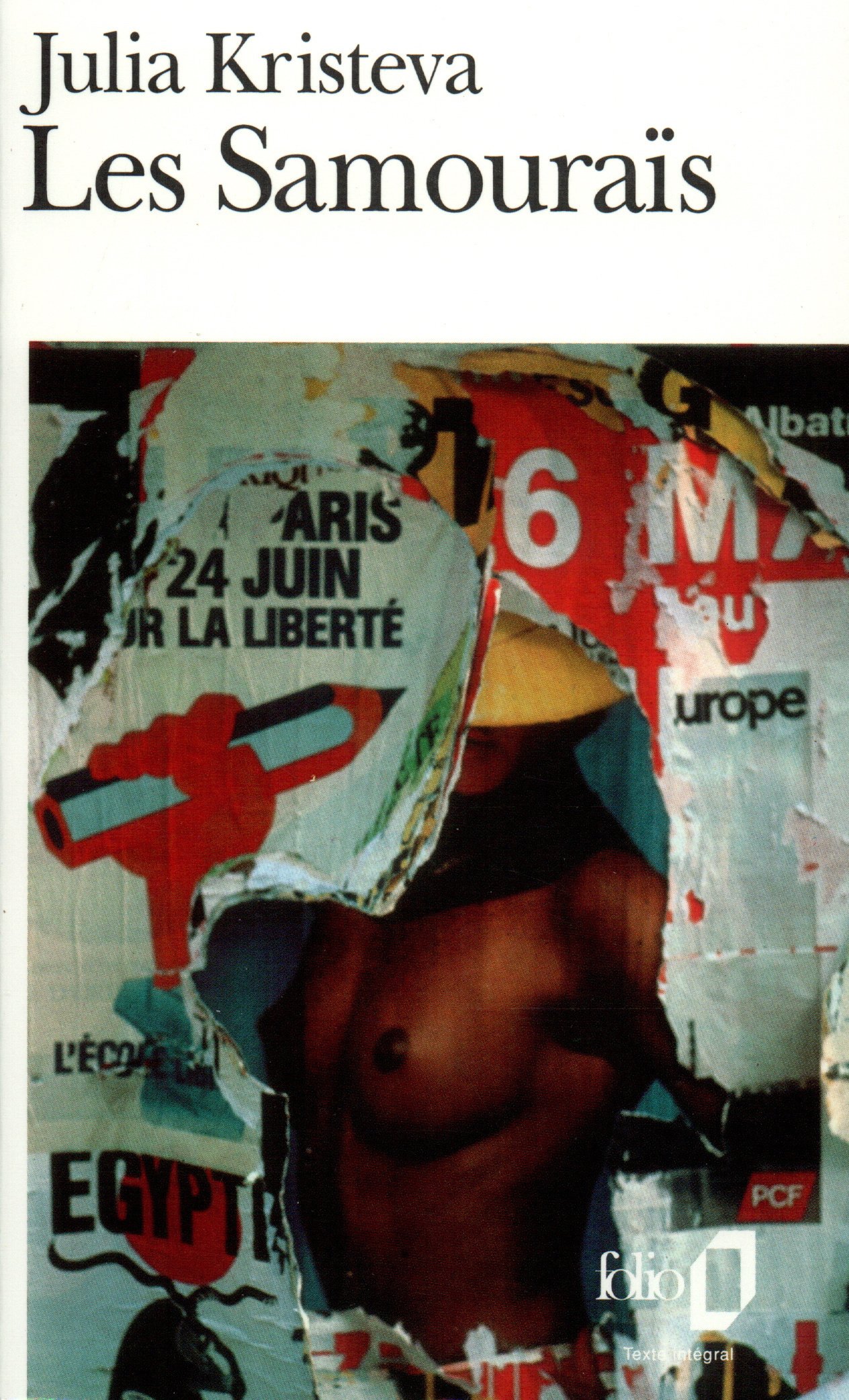
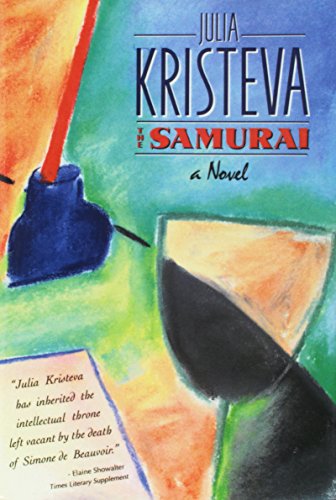
Julia Kristeva’s first novel The Samurai was published in 1990. It’s not the greatest novel, but it’s well known that the book is a thinly disguised autobiography, with the central character Olga Morena modelled on herself. Many of the famous names of ‘French theory’ feature – there is one who has written a history of madness, an anthropologist with an interest in linguistics, a Marxist who murdered his wife, a flamboyant and adulterous psychoanalyst, a semiotician who analyses literature and popular culture… The group around the Tel Quel journal are featured, the journal renamed Maintenant, including Kristeva’s husband Philippe Sollers, with their 1974 trip to China a particularly important moment in the story.
I’d read The Samurai before, but reread it recently, in part because of an interest in the China visit (on which, more soon [now here]). The other reason was because Kristeva knew Émile Benveniste in the last years of his life, and he appears in the book as Fernand Benserade. I knew this in part already, but I wanted to revisit how close the descriptions of ‘Benserade’ are to the memories of Benveniste that Kristeva shares in her various writings on him.
Olga is told that Ilya Romanski (Roman Jakobson) will be working with Benserade to set up an International Semantics Society, and she is appointed as general secretary. Here’s the longest description from the novel:
The inaccessible Benserade, who knew forty languages, spoke twenty, and because of his intelligence ruled the frisky computer logicians with a rod of iron, invited them and Olga to his place to prepare for the London meeting of the international Semantics Society. The apartment was dimly lit, full of the smell of fusty books, and pervaded by the fastidious bachelor charm of its owner, seventy years old and shy as a schoolboy. Watching him bring in the trolley laden with coffee and cookies. Carole saw him as a medieval monk. But no – he was a faithful subject of the Utopian asterisk prefixed to Indo-European words that are supposed to belong to the premigratory period. He soared so far above human necessity that there was nothing animal left about him. Yes, that was it – Benserade was a plant, he might have had a place in her garden. Or even in the loft itself: a faithful man, the only faithful man. A conifer. A cypress. She’d put him in the sun to fill him with air and chlorophyll (Les Samouraïs, 133-34; The Samurai, 100).
She also mentions her asking him about signing the Surrealist Manifesto “Révolution d’abord et toujours” in 1925, which he initially tried to pass off as a coincidence of names, before admitting to her in private that it was him, but now as a Professor at the Collège de France he had to keep up appearances (134-35/101). Much later in the book Olga’s friend Carole recounts how at a conference, “Benserade, who always behaves himself, was as bored as a schoolboy in an algebra lesson, but surreptitiously read Artaud’s Letters from Rodez while the others were droning out their papers” (274-75/206), and how he said that the two genius figures of French linguistics were Artaud and Mallarmé (275/206).
Olga also mentions his stroke, how he was found unable to speak and without identification papers, and that it took two days before the medical care knew who he was (233/309). He had not kept up his health insurance and was in poor-quality institutions, when his friends felt he should be in a private clinic and were debating what could be done to support him (235/312-13). She recounts one visit to him, in which he shakingly traced the word ‘theo’ on her chest with his finger, and how she wonders what this meant for his long-buried Jewish faith (235-36/313).
All of these moments are interesting, but if they were simply written in a novel, even one as transparent as this, I would be hesitant in making much of them. In case it was not already obvious, in a 2018 article Kristeva spells out who everyone is and her purpose in writing it: “Arnaud Bréal (Barthes), Maurice Lauzun (Lacan), Strich-Meyer (Lévi-Strauss), Wurst (Althusser), Sterner (Foucault), Edelman (Goldmann), Benserade (Benveniste)” (“L’Avenir d’une révolte”, 6). Even though the portraits of figures in the book are easy to identify, it is a novel, and there are some elements which seem unlikely to have happened in quite that way.
But the stories about Benserade are not simply plausible from other sources, they are also recounted by Kristeva herself, either in her writings about Benveniste – she wrote a preface to his Dernières leçons/Last Lectures, for example – or interviews. Here, for example, is her description of visiting Benveniste for the work on the International Association of Semiotic Studies:
Our meetings took place at his home, in the rue Monticelli, near the Porte d’Orléans. Still today I remember his office as a ‘sacred’ place (so it appeared to the timid girl I then was), in which the great scholar, with his smile of vivid intelligence, seemed to guard the secrets of the immemorial Indo-European and Iranian worlds. It was a rather dark office, where books carpeted the walls and strewed the floor, old library stock of which the odour, mixed with the steam of tea which, along with dry biscuits that we never touched, for me evoked ancient parchment scrolls. The administrative details quickly dispensed with, the professor enquired about my work… During these meetings Benveniste acted as teacher, protector and attentive listener (“Préface”, 34-35; “Preface”, 21).
She recalls this in similar terms in her book of interviews with Samuel Dock (Je me voyage, 100-1). In her writings, she says that it was her copy of Artaud’s Letters from Rodez that he asked to borrow, and that he told her about the genius of Artaud and Mallarmé. Kristeva’s early work on literature and linguistics means he would have found a receptive ear.
I’ll be discussing Kristeva’s debt to Benveniste, especially in her early work, elsewhere. As well as her early books, she led two collections honouring him – a special issue of Langages in 1971 with the title “Epistémologie de la linguistique”, and the Langue, discours, société book she edited with Jean-Claude Milner and Nicolas Ruwet. Those are important, certainly, as analyses of his work, but the biographical comments she makes about him are particularly valuable since he was such a private man and little about his life is well-known.
References
Julia Kristeva ed. “Les Épistémologies de la linguistique”, Langages 24, 1971.
Julia Kristeva, “Mémoires”, L’Infini 1, 1983, 39-54.
Julia Kristeva, Les samouraïs, Paris: Fayard, 1990; The Samurai: A Novel, trans. Barbara Bray, New York: Columbia University Press, 1992.
Julia Kristeva, “Préface: Émile Benveniste, un linguiste qui ne dit ni ne cache, mais signifie”, in Benveniste, Dernières leçons, Émile Benveniste, Dernières Leçons: Collège de France 1968 et 1969, ed. Jean-Claude Coquet and Irène Fenoglio, Paris: EHESS/Gallimard/Seuil, 2012, 13-40; “Preface: Émile Benveniste, a Linguist Who Neither Says Nor Hides, but Signifies”, in Last Lectures: Collège de France 1968 and 1969, trans. John E. Joseph, Edinburgh: Edinburgh University Press, 2019, 1-30.
Julia Kristeva, “La linguistique, l’universel et le ‘pauvre linguiste’” in Irène Fenoglio et. al. Autour d’Émile Benveniste, Paris: Seuil, 2016, 97-152.
Julia Kristeva, Je me voyage: Mémoires—Entretiens avec Samuel Dock, Paris: Fayard, 2016.
Julia Kristeva, Jean-Claude Milner and Nicolas Ruwet eds., Langue, discours, société: Pour Émile Benveniste, Paris: Seuil, 1975.
Julia Kristeva, “L’Avenir d’une révolte”, L’Infini 143, 2018, 3-11 (French; English).
This is the 68th post of a weekly series, posted every Sunday throughout 2025, and continuing into a second year. The posts are short essays with indications of further reading and sources. They are not as formal as something I’d try to publish more conventionally, but are hopefully worthwhile as short sketches of histories and ideas. They are usually tangential to my main writing focus, a home for spare parts, asides, dead-ends and possible futures. I hope there is some interest in them. They are provisional and suggestions are welcome. A few, usually shorter, pieces in a similar style have been posted mid-week. I’m not sure I’ll keep to a weekly rhythm in 2026, but there will be at least a few more pieces.
The full chronological list of ‘Sunday histories’ is here, with a thematic organisation here.
Discover more from Progressive Geographies
Subscribe to get the latest posts sent to your email.


Pingback: Indo-European Thought in Twentieth-Century France update 32 – trying to improve a draft | Progressive Geographies
Pingback: Tel Quel goes to China: Sollers, Kristeva, Barthes, Pleynet, Wahl and the Cultural Revolution | Progressive Geographies
Pingback: Hypomnemata: April 2026 | Toby Bennett
Pingback: Julia Kristeva’s Dostoyevsky – from Mikhail Bakhtin and Hans Holbein to psychoanalysis, religion and language | Progressive Geographies
Pingback: Forty years since the death of Georges Dumézil and fifty since that of Émile Benveniste | Progressive Geographies