
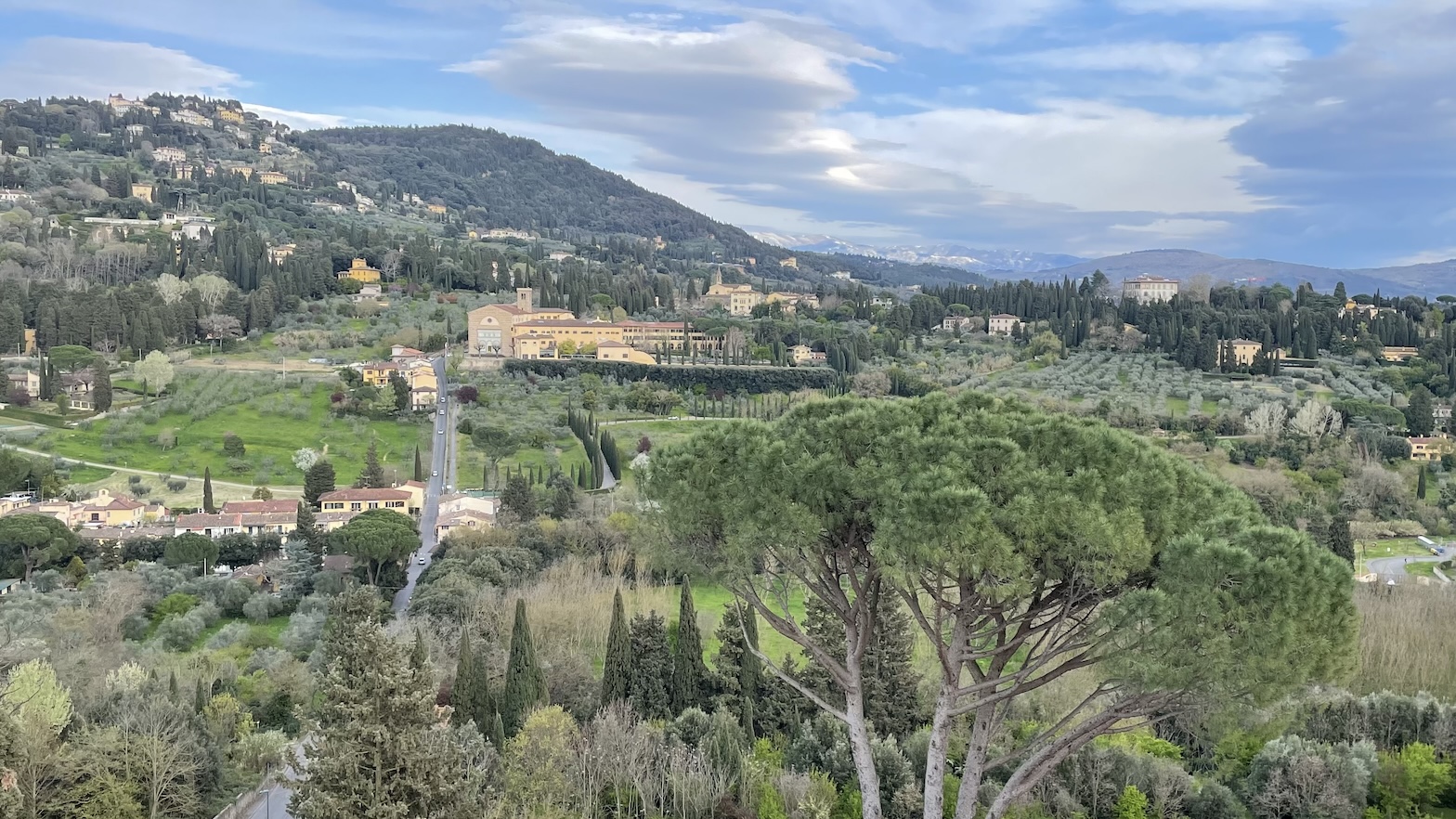
As I said in the last update, I went to the EUI in Florence at the beginning of February with a nearly complete draft of my manuscript on Indo-European Thought in Twentieth-Century France, and had the plan to leave at the end of March with a better one. I made good progress while there, and the text is definitely much better now, though there is still work ahead of me.
The early chapters were in worse shape. There were some things I’d left undeveloped, some of which were left in that state when I became unwell in June 2023 and was off work for several months, but which I didn’t fully resolve when I returned to work. Now these sections really needed to be finished and all those issues resolved.
In some ways I appreciated the small bits which needed to be written, rather than just edited. Like I imagine most people, I find editing difficult, and often tedious, and it was nice to have some more creative bits to do. I’ve said before that I like not knowing how a text is all going to come together until late in the process, since it helps to keep my interest. As soon as I know exactly what I need to do to complete something it becomes mechanical and I want to do something else. But I was often cursing my past self for leaving little indications like “[discuss]” and “[develop]” and “[find source]” in the text or notes.
There was also the inevitable revision which comes from having a clearer sense of the whole towards the end of this stage of writing than I had when I drafted the earlier parts. I’d tried to resolve most of the reference questions before I left the UK, but inevitably there were a host of things to check. Some were easily resolved at the EUI, others could be found online, but there were quite a few which needed inter-library loans or had to be addressed back in the UK.
A few relevant secondary pieces have been published since I drafted early parts, and I’ve tried to take these into account. There are a lot of archival sources which I’ve been using, and some of those I have seen since the initial chapters were drafted, so what they reveal needed to be worked into the narrative. In a few cases, I realised I now no longer agreed with what I’d initially written – new evidence had come to light, later claims required a revision of earlier ones, or I was just wrong before.
There were transitions which needed work, or framing devices for chapters or sections. Some of these felt like putting the last few pieces into a jigsaw – a nice feeling when something begins to feel right.
There are also a lot of fiddly things – working with two different editions of a text at different times, and wanting to reference a single one, or using a collected works or essay collection in preference to individual pieces. My practice of double referencing to the original language and an English translation requires a bit of work. I might have had access to a translation after I’d drafted something, or written it with only the translation, and going back to the original changed how I saw it. Standardising the translation of terms can take some time. I had often put the original language text in the note, which was helpful now, but could be deleted once I’d decided what choices to make. In a few instances I had references to a source cited by someone else, and I wanted to find and read the original. This is nearly always worthwhile. Lots of things were read again in whole or in part. And there is a continual process of new reading.
There are a few things remaining where I cannot find the source. Where does, for example, Georges Charachidzé recount that particular anecdote I remember him saying about Dumézil? If two secondary accounts give a different date for someone leaving an editorial board, which is correct? If I can find a quote in a text-only version of a book, then I know the source is correct, but what’s the original page number? Why doesn’t the page number of a quote match the edition I have access to? Is that letter mentioned by someone genuine, when their archival reference does not make sense and it’s not in the collected correspondence of those two people? Is that date of a letter correct, or have they misread the often-awful handwriting? Where did that archival file go, if it is missing from the place it should be, and the archivist cannot find it? Will that file at the Archives Nationales ever be available again, since for two years it’s been withdrawn due to asbestos testing in the warehouse? And would I want to experience the archival dust on it if it was? There are a lot of these things, which are on a long list which keeps having things added to it, and occasionally things ticked off.
Some of the recent Sunday Histories have explored little things I found while doing this work, and some have made use of notes I’d initially taken for this book but which won’t be included for thematic fit, or word length. So, while I mention the pieces written by Benveniste and Dumézil in a politically charged 1936 Festschrift in the manuscript, there was a longer story which I thought was worth telling: The French contributors to Herman Hirt’s 1936 Festschrift: Linguistics, Nationalism and Nazism. I only briefly mention Umberto Eco, since I largely try to keep to the French focus, but he connects in lots of interesting ways to people I am writing about, so I wrote a short piece to coincide with the tenth anniversary of his death: Umberto Eco, Philosophers, Mythologists and Linguists. I’ve mentioned this event in a few publications, since it is one of the most important places Foucault discusses his debt to Dumézil, but I wrote up a longer summary of A 1970 French interdisciplinary seminar on structuralism. I also wrote about what happened to the limited copies of the 1940 edition of Dumézil’s Mitra-Varuna; about Maurice Blanchot’s war-time reviews of Dumézil, and the broader question of his politics; about a couple of Dumézil’s dedications, Georges Redard’s plans for a linguistic atlas of Iranian languages and about Walter Bruno Henning, Franz Altheim and the Politics of Reviews.
I have a few more pieces for that series in development – about the time a few people from the Tel Quel journal went to China, including Roland Barthes and Julia Kristeva, and the life and work of Maria Antonietta Macciocchi, which is a digression from a digression, but which I’ve found interesting to write a little about. Most recently, I wrote a short piece on Kristeva’s portraits of Benveniste, especially in her novel The Samurai. And I returned to an earlier piece and revised it for this series, about Foucault’s 1972 visit to Attica prison.
On the last day in Florence I drafted the Conclusion. I had plenty of notes for this already, and moved some material from earlier in the text into it, but it felt like a good way to bring my time there to a close. I’ve been back in the UK for a while and am now working in various libraries to try to complete the manuscript.
I also now know what the next project will be, after I complete this text and the editorial work on the new translation and edition of Foucault’s Birth of the Clinic. It will look at the experience of French academics who were prisoners of war in Germany during the Second World War. Some elements are known but there are a lot of underexplored stories. I’ve written about two of the people I’ll be discussing – Étienne Wolff and Fernand Braudel – on this site, and about the general idea beyond the project here. Again, it will be archive-based and I’ve just received a small grant to fund that work. It won’t begin until the late summer, and will be fitted around teaching over the next couple of years.
Previous updates on this project can be found here, along with links to some research resources and publications. The re-edition of Georges Dumézil’s Mitra-Varuna is available open access. My recent articles include “Foucault, Dynastics and Power Relations” in Philosophy, Politics and Critique and “Foucault and Dumézil on Antiquity” in Journal of the History of Ideas (both require subscription, so ask if you’d like a copy); and “Alexandre Koyré and the Collège de France” in History of European Ideas (open access).
The full chronological list of ‘Sunday histories’ is here, with a thematic ordering here.
Discover more from Progressive Geographies
Subscribe to get the latest posts sent to your email.


