
Kevin Inston, Rethinking the Politics of Belonging: Towards a Theory of Improper Community – Edinburgh University Press, May 2026
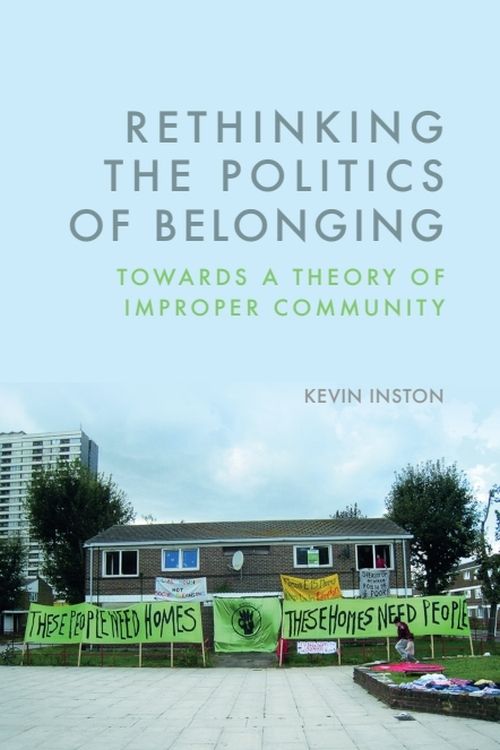
Develops an original understanding of community as asserting a common world rather than an exclusive identity, ethnicity or territory
- Builds an elucidating dialogue between four major theorists (Jean-luc Nancy, Jacques Rancière, Chantal Mouffe and Bonnie Honig) to rethink community in an open, inclusive and democratic form
- Analyses the strategies, principles, institutions and obligations that could foster and maintain the possibility of community without fixed identity and boundaries
- Explores examples including French Republican Racial Politics, proto-feminist movements, Black Lives Matter, recent housing and ecological occupations to interrogate and enrich the theoretical insights
- Engages the work of a wide range of other important thinkers including Giorgio Agamben, Hannah Arendt, Judith Butler, Jacques Derrida, Mark Devenney, Roberto Esposito, Ernesto Laclau, John Rawls, Michael Sandel, Karl Schmitt and recent work in critical legal studies and critical race theory to contextualise and critique my main theories
Community has conventionally been understood as a unifying property (identity, ethnicity, territory) that establishes relations of belonging and non-belonging. However, that understanding necessarily causes exclusion and disenfranchisement, contradicting the idea of being together community implies. Through an original dialogue between four major thinkers (Jean-luc Nancy, Jacques Rancière, Chantal Mouffe and Bonnie Honig), Kevin Inston presents an alternative account of community which affirms its irreducibility to property and resistance to appropriation so that it remains available to diverse identities, practices and opinions.
Improper communities promote a shared world in which everyone counts equally. Rethinking the Politics of Belonging examines the strategies for refusing enclosure of the common, the rules and principles that could prevent identarian politics, and the ethos and public things that could affirm community as sharing rather than property. Exploring examples including Black Lives Matters, proto-feminist movements and recent housing and ecological occupations, it demonstrates how improper communities could reinvigorate democracy by enacting and defending universal freedom and equality.
Discover more from Progressive Geographies
Subscribe to get the latest posts sent to your email.


Pingback: New Read:Kevin Inston, Rethinking the Politics of Belonging: Towards a Theory of Improper Community – Edinburgh University Press, May 2026 | Rashid's Blog: A Place for Inquisitive Souls