
Maria Antonietta Macciocchi (1922-2007) was a journalist, politician and academic. She is known for works including Daily Life in Revolutionary China (Italian and French in 1971; English in 1972). Her work on China was heavily criticised, and one example would be a roundtable organised by Esprit published in the journal to which she replied in November 1972.
This book was, however, important for the Tel Quel group, especially Philippe Sollers, and it was through Macciocchi that the Tel Quel group were invited to make their 1974 trip to China, which I write about here. That story intrigued me, and I was led from her obituary by John Francis Lane to pieces by Jadwiga Tedeschi and Robyn Marasco. There are periodic statements of her importance, but little of her work is translated and she seems to be rarely cited. This is a shame, since her work, especially on fascism, is particularly relevant today.
Macciocchi edited the Noi Donne magazine of the Italian Community Party, and later Vie Nuove, as well as writing for Unità, the paper founded by Antonio Gramsci. She studied in Paris, and later taught at the experimental University of Vincennes which was founded after May 1968.
She stood as the Italian Communist Party (PCI) candidate in a district in Naples in 1968, perhaps most interesting today because during her campaign she corresponded with Louis Althusser, about how to translate his theories and her political perspectives into a practical election campaign. Her letters about the campaign were published in Italian in 1969, in French in 1972, and translated as Letters from Inside the Italian Communist Party to Louis Althusser in 1973. The original Italian included some letters from Althusser, which are translated in the English edition, but he requested they were not included in the French edition. Macciocchi said that the letters “provided guidance and suggestions of approach [il y a donnait des indications et des suggestions de méthode]” but he believed, for reasons she did not want to judge, that “his letters would add nothing to the work [ses letteres n’ajouteraient rien à l’ouvrage]” (“Avant-propos pour l’édition française”, p. 8). Some contributions to the subsequent debate within the party were included in the second Italian edition and the translations. She was not selected to run again in 1972, in part because of her criticisms of the party in the Letters book. Her interest in China seems to have developed into a full turn to Maoism and she was eventually expelled from the PCI.
Her Pour Gramsci was published in the Tel Quel book series with Éditions du Seuil in 1974. A wide-ranging study of his work, it was important in the re-introduction of his work to French readers. Although some of his prison writings were translated in 1953, and his Oeuvres choisies in 1959, his Écrits politiques only began to be published in French in 1974. Cold War politics and internal divisions within French Marxism were behind some of the delays in his work becoming available in French. (The story of the early reception of his work in France has recently been told by Marco di Maggio, Camilla Sclocco and Anthony Crézégut. Crézégut’s article mentions a forthcoming book on Gramsci in France, but I have found no other trace of this.) The original edition of Pour Gramsci included texts by Gramsci in annexes; these were removed in the later reprints.
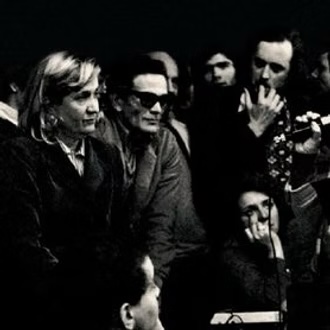
Macciocchi taught a seminar at the University of Vincennes in 1974-75, Éléments pour une analyse du fascisme, the proceedings of which were published in two volumes in 1976. It included contributions from François Châtelet, Jean-Toussaint Desanti, Jean-Michel Palmier and Nikos Poulantzas. Poulantzas’s book on Fascism and Dictatorship had been published in 1970, and in this seminar he presented on the popular impact of fascism. Macciocchi presented on Gramsci’s theory of fascism, and fascism and women. The seminar was also interesting because it screened a lot of films with discussion. One of these was Nico Naldini’s 1974 film Fascista, with a discussion between Naldini and Pier Paolo Pasolini. The seminar is discussed by Alberto Toscano in Late Fascism (pp. 143-44) and briefly mentioned in an interview about the book. Macciocchi insists that the analysis had a political urgency, rather than just a historical interest (Vol I, 7).
Macciocchi’s 1976 book La Donna “Nera”: Consenso Femminile e fascismo [The ‘Black’ Woman: Female Consent and Fascism] has not been translated and is long out of print. It develops some themes of her teaching in Paris, arguing that an account of fascism also needs to discuss patriarchy. The “black” of the title refers not to race but to the Blackshirts, the squadristi or paramilitary squadrons of Fascist Italy. A shorter version of some of her arguments appeared in Tel Quel in 1976 and this was translated in Feminist Review in 1979, with an introduction by Jane Caplan. In the article, she describes Mussolini’s invention of the “female death squadron (widows, and mothers in mourning or semi-mourning)” for soldiers lost in the First World War, and his design for their “female dress, a dismal black uniform with a skull on the breast, for the women squadron members who attack ‘the Reds’ with daggers and hatpins” (p. 29/p. 70). The article was based on a 1975 conference paper in Milan, the proceedings of which were published as Sexualité et politique. That volume also contains papers by Sollers, Robert Castel, Luce Irigaray, Marcelin Pleynet and others.
A few days after the 1 November 1975 kidnap, torture and murder of Pasolini, she wrote a piece in Le Monde. She said that the crime was political, and she accuses Italian society as a whole, rather than just the actual murderers, because they “could not bear his defiance (of sexual, political, and artistic prohibitions)”. She continued to speak about the case, including a November 1977 piece in La Repubblica. The French version was read at a February 1978 conference in Paris and appeared in Tel Quel later that year and then in English in October. She led a seminar 10-12 May 1979 at the Italian Cultural Institute in Paris and at Vincennes about him, with contributions by Italo Calvino, Sollers, Pleynet, Christine Buci-Glucksmann, Alain Finkielkraut and others, which was published as an edited book in 1980.
Much of her work could be seen as Freudian-Marxist, with an influence particularly from Wilheim Reich, alongside Althusser and Gramsci. This was condemned by other parts of the left, and her seminar was disrupted by protests. This was not at all uncommon at Vincennes. Some of the pamphlets against her are reproduced in the book from the fascism seminar (Vol II, 427-38). She ran seminars on fascism and women, feminine and feminist struggles and Marxism and feminism at Vincennes between 1975 and 1978, parts of which were edited as Les femmes et leurs maîtres in 1978.
She was a member of the European parliament between 1979 and 1984 for the Radical party. I don’t know much about her later work, but she seems to have turned from Maoism to Catholicism, writing an admiring book about Pope John Paul II.
References
Marianne Bastid et. al. “Comment connaissons-nous la Chine? Table Ronde”, Esprit 418, 1972, 579-608.
Jane Caplan, “Introduction to ‘Female Sexuality in Fascist Ideology’”, Feminist Review 1, 1979, 59-66.
Anthony Crézégut, “Gramsci’s Imaginary Prisons: Genealogy of a First French Edition (1947–1959)”, trans/ Sandrine Sanos and Sylvia Schafer, History of the Present: A Journal of Critical History 15 (2), 2025, 143-69.
Marco di Maggio, “‘Misunderstandings of hegemony’: Gramsci in the French Communist Party (1953–1983)”, Actuel Marx 62 (2), 2017, 154-69.
John Francis Lane, “Obituary: Maria Macciocchi”, The Guardian, 21 May 2007, https://www.theguardian.com/news/2007/may/21/guardianobituaries.italy
Maria Antonietta Macciocchi, Lettere dall’interno del PCI a Louis Althusser, Milano: Feltrinelli, 1969; Lettres de l’intérieur du parti: le Parti communiste, les masses et les forces révolutionnaires pendant la campagne électorale à Naples en mai 1968, Paris: François Maspero, 1970; Letters from Inside the Italian Communist Party to Louis Althusser, trans. Stephen M. Hellman, London: NLB, 1973.
Maria Antonietta Macciocchi, Daily Life in Revolutionary China, London and New York: Monthly Review, 1972.
Maria Antonietta Macciocchi, Pour Gramsci, Paris: Éditions du Seuil, 1974; Paris: Seuil/Points, 1975.
Maria-Antonietta Macciocchi, “Le Crime est politique”, Le Monde, 13 November 1975, 19.
Maria Antonietta Macciocchi, Éléments pour une analyse du fascisme: séminaire Paris VIII-Vincennes, 1974-1975, Paris: Union Générale d’Éditions, two volumes, 1976.
Maria Antonietta Macciocchi, La Donna “Nera”: Consenso Femminile e fascismo, Milano: Feltrinelli, 1976.
Maria Antonietta Macciocchi, “La sexualité féminine dans l’idéologie fasciste”, Tel Quel 66, 1976, 26-42; reprinted in Sexualité et politique: actes du colloque de Milan, 1975, Paris: UGE 10/18, 1977, 239-73; “Female Sexuality in Fascist Ideology”, Feminist Review 1, 1979, 67-82.
Maria Antonietta Macciocchi, Les femmes et leurs maîtres: Séminaire Paris VIII-Vincennes, ed. Jacqueline Aubenas-Bastié, Bourgois, 1978.
Maria-Antonietta Macciocchi, “Pasolini: assassinat d’un dissident”, Tel Quel 76, 1978, 27-39; “Pasolini: Murder of a Dissident”, trans. Thomas Repensek, October 13, 1980, 11-21.
Maria-Antonietta Macciocchi ed., Pasolini: séminaire, Paris: Bernard Grasset, 1980.
Robyn Marasco, “Reconsidering the Sexual Politics of Fascism”, Historical Materialism, 2021,https://www.historicalmaterialism.org/reconsidering-the-sexual-politics-of-fascism/
Nicos Poulantzas, Fascisme et Dictature: La IIIe Internationale face au fascisme, Paris: Seuil/Maspéro, 1974 [1970];Fascism and Dictatorship: The Third International and the Problem of Fascism, trans. Judith White, London: NLB, 1974.
Nikos Poulantzas, “À propos de l’impact populaire du fascisme”, in Maria Antonietta Macciocchi, Éléments pour une analyse du fascisme: séminaire Paris VIII-Vincennes, 1974-1975, Paris: Union Générale d’Éditions, two volumes, 1976, Vol I, 88-107; “On the Popular Impact of Fascism”, The Poulantzas Reader, ed. James Martin, London: Verso, 2008, 258-69.
Camilla Sclocco, “Gramsci’s France and Gramsci in France”, International Gramsci Journal 5 (1), 2023, 109-23.
Jadwiga Tedeschi, “Maria Antonietta Macciocchi”, Woman is a Rational Animal, 8 December 2020, https://womanisrational.uchicago.edu/2020/12/08/maria-antonietta-macciocchi/
Alberto Toscano, Late Fascism: Race, Capitalism and the Politics of Crisis, London: Verso, 2023.
Alberto Toscano and Evan Calder Williams, “A Conversation on Late Fascism”, e-flux, 15 March 2024, https://www.e-flux.com/notes/596103/a-conversation-on-late-fascism
Armando Verdiglione ed. Sexualité et politique: Documents du congrès international de psychanalyse, Milan 25-28 novembre 1975, Paris: U.G.E., 1977.
This is the 71st post of a weekly series, posted every Sunday throughout 2025, and continuing into a second year. The posts are short essays with indications of further reading and sources. They are not as formal as something I’d try to publish more conventionally, but are hopefully worthwhile as short sketches of histories and ideas. They are usually tangential to my main writing focus, a home for spare parts, asides, dead-ends and possible futures. I hope there is some interest in them. They are provisional and suggestions are welcome. A few, usually shorter, pieces in a similar style have been posted mid-week. I’m not sure I’ll keep to a weekly rhythm throughout 2026, but there will be at least a few more pieces.
The full chronological list of ‘Sunday histories’ is here, with a thematic organisation here.
Discover more from Progressive Geographies
Subscribe to get the latest posts sent to your email.


Brilliant post. Though I’ve heard of her for years, going back to when I lived n Paris, only really got informed after reading her autobiography (French version) Deux mille ans de bonheur. It’s so informative have read my livre de poche three times.
Thank you Andrew. I have recently got that book, but not yet read it. Sounds interesting.
Pingback: Georges Bataille, Roger Caillois and the Question of Fascism | Progressive Geographies