
Most of Georges Bataille’s earliest writings were literary, and between 1929 and the early 1930s he was the editor of Documents, an art and literary journal (scans are available on Gallica). Most of his articles there were included in the first volume of his Œuvres complètes, and several were included in the Encyclopædia Acephalica. (An attempt at a comprehensive listing of English translations of his work is here.)
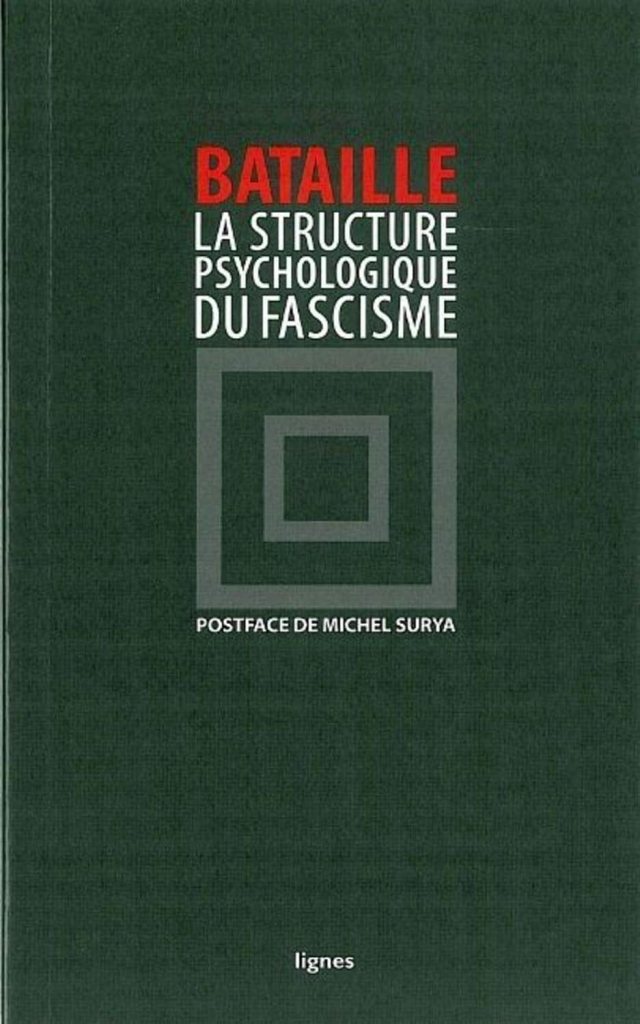
In the early 1930s he wrote increasingly political texts, including “The Psychological Structure of Fascism”, which was published in La Critique sociale in two parts in late 1933 and early 1934 (included in Œuvres completes Vol I, 339-71, as a short book with Éditions Lignes in 2009, and translated in Visions of Excess, 137-60). A crucial moment for Bataille seems to have been the Veterans’ Riot of 6 February 1934, when the police and right-wing groups clashed in Paris, and the leftist protests which followed the next week. This context is usefully discussed by Susan Rubin Suleiman in “Bataille in the Street” and Chapter 1 of Dudley Andrew and Steven Ungar’s Popular Front Paris and the Poetics of Culture. Bataille’s editor Denis Hollier reports in the wake of these events that “Bataille planned to write a book titled Le fascisme en France” (Absent without Leave, 60). This was never completed, but the surviving notes for this project were published in the posthumous Œuvres complètes (Vol II, 205-13, 214-21; untranslated).
In the mid-1930s Bataille combined these different interests in at least three groups. One was the Collège de Sociologie. The Collège was a loose grouping of intellectuals, founded by Bataille with Roger Caillois and Michel Leiris. Walter Benjamin, by this time in exile in Paris, regularly attended the Collège’s meetings, but never spoke there. A session was planned, but the war ended the Collège’s work. Famously, Benjamin gave Bataille several manuscripts for safekeeping in the Bibliothèque nationale before he fled Paris in June 1940.
The texts of the Collège were collected by Hollier in a French text, an expanded English translation, and a later revised French text (Le Collège de Sociologie/The College of Sociology). Each contains material not in the previous edition. There are some good studies of the Collège in relation to wider developments in French sociology, including by Michèle H. Richman, Simonetta Falasca-Zamponi and Stephan Moebius.
While the Collège was the public-facing front of Bataille and his colleagues’ work, at the same time he was editing the short-lived journal Acéphale, mostly written by him and whose contributors included Caillois, Pierre Klossowski and Jean Wahl. A reproduction of the journal’s five issues (issue 3-4 was a double volume) was published in 1980, but that’s almost as hard to find as the original. Scans are available online at Monoskop. The declaration of the Collège first appeared in the pages of Acéphale in 1937 (Œuvres complètes, Vol I, 491-92; The College of Sociology, 5), as did an important piece defending Friedrich Nietzsche from the fascist interpretation (Œuvres complètes, Vol I, 447-65; Visions of Excess, 182-96). This piece anticipated the arguments of Bataille’s pre-war book on Nietzsche. There was also a parallel secret society of the same name as the journal. The secret society remained largely unknown until some recent work which has brought it better to light. These include the Encyclopædia Acephalica, edited by Alastair Brotchie and The Sacred Conspiracy: The Internal Papers of the Secret Society of Acéphale and Lectures to the College of Sociology, edited by Marina Galletti and Brochie. One notorious story is that the group planned a human sacrifice, but while they had volunteers to be the victim, no-one was willing to wield the knife.
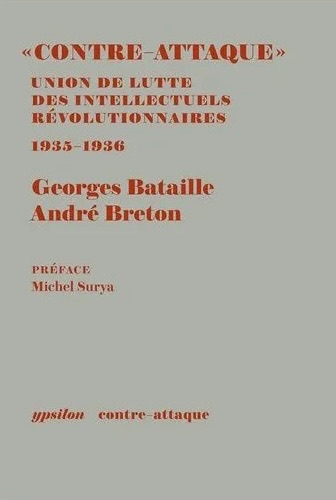
Bataille was also part of the anti-fascist Contre-Attaque group, along with André Breton and Caillois. Some Contre-Attaque publications were collected in the first volume of Bataille’s Œuvres complètes, but a more comprehensive collection of Bataille and Breton’s work, and other documents was published in 2013. Benjamin met with the group shortly before its dissolution, in January 1936, having been introduced by Klossowski. (The “Chronology” included in each volume of Benjamin’s Selected Writings is helpful on his Paris connections; so too is Paul Foss-Heimlich’s postscript to Klossowski, Living Currency).
Despite Bataille’s writings on fascism, and the aim of Contre-Attaque, this has not stopped criticism for an ambiguous attitude, particularly in relation to the group’s interest in fascist symbols. Klossowski, for example, describes the “muted, equivocal attraction [l’attirance sourde, equivoque]” of fascism for Bataille, despite despising fascists themselves (interview in Jean-Maurice Monnoyer, Le Peintre et son démon, 189). Klossowski discusses this question in Un si funeste désir/Such a Deathly Desire, Chapter 5. Benjamin also apparently suggested that Bataille’s articles, particularly “The Notion of Expenditure”, “were working to the advantage of fascism!” That may well be true, but in trying to find the source, the references lead back to an article by Giorgio Agamben (“Bataille e il paradosso della sovranità”, 115; “Bataille and the Paradox of Sovereignty”, 249) in which he reports Klossowski’s recollection of this, many years after the event. Agamben reports Klossowski recalled Benjamin said is not the most direct of sources (see Hollier, Absent without Leave, 207 n. 3). [see Update below for a better source.]
Alexandre Kojève had also criticised Bataille and Caillois for wanting to be sorcerer’s apprentices, initiating a sense of the Sacred which would return to inflame them. He was critical of this move: “a thaumaturge, for his part, could no more be carried away by a sacred knowingly activated by himself, than could a conjurer [prestidigitateur] be persuaded of the existence of magic while marvelling at his own sleight of hand”. Caillois reports this in some much later texts (Approches de I’imaginaire, 59; Gilles Lapouge, “Entretien avec Roger Caillois”). It has been discussed by, for example, Hollier (The College of Sociology, 12-13) and Patrick ffrench (After Bataille, 18-19). This accusation was the spur to Bataille appropriating the term “Sorcerer’s Apprentice” for an essay. That piece was one of four texts the Collège published in the Nouvelle Revue française in July 1938, which had an Introduction by Caillois, his text “The Winter Wind”, and Leiris’s “The Sacred in Everyday Life” (reprinted in Le Collège de Sociologie, 94-118, 302-53; The College of Sociology, 7-42).
Bataille’s biographer Michel Surya takes a strong interpretative line on Bataille’s anti-fascism, indicating the pieces he wrote, and the claims within them. His account is in part a defence of Bataille against Klossowski’s charge. One key text he indicates is the Collège’s declaration on the Munich Crisis, dated 7 October 1938, published at the start of November, and signed by Bataille, Caillois and Leiris (Le Collège de Sociologie, 355-63; The College of Sociology, 43-46). For Surya: “The clarity of this declaration, its forcefulness… cut through any charge of equivocation” (Georges Bataille, 309-10/267). Any ambiguities in the text are, for Surya, superficial, and he contends that Bataille was “one of the most peremptory antifascists as early as 1933” (Surya, Georges Bataille: La mort à l’œuvre, 273 n. 23; reworked in the later edition 309-10/267-68; see Hollier, Absent without Leave, 206 n. 3). Hollier broadly follows Surya’s line about Bataille’s anti-fascism, discussing the Collège and accusations of “ideological ambiguity” (Absent without Leave, Ch. 6, the quote is on 76). He, however, adds some qualifications to this account. He stresses that it was Caillois, not Bataille, who wrote the declaration on the Munich crisis, as shown by their correspondence (Bataille to Caillois, 10 November 1938).
Maurice Blanchot first met Bataille in December 1940, and reports that Bataille came to have some doubts about “The Psychological Structure of Fascism”, because it “might lend itself to more than one reading”. Nonetheless Blanchot is certain that Bataille in 1940 was horrified by Nazism, the Philippe Pétain-led Vichy regime and its ideology (Les Intellectuels en question, p. 41 n. 7; The Blanchot Reader, p. 226 n. 8).
However, as I have discussed in an earlier piece in this series, Maurice Blanchot’s Politics and His War-Time Reviews of Georges Dumézil, Blanchot’s own political position in this period have long been questioned. In his accusations against Dumézil, Carlo Ginzburg also draws links between his politics and those of the Collège, though not the connection to Blanchot. I’ve discussed those criticisms and the responses by Dumézil and Didier Eribon in the introduction to the recent re-edition of Dumézil’s Mitra-Varuna (open access), and will return to them in future work. For now, the point is about how Ginzburg associates Dumézil with the work of the Collège and his more general criticisms of Bataille and Caillois. In a more recent piece included in his Secularism and its Ambiguities, Ginzburg claims that Bataille and Breton’s counter-attack rather than defence risked “a slippage, from competing with fascism on the same ground to echoing or imitating fascism” (61).
Frank Pierce suggests that Dumézil attended Collège meetings (2), but he provides (and I have found) no evidence of this. It is certainly not impossible, since Caillois was a student of Dumézil in the 1930s, and became a lifelong friend. Dumézil says Bataille attended some of his seminars at the École Pratique des Hautes Études, which is also possible – as well as the connection through Caillois, Bataille certainly attended classes by Kojève there in the pre-war period. But Dumézil kept fairly detailed notes on who attended his classes and Bataille’s name does not appear in those I have seen.
Later in Secularism and its Ambiguities, Ginzburg adds:
I suspect that historians of fascism have still to grasp the relevance of the Collège for their topic. This may not entirely be their fault. The pious attitude of Bataille’s later followers has created a sacred space around the man and his work, which may have discouraged outsiders (67).
The first half of this claim is, I think one worth pursuing. There is an interesting discussion between Jared Bly and Bataille’s recent editors Benjamin Noys and Alberto Toscano on this theme here. They provide some useful references to Benjamin’s reports back to Adorno and Horkheimer of what he was encountering in France. Toscano has of course discussed the parallels between diagnoses of earlier periods and their parallels and contrasts with our present in his Late Fascism. (I mention this briefly in another piece on an earlier theorist: Maria Antonietta Macciocchi – Althusser, Gramsci, Maoism, Fascism and Pasolini.)
My notes here hopefully give some of the further indications of texts where these questions are discussed in relation to Bataille and Caillois and some pointers for future work.
Update 1 [31 May 2026]: two earlier pieces in this series, Claude Lévi-Strauss and Roger Caillois – Race, Games and a Ceremonial Sword and Walter Bruno Henning, Franz Altheim and the Politics of Reviews, provide other angles on the question of Caillois’s politics.
Update 2 [1 June 2026]: Many thanks to Philippe Theophanidis for alerting me to a better source for Klossowski’s recollection of Benjamin’s warning. This is in a short 31 May 1969 article by Klossowski in Le Monde, “Entre Marx et Fourier” (archive), where he says:
Déconcerté par l’ambiguïté de l’à-théologie “acéphalienne”, Walter Benjamin nous objectait les conclusions qu’il tirait alors de son analyse de l’évolution intellectuelle bourgeoise allemande, à savoir que la ” surenchère métaphysique et poétique de l’incommunicable ” (en fonction des antinomies de la société capitaliste industrielle) aurait préparé le terrain psychique favorable à l’expansion du nazisme. Pour lors, il tentait d’appliquer son analyse à notre propre situation. Discrètement, il voulait nous retenir sur la ” pente ” ; malgré une apparence d’incompatibilité irréductible, nous risquions de faire le jeu d’un pur et simple “esthétisme préfascisant”.
This has been translated by Andrew McGettigan as “Between Marx and Fourier” for Anthropology & Materialism:
Disconcerted by the ambiguity of Acéphale’s a-theology, Walter Benjamin presented to us objections deriving from his analysis of the intellectual evolution of the German bourgeoisie, namely that “raising the metaphysical and political stakes of the incommunicable” (in accordance with the antinomies of industrial capitalist society) would have prepared a psychic terrain favourable to Nazism. From there, he tried to apply his analysis to our own situation. Discretely, he wanted us to resist taking that “plunge”; despite the appearance of an irreducible incompatibility, we risked flirting with nothing less than “prefascist aestheticism”.
Not only is this one step closer to the original – Klossowski recalling Benjamin’s criticism, not Agamben reporting a conversation with Klossowski about it – it is from almost two decades before. I incorrectly said the Italian text of Agamben’s essay was published in 1988, but it was 1987, and is corrected below. Philippe also reminds me that Agamben relays the same anecdote in Homo Sacer (Italian, p. 125; English p. 113). There he does not provide any reference.
References
Acéphale: Religion-Sociologie-Philosophie, Paris: Jean-Michel Place, 1980 (facsimile reproduction of the original issues).
Dawn Ades and Simon Baker eds., Undercover Surrealism: Georges Bataille and Documents, London: The Hayward Gallery, 2006.
Giorgio Agamben, “Bataille e il paradosso della sovranità”, in Jacqueline Risset ed., Georges Bataille: Il politico e il sacro, Naples: Liguori, 1987, 115-19; “Bataille and the Paradox of Sovereignty”, trans. Michael Krimper, Journal of Italian Philosophy, 2000, 247-53.
Dudley Andrew and Steven Ungar, Popular Front Paris and the Poetics of Culture, Cambridge, MA: Belknap Press, 2005.
Georges Bataille, Œuvres complètes, Paris: Gallimard, twelve volumes, 1970-88.
Georges Bataille, Visions of Excess: Selected Writings 1927-1939, ed. Allan Stoekl, Minneapolis: University of Minnesota Press, 1985.
Georges Bataille, Lettres à Roger Caillois (4 août 1935-4 février 1959), ed. J.-P. Le Bouler, Paris: Folle Avoine, 1987.
Georges Bataille, Sur Nietzsche in Œuvres completes, Vol VI; On Nietzsche, trans. Stuart Kendall, New York: SUNY Press, 2015.
Georges Bataille and André Breton, « Contre-Attaque »: Union de lutte des intellectuels révolutionnaires: «Les Cahiers» et les autres documents, octobre 1935-mai 1936, Paris: Ypsilon, 2013.
Walter Benjamin, Selected Writings Vol 3, 1935-1938, eds. Howard Eiland and Michael W. Jennings, Cambridge, MA: Harvard University Press, 2002.
Walter Benjamin, Selected Writings Vol 4, 1938-40, eds. Howard Eiland and Michael W. Jennings, Cambridge, MA: Harvard University Press, 2003.
Maurice Blanchot, Les Intellectuels en question: Ébauche d’une réflexion, Tours: Farrago, 2000; “Intellectuals under Scrutiny: An Outline for Thought” in The Blanchot Reader, ed. Michael Holland, Oxford: Blackwell, 1995, 206-27.
Jared Bly, “The Other Bataille: An Interview with Benjamin Noys and Alberto Toscano”, Journal of the History of Ideas blog, 2025, https://www.jhiblog.org/2025/03/05/the-other-bataille-an-interview-with-benjamin-noys-and-alberto-toscano/
Alastair Brotchie ed. Encyclopædia Acephalica, comprising the Critical Dictionary & Related Texts edited by Georges Bataille and the Encyclopædia Da Costa edited by Robert Lebel and Isabelle Waldberg, trans. Iain White and others, London: Atlas Press, 1995.
Roger Caillois, Approches de I’imaginaire, Paris: Gallimard, 1974.
Stuart Elden, “Mitra-Varuna: A Re-Introduction to Georges Dumézil”, in Georges Dumézil, Mitra-Varuna: An Essay on Two Indo-European Representations of Sovereignty, translated by Derek Coltman, critical edition and introduction by Stuart Elden, afterword by Veena Das, HAU books, 2024, vii-xxvi.
Simonetta Falasca-Zamponi, Rethinking the Political: The Sacred, Aesthetic Politics, and the Collège de Sociologie, Montréal/Quebec: McGill-Queen’s University Press, 2011.
Patrick ffrench, After Bataille: Sacrifice, Exposure, Community, London: Routledge, 2007.
Paul Foss-Heimlich, “Sade and Fourier and Klossowski and Benjamin”, in Pierre Klossowski, Living Currency, trans. Daniel W. Smith, Vernon W. Cisney, and Nicolae Morar, London: Bloomsbury, 2017, 97-122.
Marina Galletti and Alastair Brochie eds. The Sacred Conspiracy: The Internal Papers of the Secret Society of Acéphale and Lectures to the College of Sociology, ed., London: Atlas Press.
Carlo Ginzburg, Secularism and its Ambiguities: Four Case Studies, Budapest: Central European University Press, 2023.
Denis Hollier ed., Le Collège de Sociologie 1937-1939, Paris: Gallimard, 1995 [1979]; The College of Sociology (1937-1939), trans. Betsy Wing, Minneapolis: University of Minnesota Press, 1988.
Denis Hollier, Absent without Leave: French Literature under the Threat of War, trans. Catherine Porter, Cambridge, MA: Harvard University Press, 1997.
Pierre Klossowski, Un si funeste désir, Paris: Gallimard, 1963; Such a Deathly Desire, trans. Russell Ford, SUNY Press, 2007.
Gilles Lapouge, “Entretien avec Roger Caillois”, La Quinzaine littéraire 70, 16-30 June 1970, 6-8.
Stephan Moebius, Die Zauberlehrlinge: Soziogiegeschichte des Collège de Sociologie (1937-1939), Köln: UVK, 2006.
Jean-Maurice Monnoyer, Le Peintre et son démon: Entretiens avec Pierre Klossowski, Paris: Flammarion, 1985.
Frank Pierce, “Introduction: The Collège de Sociologie and French Social Thought”, Economy and Society 32 (1), 2003, 1-6.
Michèle H. Richman, Sacred Revolutions: Durkheim and the Collège de Sociologie, Minneapolis: University of Minnesota Press, 2002.
Susan Rubin Suleiman, “Bataille in the Street: The Search for Virility in the 1930s”, Critical Inquiry 21 (1), 1994, 61-79.
Michel Surya, Georges Bataille: La mort à l’œuvre, Paris: Séguier, 1987; Georges Bataille: La Mort à l’œuvre, Paris: Gallimard Tel, revised edition, 2012; Georges Bataille: An Intellectual Biography, trans. Krzysztof Fijalkowski and Michael Richardson, London: Verso, 2002.
Alberto Toscano, Late Fascism: Race, Capitalism and the Politics of Crisis, London: Verso, 2023.
This is the 74th post of a weekly series, posted every Sunday throughout 2025, and continuing into a second year. The posts are short essays with indications of further reading and sources. They are not as formal as something I’d try to publish more conventionally, but are hopefully worthwhile as short sketches of histories and ideas. They are usually tangential to my main writing focus, a home for spare parts, asides, dead-ends and possible futures. I hope there is some interest in them. They are provisional and suggestions are welcome. A few, usually shorter, pieces in a similar style have been posted mid-week. I’m not sure I’ll keep to a weekly rhythm throughout 2026, but there will be at least a few more pieces.
The full chronological list of ‘Sunday histories’ is here, with a thematic ordering here.
Discover more from Progressive Geographies
Subscribe to get the latest posts sent to your email.


Pingback: Georges Bataille, Roger Caillois and the Question of Fascism | Rashid's Blog: A Place for Inquisitive Souls
Pingback: Introducing Richard Wilson’s Shakespeare’s Fascist Followers – text of a talk at Garrick’s Temple to Shakespeare, 27 June 2026 | Progressive Geographies