
These are my opening remarks to a roundtable celebrating Richard Wilson’s book Shakespeare’s Fascist Followers: Modern Friends, at an event on Shakespeare and British Inter-war Philosophy (1918-1939) held at Garrick’s Temple to Shakespeare on 27 June 2026. A few lines were not read on the day.
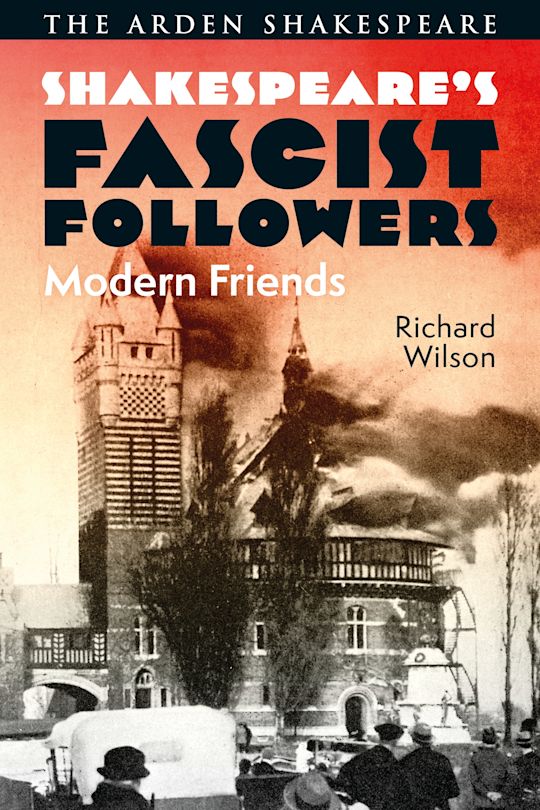
Richard Wilson’s Shakespeare’s Fascist Followers: Modern Friends was published by Bloomsbury in the Arden Shakespeare series in 2025.
As many of you know, Richard organised these events here, the Shakespeare in Philosophy series, for many years, but his health has made it impossible for him to continue in this role, or to be here today.
None of us can replace Richard; he is irreplaceable. One indication of this is that it has taken a small team – a curatorium constituted by Richard some time ago – to make this and the last few events happen. Richard used to do this largely on his own – and he organised three events a year, where we have managed just one. Of course, he was not entirely alone – Timo and Anna did much work behind the scenes, behind the cameras in particular.
If it required a team to do some of what Richard did in organising an event on his model, it was the same for this book. Richard’s illness meant that the almost finished manuscript had to be edited by friends – Roger Holdsworth, Robert Stagg, and David Thacker. As they say in their brief foreword:
We have rearranged the book’s contents, made light revisions to each of the chapters, and compiled a short bibliography of books that have evidently proved essential to this one. Any errors, glitches or infelicities that remain should be considered ours – not least because this is otherwise a book of immense learning and ethical seriousness, communicated with Richard Wilson’s customary relish (p. ix).
Aside from that short foreword, the editors are barely visible. Richard’s voice is clear, with his breadth of knowledge in Shakespeare, history, theory, performance, and politics.
Many of us will doubtless recall conversations with him over the years on themes from this book. I had an early version of Chapter 9, then as Chapter 8, as a draft from Richard. Part of Chapter 6 originally appeared in the London Review of Books in 2017.
Rather than one of us trying to present the whole book, to stand in his place, we decided that the curatorium would present parts of the book – to give a sense of the whole, a flavour rather than the full banquet. Other members of the curatorium would surely have been willing too, had they been here – Julia Ng is in Germany; John Gillies is en route to Paris.
There will be four speakers – each speaking about aspects of one of the chapters:
Richard Ashby (Chapter 2: Hamlet in Weimar: Gordon Craig and the Nietzsche Archive)
Timo Uotinen (Chapter 7: Crooked Cross: Wilson Knight and the Sun-Wheel)
Jennifer Rust (Chapter 8: Marshall McLuhan’s New Dawn)
Jessica Chiba (Chapter 9: Operation Sea Lion: Carl Schmitt and the Scepter’d Isle)
The other chapters cover other figures – it’s striking that the focus is largely on the British and Empire experience until the later chapters broaden it to continental Europe:
1 All Perform their Tragic Play: Yeats goes to Stratford
2 Hamlet in Weimar: Gordon Craig and the Nietzsche Archive
3 Dance of Death: Lawrence and the Morris Men
4 Memory Theatre: The Bad Demons of Frances Yates
5 Broken Coriolanus: Eliot’s March on Rome
6 Black Swan: Shylock and the Chestertons
7 Crooked Cross: Wilson Knight and the Sun-Wheel
8 What Light Through Yonder Window Breaks? Marshall McLuhan’s New Dawn
9 Operation Sea Lion: Carl Schmitt and the Scepter’d Isle
10 Bad Faith: Clara de Chambrun and Le Grand Will
Epilogue: Shakespeare and the Merchant of Hamburg
I’m not going to tread on toes by saying anything about Craig, Wilson Knight, McLuhan or Schmitt, as my friends on the panel will do that in more detail, better than I could do. I will just say a few more words about some of the other themes of the book, and how they connect to today’s event, and some of the previous ones.
In my own recent work on Indo-European thought in twentieth century France I’ve said before that it feels like almost every book I pick up, there is a fascist hiding underneath. Some of that is down to the collision of national, international politics and institutional ones – if people held a university post in the 1930s and 1940s it was difficult to remain politically neutral. In Italy, Germany, but also in occupied France, Netherlands or elsewhere, or even neutral Sweden, people who remained in post often had to make compromises with the political regime.
Some of the thinkers that we’ve discussed in relation to Shakespeare in previous events here did not manage to stay in their own country, either because they were Jewish or lost their post for political reasons. In 2019 Richard organised three events on Jewish German thinkers and Shakespeare. The tragic story of Walter Benjamin is well known; so too the exile of Hannah Arendt.
Ernst Kantorowicz was the third of the people discussed in 2019, and he constitutes a rather different case. In one respect he was similar to Benjamin and Arendt: he too lost his position in Germany because he was Jewish, and went into exile first in the United Kingdom and then the United States. But had he not been Jewish he might well have joined the Nazis – his early political affiliations demonstrate at best a reactionary and certainly nationalist politics.
In 2022 we had two events – one on the Collège de Sociologie, of figures including Georges Bataille and Roger Caillois. Despite Bataille founding the Contre-Attaque group against fascism, this was not just defence or resistance, but counter-attack, turning the weapon against the aggressor. The group was accused at the time of being intoxicated by fascism and its symbols, even of flirting too much with it – a charge made by Benjamin and Alexandre Kojève at the time, and others, including the recently deceased Carlo Ginzburg, since (for a fuller discussion see here). The other 2022 event was on the Frankfurt School – papers on Benjamin, Karl Kraus, Ernst Bloch and others, part of a German intellectual resistance to the rise, success and defeat of fascism.
And most strikingly, in 2024, we had an event on “Shakespeare and the Reactionary Mind: Counterrevolution, Fascism, Militarism”. Bringing some of these themes into the present. Richard’s book, and these questions, are not just of historical interest, but resonant today with our own troubled and divided times.
Most of those previous events have looked at continental Europe – France, Germany, Italy, and last year we looked at the Slovenian school.
But this event, today, is on British interwar philosophy, and Richard’s book fits squarely within that focus. Although there is some discussion of the earlier 20th century, much of the focus is on the period which E.H. Carr famously called The Twenty Years’ Crisis.
Only a couple of chapters are directly on events or thinkers on the continent.
Most are on England, Britain or the Empire where there was not the same kind of pressure on people to make a choice between fascism and exile, as there was for so many European thinkers. And yet, as Richard indicates, many performers, impresarios, directors, critics did make that choice.
Richard’s book follows previous studies on connected themes – I’m thinking of Andreas Höfele’s No Hamlets: German Shakespeare from Nietzsche to Carl Schmitt or Gerwin Strobl, The Swastika and the Stage: German Theatre and Society, 1933-1945. In a sense, Richard does for Britain what they did for Germany.
Before reading his remarkable book, I hadn’t realised how many links there were between Shakespeare, in his institutional and academic forms, and fascism.
T.S. Eliot’s fascist reworking of Coriolanus was known, perhaps as a contrast to Berthold Brecht’s version; Carl Schmitt is of course famous and, very strangely, one of the left’s favourite fascists. But I’m not sure how well-known Wilson Knight’s politics were.
A.K. Chesterton was both a manager of press and publicity for the Shakespeare memorial theatre, and editor of British Union of Fascists Blackshirt newspaper. (David Baker’s book on A.K. Chesterton develops some themes in relation to Shakespeare and particularly his links to Wilson Knight.) Richard uncovers many other intriguing and often disturbing stories.
In a recent piece for the Shakespeare journal, introducing a theme issue, Nicole Fayard has talked about “Shakespeare in Crisis”, of how “Shakespearean criticism, teaching and performance acquire renewed force when approached through the overlapping crises that shape the present, including war, displacement, democratic erosion, ecological breakdown, pandemic afterlife and economic precarity” (p. 1). Her point is not to ask how Shakespeare is relevant, but to insist that his plays are grappling with the same questions we face today, where crisis is “less an event than a governing condition” (p. 1). The piece does not mention Richard Wilson’s book, but it seems to me that it would certainly lend support to the approach.
I’ll hand over to colleagues now, but one final comment. The book is unfortunately only available in an expensive hardback format, but as with all academic publishing the best chance of a more affordable paperback is for this to sell. So, if you’re in an institutional position to do so, please do recommend this to your libraries for purchase.
References
David Baker, Ideology of Obsession: A.K. Chesterton and British Fascism, I.B. Tauris, 1996.
E.H. Carr, The Twenty Years’ Crisis, 1919-1939, London: Palgrave Macmillan, 2016 [1939].
Nicole Fayard, “Introduction: Shakespeare in Crisis”, Shakespeare, 2026, https://doi.org/10.1080/17450918.2026.2662475
Andreas Höfele, No Hamlets: German Shakespeare from Nietzsche to Carl Schmitt, Oxford: Oxford University Press, 2021.
Gerwin Strobl, The Swastika and the Stage: German Theatre and Society, 1933-1945, Cambridge: Cambridge University Press, 2007.
Richard Wilson, Shakespeare’s Fascist Followers: Modern Friends, eds. Roger Holdsworth, Robert Staff and David Thacker, Bloomsbury/Arden Shakespeare, 2025.
Richard Wilson, “Bonfire in Merrie England: Richard Wilson on the Burning Down of the Shakespeare Memorial Theatre”, London Review of Books 39 (4), 4 May 2017, https://www.lrb.co.uk/the-paper/v39/n09/richard-wilson/bonfire-in-merrie-england
This is the 79th post of a weekly series, posted every Sunday throughout 2025, and continuing into a second year. The posts are short essays with indications of further reading and sources. They are not as formal as something I’d try to publish more conventionally, but are hopefully worthwhile as short sketches of histories and ideas. They are usually tangential to my main writing focus, a home for spare parts, asides, dead-ends and possible futures. I hope there is some interest in them. They are provisional and suggestions are welcome. A few, usually shorter, pieces in a similar style have been posted mid-week. I’m not sure I’ll keep to a weekly rhythm throughout 2026, but there will be at least a few more pieces.
The full chronological list of ‘Sunday histories’ is here, with a thematic ordering here.
Discover more from Progressive Geographies
Subscribe to get the latest posts sent to your email.


Pingback: Books received – Bagnato, Mandrou, Ginzburg, Puaud, Favret-Saada, Wilson | Progressive Geographies
Pingback: Richard Wilson, Shakespeare’s Fascist Followers – Bloomsbury, September 2025; paperback April 2027 | Progressive Geographies