
Who translated Michel Foucault’s The Order of Things? The original English edition, published by Pantheon in 1970 (and Tavistock in the UK) has the title The Order of Things: An Archaeology of the Human Sciences, and under the author name says “A translation of Les Mots et les choses”. No translator is named. The “Publisher’s Note” explains the change of title from the literal Words and Things to The Order of Things, because of a potential confusion with other books titled Words and Things. But it is a publisher note, rather than a translator note, and yet it says things that ordinarily a translator would say, closing with:
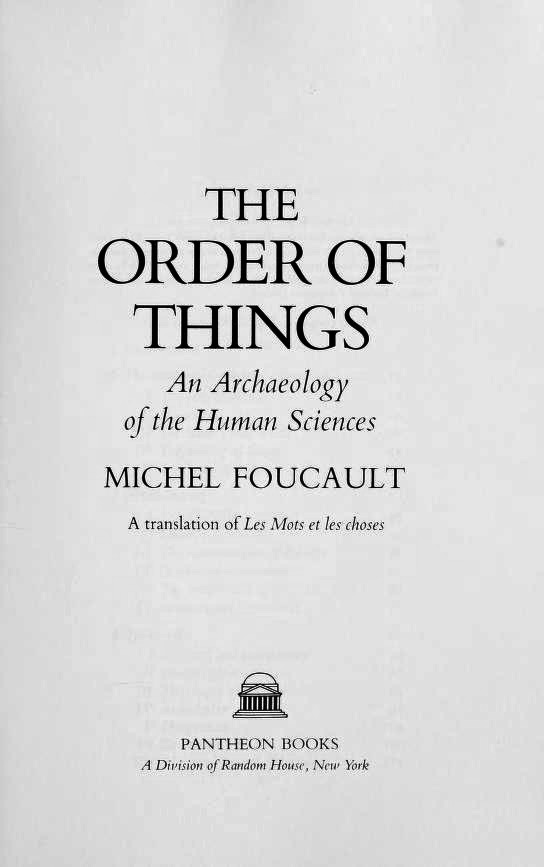
In view of the range of literature referred to in the text, it has not proved feasible in every case to undertake the bibliographical task of tracing English translations of works originating in other languages and locating the passages quoted by M. Foucault. The publisher has accordingly retained the author’s references to French works and to French translations of Latin and German works, for example, but has, as far as possible, cited English editions of works originally written in that language (p. viii of original edition).
At least one reviewer picked up on the lack of a named translator. George Steiner had this to say in a review entitled “The Mandarin of the Hour“:
The translator (whom, with maddening disregard for human effort and responsibility, the publisher leaves anonymous) has striven hard. Nevertheless, an honest first reading produces an almost intolerable sense of verbosity, arrogance and obscure platitude. Page after page could be the rhetoric of a somewhat weary sybil indulging in free association. Recourse to the French text shows that this is not a matter of awkward translation (The New York Times, 28 February 1971).
Foucault responded to that review in the first issue of Diacritics, a piece entitled “Monstrosities in Criticism“. But though he engages with several of Steiner’s criticisms, he does not reveal the translator.
Bibliographies of Foucault sometimes credit Alan Sheridan. Sheridan also translated The Birth of the Clinic and The Archaeology of Knowledge in the early 1970s, and went on to translate Discipline and Punish. He translated several other books, some for Tavistock and/or Pantheon. In Sheridan’s 1980 book Michel Foucault: The Will to Truth, the bibliography says “The Order of Things, trans. A.S., London, Tavistock and New York, Pantheon, 1970 (with Foreword by M.F.)” (p. 227). That would seem to indicate he was the translator and is the same way he credits himself for the books which we know he translated. But in the “Author’s Note” to The Will to Truth he thanks publishers of translations that have allowed him to quote from them, and does not mention The Order of Things. At the end of his note he says: “I have taken the liberty, on occasion, of rewording the extracts quoted. In the case of two books, I have preferred to use my own renderings” (p. ix). But this doesn’t seem to apply to The Order of Things. A check of some of his translations from The Order of Things in The Will to Truth suggests he followed the published translation. It is also listed on Sheridan’s own website under his translations. So, until now, I’d been content to think Sheridan was the translator, just strangely uncredited.
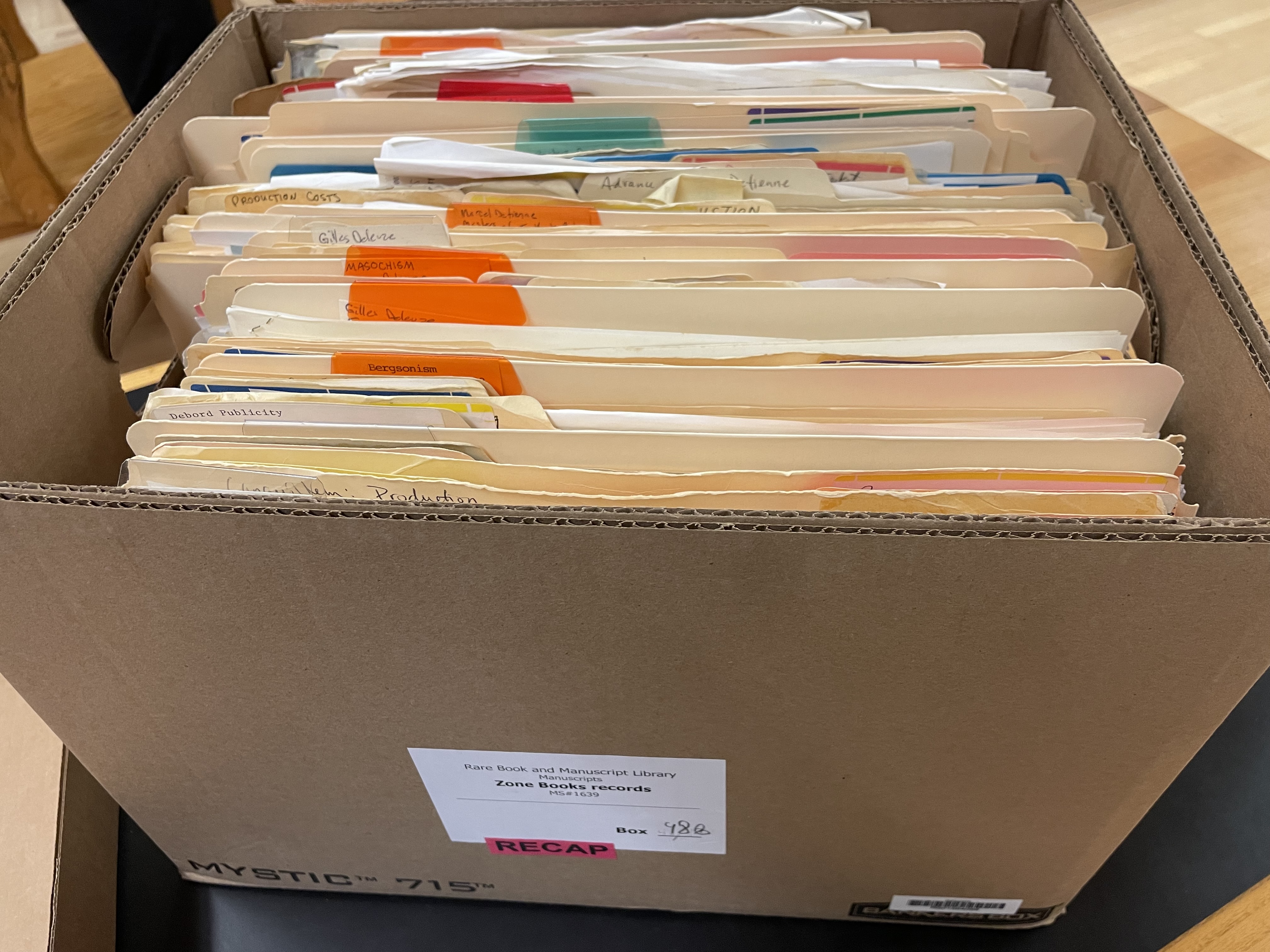
In the Columbia University archives are the records of Zone books, who published the first English translation of Georges Dumézil’s Mitra-Varuna in 1988. I looked at their records relating to this book last month. I have edited a new edition of this text, based on the existing translation, but comparing the first and second French editions, and doing more work with the notes. Among other things in the archive, I was looking for any clues about the translator of that book, Derek Coltman. I had wanted to contact him when the book was going through the re-editing process. I couldn’t find any contact details, and in the end I had assumed he wasn’t still alive, but had not been able to find out for sure. But there is some correspondence with him in the Zone books archive, sent from an old farmhouse in rural Norfolk, England, and he is asked at one point for a cv. He sends what is a rather rambling letter instead, narrating his career to date, from a degree in 1952 to working as a waiter in a cabaret theatre in New York, to his early translations. A 1952 degree suggests he would be very elderly if he were still alive today (Update June 2025: he apparently died in 2012). But I was struck by this astonishing passage about his previous translation experience:
It was in the mid to late sixties also that I did Foucault’s Words and Things for a New York imprint called Pantheon, a fact that I mention partly because Foucault figures on your list of authors and partly because there is a mystery about it that still niggles at me occasionally. It was a project I was rather dubious about tackling in those days; but Richard Howard and Susan Sontag ganged up on me one day in the 8th Street Delicatessen, and what could I do but succumb? An hour with Ms. Sontag and not only do you start suffering from a strange intellectual elation, you even start to suspect yourself of being perhaps rather cleverer than you previously dared hope, So what was the mystery? Well, the translation was approved, accepted, and paid for; but was it ever published? I never received a copy; I didn’t get an answer when I wrote to enquire after the book’s fate; and I’ve never seen it listed in a library catalogue. Never mind, it was a fascinating book to do. The first chapter in particular: a long, amazingly detailed, continually surprising analysis of Velazquez’s Las Meninas.
I like the idea that Richard Howard – who had translated the abridged version of the History of Madness as Madness and Civilisation – and Susan Sontag persuaded Coltman. Some parts of this seem plausible, but I don’t think he can have looked very hard in libraries. That said, if he was only looking for a book entitled Words and Things, then perhaps that would explain why he couldn’t locate it. Could he really have missed that the book had appeared as The Order of Things? By the late 80s, when this CV was written, Foucault was well-known, and his 1984 death was widely noted. But why did Pantheon not acknowledge Coltman’s role in the published version, nor according to him, respond to their correspondence?
It could be that Coltman’s translation was not used, for an unknown reason, and Pantheon commissioned Sheridan instead. But if Pantheon were unhappy with the quality, why did they accept it and pay Coltman? Or maybe Sheridan was asked to rework Coltman’s draft, and translator credit was unmentioned, perhaps to avoid indicating problems. (There are translations where a committee approach means no one wants their name to appear. Claude Lévi-Strauss’s The Savage Mind being one example – its problems begin, but by no means end, with the title.) The Pantheon archives are at Columbia too, but I can find no records relating to Coltman, Foucault, or Sheridan there. The records of Georges Borchardt, Inc. are also at Columbia. This is a literary agency who represented Gallimard and Plon to anglophone publishers, and negotiated the translation rights to this and other works by Foucault. The file on Foucault has some interesting material, but nothing on who translated the text. There is a note that Sontag tried to persuade another publisher to buy the rights, after she had picked up a copy of Les Mots et les choses in Paris in 1966, so she was certainly interested in the idea of its translation. Perhaps there is something in the Tavistock archives. But the question of who translated The Order of Things, which I’d thought settled by Sheridan’s 1980 book, is, for me, open to question again.
Update 17 June 2025: I’ve been told that Derek Coltman died in 2012. I’d written to the address I found in the file but the current owners informed me he had moved away and later died. Sheridan died in 2015, Howard in 2022 and Sontag in 2004. It seems this is only going to be resolved by some other archival trace somewhere.
References
Georges Dumézil, Mitra-Varuna: An Essay on Two Indo-European Representations of Sovereignty, trans. Derek Coltman, ed. Stuart Elden, Chicago: Hau books, 2023.
Michel Foucault, The Order of Things: An Archaeology of the Human Sciences, New York: Pantheon/London: Tavistock, 1970.
Michel Foucault, “Monstrosities in Criticism”, trans. Robert J. Matthews, Diacritics 1 (1), 1971, 57-60, https://www.jstor.org/stable/464562
Alan Sheridan, Michel Foucault: The Will to Truth, London: Tavistock, 1980.
George Steiner, “The Mandarin of the Hour”, The New York Times, 28 February 1971, https://archive.nytimes.com/www.nytimes.com/books/00/12/17/specials/foucault-order.html
Archives
MS#0135, Georges Borchardt Inc. records, 1949-2024, box 234, Foucault, Michel, Rare Books and Manuscript Library, Columbia University, https://findingaids.library.columbia.edu/archives/cul-4078396
Pantheon Books records, 1944-1968, Rare Books and Manuscript Library, Columbia University, https://findingaids.library.columbia.edu/archives/cul-4079194
Zone Books records, Box 48b, Rare Books and Manuscript Library, Columbia University, https://findingaids.library.columbia.edu/archives/cul-10080831
This is the fourteenth post of an occasional series, where I try to post short essays with some indications of further reading and sources, but which are not as formal as something I’d try to publish more conventionally. They are usually tangential to my main writing focus, a home for spare ideas, asides, dead-ends and possible futures. I hope there is some interest in them. They are provisional and suggestions are welcome.
The full list of ‘Sunday histories’ is here.
Discover more from Progressive Geographies
Subscribe to get the latest posts sent to your email.


Pingback: Sunday histories – short essays on Progressive Geographies | Progressive Geographies
Fascinating piece. Since I’m francophone, I have always read Foucault in French, but my students in the Netherlands used to read him in English. So the question of translation has been a perpetual issue in our discussions.
Pingback: Indo-European Thought in Twentieth-Century France update 27: more archive work on Saussure, Blanchot, Foucault, Jakobson and Koyré, two recordings, and a talk at the University at Buffalo | Progressive Geographies
Pingback: Indo-European Thought in Twentieth-Century France update 28: archives in Princeton, Chicago and final work in New York | Progressive Geographies
Pingback: Josué V. Harari, the Marquis de Sade, and Michel Foucault’s 1970 lectures in Buffalo | Progressive Geographies
Pingback: Michel Foucault’s early English translations – indications from the archives of the Georges Borchardt literary agency, the memoirs of André Schiffrin and the Susan Sontag connection | Progressive Geographies
Pingback: Pierre Bourdieu and Erwin Panofsky: Architecture, Scholasticism and the Concept of Habitus | Progressive Geographies
Pingback: Michel Foucault’s early English translations – indications from the archives of the Georges Borchardt literary agency, the memoirs of André Schiffrin and the Susan Sontag connection | Progressive Geographies
Pingback: Michel Foucault’s early English translations – indications from the archives of the Georges Borchardt literary agency, the memoirs of André Schiffrin and the Susan Sontag connection | Progressive Geographies
Pingback: Foucault and his Critics – two minor notes on his exchanges with Jacques Derrida and J.M. Pelorson | Progressive Geographies