
There is a small historical error in Foucault’s History of Madness, which endures through the different French versions with the exception of Oeuvres, but which is corrected in one of the English versions. Yes, there are other errors, but I’m focused on this one, because Foucault tried to correct it.
In 1961, in Folie et déraison: Histoire de la folie à l’âge classique, it says:
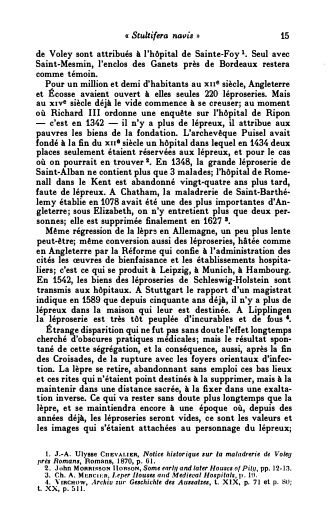
Pour un million et demi d’habitants au XIIe siècle, Angleterre et Écosse avaient ouvert à elles seules 220 léproseries. Mais au XIVe siècle déjà̀ le vide commence à se creuser ; au moment où Richard III ordonne une enquête sur l’hôpital de Ripon – c’est en 1342 – il n’y a plus de lépreux, il attribue aux pauvres les biens de la fondation.
Richard III was King of England from 1483 until 1485. So, either Foucault’s date is incorrect or it was another King.
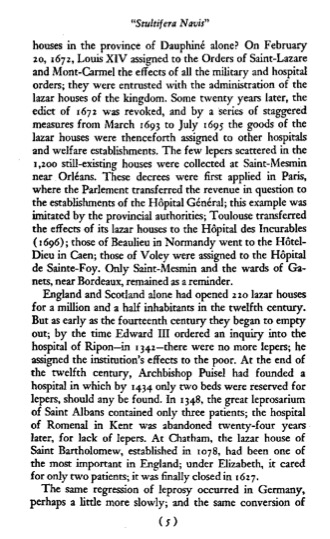
The passage appears on p. 5 of the original 1961 Plon edition and its 1964 reprint, and p. 15 of the abridged 1964 edition. In the 1965 English translation of the abridged edition, Madness and Civilization, this King is changed to Edward III, who ruled 1327-1377. In Richard Howard’s translation:
England and Scotland alone had opened 220 lazar houses for a million and a half inhabitants in the twelfth century. But as early as the fourteenth century they began to empty out; by the time Edward III ordered an inquiry into the hospital of Ripon -in 1342- there were no more lepers; he assigned the institution’s effects to the poor (p. 5).
The change was made by Howard as translator, but on Foucault’s direction: there is a letter from the Georges Borchardt literary agency to Pantheon books on 28 May 1964, conveying Foucault’s wish that the correction is made. Foucault hadn’t spotted the mistake when abridging the text, but presumably soon afterwards.
But the 1972 version of the French, as Histoire de la folie à l’âge classique (p. 15), and the 1976 Tel reprint (p. 15 in some printings; p. 17 in others), both have Richard III. In resetting the text for this edition Gallimard simply carried over the error from the earlier French editions, and Foucault didn’t spot it on the proofs.
The 2005 English translation of the unabridged text, History of Madness, has this:
For their million-and-a-half inhabitants in the twelfth century, England and Scotland had opened 220 leper houses. But even by the fourteenth century they were beginning to empty: when Richard III ordered an inquiry into the state of Ripon hospital in 1342, it emerged that there were no more lepers, and the foundation was charged with the care of the poor instead.
In this case, the translator is working from a defective French text – either the 1961 or 1972/1976 edition – not realising the earlier English translation had a correction of an original French error. The reprinted text in Oeuvres has “… au moment où [Eduoard] III ordonne une enquête” (Vol I, p. 11), where the editor of this text, Jean-François Bert, has corrected the mistake. But it’s not clear whether he did this because he spotted the error, or realised Foucault once had, or both.
We are left with the curious situation that the one accurate version of this passage in a standalone version of the text is the much-criticised Madness and Civilization. There it is both historically correct and amended to Foucault’s wish.
On the different French and English editions, and persistent confusions over dating and status, see here.
This note is in the same register as the ‘Sunday histories‘ posts, though its minor status means I’ve posted it mid-week. I should have posted it yesterday for Shakespeare’s birthday given he wrote plays on Richard III and – disputed – on Edward III.
Discover more from Progressive Geographies
Subscribe to get the latest posts sent to your email.


Pingback: Indo-European Thought in Twentieth-Century France update 28: archives in Princeton, Chicago and final work in New York | Progressive Geographies
Pingback: Michel Foucault’s early English translations – indications from the archives of the Georges Borchardt literary agency, the memoirs of André Schiffrin and the Susan Sontag connection | Progressive Geographies
Pingback: Michel Foucault’s early English translations – indications from the archives of the Georges Borchardt literary agency, the memoirs of André Schiffrin and the Susan Sontag connection | Progressive Geographies
Pingback: Michel Foucault’s early English translations – indications from the archives of the Georges Borchardt literary agency, the memoirs of André Schiffrin and the Susan Sontag connection | Progressive Geographies