
In a previous piece on Vladimir Nabokov, Roman Jakobson, Marc Szeftel and The Song of Igor, I outlined the story of a planned collaborative edition and English translation of the Slavic epic The Song of Igor. This is a text of disputed provenance, probably late 12th or early 13th century, on which Jakobson had led a collaborative French edition in 1948, La Geste du Prince Igor’, along with Henri Grégoire and Marc Szeftel. Nabokov wrote a review of the text, but struggled to find an outlet, and a discussion led to an alternative plan to work together – Jakobson providing a critical edition of the text; Nabokov an English translation – before they fell out. Nabokov published his translation separately; Jakobson did not publish his planned new edition. I discuss all of that more fully in the earlier piece.
Since writing that, I have continued to think about this story and, although it feels like a digression from a digression, to explore some sources which I hadn’t made use of in the previous piece. There I should have mentioned that Jakobson published two pieces on The Song of Igor in 1952, especially because they are his most detailed discussions in English. One, in the medieval journal Speculum, was on the current academic debates about the piece, and the other in the Harvard Library Bulletin was a philological study of the extant manuscripts. Both are reprinted in his Slavic Epic Studies, which also contains Jakobson’s parts of La Geste du Prince Igor’. That volume of Jakobson’s Selected Writings also includes Jakobson’s parts of a book he co-edited with Ernest Simmons, Russian Epic Studies, published in 1949, mostly concerning The Song of Igor, and including essays by Grégoire, Manfred Kridl, Margaret Schlauch and Szeftel. It is a companion volume, most of whose essays are in English, to La Geste du Prince Igor’.
Some of Nabokov’s archive is in the Berg collection at the New York Public Library. This includes Nabokov’s typescript copy of his translation, with his handwritten corrections. It was interesting to see this, but it did not reveal anything particularly useful for this story. But the Berg collection also has correspondence between Jakobson and Nabokov. Unlike the typescript, this required permission from the Nabokov estate to consult, but that was eventually given. The correspondence fills in some useful detail of the plans for the collaboration between Jakobson, Szeftel and Nabokov, but the 14 April 1957 letter which broke off the collaboration still feels like an abrupt interruption. That letter has been published (Vladimir Nabokov, Selected Letters, 1940-1977, p. 216) and I reproduce it in the earlier piece. But the previous letter – at least in the files in New York – is from two years before (27 April 1955), and at that time the collaboration was progressing well.
I hoped that this and some other correspondence would shed some more light on this. One thing which is interesting and useful about the Nabokov archive is that this has carbon copies of his letters to Jakobson, rather than just the letters he received from Jakobson. Often with correspondence it’s necessary to consult two (or more) archives to get both sides of the story. (The parallel file of Nabokov correspondence in Jakobson’s archive at MIT has only a few letters, only one of which isn’t in the Nabokov archive) There is also some correspondence in the George Vernadsky papers at Columbia University, both from Jakobson and Nabokov. Some of the Jakobson letters to Vernadsky are in English; some others, and all of Nabokov’s, are in Russian. If I was to pursue this story further, I would need help. But almost all the Jakobson-Nabokov letters are in English.
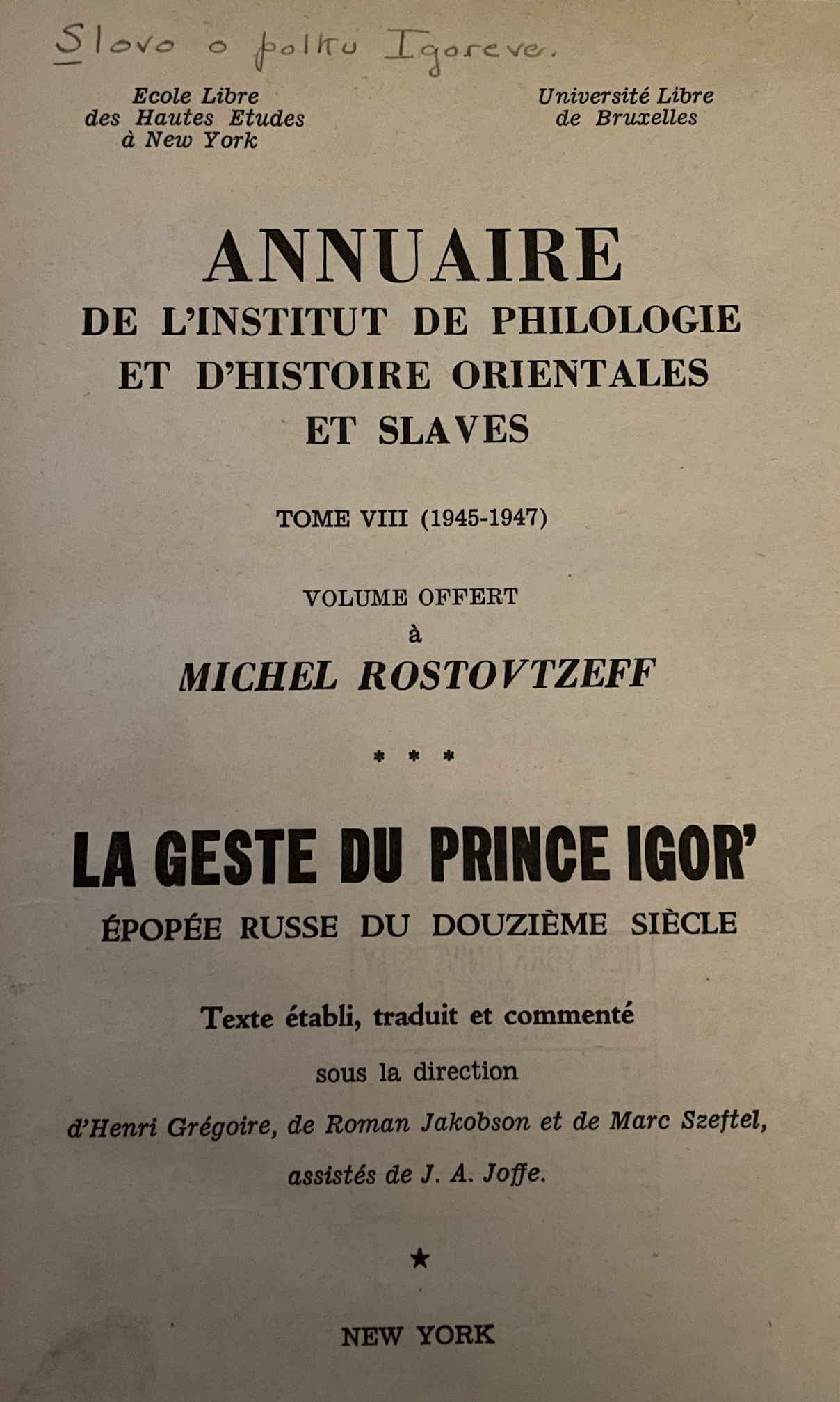
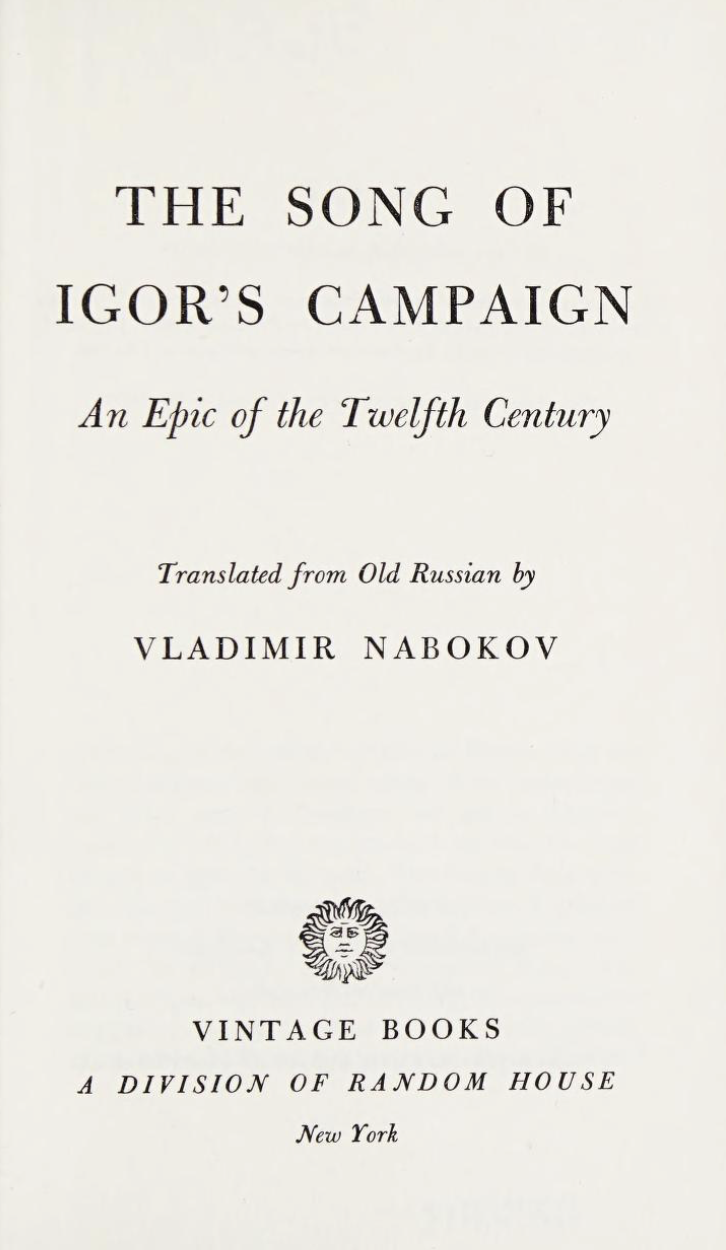

I had, however, neglected an important published source for detail on the story – the correspondence between Nabokov and Edmund Wilson. Wilson was a literary critic and journalist, author of To the Finland Station, among other works, and husband of Mary McCarthy between 1938-46. The Nabokov-Wilson correspondence was published in 1979, and in an expanded edition in 2001 as Dear Bunny, Dear Volodya. In 1943, Edmund Wilson told Nabokov of an event he went to in New York with Roman and Sophie Grynberg:
I also went with them to a Russian occasion which was tout autrement intéressant than the Stalinist evening I described to you: the first in a series of lectures devoted to rescuing the Slovo o Polku Igorebe from the aspersions of André Mazon – a matter, I gathered, of patriotic duty. The discussion had many humors which would have amused you. Vernadsky said that the French, not content with having burned the manuscript in Moscow [in 1812], were now trying to deprive them of the poem itself. The French Byzantologist [Henri] Grégoire, who presided, seemed to get a little nettled by the Russians and the session ended with a debate which became I thought, rather acrimonious (1 April 1943, p. 108).
The Mazon book in question is Le Slovo d’Igor, published in 1940, which suggested the Igor text was a much later forgery. The New School teaching records note an École Libre des Hautes Études course in Spring 1943, under the title “Le Dit d’Igor et la question de son authenticité”, organised by the Slavic Section, with Grégoire, Alexandre Koyré, Roman Jakobson, Wacław Lednicki and Vernadsky. It is a lecture in this course which Wilson attended, but which Nabokov did not. So, it would seem Nabokov was first told of this project by Wilson, even though he had known Vernadsky at least for a few years before.
The course directly led to the collaborative volume La Geste du Prince Igor’ in 1948, though not all those participating in the teaching were involved with that. Koyré’s involvement, in particular, seems to have ended with the seminar. The named editors of the book were Grégoire, Jakobson and Szeftel, with the assistance of J.A. Joffe. Jakobson and Grégoire’s seminar feud had clearly been overcome, at least temporarily, with Grégoire’s contribution to the volume a French translation of the tale. (In 1946, Jakobson also wrote a laudatory piece about Grégoire for Byzantina Metabyzantina, which was reprinted in Le Flambeau – a journal Grégoire co-edited – after Grégoire’s death in 1964.) Jakobson contributes by far the most material, including a critical edition and reconstruction of the text, a long essay on its authenticity and notes. He also edited Samuel H. Cross’s English translation for the volume. Szeftel and Vernadsky provide historical contextualisation.
On 1 November 1948, Nabokov told Wilson he was translating the text into English (p. 236). In reply, Wilson told him about the publication:
Do send me your Igor translation. I’ve just received an elaborate volume, La Geste du Prince Igor, published by the Ecole Libre des Hautes Etudes à New York, under the auspices of Jakobson and others. Have you seen it? It includes translating into various languages, a vindication of the Слово authenticity, commentary, etc. (15 November 1948, p. 238).
Nabokov wrote back:
I know the La Geste volume well, – and am, as a matter of fact, reviewing it for the American Anthropologist. It is on the whole an admirable work, Szeftel’s and Jakobson’s studies being especially brilliant. There is a touch of kvasnoǐ [jingoist] Russian patriotism about Vernadsky’s essay. Cross’s translation, although revised and corrected by Jakobson in regard to sense, is couched in hopelessly pedestrian English, so that many images are distorted or lost. It would be nice if you wrote something about the book for the New Yorker (21 November 1948, p. 241).
Nabokov’s planned review for the American Anthropologist never appeared. One letter to Jakobson suggests they wanted it to be much shorter, and Nabokov refused. (I’ve not found the unpublished review in his papers, unfortunately.) But for a French volume about a Russian text, there was quite a lot of attention in English-language journals. There are reviews in, at least, Comparative Literature; Language; The American Slavic and East European Review; The Journal of American Folklore; Modern Languages Notes; Journal of American Oriental Society; and The Catholic Historical Review. These almost all support Jakobson’s claims about the text’s authenticity against Mazon’s position. To take just one example. René Wellek says that “Jakobson demonstrates beyond the possibility of doubt that André Mazon’s bold attempt… to prove the poem a forgery of the late eighteenth century is totally mistaken” (p. 502). He concludes: Jakobson and his colleagues’ work “illuminates the most important poem of ancient Russia in its historical relations and definitely, even crushingly, refutes the doubts about its authenticity raised by M. Mazon” (p. 503).
Wilson, in reply to the November 1948 letter, said that it should be Nabokov who wrote for the New Yorker, and that he would speak to them about it, telling Nabokov not to mention that most of the texts in the volume were in French. (Nabokov told him that his piece was too good to give away to American Anthropologist without payment, and so he liked the New Yorker idea. But this too never appeared.) Wilson went on to retell the story of attending one of the École Libre lectures, repeating most of the details of his letter from five years before. But he adds some detail about the clash between the French and Russians at the class, especially Henri Grégoire presiding over the event and his confrontation with Jakobson. Jakobson apparently kept interrupting and then Grégoire said: “M. Jakobson, c’est un monstre [Mr Jakobson is a monster]”. Wilson continues:
There was a terrible silence, as the audience remembered poor Jakobson’s extraordinary appearance and wondered whether the meeting would have to end in violence. But the speaker went on: “Je veux dire qu’il est un monstre de science – il est philologue, sociologue, anthropologue [I mean that he is a monster of learning – he is a philologist, a sociologist, an anthropologist]” etc. It was at the moment [April 1943] when the Russians were standing up to the Germans after the ignoble flop of the French, and I was struck by the Russian propensity for using events in the literary world as pretexts for creating issues in connection with current politics (which you seem to have reacted against by leaning in the other direction at an angle of forty-five degrees and denying that literature has anything to do with social institutions) (2 December 1948, pp. 243-44).
In the end, the planned Jakobson-Nabokov collaboration did not happen, and Nabokov’s review was not published either. Nabokov reworked his earlier translation, telling Wilson it was “completely revamped”. He said that “The commentary to it has inherited a Eugene gene and is threatening to grow into another mammoth” (2 March 1959, p. 361). The commentary of the 1960 translation is, however, nothing like as extensive as Nabokov’s edition of Eugene Onegin, which appeared in four volumes.
The editor of the Wilson-Nabokov letters, Simon Karlinsky, says of Nabokov’s 1960 translation: “Because Nabokov’s edition, while tending to accept the work’s authenticity, also outlines the grounds for skepticism, Jakobson took a strongly negative attitude to it” (p. 244 n. 5). As my earlier post indicates, the Nabokov-Jakobson acrimony predates the publication of the translation, and their falling out is the reason for its appearing without the critical edition of the text by Jakobson. There are more possible leads to follow about this failed collaboration, in archives in New York and nearby. And there is another aspect of the Jakobson story, with a minor connection to Nabokov, about which I’m trying to find out more. However these additional sources hopefully give some more detail about The Song of Igor aspect.
As a footnote to this story, here’s another fractured relationship. Even though Jakobson and Grégoire had managed to work together on the collaborative volume, almost as soon as it was published, they fell out again because of this project. This was because in 1948, Grégoire wrote a piece about The Song of Igor for the journal he co-edited, Le Flambeau. At the time of the collaborative volume’s publication, an article is not surprising to raise the profile of the book. But Grégoire raises doubts about the text’s authenticity, and while he hesitantly suggests that it is genuine, he at times sides with Mazon. He is also critical of La Geste du Prince Igor’; a book of which he was one of the named editors. In particular, he concludes in an extraordinary way:
André Mazon’s book is certainly more fun to read that the rather pedantic and massive collective work which is his refutation. (We can regret, in particular, the rather heavy-handed ‘manner’ of Jakobson, author of a decisive series of magnificent discoveries, but who often gives himself the air of an irritated theologian.) André Mazon, I believe, is wrong, but he is wrong with spirit; and his indictment, by its very brilliance, has made the weakness of the accusation more apparent. The Song of Igor is so sophisticated, in the American sense of the word, that it can be called a forgery. But it is a forgery… of the twelfth century, as Boris Unbegaun, a distinguished convert, has just told me, very wittily (p. 103).
Jakobson, outraged, wrote a furious letter to him, a copy of which is in Vernadsky’s papers. As well as worrying what this would do for their sales, Jakobson is incredulous that Grégoire could now turn against Jakobson’s critique of Mazon, after having published it in their collaborative volume. He points out that Grégoire “had read the largest part, namely the severest, of my manuscript. You corrected it and you agreed completely”. Jakobson resigned from being Vice-President of Grégoire’s Byzantine Congress, and withdrew a paper on Old Church Slavonic and Byzantine poetry he was planning to present there. In a 1965 postscript to his Slavic Epic Studies, written after Grégoire’s death the previous year, Jakobson tells his version of the story, in relation to Mazon and Grégoire (pp. 738-51).
The debate about the Song’s authenticity rumbles on. Edward Keenan wrote a very detailed new attempt at proving it a forgery in 2003. Norman Ingham delivered an uncompromising rebuttal, published only posthumously in 2017. In Jakobson’s view, there was no room for compromise. As he wrote to Vernadsky later on 29 May 1948: “The Igor struggle has to be unconditionally won”. His inability to entertain any doubts from Grégoire may also have been a factor with Nabokov, nearly a decade later. But as my earlier piece indicates, there were other reasons for the split with Nabokov.
Update 9 Nov 2025: I discuss Nabokov’s original translation and Jakobson’s intent to complete his edition here.
References
La Geste du Prince Igor’: Épopée Russe du douzième siècle, ed. and trans. Henri Grégoire, Roman Jakobson and Marc Szeftel, New York: Columbia University Press, 1948. Jakobson’s parts are reprinted in Selected Writings IV: Slavic Epic Studies, The Hague: Mouton & Co, 1966, 106-300.
The Song of Igor’s Campaign: An Epic of the Twelfth Century, trans. and foreword by Vladimir Nabokov, London: Weidenfeld and Nicolson, 1960.
Stuart Elden, “Vladimir Nabokov, Roman Jakobson, Marc Szeftel and The Song of Igor”, Progressive Geographies, 9 February 2025.
Henri Grégoire, “La Geste du Prince Igor: un faux… du XIIe siècle”, Le Flambeau 31 (1), 1948, 93-103.
Norman W. Ingham, “The Igor’ Tale and the Origins of Conspiracy Theory”, ed. Valentina Pichugin, Russian History 44 (2-3), 2017, 135-49.
Roman Jakobson, “Henri Grégoire: Investigateur de l’épopée”, Byzantina Metabyzantina: A Journal of Byzantine and Modern Greek Studies I (1), 1946, k-kb’; reprinted in Selected Writings IV: Slavic Epic Studies, The Hague: Mouton & Co, 1966, 101-5.
Roman Jakobson, “The Archetype of the First Edition of the Igor’ Tale”, Harvard Library Bulletin VI (1), 1952, 5-14; reprinted in Selected Writings IV: Slavic Epic Studies, The Hague: Mouton & Co, 1966, 464-73.
Roman Jakobson, “The Puzzles of the Igor’ Tale on the 150th Anniversary of its First Edition”, Speculum 27, 1952, 43-66; reprinted in Selected Writings IV: Slavic Epic Studies, The Hague: Mouton & Co, 1966, 380-410.
Roman Jakobson and Ernest J. Simmons (eds.), Russian Epic Studies, Philadelphia: American Folklore Society, 1949.
Edward L. Keenan, Josef Dobrovský and the Origins of the Igor’ Tale, Cambridge, MA: Ukrainian Research Institute, 2003.
André Mazon, Le Slovo d’Igor, Paris: Librairie Droz, 1940.
Vladimir Nabokov, Selected Letters, 1940-1977, eds. Dmitri Nabokov & Matthew J. Bruccoli, London: Weidenfeld & Nicolson, 1990.
Vladimir Nabokov and Edmund Wilson, Dear Bunny, Dear Volodya: The Nabokov-Wilson Letters, 1940-1971, ed. Simon Karlinsky, Berkeley: University of California Press, revised and expanded edition, 2001
Robert Roudet, “Mazon et le ‘Slovo d’Igor’”, Revue des études slaves 82 (1), 2011, 55-67.
René Wellek, “La Geste du Prince Igor’ Épopée russe du douzième siècle by Henri Grégoire, Roman Jakobson and Marc Szeftel”, Modern Language Notes 63 (7), 1948, 502-3.
Edmund Wilson, The Forties: From Notebooks and Diaries of the Period, ed. Leon Edel, New York: Farrar, Straus, and Giroux, 1983.
Archives
Roman Jakobson papers, MIT, Department of Distinctive Collections, https://archivesspace.mit.edu/repositories/2/resources/633
Vladimir Nabokov papers, 1918-1987, Berg Coll MSS Nabokov, New York Public Library, https://archives.nypl.org/brg/19126
George Vernadsky Papers circa 1500-1973, Rare Books and Manuscript Library, Columbia University, https://findingaids.library.columbia.edu/archives/cul-4078205
This is the eighteenth post of a weekly series, where I post short essays with some indications of further reading and sources, but which are not as formal as something I’d try to publish more conventionally. They are usually tangential to my main writing focus, a home for spare ideas, asides, dead-ends and possible futures. I hope there is some interest in them. They are provisional and suggestions are welcome.
The full list of ‘Sunday histories’ is here.
Discover more from Progressive Geographies
Subscribe to get the latest posts sent to your email.


Pingback: Vladimir Nabokov, Roman Jakobson, Marc Szeftel and The Song of Igor | Progressive Geographies
Pingback: Indo-European Thought in Twentieth-Century France update 28: archives in Princeton, Chicago and final work in New York | Progressive Geographies
Pingback: The Early Edward Said, Michel Foucault and Jonathan Swift | Progressive Geographies
Pingback: Roman Jakobson, Franz Boas, and the Paleo-Siberian and Aleutian material at the New York Public Library | Progressive Geographies
Pingback: Sunday histories – short essays on Progressive Geographies | Progressive Geographies
Pingback: Vladimir Nabokov’s original and unpublished translation of The Discourse of Igor’s Campaign; and Roman Jakobson’s enduring wish to complete his English edition | Progressive Geographies
Pingback: Vladimir Nabokov’s original and unpublished translation of The Discourse of Igor’s Campaign; and Roman Jakobson’s enduring wish to complete his English edition | Progressive Geographies
Pingback: Gordon and Tina Wasson, Slavic Studies in the Cold War, and the Hallucinogenic Mushroom | Progressive Geographies