
At the beginning of 2025 I decided to try to post a short essay each week on Progressive Geographies. I felt the blog had become too much of a noticeboard, sharing information about interesting books, talks or shorter pieces by other people and, much less often, a few things about my own work. I had not been writing very much for the blog itself, apart from the research updates on my Mapping Indo-European thought in twentieth-century France project; and some research resources – bibliographies, a few textual comparisons, sometimes very short translations.
Somewhat to my surprise I’ve managed to keep to a weekly schedule to these essays, usually with a few pieces in development at the same time. I called these ‘Sunday histories’ after the condescending name of ‘Sunday historian’ given to amateurs by professional historians, since these were people whose only time for doing history was outside of the working week. Philippe Ariès called his memoir Un Historien du Dimanche for this reason. But these short posts are also histoires in the French sense of stories as much as formal histories. At the end of each of these pieces I’ve tried to provide indications of sources which would provide much more information, some of which are published and others are archives.
The intention was not that the pieces would be parts of a paper or book chapter I’m writing, but usually something tangential to what I’m working on, perhaps a development of something which would only be a footnote or aside in another text. Sometimes they are some notes on a topic which might be further developed in the future, or where I’ve reached a dead end. A couple of times they have developed from a talk I’ve given or are a summary of what will be a longer piece published in a more formal way. A few times I’ve revisited earlier occasional pieces on this blog, and tidied them up into a similar format. A couple have seemed more minor, and have been posted mid-week.
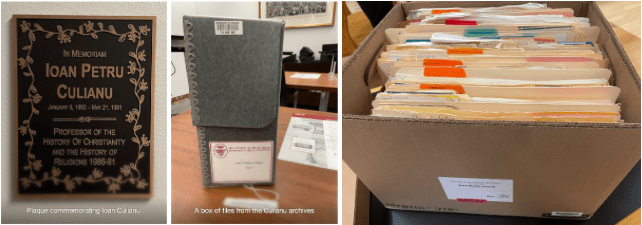
The most popular, as I might have expected, have been on Michel Foucault. The ones on Émile Benveniste have been the most connected to the current writing; the ones on Alexandre Koyré and Roman Jakobson relate to possible future projects. Some connect back to earlier interests in Martin Heidegger, Henri Lefebvre or territory. A few have been on figures who connect to the Indo-European project in some way, such as Marie-Louise Sjoestedt, Elisabeth Raucq and Leonard and Elisabeth Palmer, on whom I could find limited information, so the posts are attempts to gather the sources I could find together. Others were reports of interesting stories I wanted to say something about – Walter Henning’s Khwarezmian Dictionary Project; Thomas Sebeok and the warning signs about nuclear waste repositories; the murder of Ioan Culianu or Edward Said’s abandoned book on Jonathan Swift. A lot of the pieces developed from something I found doing archival work. Some seem to have reached an audience; others sunk without trace. It’s not easy to know how they are being received.
These pieces are something of a reaction against academic publishing – its slow processes, its costs, and its metrics. These pieces are posted shortly I’ve finished them, though they might be revised later; they are free to access (I don’t plan to turn these into subscription-only); and they are not ‘outputs’ in the tradition sense.
I have a few drafts of future posts – another one relating to the early reception of Foucault’s work in the United States; a reworked version of the story of a possible collaboration between Alexandre Kojève and Lefebvre; and on Jakobson’s 1972 lectures at the Collège de France. There will maybe be something on Pierre Bourdieu and Erwin Panofsky, perhaps on Jean Hyppolite, probably on ancient Greek words for kings.
When I have been asked about running a blog, I’ve said the three guidelines I set myself were these: be useful to yourself, since you never know if anyone else will read it; be useful to others, if you do want an audience; and be nice, which means I rarely post about things I don’t like. Those still seem like good ideas to me, and they are ones that shape these little posts. The posts are provisional and suggestions are welcome. I’m sure specialists in the areas I discuss will know much more or correct details. I hope there is some interest in them.
The full list is here.
Discover more from Progressive Geographies
Subscribe to get the latest posts sent to your email.


some interesting titles @ https://luminosoa.org/books