
In an earlier piece in the ‘Sunday Histories’ series, I discussed the work Roman Jakobson did for Franz Boas on the Paleo-Siberian and Aleutian material at the New York Public Library. In his initial time in the United States, as a refugee from Western Europe, he was piecing together a living by undertaking research projects making use of his prodigious range of languages. I reported that he indicates in one of his letters to Boas that:
… he was also doing research on the relatively unknown Yiddish-Czech language spoken by medieval Czech Jews, for the Yiddish Scientific Institute (YIVO), also in New York (Jakobson to Boas, 11 September 1941). He had met YIVO co-founder Max Weinrich in Copenhagen at the Fourth Congress of Linguistics in August 1936 (Jakobson to YIVO, 27 February 1969, Rachel Erlich papers, box 5). Some of Jakobson’s work for YIVO was published in “The City of Learning: The Flourishing Period of Jewish Culture in Medieval Prague” in The American Hebrew in December 1941. Jakobson there says he is “preparing a special detailed study about the ‘Canaan language’ in Jewish medieval culture” (p. 373). In a later piece he describes this as a book entitled Czech in Medieval Hebrew Sources (Selected Writings, Vol VI.2, 886). That study was never completed, though Jakobson did work on Canaanic (see Dittmann, “Roman Jakobson’s Research into Judeo-Czech”; Bláha et. al. “Roman Jakobson’s Unpublished Study on the Language of Canaanite Glosses”). He would also occasionally publish on Yiddish, writing a preface to Uriel Weinreich’s College Yiddish in 1949 (pp. 9-10). Uriel was the son of Max, with whom Jakobson would occasionally work. Jakobson and Morris Halle contributed to Max Weinreich’s Festschrift on “The Term ‘Canaan’ in Medieval Hebrew”. Although not published until 1964, this text was drafted in New York in 1942-44, before being completed in 1962 (see Selected Writings, Vol VI.2, 886).
William Pimlott has now shared with me another source for Jakobson’s work on Yiddish, a report of a paper Jakobson gave to The First World Conference on Yiddish Studies, held in New York City from 7-10 April 1958, and sponsored by YIVO. Max Weinrech chaired the event, which opened in the Earl Hall auditorium of Columbia University, where Jakobson had previously taught. Jakobson appears to have been the first speaker in the first session. From the report of the conference in the News of the Yivo newsletter:
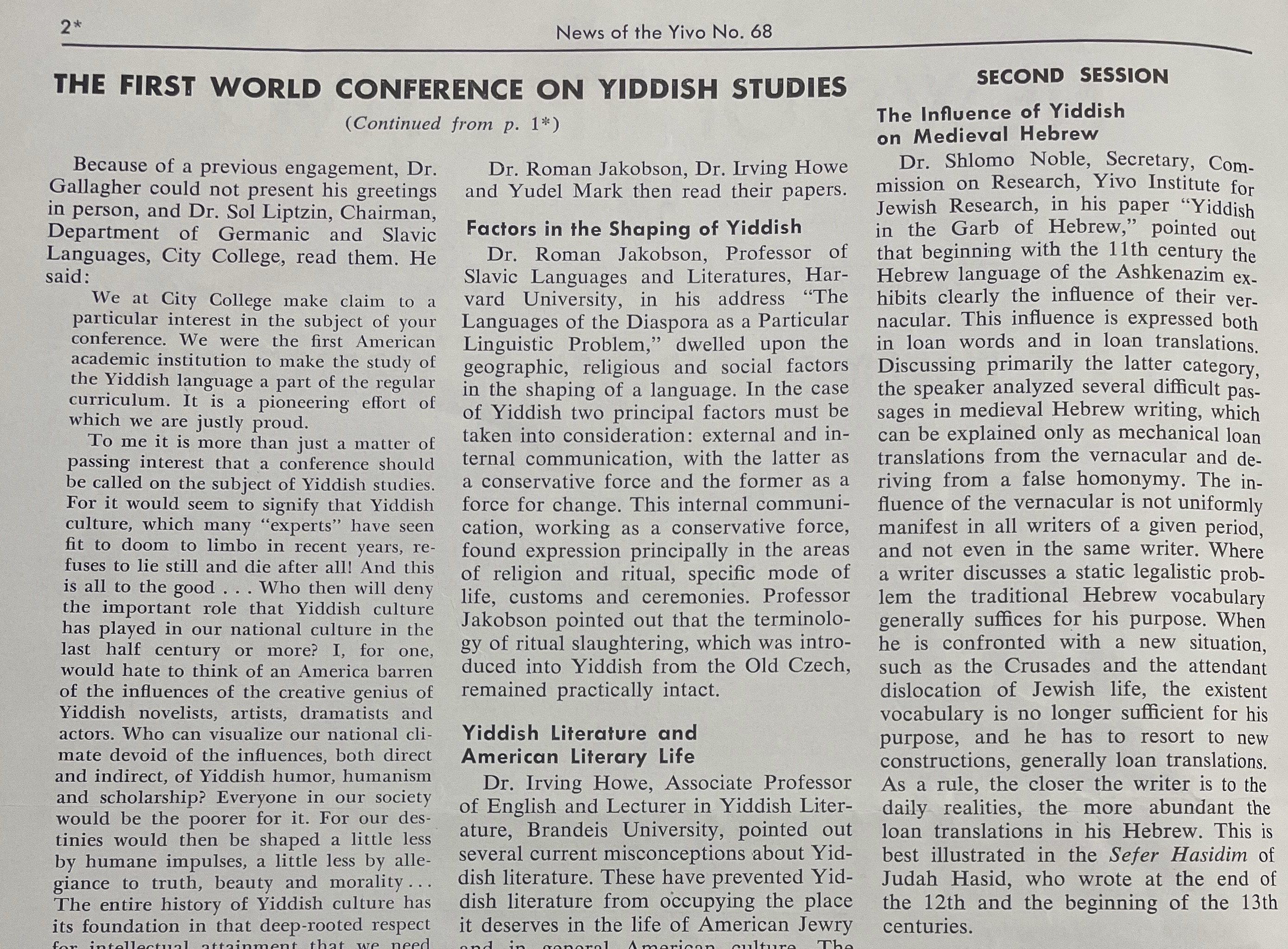
Factors in the Shaping of Yiddish
Dr. Roman Jakobson, Professor of Slavic Languages and Literatures, Harvard University, in his address “The Languages of the Diaspora as a Particular Linguistic Problem,” dwelled upon the geographic, religious and social factors in the shaping of a language. In the case of Yiddish two principal factors must be taken into consideration: external and internal communication, with the latter as a conservative force and the former as a force for change. This internal communication, working as a conservative force, found expression principally in the areas of religion and ritual, specific mode of life, customs and ceremonies. Professor Jakobson pointed out that the terminology of ritual slaughtering, which was introduced into Yiddish from the Old Czech, remained practically intact (News of the Yivo 68, p. 2).
As might be expected, this lecture has not gone unnoticed by specialists. Ondřej Bláha, Robert Dittmann, Karel Komárek, Daniel Polakovič and Lenka Uličná say this:
Jakobson returned to the topic of Judeo-Czech also in his lecture The Languages of the Diaspora as a Particular Linguistic Problem, presented at the opening session of the Conference on Yiddish Studies on 7th April 1958. Its 13-page long transcript has also been preserved in the MIT Archives (RJP 34/44) and will be edited by the present authors for publication. Even though Jakobson apologizes in the opening words for entering the field of Yiddish, he does admit a long-term interest in the language and refers among other things also to Judeo-Czech and its expansion to Poland where some formerly Czech words like butcher terms or proper nouns were kept for internal communication within the Jewish community evidencing “enormous conservativism” (“Roman Jakobson’s Unpublished Study on the Language of Canaanite Glosses”, p. 287).
The archival code they give of “RJP 34/44” means the Roman Jakobson papers, held in the Department of Distinctive Collections at the Massachusetts Institute of Technology, MC 0072, box 34, folder 44. That folder contains an English typed transcript, with handwritten corrections and additions for some gaps in the transcription, usually when Jakobson was giving words or phrases in other languages, including German, Czech, Russian, Hebrew and Yiddish. This is the text Bláha and his colleagues published in a Czech volume, Kenaanské glosy ve středověkých hebrejských rukopisech s vazbou na české země. In that volume it appears both as a Russian text with Czech apparatus and the original English version. In a companion volume of essays first presented at a conference in Prague, Knaanic Language: Structure and Historical Background, a number of papers engage with Jakobson’s work on this language.
According to Robert Dittmann’s discussion of Jakobson’s work on this topic, the language used by Czech Jews in Poland “remained unchanged because it was not necessary to adapt these terms to the non-Jewish population, because the whole problem of butchers was an internal Jewish problem” (Dittmann, “Roman Jakobson’s Research into Judeo-Czech”, p. 278). Jakobson’s point is that vocabulary around money-lending, when Jewish people engaged with other peoples in the area, picked up elements of the local languages.
He also focuses a lot on the notion of diaspora, indicating that it is a term initially used to describe the Jewish linguistic experience. He gives the example of Vladimir the Great who converted to Christianity and converted the people of Russia. Apparently, the Grand Prince said to a Jewish representative, “Well, you recommend me your religion, but what is your territory?” Jakobson says “And the Jews answered, ‘We have no territory… We have only a pale of settlement’. And this is probably the best definition of the diaspora, and also of the linguistic implications of this question” (p. 797). At the end of his lecture, Jakobson returns to this relation of language to territory in his present moment, that is April 1958:
Then, all the events of our time, with the creation of certain facts which even, to a certain degree, eliminate the notion of an absolute Diaspora, because there is a group Hebrew not more only a hieratic language, but also as a cultural language; and which are not more only a pale, a čerta osedlosti, but a territory. And this creates completely new situations as also all the tragic events of the last decades in Eastern Europe, especially in Poland. But here, I would, if I would discuss this question, it would be a new problem, and not more the problem of the linguistic aspects of the Diaspora (p. 813, following the transcription, and checked to the typescript, which has some awkward expressions).
The same issue of News of the Yivo indicates a Russian-language piece Jakobson published in 1953, first in the Yivo journal Yidishe Shprakh, and then translated in a book honouring the Yiddish philologist Judah A. Joffe in 1958:
Roman Jakobson points out what happened to “The Yiddish Sound Structure in its Slavic Environment”. The difference in vowel length was obliterated and the accent in Hebrew words tended to shift away from the ultima. Ukrainian Yiddish approximated the vocalic system of its environment, and under its influence developed palatalized consonants (News of the Yivo 68, p. 8).
That piece is reprinted in Selected Writings, but only in its original language. These indications, and the essay with Halle, demonstrate Jakobson’s enduring interest in a topic he seems to have begun researching in his early years in exile as a source of income, drawing on the nearly two decades he had spent in Czechoslovakia between the world wars. The News of the Yivo therefore provides some useful English summaries of evidence for the broader story of Jakobson’s work in the United States.
For a related piece in this series, see Roman Jakobson’s two series of 1972 lectures at the Collège de France – dating, topics and archival traces, and his friendships with Claude Lévi-Strauss and Jacques Lacan
References
“The First World Conference on Yiddish Studies”, News of the Yivo 68, 1958, 1-7.
“The Judah A. Joffe Book”, News of the Yivo 68, 1958, 8.
Ondřej Bláha, Robert Dittmann, Karel Komárek, Daniel Polakovič and Lenka Uličná, “Roman Jakobson’s Unpublished Study on the Language of Canaanite Glosses”, Jews and Slavs 24, 2012, 282-318.
Ondřej Bláha, Robert Dittmann, and Lenka Uličná eds., Knaanic Language: Structure and Historical Background. Proceedings of a Conference Held in Prague on October 25-26, 2012, Prague: Academia, 2013.
Ondřej Bláha, Robert Dittmann, Karel Komárek, Daniel Polakovič and Lenka Uličná eds., Kenaanské glosy ve středověkých hebrejských rukopisech s vazbou na české země, Prague: Academia, 2015.
Robert Dittmann, “Roman Jakobson’s Research into Judeo-Czech”, in Tomáš Kubíček and Andrew Lass eds. Roman O. Jakobson: A Work in Progress, Olomouc: Palacký University, 2014, 145-53.
Roman Jakobson, “The City of Learning: The Flourishing Period of Jewish Culture in Medieval Prague” [1941], reprinted in Selected Writings, Vol IX.2, 371-79.
Roman Jakobson, “Zvukovye osobennosti, svjazyvajuscie idis s ego slavjanskim okruzeniem [The Yiddish Sound Pattern and Its Slavic Environment]”, Yidishe Shprakh 13, 1953, 70-83; translated in Judah A. Joffe Book, New York: Yivo Institute for Jewish Research, 1958, 207-220; and reprinted in Selected Writings, Vol I, 402-12.
Roman Jakobson, “The Language of the Diaspora as a Particular Linguistic Problem (Paper given at the opening session of the Conference on Yiddish Studies, April 7, 1958)”, in Ondřej Bláha, Robert Dittmann, Karel Komárek, Daniel Polakovič and Lenka Uličná eds., Kenaanské glosy ve středověkých hebrejských rukopisech s vazbou na české země, Prague: Academia, 2015, 794-813.
Roman Jakobson, Selected Writings, The Hague: Mouton & Co, nine volumes, 1962-
Roman Jakobson and Morris Halle, “The Term ‘Canaan’ in Medieval Hebrew” [1964], reprinted in Jakobson, Selected Writings, Vol VI.2, 858-86.
Uriel Weinreich, College Yiddish, New York: YIVO Institute for Jewish Research, 1974 [1949].
Archives
Rachel (Shoshke) Erlich papers, 1934-1984, RG 1300, YIVO archives, Center for Jewish History, New York, https://archives.cjh.org/repositories/7/resources/22118
Roman Jakobson papers, MC-0072, Department of Distinctive Collections, Massachusetts Institute of Technology, https://archivesspace.mit.edu/repositories/2/resources/633
- “Report on the Extra-Curricular Activities of Roman Jakobson during the Academic Year of 1957-1958”, box 1, folder 28
- “The Languages of the Diaspora as a Particular Linguistic Problem, lecture transcript and notes, 1958”, unpublished lecture, 7 April 1958, box 34, folder 44.
This is the 43rd post of a weekly series, where I post short essays with some indications of further reading and sources, but which are not as formal as something I’d try to publish more conventionally. They are usually tangential to my main writing focus, a home for spare ideas, asides, dead-ends and possible futures. I hope there is some interest in them. They are provisional and suggestions are welcome. A few shorter pieces in a similar style have been posted mid-week.
The full chronological list of ‘Sunday histories’ is here, with a thematic ordering here.
Discover more from Progressive Geographies
Subscribe to get the latest posts sent to your email.


Pingback: Roman Jakobson’s paper to The First World Conference on Yiddish Studies, 1958: “The Languages of the Diaspora as a Particular Linguistic Problem” | Rashid's Blog: Portal for Inquisitive Learners
Pingback: Vladimir Nabokov’s original and unpublished translation of The Discourse of Igor’s Campaign; and Roman Jakobson’s enduring wish to complete his English edition | Progressive Geographies
Pingback: Indo-European Thought in Twentieth-Century France update 30 – archive work in Paris, Bern and Cambridge, MA, and Benveniste’s library | Progressive Geographies