
R. Gordon Wasson was Vice President at the American investment bank J.P. Morgan & Co., a major supporter of Slavic Studies in the United States during the Cold War, and fascinated by hallucinogenic mushrooms.
His wife, Valentina Pavlovna Wasson was born in Russia, and this explains part of Gordon Wasson’s interest in Slavic Studies. Before the Second World War he had been a journalism student at Columbia University in New York, where the linguist Roman Jakobson taught in the second half of the 1940s. Wasson seems to have played an important role as an alumnus of Columbia, presumably in part because of his financial connections. When Jakobson faced political scrutiny during the anti-Communist period, Wasson strongly defended him. This pressure was part of the reason for Jakobson leaving Columbia University in 1949, and Wasson expressed his strong dissatisfaction about this to Albert C. Jacobs as Provost and Dwight Eisenhower, President of Columbia University before he was President of the United States.
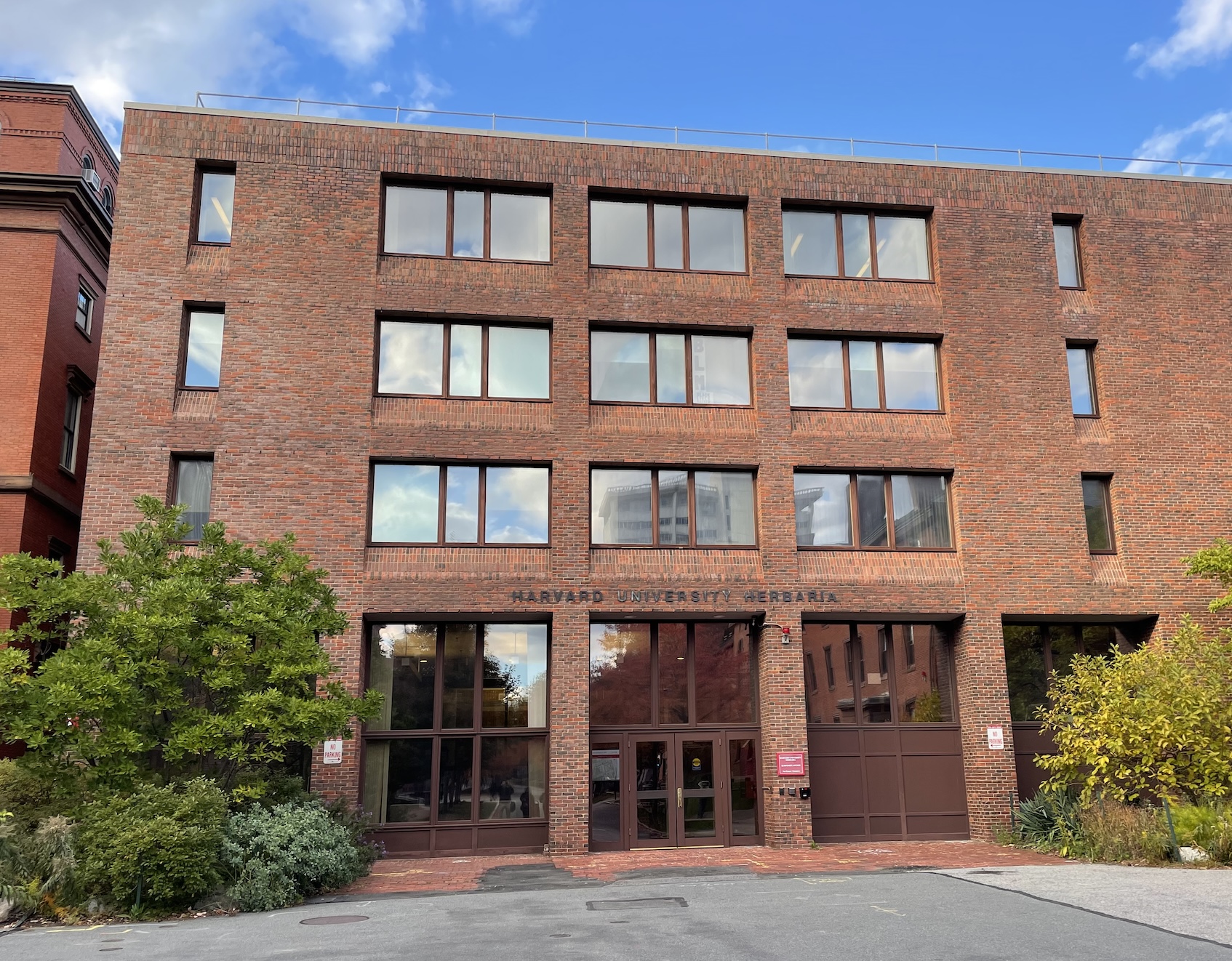
Gordon Wasson chaired the Committee for the Promotion of Advanced Slavic Cultural Studies (PROM), of which Frank Altschul, George F. Kennan, Boris A. Bakhmeteff (until his death in 1951), and Philip E. Mosely were members, later joined by Ferdinand W. Coudert and Curt H. Reisinger, with Jakobson, René Wellek, Michael Karpovich (until 1959) and then Cornelis H. van Schooneveld as its academic consultants. The group issued a statement of purpose in 1949, reported in the journal Speculum. Some of the money distributed by the Committee seems to have come from Wasson himself. A copy of the initial founding document from March 1949 is in the Rare Book and Manuscript Library Central Files at Columbia University, and in Wasson’s papers in the Botany Library at the Harvard University Herbaria. The papers of the historian Michael Karpovich in the Bakhmeteff Archive at Columbia University and Kennan’s archives at Princeton University have a lot of information about the Committee and the grants it awarded. While Jakobson and Kennan are well known, on Karpovich, the obituary by Mosely and colleagues and the article by Pereira are helpful. The PROM committee funded various projects, including the 1949 collection Russian Epic Studies, edited by Jakobson and Ernest Simmons (a sequel to Jakobson’s work on The Song of Igor, which I write about here, here and here); the 1956 Festschrift For Roman Jakobson, edited by Morris Halle, Horace G. Lunt, Hugh McLean, and van Schooneveld; the 1957 translation of Vladimir Propp’s The Morphology of the Folktale, with an introduction by Svatava Pirkova-Jakobson; and Roman Jakobson, Gerta Hüttl-Folter and John Fred Beebe, Paleosiberian Peoples and Languages: A Bibliographical Guide in 1957 (on which, see here).
After Jakobson left Columbia, Gordon Wasson worked with Jakobson and Karpovich in building up the Department of Slavic Languages and Literatures at Harvard University. When PROM closed in 1965, the assets were transferred to Harvard’s Slavic programme with the direction to spend them on advanced Slavic Studies.
The story is usually told that it was Tina’s childhood experience of foraging for mushrooms which eventually convinced her husband to investigate further. As Gordon Wasson recalls:
It was a walk in the woods, many years ago, that launched my wife and me on our quest of the mysterious mushroom. We were married in London in 1926, she being Russian, born and brought up in Moscow. She had lately qualified as a physician at the University of London. I am from Great Falls, Mont, of Anglo-Saxon origins. In the late summer of 1927, recently married, we spent our holiday in the Catskills. In the afternoon of the first day we went strolling along a lovely mountain path, through woods crisscrossed by the slanting rays of a descending sun. We were young, carefree and in love. Suddenly my bride abandoned my side. She had spied wild mushrooms in the forest, and racing over the carpet of dried leaves in the woods, she knelt in poses of adoration before first one cluster and then another of these growths. In ecstasy she called each kind by an endearing Russian name. She caressed the toadstools, savored their earthy perfume. Like all good Anglo- Saxons, I knew nothing about the fungal world and felt that the less I knew about those putrid, treacherous excrescences the better. For her they were things of grace, infinitely inviting to the perceptive mind. She insisted on gathering them, laughing at my protests, mocking my horror. She brought a skirtful back to the lodge. She cleaned and cooked them. That evening she ate them, alone. Not long married, I thought to wake up the next morning a widower (“Seeking the Magic Mushroom”, p. 113).
One of Gordon Wasson’s earliest pieces on this topic was published in the Festschrift organised for Jakobson’s sixtieth birthday. Wasson’s essay “Lightning Bolt and Mushrooms: An Essay in Early Cultural Exploration” explores the belief that underground fungus grew in thunderstorms. He ranges widely, drawing upon literature from different parts of the world, and reporting correspondence with the Norwegian scholar of Iranian Georg Morgenstierne, H.R.P. Dickson, author of The Arab of the Desert, and the Himalayan climber Charles Evans, among others. In the piece he discusses his experiences in Mexico, but also the fieldnotes of anthropologists working in Eastern Siberia, Waldemar Bogoras and Waldemar Jochelson. These last two people’s papers are at the New York Public Library, and early in his time in the United States Jakobson did some work cataloguing their manuscripts for Franz Boas. I write about that here.
Gordon Wasson also wrote his experience of the mushroom in a Mexican ceremony in Life magazine, which brought this interest to a much wider audience. The title “Seeking the Magic Mushroom” was apparently the magazine’s choice, and one with which he was unhappy. The Mexico trip was controversial for at least three reasons – Wasson was able to get access to the ritual under false pretences; he published identifying information about the shaman who conducted it, leading to implications for her within her community; and the trip was part-funded by the CIA, who were interested in the possible uses of hallucinogens in their interrogations as part of the MKUltra project, although it seems Wasson himself was unaware of the purpose. Lidia Tripiccione, “Cold War Networks and the Scholarly Byt” explores some of these issues, and the conspiracies around them. Jan Irvin’s chapter “R. Gordon Wasson: The Man, the Legend, the Myth” is more sensationalist.
The focus on the hallucinogenic properties got the public’s attention, but the Wasson’s interest was not just in the more sensational aspects. The same year, Gordon and Tina published the colourfully illustrated Mushrooms, Russia and History in two limited-edition volumes. This book is available at archive.org, which is fortunate as second-hand copies are extremely expensive. It explores questions such as the contrast between English and Russian attitudes, the poisonous nature of some mushrooms, the relation to the toad (the English ‘toadstool’; French crapaud is a toad, but crapaud rouge a kind of mushroom; Welsh caws llyffant, literally “toad’s cheese”, etc.), and the role of mushrooms in Leo Tolstoy’s Anna Karenina.
Tina Wasson died of cancer in 1958, but Gordon Wasson continued their shared interest in the mushroom. For many years he sent letters to linguists and anthropologists about vocabulary and different cultural attitudes to mushrooms, and over time he became convinced that the soma mentioned in the Rig Veda was not, as usually thought, some kind of herb, but actually a mushroom. In the Wasson archives at the Harvard University Herbaria there is an extensive correspondence with, among others, Claude Lévi-Strauss and Jakobson, and quite a bit with Georges Dumézil and Harold Bailey. The extent of these, and other correspondences, indicates that while Wasson’s money and support of projects undoubtedly helped get attention, he was not dismissed as a crank. These linguists and anthropologists took the work very seriously. Dumézil, for example, mentions this line of inquiry in his Fêtes romaines d’été et d’automne in 1975: “I leave aside the debate, brilliantly opened and supported by Monsieur R. Gordon Wasson: soma-herb or (originally) soma-mushroom” (p. 93 n. 4). Much of the correspondence with Dumézil, though, concerns Caucasian vocabulary, especially words meaning caviar. Lévi-Strauss reviewed the Soma book for L’Homme in 1970, in which he connected the analyses to his own research for the Mythologiques series.
The most extensive correspondence I looked at in Harvard was with Jakobson, which concerns both the funding of Slavic studies; the complications around Jakobson’s status in the United States, including his long-drawn out process of getting citizenship, and the political accusations; as well as vocabularies and etymologies concerning the mushroom. These are sometimes in the same letter. There is a lot there, and fortuitously, Wasson’s archive often keeps correspondence relating to Jakobson with others in the same folders, along with Jakobson’s letters to him and carbon copies of ones he sent. In his 1961 article, “The Hallucinogenic Fungi of Mexico: An Inquiry into the Origins of the Religious Idea among Primitive Peoples”, Wasson includes a part of one of the letters by Jakobson, concerning Holger Pedersen’s etymology of the fungal name in the Indo-European languages” (p. 150).
In 1963, Wasson was a Bollingen fellow for a project on “A study of the role of hallucinogenic agents in primitive religion” (McGuire, Bollingen, p. 327). This explained his interest in the writings of Mircea Eliade, particularly in Shamanism: Archaic Techniques of Ecstasy, first published in French in 1951 and translated into English in 1964. Eliade was unhelpful though, replying to a request from Wasson (13 October 1959), and saying that all his related notes were in Europe and unavailable (22 October 1959). Incidentally, when Louis Renou introduced Émile Benveniste to Eliade, Eliade recalls that Benveniste “was curious to find out certain particulars about the ecstasy of Asiatic shamans” (Autobiography Volume 2, p. 116). There does not seem to have been correspondence between Wasson and Benveniste, except when Benveniste was the co-signatory of a letter from L’Homme, which he edited with Pierre Gourou and Lévi-Strauss, inviting a submission (1 June 1960). This lack of contact between Benveniste and Wasson is a little surprising given their mutual contacts and research interests. They met at least once in late 1969 (Wasson to Jakobson, 10 November 1969), but Benveniste’s stroke later that year put an end to his academic work.
Not everyone was convinced, of course. Walter Henning sent a brief and critical reply to a request for information (13 June 1966), implying that Wasson was an amateur and did not know what he was doing (23 June 1966). Harold Bailey’s successor as chair of Sanskrit at Cambridge, John Brough, wrote a long critique of 31 pages in the Bulletin of the School of Oriental and African Studies in 1971. Brough argued that unless the argument that the soma was the mushroom could be proved for the Rig Veda, “and proved beyond any possible doubt”, all the other material Wasson provided from other traditions would “remain, in the strictest sense, irrelevant” (“Soma and Amanita muscaria”, pp. 332-33). Accordingly, Brough concentrates on the analysis of the Indian tradition, which he considers as unproven. While this is critical, Brough is doing Wasson the service of at least taking the work seriously, and marshalling all the resources of a Sanskrit expert to challenge his hypothesis.
I cannot close without an expression of admiration for the enormous labour in scholarly research which Mr. Wasson has devoted to the preparation of this book, and of gratitude for the great quantity of fascinating materials which he has placed before us. It is therefore with all the more regret that I find myself unable to accept that he has proved his theory that the original Vedic Soma was Amanita muscaria (p. 362).
Wasson responded in a booklet published by the Botanical Museum of Harvard University, Soma and the Fly-Agaric,twice the length of the review, the following year. A similar exchange had taken place with the Dutch Indologist F.B.J. Kuiper in the Indo-Iranian Journal in 1970, a journal which Kuiper had founded and which gave Wasson space to reply. The biologist Richard Evans Schultes wrote a foreword to the response to Brough, in which he explains that Wasson had originally asked the Bulletin of the School of Oriental and African Studies to publish his rejoinder, which was refused. Evans Schultes was director of the Botanical Museum of Harvard University, and suggested to Wasson that it should publish the response. He says that they tried to reprint Brough’s critique alongside the rejoinder, which was also denied by the Bulletin, a decision he deplores. He signs off his foreword by indicating the interest of botanists in this debate, and that “Soma and the ṚgVeda are too important to be left to the Vedists” (p. 8).
Wasson ends his response to Brough on a somewhat different note. After indicating the important support he had received from Renou, who had died in 1966, he indicates the need for “an Indo-Europeanist of stature, preferably one intimate with the Indo-Iranian linguistic area”, to consider again the etymology of soma, and whether the “traditional and accepted” meaning of su-, meaning to press, has alternatives. “Had Renou lived, had Emile Benveniste not been stricken, this matter would surely have been explored” (“Soma and the Fly Agaric”, p. 42).
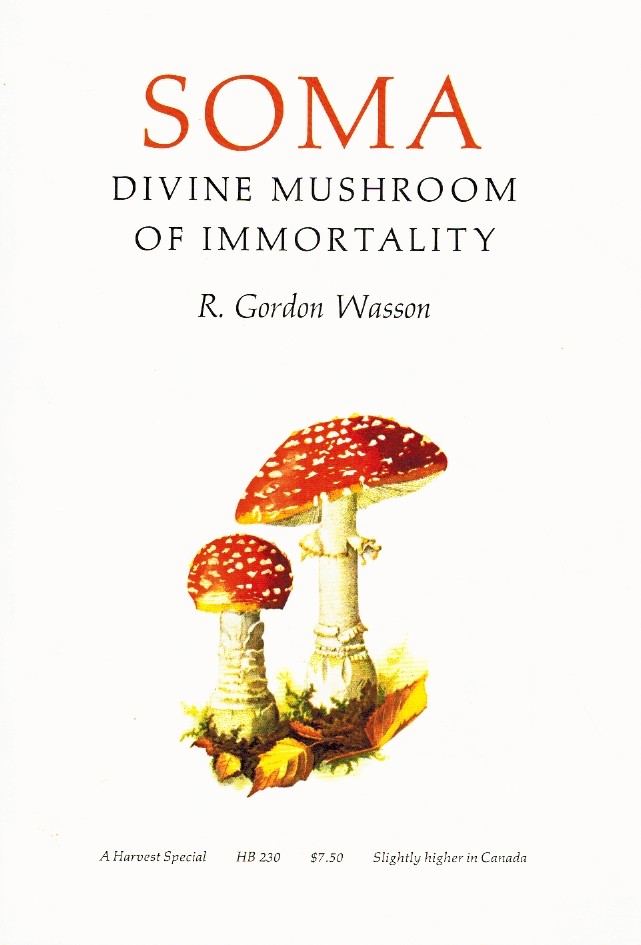
Some Sanskrit scholars did support this work. Wendy Doniger, Professor of the History of Religions at the University of Chicago, contributed a chapter to Gordon Wasson’s Soma: Divine Mushroom of Immortality in 1968, and wrote the epilogue to one of his last publications, “The Last Meal of the Buddha”, in 1983. Actually, as Doniger indicates in her reminiscences of Wasson, she was responsible for more of the Soma book, initially reduced to just the author of one chapter in case it “might endanger my fledgling career if my name was too closely associated with its maverick hypothesis”, but later described by Wasson as its co-author (Doniger, “‘Somatic’ Memories of R. Gordon Wasson”, p. 56).
Those comments are in a volume of essays Thomas J. Riedlinger produced in tribute, a few years after Wasson’s death, entitled The Sacred Mushroom Seeker: Essays for R. Gordon Wasson. Many of the Indo-European linguists and mythologists he was in correspondence with were already dead, so Jakobson, for example, could not repay a debt. It has a foreword by Evans Schultes, and short essays by Doniger and others, including the anthropologist Irmgard Weitlaner-Johnson, and Albert Hofmann, the Swiss chemist whose work on lysergic acid diethylamide (LSD) is well known. The book also includes a memoir by the Wassons’ daughter, Masha Wasson Britten.
References
“Committee for the Promotion of Advanced Slavic Cultural Studies”, in “Announcements”, Speculum 24 (3), 1949, 469-72.
Henryk Baran, “Roman Jakobson, Gordon Wasson, and the Development of American Slavic Studies”, in Judith Deutsch Kornblatt (ed.), American Contributions to the 16th International Congress of Slavists Volume 2: Literature, Bloomington, Indiana: Slavica, 2018, 1-18.
Henryk Baran, “Roman Jakobson and American Slavic Studies: The First Postwar Decade”, Roczniki HumanistyczneLXIX (7), 2021, 91-116, https://ojs.tnkul.pl/index.php/rh/article/view/16392
Michael Brinley, “Linguistic Diplomacy: Roman Jakobson between East and West, 1956–68”, Journal of the History of Ideas 84 (2), 2023, 337-63.
John Brough, “Soma and Amanita muscaria”, Bulletin of the School of Oriental and African Studies 34 (2) 1971, 331-62.
Wendy Doniger, “‘Somatic’ Memories of R. Gordon Wasson”, in Thomas J. Riedlinger ed., The Sacred Mushroom Seeker: Essays for R. Gordon Wasson, Portland, Oregon, Dioscordies Press, 1990, 55-59.
Georges Dumézil, Fêtes romaines d’été et d’automne, suivi de Dix Questions romaines, Paris: Gallimard, 1975.
Mircea Eliade, Le Chamanisme et les techniques archaïques de l’extase, Paris: Payot, 1951; Shamanism: Archaic Techniques of Ecstasy, trans. Willard R. Trask, Princeton: Princeton University Press, 1964.
Mircea Eliade, Autobiography Volume II: 1937-1960, Exile’s Odyssey, trans. Mac Linscott Ricketts, Chicago: University of Chicago Press, 1988.
David C. Engerman, “The Ironies of the Iron Curtain: The Cold War and the Rise of Russian Studies in the United States”, Cahiers du Monde russe 45 (3/4), 2004, 465-96.
David C. Engerman, Know Your Enemy: The Rise and Fall of America’s Soviet Experts, Oxford: Oxford University Press, 2009.
Richard Evans Schultes, “Foreword”, in R. Gordon Wasson, Soma and the Fly-Agaric: Mr. Wasson’s Rejoinder to Professor Brough, Cambridge, MA: Botanical Museum of Harvard University, 1972, 7-8.
Jan Irvin, “R. Gordon Wasson: The Man, the Legend, the Myth” in John Rush (ed.), Entheogens and the Development of Culture, Berkeley: North Atlantic Books, 2013, 565-619.
Roman Jakobson, Gerta Hüttl-Folter and John Fred Beebe, Paleosiberian Peoples and Languages: A Bibliographical Guide, New Haven: HRAF Press, 1957.
Roman Jakobson and Ernest J. Simmons (eds.), Russian Epic Studies, Philadelphia: American Folklore Society, 1949.
F.B.J. Kuiper, “R. Gordon Wasson, Soma, Divine Mushroom of Immortality”, Indo-Iranian Journal 12 (4) 1970, 279-85.
Claude Lévi-Strauss, “Les Champignons dans la culture: A propos d’un livre de M. R.-G. Wasson”, L’Homme 10 (1), 1970, 5-16.
William McGuire, Bollingen: An Adventure in Collecting the Past, Princeton: Princeton University Press, 1982.
Philip E. Mosely, Martin E. Malia, William Henry Chamberlin and Dimitri von Mohrenschildt, “Michael Karpovich, 1888-1959”, The Russian Review 19 (1), 1960, 56-76.
Norman G.O. Pereria, “The Thought and Teachings of Michael Karpovich”, Russian History 36 (2), 2009, 254-77.
Vladimir Propp, The Morphology of the Folktale, trans. Laurence Scott, revised edition edited by Louis A. Wagner, Austin: University of Texas Press, 1968 [1958].
Thomas J. Riedlinger ed., The Sacred Mushroom Seeker: Essays for R. Gordon Wasson, Portland, Oregon, Dioscordies Press, 1990.
Lidia Tripiccione, “Cold War Networks and the Scholarly Byt: How Russian Formalism Became an American Thing”, Slavic Review 82 (4), 2023, 949-70.
R. Gordon Wasson, “Lightning Bolt and Mushrooms: An Essay in Early Cultural Exploration”, in Morris Halle, Horace G. Lunt, Hugh McLean, Cornelius H. van Schooneveld eds., For Roman Jakobson: Essays on the Occasion of His Sixtieth Birthday, 11 October 1956, The Hague: Mouton, 1956, 605-12.
R. Gordon Wasson, “Seeking the Magic Mushroom”, Life, 13 May 1957, 101-20 (whole issue available at https://www.cuttersguide.com/pdf/Periodical-Publications/life-by-time-inc-published-may-13-1957.pdf).
R. Gordon Wasson, “The Divine Mushroom: Primitive Religion and Hallucinatory Agents”, Proceedings of the American Philosophical Society 102 (3), 1958, 221-23.
R. Gordon Wasson, “The Hallucinogenic Fungi of Mexico: An Inquiry into the Origins of the Religious Idea among Primitive Peoples” Botanical Museum Leaflets, Harvard University XIX (7), 1961, 137-62.
R. Gordon Wasson, Soma: Divine Mushroom of Immortality, New York: Harvest, 1968.
R. Gordon Wasson, “Soma: Comments Inspired by Professor Kuiper’s Review” Indo-Iranian Journal 12 (4), 1970, 286-98.
R. Gordon Wasson, Soma and the Fly-Agaric: Mr. Wasson’s Rejoinder to Professor Brough, Cambridge, MA: Botanical Museum of Harvard University, 1972.
R. Gordon Wasson, “The Last Meal of the Buddha”, Botanical Museum Leaflets, Harvard University 29 (3), 1983, 219-49, with an epilogue by Wendy Doniger O’Flaherty, 246-47.
Valentina Pavlovna Wasson and R. Gordon Wasson, Mushrooms, Russia and History, New York: Pantheon Books, two volumes, 1957, https://archive.org/details/wasson-1957-mushrooms-russia-history/page/n1/mode/2up
Matthew Wills, “The Nice Married Couple Who Inspired People to ’Shroom”, JSTOR Daily, 13 July 2021, https://daily.jstor.org/the-nice-married-couple-who-inspired-people-to-shroom/
Archives
Central Files (Office of the President Records), 1890-1984, Columbia University, Rare Book and Manuscript Library, Columbia University, https://findingaids.library.columbia.edu/archives/cul-4080177
Fonds Georges Dumézil, Collège de France
Roman Jakobson papers, MIT, Department of Distinctive Collections, https://archivesspace.mit.edu/repositories/2/resources/633
Mikhail Mikhailovich Karpovich Papers, BA#0185, Boris A. Bakhmeteff Archive of Russian and East European History and Culture, Rare Book and Manuscript Library, Columbia University, https://findingaids.library.columbia.edu/archives/cul-4079525
George F. Kennan Papers, Public Policy Papers, box 8, folder 13, Committee for the Promotion of Advanced Slavic Cultural Studies, Department of Rare Books and Special Collections, Princeton University Library, https://findingaids.princeton.edu/catalog/MC076_c00107
Tina and R. Gordon Wasson Ethnomycological Collection Archives, Botany Libraries, Harvard University Herbaria, https://hollisarchives.lib.harvard.edu/repositories/17/resources/7438
This is the 47th post of a weekly series, where I post short essays with some indications of further reading and sources, but which are not as formal as something I’d try to publish more conventionally. They are usually tangential to my main writing focus, a home for spare ideas, asides, dead-ends and possible futures. I hope there is some interest in them. They are provisional and suggestions are welcome. A few, usually shorter, pieces in a similar style have been posted mid-week.
The full chronological list of ‘Sunday histories’ is here, with a thematic ordering here.
Discover more from Progressive Geographies
Subscribe to get the latest posts sent to your email.


fossil capital
https://trinitysocialjustice.com/alex-loftus-on-ecology-right-wing-populism-and-gramscian-geography/
This is very interesting; do you plane on writing even more extensively about Wasson in the future?
Thanks for the comment. Probably not on the Wassons directly, though possibly in relation to Jakobson. I really took a look at the archives because of my interest in other people – Jakobson, Dumézil and Lévi-Strauss, mainly.
Pingback: Indo-European Thought in Twentieth-Century France update 30 – archive work in Paris, Bern and Cambridge, MA, and Benveniste’s library | Progressive Geographies
Pingback: Claude Lévi-Strauss and Roger Caillois – Race, Games and a Ceremonial Sword | Progressive Geographies
Pingback: Indo-European Thought in Twentieth-Century France update 31 – Paris archives, library problems, and working towards a complete draft | Progressive Geographies