
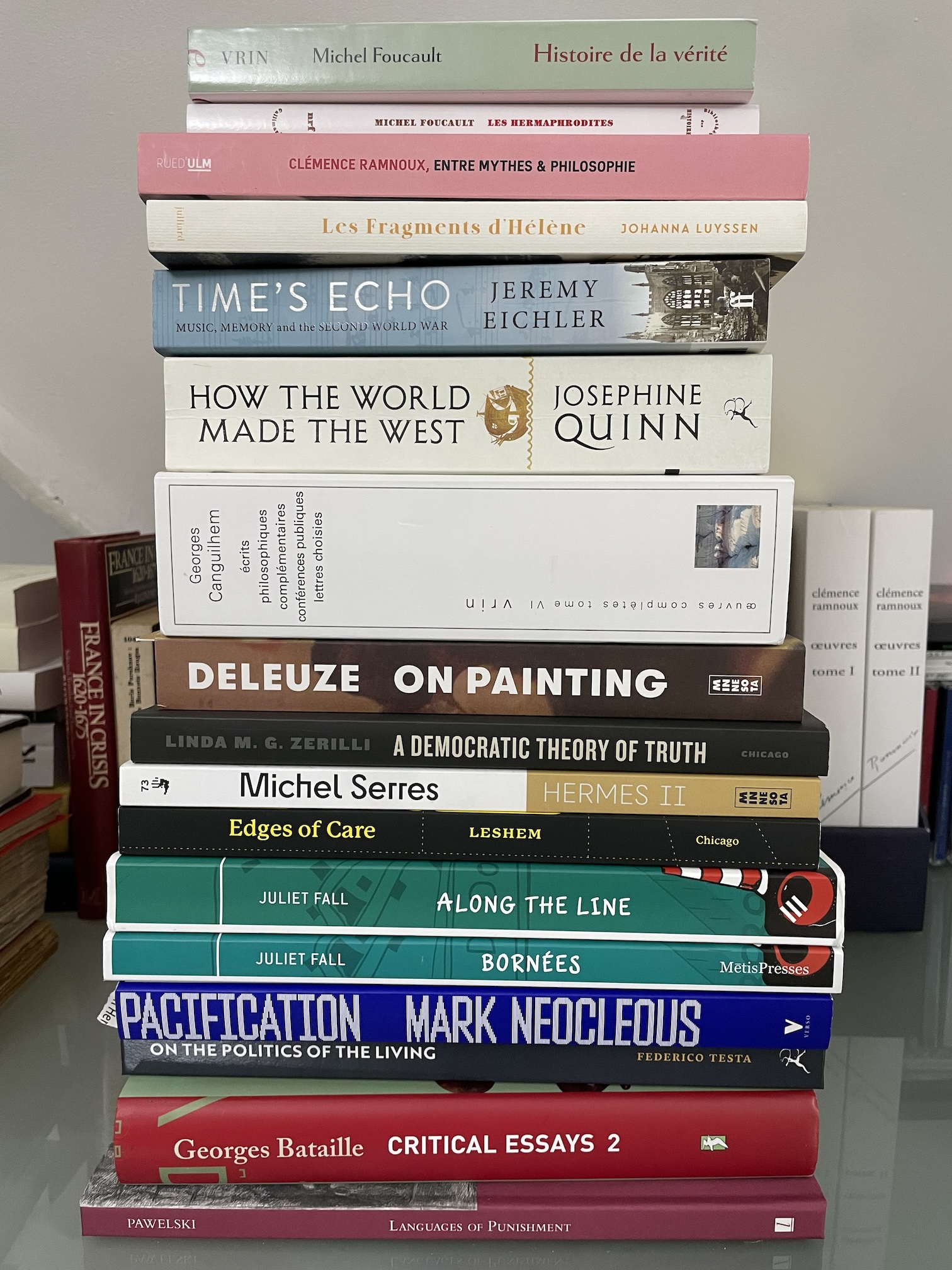
A list of academic books I liked published in 2025, or late 2024, or in paperback this year.
Many of the books I read this year were published years ago; some of the 2025 ones I’ve bought or have been sent remain unread. Some listed are books I reviewed or endorsed, and others are by friends and colleagues. It’s of course biased by my interests and prejudices. So while there are doubtless many other good books this year, I can at least say I think these ones are worth reading.
- Atossa Araxia Abrahamian, The Hidden Globe: How Wealth Hacks the World (Macmillan)
- Etienne Anheim and Paul Pasquali, Bourdieu et Panofsky: Essai d’archéologie intellectuelle, suivi de leur correspondance inédite (Éditions de Minuit)
- Georges Bataille, Critical Essays Volume 2: 1949-1951, trans. Chris Turner, ed. Alberto Toscano and Benjamin Noys (Seagull)
- Seyla Benhabib and Ayelet Shachar eds. Lawless Zones, Rightless Subjects: Migration, Asylum, and Shifting Borders (Cambridge)
- Franck Billé, Somatic States: On Cartography, Geobodies, Bodily Integrity (Duke)
- Claire Blencowe, Spirits of Extraction: Christianity, Settler Colonialism and the Geology of Race (Manchester)
- Georges Canguilhem, Œuvres complètes Tome VI : Écrits philosophiques complémentaires, conférences publiques, lettres choisies – eds. Camille Limoges and Pierre-Olivier Méthot (Vrin)
- Madeleine Chalmers, French Technological Thought and the Nonhuman Turn (Edinburgh)
- Rossella Saetta Cottone ed. Clémence Ramnoux, entre mythes et philosophie: Dumézil, Freud, Bachelard (avec des inédits de Clémence Ramnoux) (Éditions Rue d’Ulm)
- Gilles Deleuze, On Painting: Courses, March-June 1981, trans. Charles Stivale (Minnesota)
- Derek S. Denman, Fortress Power: Hostile Designs and the Politics of Spatial Control (Minnesota)
- Jeremy Eichler, Time’s Echo: Music, Memory, and the Second World War (Faber & Faber)
- Juliet Fall, Bornées: Une histoire illustrée de la frontière (Mētis); Along the Line: Writing with Comics and Graphic Narrative in Geography (EPFL) – review forthcoming in Dialogues in Human Geography [now here]
- Michel Foucault, Les Hermaphrodites, eds. Arianna Sforzini and Henri-Paul Fruchaud (Gallimard), Archéologie des sciences humaines: Cours São Paulo (1965) – ed. Philippe Sabot, (EHESS/Gallimard/Seuil) and Histoire de la vérité Cours à l’Université d’État de New York à Buffalo, mars et avril 1972 (Vrin)
- Fernanda Gallo, Hegel and Italian Political Thought: The Practice of Ideas, 1832-1900 (Cambridge)
- Marjorie Garber, Shakespeare in Bloomsbury (Yale)
- Ari Jerrems, The Spatial Limits of Political Community: Bordering the Neighbour in Urban Spain (Bristol)
- Ernst Kantorowicz, Radiances: Unpublished Essays on Gods, Kingship, and Images of the State (Cornell) – review forthcoming in The English Historical Review
- Nitzan Itzhak Lebovic, Homo Temporalis: German Jewish Thinkers on Time (Cornell)
- Stephen Legg, Spaces of Anticolonialism: Delhi’s Urban Governmentalities (Georgia)
- Noam Leshom, Edges of Care: Living and Dying in No Man’s Land (Chicago)
- Johanna Luyssen, Les Fragments d’Hélène (Julliard)
- Ingrid A. Medby, Arctic State Identity: Geography, History, and Geopolitical Relations (Manchester)
- Martin Mittelmeir, Naples 1925: Adorno, Benjamin, and the Summer That Made Critical Theory (Yale)
- Alison Mountz & Kira Williams, Let Geography Die: Chasing Derwent’s Ghost at Harvard (MIT – print and open access)
- Mark Neocleous, Pacification: Social War and the Power of Police (Verso)
- Melissa Pawelski, Languages of Punishment: Translating Foucault into English and German (Legenda)
- Chris Philo, Adorno and the Antifascist Geographical Imagination (Edinburgh) – review in Dialogues in Human Geography
- Josephine Quinn, How the World Made the West: A 4,000-Year History (Bloomsbury)
- Ingrid Robeyns, Limitarianism: The Case Against Extreme Wealth (Penguin)
- Christoph Schuringa, A Social History of Analytic Philosophy: How Politics has Shaped an Apolitical Philosophy (Verso)
- Michel Serres, Hermes II: Interference, trans. Randolph Burke (Minnesota)
- Michael J. Shapiro, Negotiating Civic Life: Literature, Film, Politics (Edinburgh) – which I endorsed
- Quentin Skinner, Liberty as Independence (Cambridge)
- Lyndsey Stonebridge, We are Free to Change the World: Hannah Arendt’s Lessons in Love and Disobedience – Penguin (US; UK)
- Elaine Stratford, The Drowned: Elements of Loss and Repair (Palgrave) – which I endorsed
- Federico Testa, On the Politics of the Living: Foucault and Canguilhem on Normativity and Biopolitical Resistance (Bloomsbury) – which I endorsed
- Richard Wilson, Shakespeare’s Fascist Followers: Modern Friends (Bloomsbury/Arden Shakespeare)
- Trevor Wilson, Alexandre Kojève and the Specters of Russian Philosophy (Northwestern)
- Linda M.G. Zerelli, A Democratic Theory of Truth (Chicago)
Here are the lists of books I liked from previous years – 2013, 2014, 2015, 2016, 2017, 2018, 2019, 2020, 2021, 2022, 2023 and 2024
Discover more from Progressive Geographies
Subscribe to get the latest posts sent to your email.


