
Louise Ridden, Nonviolent Encounters: Unarmed Civilian Protection through Bodies, Spaces and Times – Edinburgh University Press, April 2026 (print and open access)
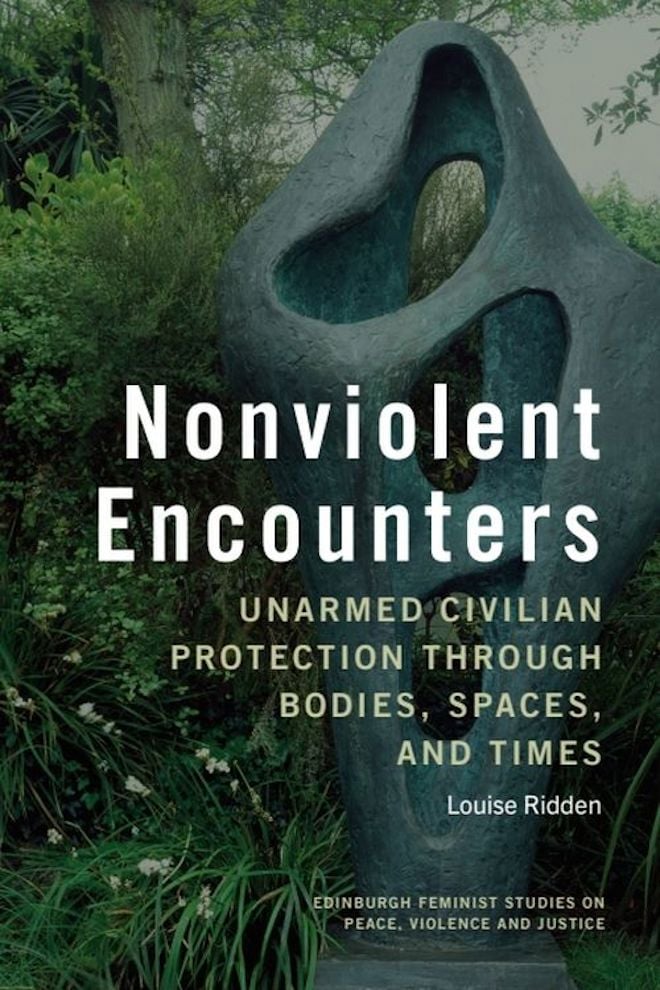
Studies nonviolence as a way of knowing, doing and being in armed conflict
- Discusses the practice of Unarmed Civilian Protection (UCP) in South Sudan, Indonesia, Kosovo, Albania, the US, Northern Ireland, Syria, Israel and Palestine
- Draws together feminist theorising from International Relations, Peace and Conflict Studies, Critical Geography and Critical Military Studies
- Challenges the centrality of violence in academic work relating to armed conflict by de-centring and displacing violent epistemological and ontological frameworks
- Addresses the key conceptual building blocks of embodiment, space and temporality
- Directly engages with assumptions around the efficacy and legitimacy of violence in the protection of civilians
This book takes the emerging practice of Unarmed Civilian Protection as a case study of nonviolence to interrogate the roles of violence and nonviolence in conflict knowledge production. By focusing on nonviolent actors using UCP, it decentres violence, which is often so prominent in peace research. This approach creates space to fundamentally reimagine how the world might be when imagined and enacted through nonviolence.
Drawing together feminist theorising from critical military studies, peace and conflict studies and international relations, Nonviolent Encounters argues that decentring violence in conflict knowledge production upsets the simple binaries of protector/protected and war/peace, underpinned by the ‘one-world’ onto-epistemology of much Western conflict knowledge. Instead, space is created to reconsider nonviolence, not as the binary opposite of violence, but as a way of knowing, doing and being – as a way of producing alternative ontological worlds.
Discover more from Progressive Geographies
Subscribe to get the latest posts sent to your email.


When it comes to sustainable peace, also childhood seems to matter. Franz Jedlicka, a peace researcher from Austria, focuses on this linkage.
Olivia