
In 1932, the mythologist Georges Dumézil was advertised as having a forthcoming book entitled Le Monde Russe [The Russian World] for a new series called ‘Géographie pour tous’ [Geography for everyone].
The book never appeared. At the time Dumézil was teaching in Uppsala, and trying to get a post back in France. He returned in 1933 for a temporary position at the École Pratique des Hautes Études, and eventually secured a permanent teaching role there in 1935. Fatefully, between 1933 and 1935 he supplemented his teaching income with journalism, published under a pseudonym. This included both book and travel reviews for a few different newspapers, including Candide, Ric et Rac, and much more extensive work as the foreign politics reporter for the right-wing Le Jour. Dumézil’s journalism is a story which is discussed in various places, notably by Didier Eribon in Faut-il brûler Dumézil, and which I am revisiting with some new evidence and references in my manuscript on Benveniste and Dumézil.
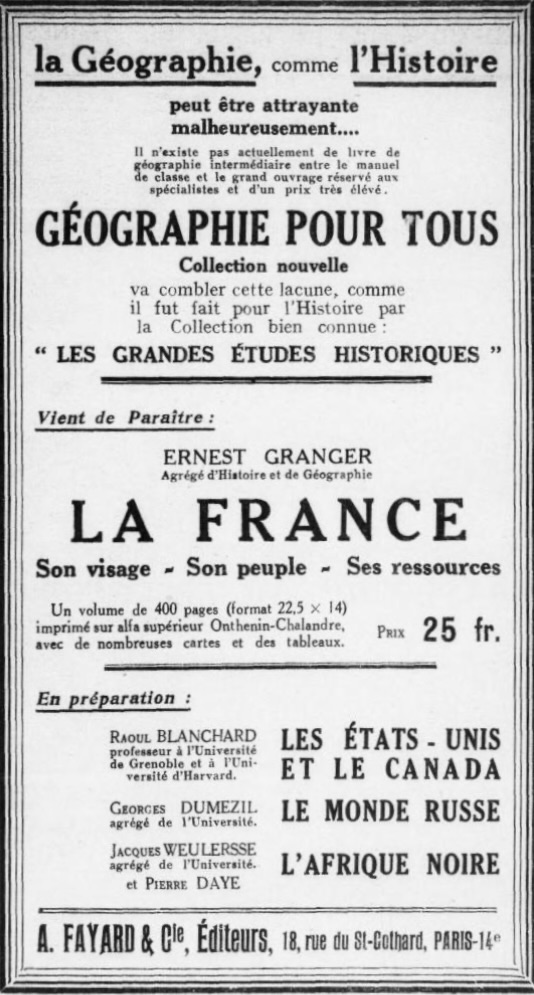
It’s interesting that Dumézil was planning to write a book for a popular audience. Presumably this was also something he considered doing for income. The source was a full-page advertisement in La Nouvelle Revue des jeunes, 15 June 1932, p. 677. The series description reads:
Geography, like History / can be attractive, / unfortunately… / There is currently no geography book that falls between a school textbook and a major, very expensive work only for specialists. / Geography for all / New collection / will fill this gap, as was done for History by the well-known collection: “Great Historical Studies”.
There are three books mentioned, beyond Dumézil’s possible study: Ernest Granger, La France; son visage, son peuple, ses ressources, just published; and two forthcoming studies, Raoul Blanchard, Les États-Unis et le Canada; and Jacques Weulersse, L’Afrique Noire. “Les grande études historiques” was another Fayard series, edited by Dumézil’s close friend Pierre Gaxotte, who also edited Je Suis Partout in this period, before being replaced by Robert Brasillach. Some of these newspapers were published by Fayard – Candide, Ric et Rac, and Je Suis Partout. (There is a history of Fayard on their website.) Gaxotte was a journalist and writer, author of a conservative critique of the French Revolution, which was dedicated to Dumézil. Although Gaxotte held reactionary views, and was close to Charles Maurras of Action française, it was when Brasillach took over Je Suis Partout that the newspaper went fully fascist, and later collaborationist. Brasillach was executed after the war; Gaxotte was elected to the Académie française.
Granger’s book was published in 1932; Blanchard’s book as L’Amérique du nord: États-Unis, Canada et Alaska in 1933, and Weulersse’s in 1934. E.F. Gautier published L’Afrique blanche in 1939. A companion to Weulersse’s book on sub-Saharan Africa, Gautier discussed north and east Africa. This division is remarkable in itself, with Gautier seeing the Tropic of Cancer as the divide between ‘White Africa’ and ‘Black Africa. This is, for him, racial as well as geographic, though his book on ‘White Africa’ includes Egypt, Abyssinia, and Anglo-Egyptian Sudan as well as Morocco, Algeria, Tunisia and Libya. His division, as well as the regions of Weulersse’s study, are interesting and revealing in terms of a 1930s French colonial view of the continent.
As far as I can tell, no other books in the series appeared. The list of other books in the series found in the early volumes does not mention Dumézil’s possible book, and I have never found another trace of it.
A curiosity, but not implausible, especially given Dumézil’s friendship with Gaxotte and his work for the press’s newspapers. Nor is the subject matter outside of his competence. While he was teaching abroad, initially in Turkey and then Sweden, Dumézil began a parallel career on Caucasian linguistics and legends. He would publish extensively in Caucasian studies, especially on the dying Ubykh language, he taught Armenian for several years in Paris, and published collections of folktales and especially about the Nart sagas. He said it was while he was based in Turkey that he first visited an exhibition on the non-Russian people of the Soviet Union and it led him to this enduring interest, with works published between the late 1920s and his 1986 death. But I hadn’t previously known he was considering a work on the geography of Russia. There are some comments on linguistic geography throughout his work, and he provides elements of a historical geography of the Ubykh people, particularly in the introduction to the third volume of his Documents anatoliens sur les langues et les traditions du Caucase series, Nouvelles Études Oubykhs in 1965.
The other books in the series do discuss elements of human geography, including administrative and political divisions, populations, and economic resources, but concentrate on physical geography.
References
Raoul Blanchard, L’Amérique du nord: États-Unis, Canada et Alaska, Paris: A. Fayard, 1933.
Georges Dumézil, “Notes pour un centenaire”, Documents anatoliens sur les langues et les traditions du Caucase III: Nouvelles Études Oubykhs, Paris: Institut d’Ethnologie, 1965, 15-36.
Didier Eribon, Faut-il brûler Dumézil? Paris: Flammarion, 1992.
E.F. Gautier, L’Afrique blanche, Paris: A. Fared, 1939.
Pierre Gaxotte, La Révolution française, Paris: Arthème Fayard, 1928; French Revolution, trans. Walter Alison Phillips, New York: Charles Scribner’s Sons. 1932.
Ernest Granger, La France: son visage, son peuple, ses ressources, Paris: A. Fayard, 1932.
Jacques Weulersse, L’Afrique Noire, Paris: A. Fayard, 1934.
This is the 72nd post of a weekly series, posted every Sunday throughout 2025, and continuing into a second year. The posts are short essays with indications of further reading and sources. They are not as formal as something I’d try to publish more conventionally, but are hopefully worthwhile as short sketches of histories and ideas. They are usually tangential to my main writing focus, a home for spare parts, asides, dead-ends and possible futures. I hope there is some interest in them. They are provisional and suggestions are welcome. A few, usually shorter, pieces in a similar style have been posted mid-week. I’m not sure I’ll keep to a weekly rhythm throughout 2026, but there will be at least a few more pieces.
The full chronological list of ‘Sunday histories’ is here, with a thematic ordering here.
Discover more from Progressive Geographies
Subscribe to get the latest posts sent to your email.


Pingback: Forty years since the death of Georges Dumézil and fifty since that of Émile Benveniste | Progressive Geographies