Sakora Christmas, Territorial Natures: Imperial Japan and the Mongolian Question – University of Chicago Press, October 2026

Sakora Christmas, Territorial Natures: Imperial Japan and the Mongolian Question – University of Chicago Press, October 2026
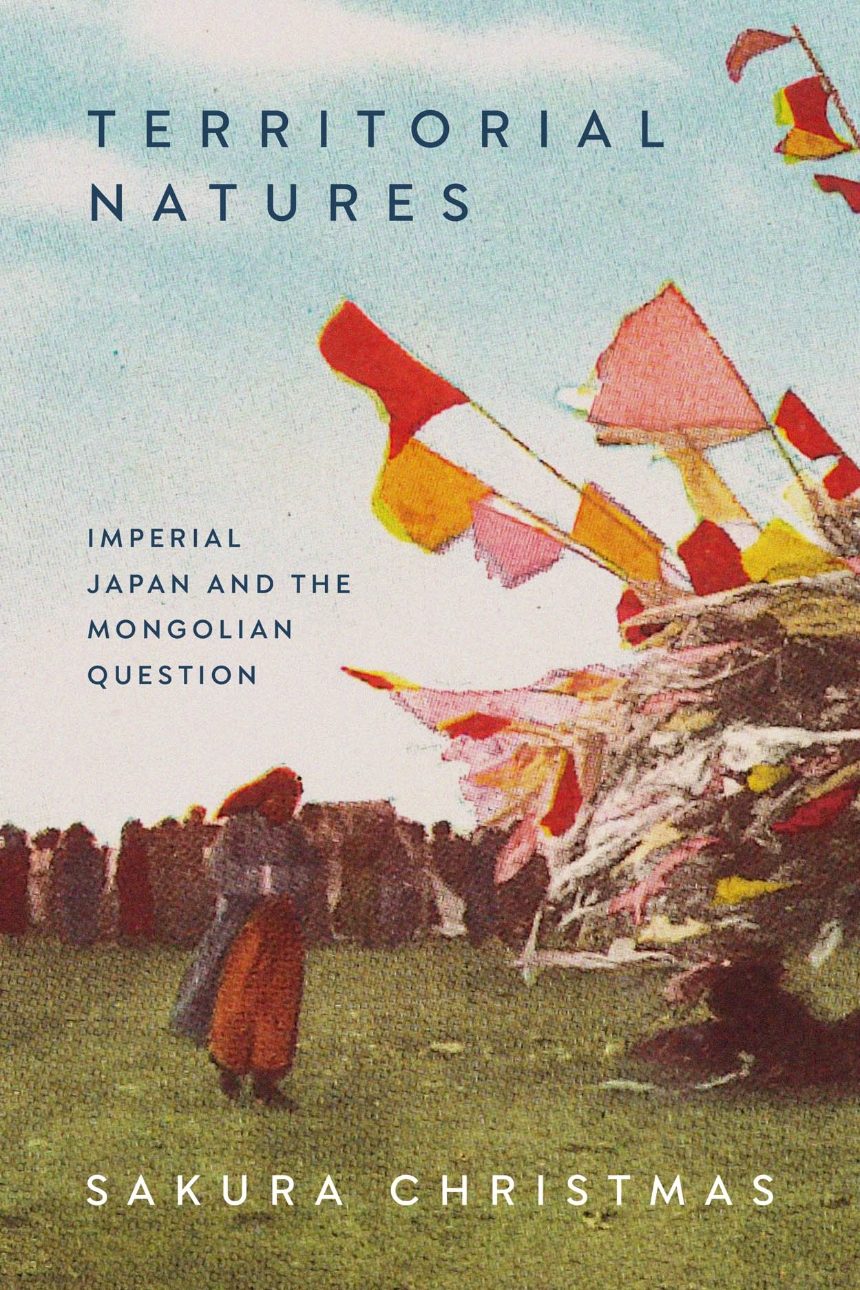
A critical account of the Japanese occupation in Inner Mongolia.
 
Early in the twentieth century, the steppe borderlands between China and Mongolia erupted in violence. As imperial Japan expanded into this area, this crisis between nomadic and settler communities posed fundamental problems in governance. In response, Japanese and Mongol leaders together proposed a radical solution: Demarcating an autonomous region in Manchukuo for minority peoples, a new kind of political space that would later define the territorial structure of Communist China. 
 
In Territorial Natures, Sakura Christmas explores how the fraught partition of this autonomous region warped the ethnic and environmental boundaries of Manchukuo. She challenges its origin story as a socialist invention by the Chinese state, instead seeing it as also a fascist extension from the Japanese occupation. By reading Chinese and Mongolian sources against Japanese archives, Christmas reveals how this contested history seeded the volatile landscape of autonomous regions in the People’s Republic of China today.
Posted in Territory, Uncategorized | Leave a comment

The Story of Capital: Book Launch with David Harvey in Conversation with Adam Tooze

The Story of Capital: Book Launch with David Harvey in Conversation with Adam Tooze – discussing The Story of Capital: What Everyone Should Know About How Capital Works (Verso, 2026), via Reading Capital with David Harvey

Posted in Adam Tooze, David Harvey, Uncategorized | 1 Comment

Mark Pennington, Foucault and Liberal Political Economy: Power, Knowledge, and Freedom – Oxford University Press, August 2025 and New Books interview

Mark Pennington, Foucault and Liberal Political Economy: Power, Knowledge, and Freedom – Oxford University Press, August 2025

New Books interview with Morteza Hajizadeh – thanks to dmf for the link

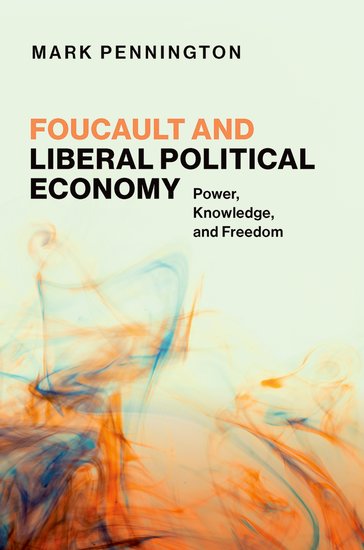
This highly original and innovative book is the first to comprehensively engage the ideas of the French social theorist and philosopher Michel Foucault from within the tradition of liberal political economy. Divided into two parts the book commences by demonstrating important commonalities between Foucault’s ideas and those of a neglected ‘post-modern’ stream in liberal political and economic thought. These ideas draw on a social theory emphasising a culturally situated individualism; a philosophy of science highly critical of socio-economic ‘scientism’ and ‘expert rule’; and an understanding of freedom as an open-ended process of ‘self-creation’ in the face of cultural power relations—a freedom threatened by alignments between state power and more decentred manifestations of power. 

Part two combines the tools of Foucault’s critical social theory with those of a post-modern liberalism to problematise four separate though overlapping ‘bio-political’ or ‘pastoral’ dispositifs in contemporary liberal societies focused on social justice, public health, ecological sustainability, and law and order. Where the Foucauldian and the post-modern liberal approaches suggest that freedom requires a cultural and economic ‘creative destruction’ that destabilises existing modes of thought and ways of being, the pastoral dispositifs that seek to ‘monitor and correct’ multiple pattern anomalies are shown to stifle the space for that creative freedom. 

Though the book does not engage the question of whether Foucault himself moved towards endorsing liberal political economy, it throws considerable light on how key Foucauldian concerns may be addressed within the liberal tradition, and why Foucauldians may have reason to embrace a reconstituted or post-modern liberalism.

Posted in Uncategorized | Leave a comment

Henri Lefebvre wasn’t a fan of previous missions to the moon

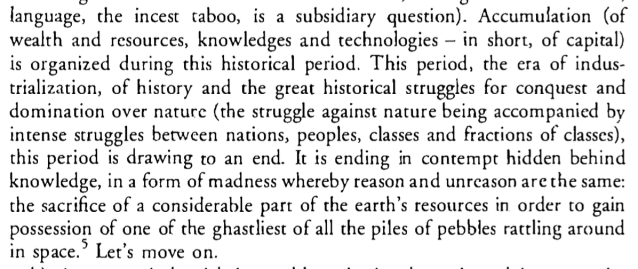
Henri Lefebvre wasn’t a fan of previous missions to the moon, describing it as “the sacrifice of a considerable part of the earth’s resources in order to gain possession of one of the ghastliest of all the piles of pebbles rattling around in space” (La Fin de l’histoire in 1970, p. 212, Key Writings, p. 182).

... Accumulation (of wealth and resources, knowledges and technologies – in short, of capital) is organized during this historical period. This period, the era of industrialization, of history and the great historical struggles for conquest and domination over nature (the struggle against nature being accompanied by intense struggles between nations, peoples, classes and fractions of classes), this period is drawing to an end. It is ending in contempt hidden behind knowledge, in a form of madness whereby reason and unreason are the same: the sacrifice of a considerable part of the earth's resources in order to gain possession of one of the ghastliest of all the piles of pebbles rattling around in space. Let’s move on.
Posted in Henri Lefebvre | Leave a comment

Foucault’s lectures in Buffalo – audio recordings of the 1972 course and part of the 1970 course online

Foucault’s lectures in Buffalo – audio recordings of the 1972 course and part of the 1970 one are now available online.

The 1972 course has recently been transcribed as Histoire de la vérité, edited by Henri-Paul Fruchaud and Orazio Irrera. This was made on the basis of these recordings, which are in the Buffalo archives. The tapes also include the introductory lecture of the 1970 course, and one of the two lectures on Sade which were included in Grande étrangère/Language, Madness, Desire, on the basis of a transcription sent to Foucault.

I was able to listen to these recordings after I had visited the Buffalo archives last year. It’s good they are now more widely available. I discuss what the archives reveal briefly here and in more detail in a piece in Foucault Studies.

Leonhard Riep discusses Foucault’s 1972 Buffalo course in detail in an essay in that same issue. For those that don’t read French, Leonhard provides the most comprehensive study of the course. I expect the course will be translated in The Chicago Foucault Project series at some point.

In my Foucault Studies piece I argue that much of the 1970 course has been published, but as a series of disconnected lectures, mostly on the basis of Foucault’s manuscripts. It was advertised as “The desire for knowledge or the phantasms of knowledge in French literature in the nineteenth and twentieth centuries”, and contained lectures on Sade, Flaubert, Balzac and Nietzsche, and possibly Blanchot, Bataille and Jules Verne. Foucault also gave a different version of the “What is an Author?” lecture (not currently published, despite what one version claims), and a public lecture on Manet at a local art gallery. The recording of the second Sade lecture is not in the Buffalo archives, I’m unaware of surviving recordings of the other lectures in the course, and the introductory 1970 lecture has not yet been transcribed. The different version of “What is an Author?” has been transcribed but is not yet published – see my preliminary analysis here.

The lectures and discussions – almost thirty hours – are available here.

I’ve added these to the list of audio and video recordings of Foucault.

Posted in Michel Foucault, Uncategorized | Leave a comment

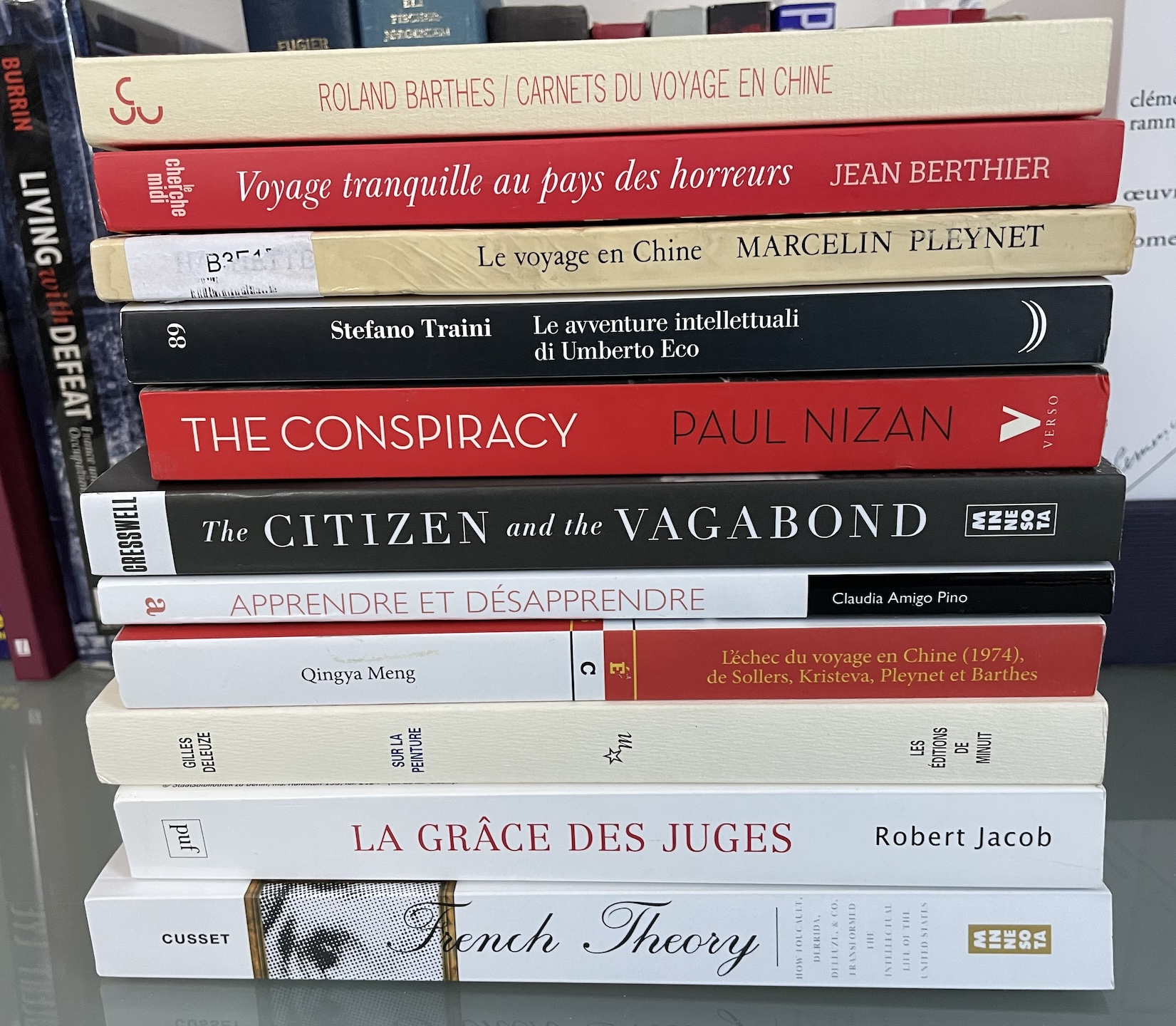
Books received – Barthes, Berthier, Pleynet, Traini, Nizan, Cresswell, Amigo Pina, Meng, Deleuze, Jacob, Cusset

I’ve been away for a while, so there were a few books waiting for me on my return. Several of these relate to a planned ‘Sunday History‘ on the Tel Quel visit to China – Jean Berthier’s recent book Voyage tranquille au pays des horreurs: Sollers, Barthes, Kristeva, Pleynet, Wahl… en Chine and some of the older ones on it. The pile also includes Gilles Deleuze,  Sur la peinture, the first of his courses to be published – I already have the others out so far, and the English translation On Painting. Tim Cresswell’s The Citizen and the Vagabond: A Politics of Mobility was sent by University of Minnesota Press, François Cusset’s older French Theory was recompense for review work for them.

Posted in Uncategorized | Leave a comment

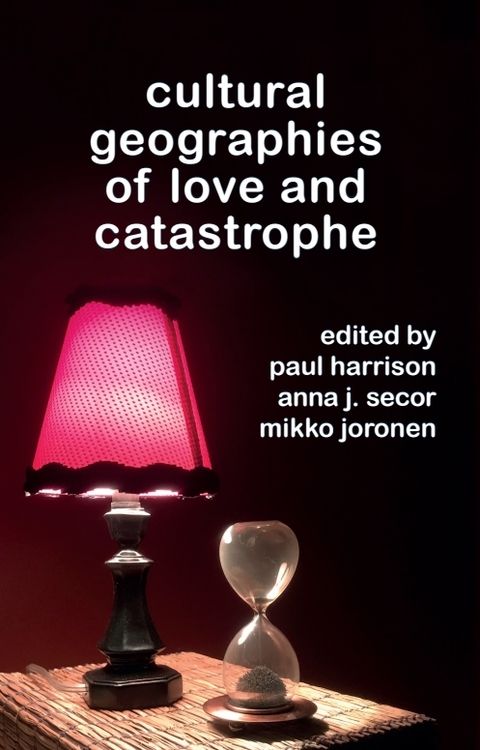
Paul Harrison, Anna J. Secor and Mikko Joronen eds. Cultural Geographies of Love and Catastrophe – Edinburgh University Press, August 2026 (print and open access)

Paul Harrison, Anna J. Secor and Mikko Joronen eds. Cultural Geographies of Love and Catastrophe – Edinburgh University Press, August 2026 (print and open access)

Offers a new cultural geographical theorisation of love

  • Suggests new ways to think about love in relation to world-ending catastrophes of various kinds (from the personal to the ecological)
  • Showcases an exciting range of theoretical and creative approaches to cultural geographies of love and catastrophe

Across thirteen chapters, this collection examines how love takes place. Ranging from the classical to the contemporary, the artistic to the political, the human to the ecological, the contributors consider how love makes, unmakes, and remakes selves, communities and worlds. Resisting the urge to purify love, alive to love’s turbulence, they address the strange new attachments and alliances love makes possible and those it blights and prohibits. To love, to be loved, to speak of love, is a threat as much as it is a promise: the promise and threat of being undone by love. Love and catastrophe are not opposed but entwined.

At the heart of the collection is a surprising thesis: that love is always an experiment with distances, with intervals, with spacing. An education in love, an education by love, is a geography lesson.

Posted in Uncategorized | 1 Comment

Sixteen Writing Tips from Marcus Rediker

Sixteen Writing Tips from Marcus Rediker – Pittsburgh Review of Books

Lots more writing and publishing posts and links here.

Posted in Uncategorized | Leave a comment

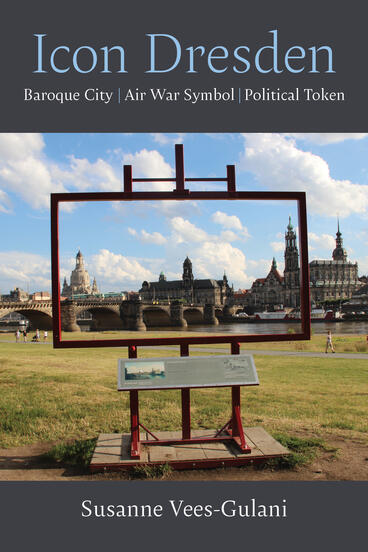
Susanne Vees-Gulani, Icon Dresden: Baroque City, Air War Symbol, Political Token – University of Michigan Press, February 2026 (print and open access) and New Books discussion

Susanne Vees-Gulani, Icon Dresden: Baroque City, Air War Symbol, Political Token – University of Michigan Press, February 2026 (print and open access)

New Books discussion with Miranda Melcher – thanks to dmf for the link

Icon Dresden explores how memory and politics in Dresden after its 1945 bombing are deeply intertwined with the city’s urban history. It highlights the complex origins of Dresden’s reputation as an exclusively cultural center, focusing on urban planning, marketing, tourism, and the city’s visual archive since the 17th century. Based on this iconic status, a narrative of victimhood arose after its destruction that ignored responsibilities while highlighting the city’s innocence. Despite its origin in Nazi propaganda, this narrative influenced postwar political discourse in socialist and post-reunification Germany. Icon Dresden also provides insight into Dresden’s role under National Socialism and the GDR’s evasive response to this history. It reveals how the strong presence of far-right movements in the city today stems from multiple discourses formed over centuries and communicated from generation to generation. 

Drawing on urban, heritage, and tourism studies, visual and memory studies, and environmental psychology, Icon Dresden examines Dresden’s history, identity, visual representations, and rebuilding decisions. It exposes the narratives that define its place in German and international memory and how, paradoxically, they support both Dresden’s current image as a symbol of peace and reconciliation and its backing of nativist and far-right movements.

Posted in Uncategorized | Leave a comment

Appel à communication – 11e rencontres doctorales du Centre Michel Foucault (2026)

Posted in Uncategorized | 1 Comment