Fernanda Gallo, Hegel and Italian Political Thought: The Practice of Ideas, 1832-1900 – Cambridge University Press, September 2024

Fernanda Gallo, Hegel and Italian Political Thought: The Practice of Ideas, 1832-1900 – Cambridge University Press, September 2024

update May 2025: New Books network discussion with Lily Goren

Across Italy in the nineteenth century, a generation of intellectuals engaged with Hegel’s philosophy while actively participating in Italian political life. Hegel and Italian Political Thought traces the reception and transformation of these ideas, exploring how Hegelian concepts were reworked into political practices by Italians who had participated in the 1848 revolution, who would lead the new Italian State after unification, and who would continue to play a central role in Italian politics until the end of the century. Fernanda Gallo investigates the particular features of Italian Hegelianism, demonstrating how intellectuals insisted on the historical and political dimension of Hegel’s idealism. Set apart from the broader European reception, these thinkers presented a critical Hegelianism closer to practice than ideas, to history than metaphysics. This study challenges conventional hierarchies in the study of Italian political thought, exploring how the ideas of Hegel acquired newfound political power when brought into connection with their specific historical context.

Posted in Georg Wilhelm Friedrich Hegel | Leave a comment

Books received – Politzer, Nelson, Keshavarzian, Daix, Livingstone

Michel Politzer, Les Trois morts de Georges Politzer, William Max Nelson, Enlightenment Biopolitics: A History of Race, Eugenics and the Making of Citizens, Arang Keshavarzian, Making Space for the Gulf: Histories of Regionalism and the Middle East, Pierre Daix’s biography of Fernand Braudel, and David N. Livingstone, The Empire of Climate: A History of an Idea.

University of Chicago Press, Stanford University Press and Princeton University Press sent the copies of Nelson, Keshavarzian and Livingstone’s books; the older French ones were picked up second-hand.

Posted in David N. Livingstone, Uncategorized | Leave a comment

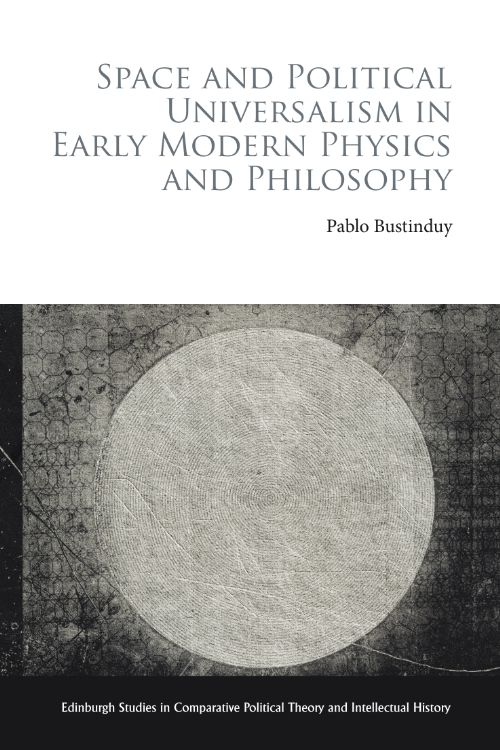
Pablo Bustinduy, Space and Political Universalism in Early Modern Physics and Philosophy – Edinburgh University Press, March 2024

Pablo Bustinduy, Space and Political Universalism in Early Modern Physics and Philosophy – Edinburgh University Press, March 2024

Examines how the imagination of space in the early modern period influenced the development of the modern concept of political universalism
  • Offers a history and genealogy of the concept of space in the European philosophical tradition
    Presents the political effects of the modern cosmological transition
  • Provides a systematic critique of the Westphalian logic of the State as absolute, universal, autonomous, and unique
  • Gives an account of the developments and contradictions of abstract universalism, and its philosophical entanglement with the European colonial project and the nascent logic of capitalism
  • Discusses the emancipatory content of universalism and the philosophical causes and effects of its contemporary crisis

How did early modern philosophy of space shape the modern concept of political universalism? In this book, Pablo Bustinduy persuasively argues that political universalism emerged from both the developments of Newtonian science and the formulation of the modern philosophy of the State. In the metaphysics of an open, empty, abstract and absolute space, Bustinduy suggests, the universalist project of modern politics found its logical model and foundation. There, the anxiety of a dislocated world was overcome, and the ontology of modern physics found a specific political expression that, despite being besieged by multiple crises, still animates our political imagination.

By offering a political reading of early modern philosophy of space, Space and Political Universalism in Early Modern Physics and Philosophy reveals the connections between the logical development of early modern science, the contemporary elaborations of the philosophy of the State, and the historical articulations of the Westphalian system, early capitalist social formations, and the European colonial project. In doing so, it offers a powerful reflection on how we might detach democracy from the ‘perilous metaphysics’ of infinite space that has engendered political violence and domination, positing space as an emptiness that prevents the closure of the political itself.

Posted in Uncategorized | Leave a comment

Catherine Hall, Lucky Valley: Edward Long and the History of Racial Capitalism – Cambridge University Press, February 2024

Catherine Hall, Lucky Valley: Edward Long and the History of Racial Capitalism – Cambridge University Press, February 2024

Why does Edward Long’s History of Jamaica matter? Written in 1774, Long’s History, that most ‘civilised’ of documents, attempted to define White and Black as essentially different and unequal. Long deployed natural history and social theory, carefully mapping the island, and drawing on poetry and engravings, in his efforts to establish a clear and fixed racialized hierarchy. His White family sat at the heart of Jamaican planter society and the West India trade in sugar, which provided the economic bedrock of this eighteenth-century system of racial capitalism. Catherine Hall tells the story behind the History of a slave-owning family that prospered across generations together with the destruction of such possibilities for enslaved people. She unpicks the many contradictions in Long’s thinking, exposing the insidious myths and stereotypes that have poisoned social relations over generations and allowed reconfigured forms of racial difference and racial capitalism to live on in contemporary societies.

  • The first critical exploration of Long’s History of Jamaica in its full political and economic context 
  • Essential to understanding the history of racial difference through ‘enlightenment’ definitions and how these have shaped society even to the present day 
  • Explores the concept of racial capitalism and how race and wealth could not be disentangled
Posted in Uncategorized | Leave a comment

Eric S. Nelson, Heidegger and Dao: Things, Nothingness, Freedom – Bloomsbury, November 2023

Eric S. Nelson, Heidegger and Dao: Things, Nothingness, Freedom – Bloomsbury, November 2023

In this innovative contribution, Eric S. Nelson offers a contextualized and systematic exploration of the Chinese sources and German language interpretations that shaped Heidegger’s engagement with Daoism and his thinking of the thing, nothingness, and the freedom of releasement (Gelassenheit). Encompassing forgotten and recently published historical sources, including Heidegger’s Daoist and Buddhist-related reflections in his lectures and notebooks, Nelson presents a critical intercultural reinterpretation of Heidegger’s philosophical journey.

Nelson analyzes the intersections and differences between the Daodejing, the Zhuangzi, and Heidegger’s philosophy and the linguistic and conceptual shifts in Heidegger’s thinking that correlate with his encounters and interactions with Daoist, Buddhist, and East Asian texts and interlocutors. He thereby traces hints for encountering things and environments anew, models for intercultural hermeneutics, and ways of reimagining the thing, nothingness, and freedom with and beyond Heidegger’s thought.

This work elucidates the thing, the mystery, and freedom in Heidegger and Daoism in Part I and Heidegger’s thinking of nothingness, emptiness, and the clearing in relation to Daoist and Buddhist philosophy in Part II. In each part, Nelson unfolds a fresh perspective for thinking further with Heidegger and East Asian philosophies in relation to the contemporary existential and environmental situation for the sake of nourishing life amidst damaged life.

Posted in Martin Heidegger, Uncategorized | Leave a comment

Mark Carrigan on writing – beginning of a series of posts

Mark Carrigan on writing – beginning of a series of posts. Thanks to Dave Beer for the link.

Posted in Uncategorized | Leave a comment

It’s Not Your Fault That Academic Life is Getting Harder by Glen O’Hara

Posted in Uncategorized | 1 Comment

Martin Procházka (ed.), Shakespeare to Autofiction: Approaches to authorship after Barthes and Foucault, UCL Press, April 2024 (open access)

Martin Procházka (ed.), Shakespeare to Autofiction: Approaches to authorship after Barthes and Foucault, UCL Press, April 2024 (open access)

From Shakespeare to Autofiction focuses on salient features of authorship throughout modernity, ranging from transformations of oral tradition and the roles of empirical authors, through collaborative authorship and authorship as ‘cultural capital’, to the shifting roles of authors in recent autofiction and biofiction. In response to Roland Barthes’ ‘removal of the Author’ and its substitution by Michel Foucault’s ‘author function’, different historical forms of modern authorship are approached as ‘multiplicities’ integrated by agency, performativity and intensity in the theories of Pierre Bourdieu, Wolfgang Iser, Gilles Deleuze and Félix Guattari.

The book also reassesses recent debates of authorship in European and Latin American literatures. It demonstrates that the outcomes of these debates need wider theoretical and methodological reflection that takes into account the historical development of authorship and changing understandings of fiction, performativity and new media. Individual chapters trace significant moments in the history of authorship from the early modernity to the present (from Shakespeare’s First Folio to Latin American experimental autofiction), and discuss the methodologies reinstating the author and authorship as the irreducible aspects of literary process.

Posted in Michel Foucault, Roland Barthes, Uncategorized, William Shakespeare | Leave a comment

Camus journaliste – Le blog de Gallica

Camus journaliste – Le blog de Gallica

« Albert Camus à Alger en 1937 », Christiane Chaulet-Achour, Albert Camus, Alger, Atlantica, 1998

L’activité journalistique d’Albert Camus illustre son sens de l’engagement avant, pendant et après la Seconde Guerre mondiale. Il utilise la presse comme peu d’écrivains l’ont fait pour dénoncer les injustices et les violences de son temps. Il devient l’une des voix emblématiques de la Résistance dans les colonnes du journal Combat.

Posted in Albert Camus, Uncategorized | 1 Comment

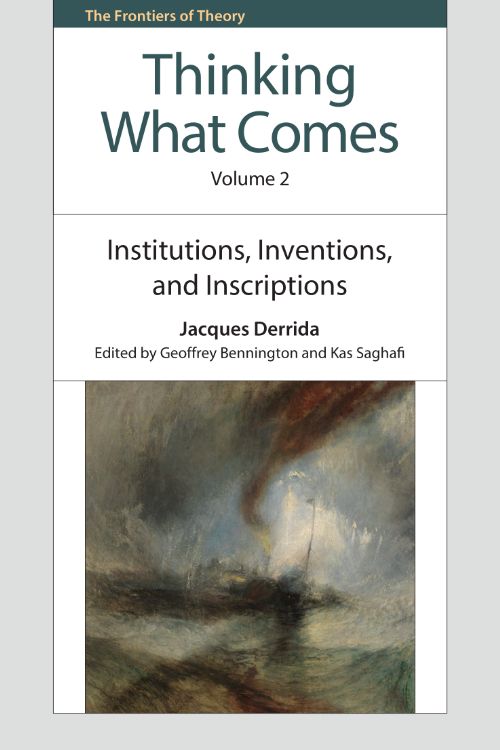
Jacques Derrida, Thinking What Comes, eds. Geoffrey Bennington, Kas Saghafi, two volumes, Edinburgh University Press, March 2024

Jacques Derrida, Thinking What Comes, eds. Geoffrey Bennington, Kas Saghafi, two volumes, Edinburgh University Press, March 2024 – volume 1; volume 2

In two volumes, Geoffrey Bennington and Kas Saghafi present the majority of Jacques Derrida’s untranslated, and previously uncollected, essays and interviews. Dating mostly from 1992 to 2004, these writings offer a fuller picture of Derrida’s biography, theoretical engagements and the stakes of his social and political investments. In the interviews in Essays, Interviews, and Interventions by Jacques Derrida: Thinking What Comes, Volume 1, Derrida proposes the foundation of a new European political culture, discusses the strengths of Nelson Mandela, and reflects on the archive. He also considers his experience of political life, his relationship to institutions (particularly the Collège international de philosophie), and his views on ‘intellectualism’. Whether writing about public health, Palestine, or the notion of the promise, Derrida is razor-sharp and impassioned. These volumes allow significant insight into his mature thought.

… Institutions, Inventions, and Inscriptions by Jacques Derrida: Thinking What Comes, Volume 2 collects Derrida’s writings on friends including Emmanuel Levinas, Alain David, Louis Marin, Marie-Louise Mallet, Safaa Fathy, Mathieu Bénézet and Jos Joliet. It also features interviews that illuminate his experience at school, his writing habits, the relation he saw between philosophical discourse to the ‘poetic’, and his views on the singularity of literature and fiction. Whether writing about racism and anti-Semitism, filiation and fidelity, or hospitality and responsibility, Derrida is razor-sharp and impassioned. These volumes allow significant insight into his mature thought.

Posted in Jacques Derrida, Uncategorized | Leave a comment