Indo-European Thought in Twentieth-Century France update 19: back to Dumézil, politics, and Benveniste in Persia and Afghanistan

Since the last update on this project, I have begun work on a chapter on Dumézil’s career from the late 1930s to the late 1940s. This is another fascinating period, partly because of the range of books he published – 14 in 11 years – but also because of the context. He was sent to Turkey at the outbreak of war as part of the military mission, returned after the defeat, lost his teaching posts under Vichy because he had once been a freemason, got them back, lost them again at the Liberation, and got them back again. In 1949 was elected to the Collège de France, where he taught for the rest of his career. Except for periods in the war (1939-40, 1941-43 and a short time in 1944), he taught at the EPHE throughout this time, and before he was elected to the Collège also taught Armenian at the École nationale des langues orientales vivantes. But the key points of the story hide an undergrowth of detail, which I’ve been trying to work through.

This is a period which has been most closely scrutinised because of his political positions, with a critique by Carlo Ginzburg following a brief indication by Arnaldo Momigliano, the qualified defence by Didier Eribon, and further analysis from Bruce Lincoln, Cristiano Grottanelli and others. A particular focus of Ginzburg is the 1939 book Mythes et dieux des Germains, but there are some other pieces around this time which are also troubling. Some of the detail will only become clear when I’ve gone back to some of the archives, though I have got a lot of stuff copied to work on remotely. I think some of the criticisms need to be further nuanced in relation to the more precise dates which archival sources provide, but I have no wish to be an apologist, and there is some problematic material to account for here.

Trying to situate the story has led me to look at a range of questions: France’s military and political war; war-time censorship, paper shortages, and publishing more generally; Vichy laws about Jews and freemasons; collaboration, collaborationism and the épuration purging or cleansing after the Liberation; the parallels and contrasts between Dumézil and the linguist of Finnish and Hungarian Aurélien Sauvageot; the death of Georges Politzer; and the election processes of the Collège de France, on which I’d already done some work for Foucault and Alexandre Koyré’s unsuccessful attempt. I knew something about all these before, but I know more now. I’ve also written a little more on some of the people Dumézil was in dialogue with, including the politically problematic figures of Stig Wikander, Otto Höfler and Jan de Vries. (The discussion of Mircea Eliade’s post-war time in Paris will, I think, come in a dedicated chapter.)

In the last update I mentioned Benveniste’s 1947 fieldtrip to Persia and Afghanistan, and the various sources for this, including an unpublished report in his archive. There is actually a second report in the archives of Henry Corbin, which I hadn’t previously made use of. While some of the detail is the same as the one in Benveniste’s archive, there are a couple of extra things mentioned, including the audience Benveniste and Corbin had with the Shah. That led me to look for any other information on this. Some of the Benveniste-Corbin correspondence is published in the Corbin Cahier de l’Herne, and most of that relates to the 1947 trip. There are a lot of letters between them, mainly from Benveniste to Corbin, archived in the Fonds Henry et Stella Corbin, once at the EPHE and now at the new Humathèque Condorcet. I had looked at these, but only now began to realise how helpful they were. It took a bit of work to line up the letters – they are in two files, with duplicates, chaotic order and some pages missing. Some of the manuscript letters also exist in typescript. There are a few which are undated. But there is enough to really help fill in some detail about the fieldtrip, which took Benveniste through India shortly before partition and then on the return trip through newly independent Pakistan, and was not always straight-forward. But Benveniste’s close relation to the governments of both Persia and Afghanistan gave him exceptional access.

This led me back to Georg Morgenstierne’s reports on his linguistic studies in these areas in the 1920s, and forward to Georges Redard’s project for a linguistic atlas of Iranian speakers, with an initial focus on a linguistic atlas of Afghanistan. No volumes of the planned atlas were ever published, but there are various reports on progress, often delivered to the International Congress of Orientalists, which after the war took place about every three years. 

I’ve been working in Oxford libraries again, mainly the Bodleian Old Library and the Taylor Institute, and some of the libraries in London I’ve been using over recent months. Some of these became more regular places to work because the British Library had been difficult to use, though it is now functional to some degree. It requires ordering things with paper requests and then having to go up to the issue desk to ask if anything has arrived yet. I did quite a lot of research for my PhD in the old British Library reading room at the British Museum in the 1990s and this really took me back. But at least there is a working online catalogue now. With a couple of things I really couldn’t find an alternative library that had copies. I had a morning at the Warburg Institute Archives, which I’d not used before. They have a few letters relating to Ernst Kantorowicz, but more to and from Koyré, both of whom are tangentially connected to this project. I discovered that the online catalogue is very partial, and even the paper catalogue is incomplete. I thought I’d finished, and was packing up to leave, when the archivist told me there was one other place he could look, which uncovered some more letters, and led me to stay for a bit longer. So there is more than I expected, and I need at least one return visit.

I put this work aside for a while to write a chapter on “Foucault and Structuralism”, for The Foucauldian Mind, edited by Daniele Lorenzini. While I discuss Foucault’s relation to so-called structuralism in The Early Foucault and, especially, The Archaeology of Foucault, I have tried to develop some of the claims and frame it in a new way. I say a bit more about that chapter here. A related paper on “Canguilhem, Dumézil, Hyppolite: Georges Canguilhem and his Contemporaries” is now published (I’m happy to share if you contact me by email).

I have a Paris trip in May, with a plan to do some initial work with the Benveniste archive at the Bibliothèque nationale, various things at the Collège de France and the Archives nationales (many of which were exemptions I applied for when there last time), and possibly an initial look at the papers of the Centre Alexandre Koyré at the Humathèque Condorcet. Too much for this visit alone, so I’m planning the next couple of trips – though mindful to avoid Paris during the Olympics and, as ever, the rest of August. I hope to get to Switzerland to do an initial survey of a couple of archives in June. I am sure I need more time than the few days I’ll have there, but hopefully this trip will give me an idea of how much is needed.

Previous updates on this project can be found here, along with links to some research resources and forthcoming publications, including the still-delayed re-edition of Georges Dumézil’s Mitra-Varuna. There is a lot more about the earlier Foucault work here. The final volume of the series, The Archaeology of Foucault, and the special issue of Theory, Culture & Society I co-edited on “Foucault before the Collège de France” are both now published.

Posted in Alexandre Koyré, Carlo Ginzburg, Emile Benveniste, Ernst Kantorowicz, Georges Dumézil, Michel Foucault, Mircea Eliade, Uncategorized | 2 Comments

Jameson at 90: A Verso Blog Series

Jameson at 90: A Verso Blog Series

Fredric Jameson turns 90 years old this month. To celebrate this milestone, we’re publishing a series of short essays focused on the major books in Jameson’s oeuvre.

Daniel Hartley on Sartre: The Origins of a Style (1961) – Unintimidated Languages

Christopher Breu discusses Marxism and Form (1971) – On Prophetic Form and the Whole Tangled, Dripping Mass of the Dialectic.

Matthew Beaumont on The Prison-House of Language (1972) – Intense Curiosity

Ian Buchanan on Fables of Aggression (1979) here

Philip E. Wegner on The Ideologies of Theory (1988/2008) – Deep Listening

Maria Elisa Cevasco on Political Unconscious (1981) – History is what hurts

Kristin Ross, Synchronic History

The whole series can be found here – recent additions [19 June 2024] include Alberto Toscano and Robert T. Tally Jr.

Posted in Fredric Jameson, Jean-Paul Sartre | Leave a comment

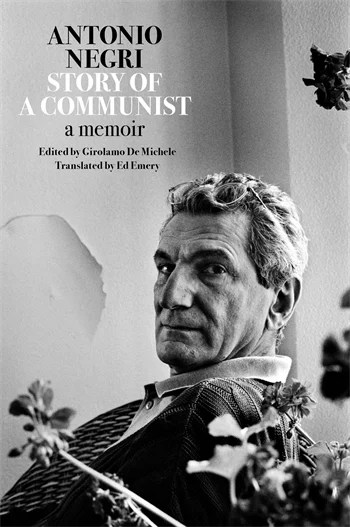
Antonio Negri, Story of a Communist: A Memoir – trans. Ed Emery, ed. Girolamo De Michele, Columbia University Press, October 2024

Antonio Negri, Story of a Communist: A Memoir – trans. Ed Emery, ed. Girolamo De Michele, Columbia University Press, October 2024

The philosopher Antonio Negri was one of the preeminent thinkers of our time: his writings on class, socialism, and empire have had an enormous influence on contemporary political theory. His political activism and outspoken advocacy for the downtrodden also placed him at the centre of some of the most dramatic developments in recent Italian history. Story of a Communist—the first volume of Negri’s three-part autobiography—gives a riveting account of his intellectual development and of the price he paid for living out his ideals.

Negri paints a vivid portrait of the ferment in which some of his most important arguments and ideas took shape, and he provides crucial context for an understanding of the operaismo movement and of the influence that it continues to exert. Story of a Communist is also a very personal work, however: it is a compelling and often moving narrative of a childhood overshadowed by fascism, and of the ways in which Negri’s later political interventions were shaped by his profoundly important relationships with comrades and collaborators. 

This first volume traces the author’s involvement with left-wing politics in the post-war period, recounting in fascinating detail his efforts to marry together his early intellectual work with his commitment to militant labour activism. It also provides an indispensable ground-level perspective on the increasingly repressive measures taken by the Italian government in response to the social movements 1960s and ‘70s, with the narrative culminating in a gripping description of Negri’s own arrest in 1979 for alleged involvement in terrorist activities. This is, in short, a powerful record of an extraordinary life, and of the historical forces that shaped it.

Posted in Antonio Negri | Leave a comment

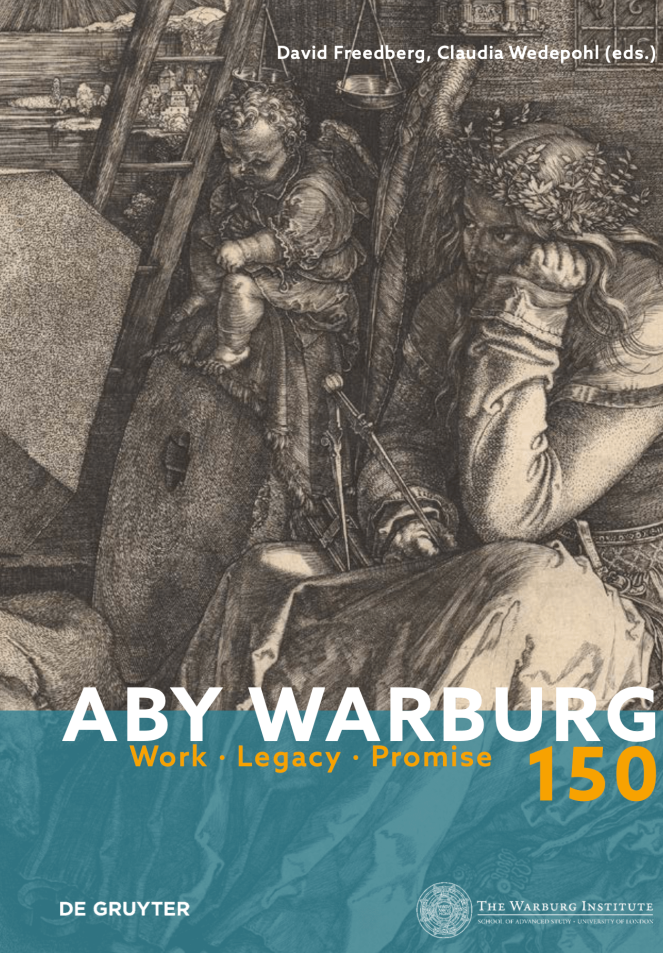
David Freedberg and Claudia Wedepohl (eds.), Aby Warburg 150: Work, Legacy, Promise – De Gruyter, April 2024

David Freedberg and Claudia Wedepohl (eds.), Aby Warburg 150: Work, Legacy, Promise – De Gruyter, April 2024

Cover of the book, with Melancholia I by Albrecht Dürer (1514)

Aby Warburg is regarded as one of the great pioneers of modern cultural studies. This book brings together texts by many of the most renowned researchers in the field who have been influenced by his work. They address his extraordinary impact on the understanding of cultural transmission and the influence of images and texts across time and space. What emerges is the continuing significance of Warburg for our own times. No one concerned with the many forms of the survival of the past in the present and the infinitely complex relationships between images and society will want to miss this book. 

Published in cooperation with the Warburg Institute, London and with the assistance of a grant from the Italian Academy for Advanced Studies in America at Columbia University, New York.

With contributions by: Andreas Beyer , Horst Bredekamp , Lorraine Daston , Georges Didi-Huberman , Uwe Fleckner , Kurt W. Forster , David Freedberg , Carlo Ginzburg , Anke te Heesen , Christopher D. Johnson , Peter N. Miller , W. J. T. Mitchell , Andrea Pinotti , Ulrich Raulff , Elizabeth Sears , Quentin Skinner , Martin Treml , Marina Warner , Martin Warnke , Claudia Wedepohl and Sigrid Weigel

Posted in Carlo Ginzburg, Quentin Skinnner, Uncategorized | 1 Comment

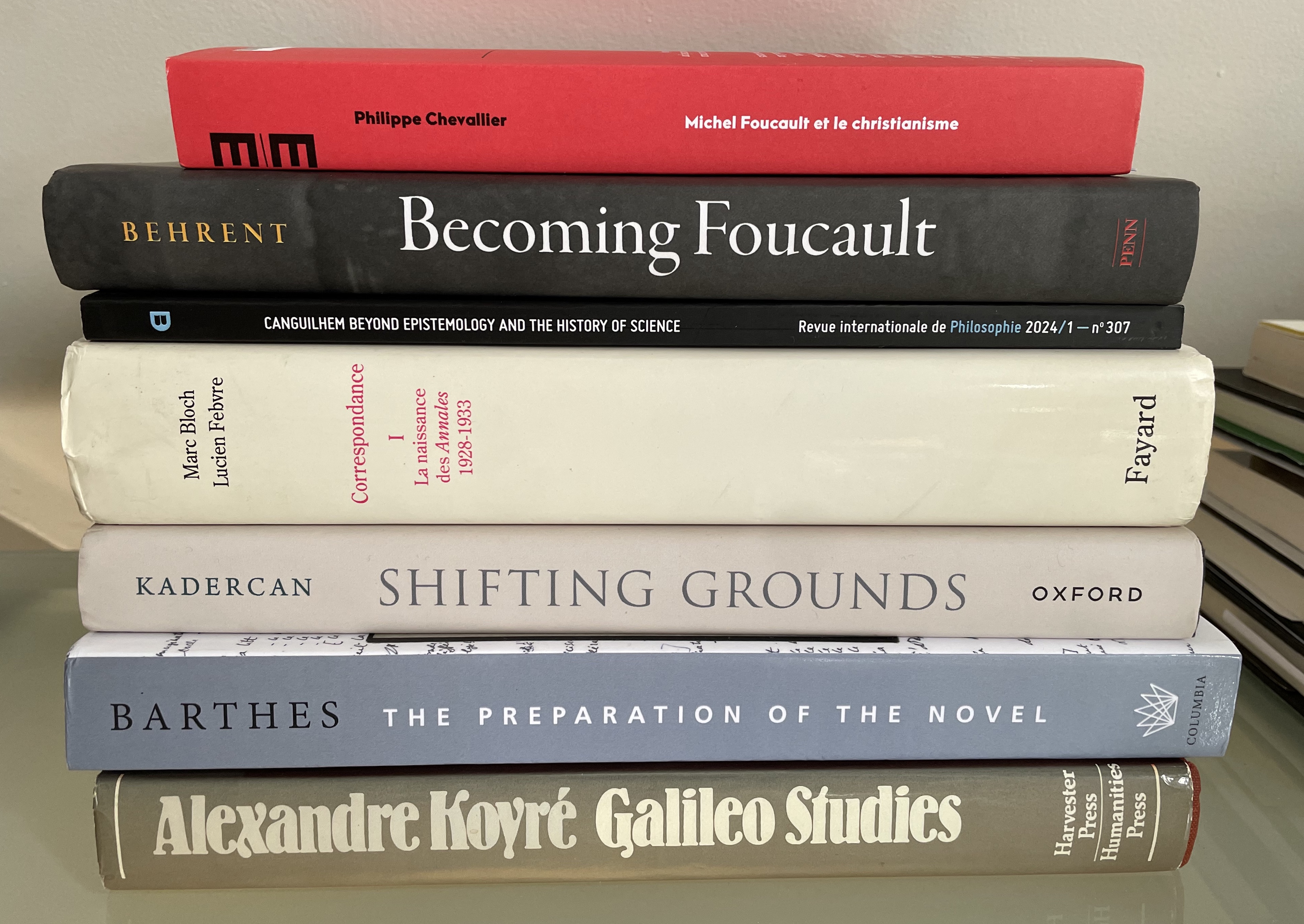
Books received – Chevallier, Behrent, Testa, Bloch & Febvre, Kadercan, Barthes, Koyré

Some books I’ve mentioned here recently – Philippe Chevallier, Michel Foucault et le christianisme: Nouvelle édition revue et augmentée; Michael C. Behrent, Becoming Foucault: The Poitiers Years; Federico Testa (ed.), Canguilhem beyond Epistemology and the History of Science – a special issue of Revue Internationale de Philosophie; and Burak Kadercan, Shifting Grounds: The Social Origins of Territorial Conflict – and older books by Bloch and Febvre, Barthes and Koyré.

The publisher sent a copy of Philippe’s book, on his request; the Behrent is to review; I have an essay in Federico’s collection, and Burak generously sent a copy of his book. The others were bought second-hand.

Posted in Alexandre Koyré, Georges Canguilhem, Michel Foucault, Roland Barthes, Territory, Uncategorized | Leave a comment

Eduardo Mendieta, The Philosophical Animal: On Zoopoetics and Interspecies Cosmopolitanism – SUNY Press, June 2024

Eduardo Mendieta, The Philosophical Animal: On Zoopoetics and Interspecies Cosmopolitanism – SUNY Press, June 2024 – part of the SUNY Press Open Access series

Humans are animals who fictionalize other animals to asse their “humanness.” We are philosophical animals who philosophize about our humanity by projecting images onto a mirror about other animals. Spanning literature, philosophy, and ethics, the thread uniting The Philosophical Animal is the bestiary and how it continues to inform our imaginings. Beginning with an exploration of animals and women in the literary work of Coetzee, famous for his book on the Lives of Animals, Eduardo Mendieta then dives into the genre of bestiaries in order to investigate the relation between humanity and animality. From there he approaches the works of Derrida and Habermas from the standpoint of genetic engineering and animal studies. While we have intensely modified many species genetically, we have not done this to ourselves. Why? Finally, Mendieta deals with the political and ethical implications suggested by this question before ending on an autobiographical note about growing up around so-called animals, and in particular horses.

“This eloquent discussion brings a range of continental figures and European traditions of philosophy to bear on the question of the animal. From Habermas to Derrida, and all that lies between, Mendieta’s discussion is unique and thought-provoking.” — Cynthia Willett, author of Interspecies Ethics

Posted in Eduardo Mendieta, Jacques Derrida, Jürgen Habermas | Leave a comment

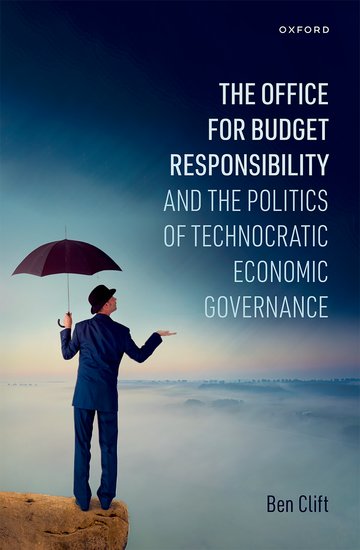
Ben Clift, The Office for Budget Responsibility and the Politics of Technocratic Economic Governance – Oxford University Press, March 2023 and Faculti interview

Ben Clift, The Office for Budget Responsibility and the Politics of Technocratic Economic Governance – Oxford University Press, March 2023

The Office for Budget Responsibility and the Politics of Technocratic Economic Governanceis about the politics of economic ideas and technocratic economic governance. It is also a book about the changing political economy of British capitalism’s relationship to the European and wider global economies. It focuses on the creation in 2010 and subsequent operation of the independent body created to oversee fiscal rectitude in Britain, the Office for Budget Responsibility (OBR). More broadly, it analyses the politics of economic management of the UK’s uncertain trajectory, and of British capitalism’s restructuring in the 2010s and 2020s in the face of the upheavals of the global financial crisis (GFC), Brexit and COVID. A focus on the intersection between expert economic opinion of the OBR as UK’s fiscal watchdog, and the political economy of British capitalism’s evolution through and after Brexit, animates a framework for analysing the politics of technocratic economic governance. 

The technocratic vision of independent fiscal councils fails to grasp a core political economy insight: that economic knowledge and narratives are political and social constructs. The book unpacks the competing constructions of economic reason that underpin models of British capitalism, and through that inform expert economic assessment of the UK economy. It also underlines how contestable political economic assumptions undergird visions of Britain’s international economic relations. These were all brought to the fore in economic policy debates about Britain’s place in the world, which in the 2010s centred on Brexit. This book analyses OBR forecasting and fiscal oversight in that broader political context, rather than as a narrowly technical pursuit.

There is an interview about the book at Faculti

Posted in Uncategorized | Leave a comment

Jo van Every, ‘You don’t have to start with an abstract’

Jo van Every, ‘You don’t have to start with an abstract

Some interesting discussion, particularly in terms of highlighting multiple ways to work, rather than a single way to begin.

Do you use conferences as a way to start new writing projects?

In my experience it’s a pretty common practice. You are working on some research. You need to transition into the writing phase. A conference offers an impetus to make a decision about what you might write and get some kind of reasonable draft in order. After the conference, you can revise it into an article or book chapter.

There is lots to like about this strategy [continues here]

Posted in Uncategorized | Leave a comment

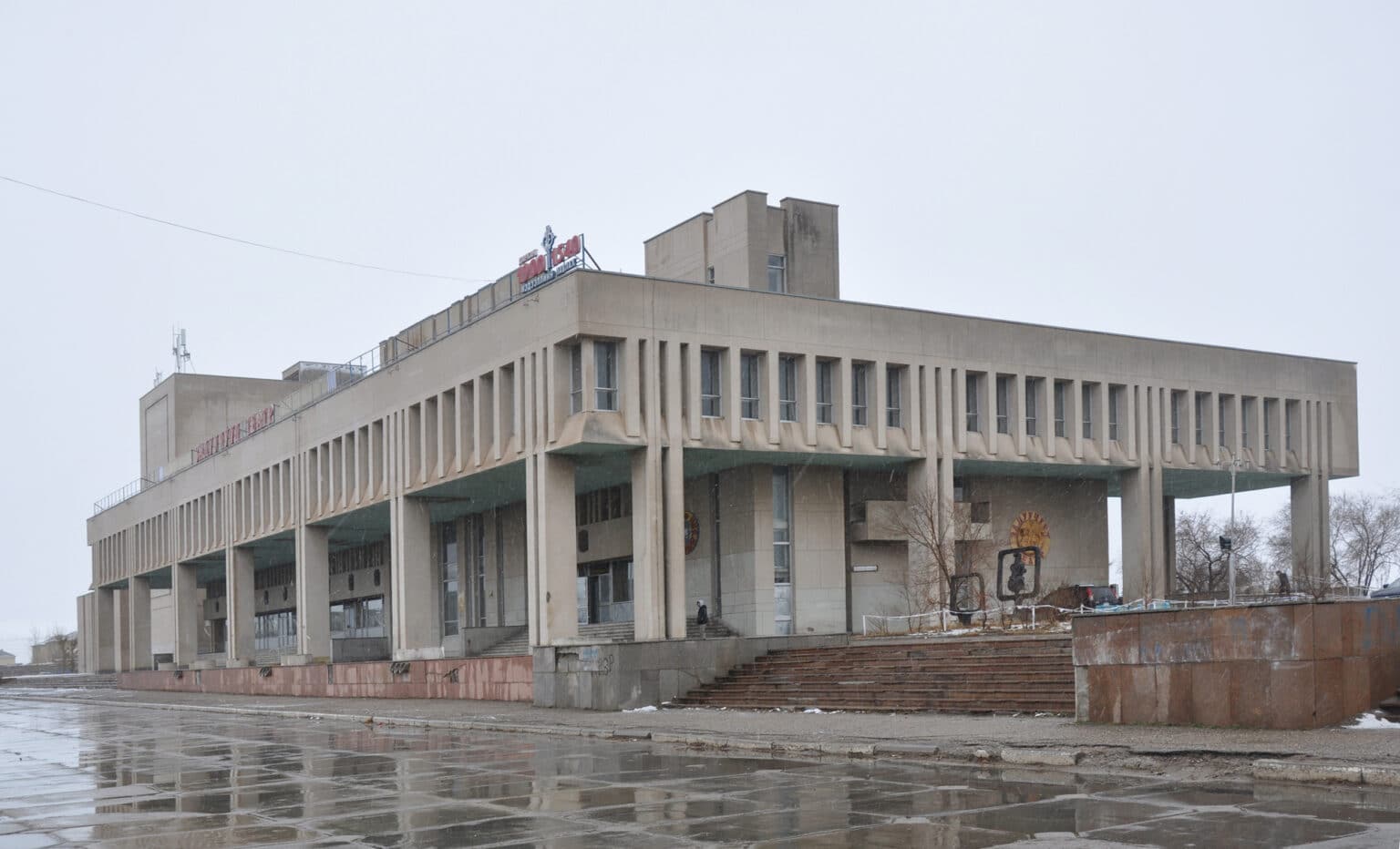
“The Architectural Gift,” a conversation between architectural historian Łukasz Stanek and Places editor Frances Richard

 “The Architectural Gift,” a conversation between architectural historian Łukasz Stanek and Places editor Frances Richard

House of Culture and Youth Theatre Complex in Darkhan, Mongolia, designed by L. Kataev, E. Antipova, and V. Shifrin, 1978. A gift of the Soviet Union to what was then the Mongolian People’s Republic. Photographed in 2018. [Unless otherwise noted, all photographs are by Łukasz Stanek]

Gifted buildings are potent mechanisms of geopolitical reshuffling, premised on an uneven power relation between giver and receiver. How do such exchanges shape cities in transition?

For visual case studies of three buildings presented to a government or organization by another — in Ghana, in Pakistan, in the United States — see The Architectural Gift: Kumasi, Islamabad, Detroit.

Posted in Uncategorized | Leave a comment

Matthew Beaumont, How We Walk: Frantz Fanon and the Politics of the Body – Verso, March 2024, and discussion at the Verso podcast

Matthew Beaumont, How We Walk: Frantz Fanon and the Politics of the Body – Verso, March 2024

You can tell a lot about people by how they walk. Matthew Beaumont argues that our standing, walking body holds the social traumas of history and its racialized inequalities. Our posture and gait reflect our social and political experiences as we navigate the city under capitalism. Through a series of dialogues with thinkers and walkers, his book explores the relationship between freedom and the human body

How We Walk foregrounds the work of Frantz Fanon, psychiatrist and leading thinker of liberation, who was one of the first people to think about the politics of ‘walking while black’. It also introduces us to the renegade psychoanalyst Wilhelm Reich, who wrote that one could discern the truth about a person through their posture and gait. For Marxist philosopher Ernst Bloch, the ability to walk upright and with ease is a sign of personal and social freedom.

Through these excursions, Beaumont reimagines the canonical literature on walking and presents a new interpretation of the impact of class and race on our physical and political mobility, raising important questions about the politics of the body.

There is a discussion with Annie Olaloku-Teriba at the Verso podcast. Thanks to dmf for that link.

Posted in Frantz Fanon, Uncategorized | Leave a comment