
Foucault: Genealogies for the Future – Rice University, 18-19 April 2024, with online option
news story about the event, organised by Niki Kasumi Clements, here

Foucault: Genealogies for the Future – Rice University, 18-19 April 2024, with online option
news story about the event, organised by Niki Kasumi Clements, here
Douglas Porch, Resistance and Liberation: France at War 1942-1945 – Cambridge University Press, January 2024

In Resistance and Liberation, Douglas Porch continues his epic history of France at war. Emerging from the debâcle of 1940, France faced the quandary of how to rebuild military power, protect the empire, and resuscitate its global influence. While Charles de Gaulle rejected the armistice and launched his offshore crusade to reclaim French honor within the Allied camp, defeatists at Vichy embraced cooperation with the victorious Axis. The book charts the emerging dynamics of la France libre and the Alliance, Vichy collaboration, and the swelling resistance to the Axis occupation. From the campaigns in Tunisia and Italy to Liberation, Douglas Porch traces how de Gaulle sought to forge a French army and prevent civil war. He captures the experiences of ordinary French men and women caught up in war and defeat, the choices they made, the trials they endured, and how this has shaped France’s memory of those traumatic years.
The sequel to Defeat and Division: France at War 1939-1942 – Cambridge University Press, August 2022

Defeat and Division launches a definitive new account of France in the Second World War. In this first volume, Douglas Porch dissects France’s 1940 collapse, the dynamics of occupation, and the rise of Charles de Gaulle’s Free France crusade, culminating in the November 1942 Allied invasion of French North Africa. He captures the full sweep of France’s wartime experience in Europe, Africa, and beyond, from soldiers and POWs to civilians-in-arms, colonial subjects, and foreign refugees. He recounts France’s struggles to reconstruct military power within the context of a global conflict, with its armed forces shattered into warring factions and the country under Axis occupation. Disagreements over the causes of the 1940 debacle and the subsequent requirement for the armistice mirrored long-standing fractures in politics, society, and the French military itself, as efforts to reconstitute French military power crumbled into Vichy collaboration, De Gaulle’s exile resistance, Alsace-Moselle occupation struggles, and a scuffle for imperial supremacy.
Angharad Closs Stephens, National Affects: The Everyday Atmospheres of Being Political – Bloomsbury, September 2022, now in paperback

Identity is widely acknowledged to be a felt experience, yet questions of atmosphere, mood and public sentiments are rarely made central to understanding the global politics of nationalism. This book asks what difference it makes when we address national identity as principally an affective force? National Affects traces how ideas about ‘us and them’ take form in ordinary spaces, in ways that are both deeply felt and hardly noticeable, in studies of global events that range from the London 2012 Olympic Games to responses to acts of terror, the European refugee crisis and ‘Brexit’.
In this timely intervention, Angharad Closs Stephens addresses the affective dimensions of being together to open new angles in the study of nationalism and global politics. She asks how the nation is felt in everyday life, as well as differently experienced, and investigates different forms of enacting being together to generate new insights in the study of national identity. National Affects draws on academic theories in the study of Politics, International Relations and Human Geography, as well as stories, performance works and novels, to establish a new tone of critical enquiry. Informed by longstanding critical interrogations of the politics of ‘us and them’, this book argues that these ideas are not as stable as they are often made to seem.
Drawing on a combination of artistic and academic interventions, this book offers a refreshing approach to conceptualising the politics of nationalism, identity and citizenship. In its focus on everyday atmospheres, it identifies new registers for intervening politically. Overall, National Affects outlines other ways of imagining and practising being political together, beyond the exclusionary politics of nationalism.
Philippe Chevallier, Michel Foucault et le christianisme: Nouvelle édition revue et augmentée – ENS éditions, April 2024
This excellent book is updated in the light of newly available material since the pioneering 2011 first edition.

Des rites antiques à la confession moderne, le christianisme fut pour Foucault une interrogation constante, aiguillée par notre actualité : quel destin cette religion a-t-elle eu dans nos vies, dans la manière de nous conduire, de connaître notre désir, de chercher notre salut ? Ce livre propose la première synthèse de l’ensemble des lectures chrétiennes de Foucault, d’Histoire de la folie au grand livre posthume Les aveux de la chair, enrichie par la consultation de ses archives. Écartant les conclusions hâtives, ce parcours épouse la logique d’un travail que Foucault voulut autant historique que philosophique : une certaine manière de lire les textes anciens et d’inciser notre passé. Loin des lieux communs d’un christianisme ascétique et intransigeant, Foucault définit l’originalité chrétienne comme la reconnaissance d’un rapport précaire à la vérité.
Initialement publié en 2011, cet ouvrage pionnier bénéficie d’une mise à jour intégrale, qui tient compte des découvertes les plus récentes que permet l’archive.
« Cette enquête remarquable nous offre l’aperçu le plus complet et le mieux informé d’un nouveau terrain de recherche. Toute personne intéressée par l’œuvre de Foucault doit le lire. » (Colin Gordon, Foucault News)
David N. Livingstone, The Empire of Climate: A History of an Idea – Princeton University Press, April 2024 (USA); June 2024 (UK)
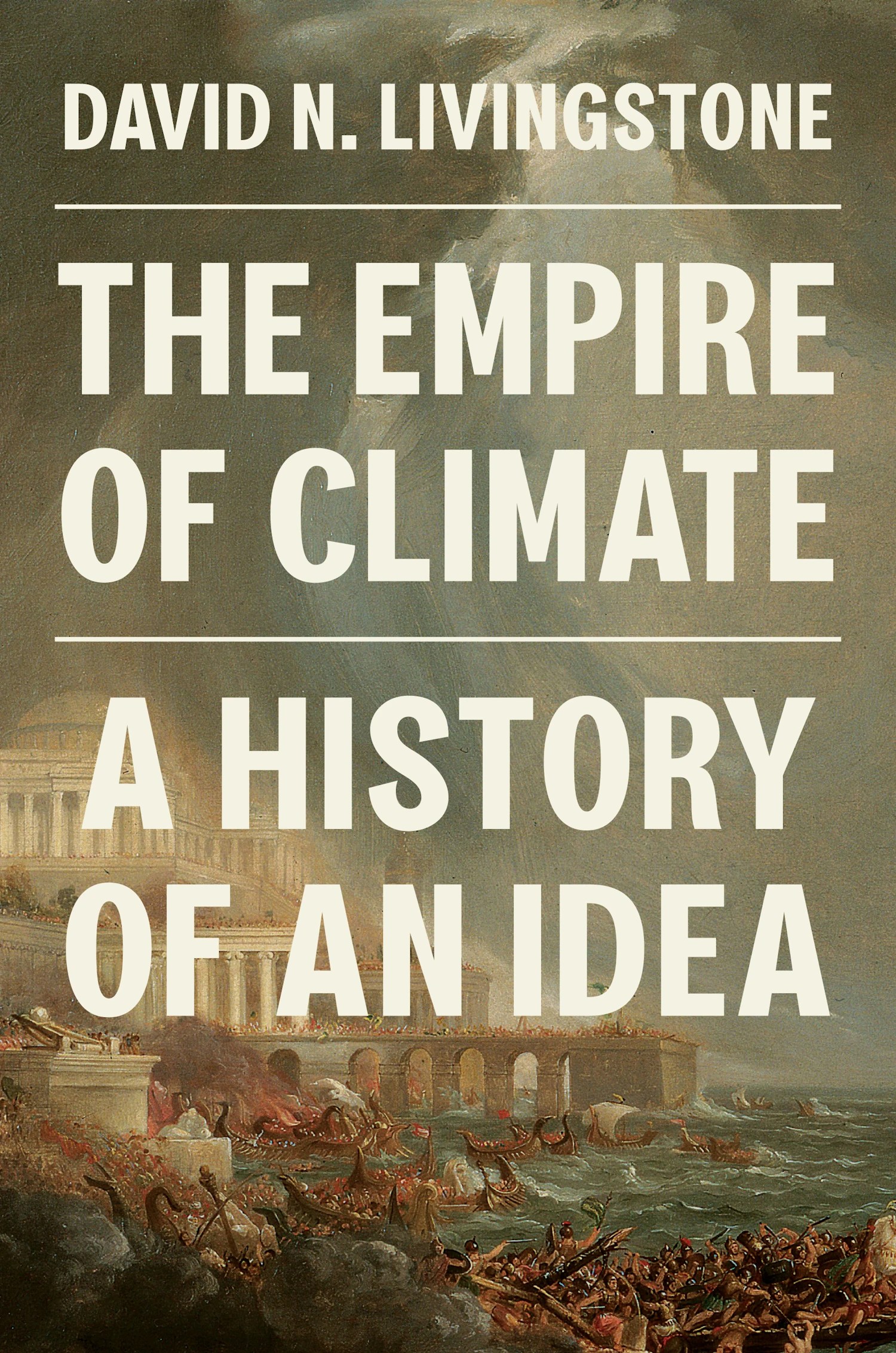
Scientists, journalists, and politicians increasingly tell us that human impacts on climate constitute the single greatest threat facing our planet and may even bring about the extinction of our species. Yet behind these anxieties lies an older, much deeper fear about the power that climate exerts over us. The Empire of Climate traces the history of this idea and its pervasive influence over how we interpret world events and make sense of the human condition, from the rise and fall of ancient civilizations to the afflictions of the modern psyche.
Taking readers from the time of Hippocrates to the unfolding crisis of global warming today, David Livingstone reveals how climate has been critically implicated in the politics of imperial control and race relations; been used to explain industrial development, market performance, economic breakdown; and served as a bellwether for national character and cultural collapse. He examines how climate has been put forward as an explanation for warfare and civil conflict, and how it has been identified as a critical factor in bodily disorders and acute psychosis.
A panoramic work of scholarship, The Empire of Climate maps the tangled histories of an idea that has haunted our collective imagination for centuries, shedding critical light on the notion that everything from the wealth of nations to the human mind itself are subject to climate’s imperial rule.
Thinking Global Podcast – Quentin Skinner at E-International Relations

This week on the Thinking Global Podcast, Professor Quentin Skinner (Queen Mary, University of London – @QMHistory) speaks with the team about contextualism, Machiavelli, Hobbes, and more. Professor Skinner chats with Kieran (@kieranjomeara) and Tusharika (@Tusharika24) about what contextualism is as a methodological approach to political thought, how he applies this to Machiavelli and Hobbes, and how this relays back to what it is to think about global politics.
Quentin Skinner is Emeritus Professor of Humanities at Queen Mary, University of London (@QMHistory). Prof. Skinner has published on a number of philosophical themes, including the nature of interpretation and historical explanation, and on several issues in contemporary political theory, including the concept of political liberty and the character of the state. He has written extensively on questions about historical method and historical explanation, being a key figure in the ‘Cambridge’ contextualist school of political thought (@cambridge_cpt). Many of these essays have been collected in the volume, edited by James Tully, Meaning and Context: Quentin Skinner and his Critics (1988).
His historical research centres on early-modern Europe, and one of his principal interests lies in the Italian Renaissance. He has published books on Machiavelli, on early Renaissance political painting, on ideals of civic virtue, and has edited Machiavelli’s The Prince. These include Machiavelli: A Very Short Introduction (2000), Machiavelli (1981) and more. The other main focus of his research concerns seventeenth century England, writing on the relations between rhetoric and philosophy, including a book on Shakespeare’s use of classical rhetoric – Forensic Shakespeare(2014) – and on debates about political liberty in the English revolution – Liberty Before Liberalism(1998). He has also published three books on the philosophy of Thomas Hobbes – Hobbes and Republican Liberty (2008), Reason and Rhetoric in The Philosophy of Hobbes (2010), From Humanism to Hobbes (2018) and more. His best-known multi-volume works, The Foundations of Modern Political Thought (1978) and Visions of Politics (2002), attempt to span his insight into the whole early-modern period. This is without mentioning a host of influential articles, such as his famous ‘Meaning and Understanding in the History of Ideas’ (1969).
Some interesting thoughts from Dave Beer on making decisions about research plans – At a research junction
A few years ago I wrote a page for this site about how, largely retrospectively, I saw the main periods of my research – Social/Spatial Theory, Territory, and Foucault, and the beginning of the new project. Even there I noted the overlap, some abandoned ideas – usually because I didn’t get funding – and the things that didn’t fit. And that, of course, was a retrospective, imposing order on things which were not always as clear at the time.
One of the things that I would say that is perhaps a little different from Dave is that I seem to get committed to things a long way into the future, either because of the scale of books I take on, the good fortune I’ve had in getting a couple of three-year research fellowships, the linked volumes of certain projects (the Foucault and territory books, for example) or a combination of these. It was clear Foucault’s Last Decade was going to produce a second book The Birth of Power before I’d completed Last Decade, and when I decided in late 2016 to continue the series further back, I knew I needed two books to do it justice – The Early Foucault and The Archaeology of Foucault. Before that series, some parts of what became The Birth of Territory were written before Terror and Territory was even an idea, and even earlier, the material on calculation in Speaking Against Number was initially conceived of as a theoretical introduction to a project that then had the working title of The Geometry of the Political. And at the beginning of my career, Understanding Henri Lefebvre was a massive development of something that was initially a chapter in my PhD thesis, which got cut – the final thesis looked at only Nietzsche, Heidegger and Foucault, of which the Heidegger and Foucault material became Mapping the Present. (The Nietzsche stuff was cannibalised for that book, and a later book chapter.)
What this has meant, for me, is that I can’t really remember the last time I wasn’t writing a book, and can rarely think of a time when I didn’t know the book I would be working on after that. One of the consequences of this is that I am often impatient about delays in review, or production, or for other reasons, as I feel it isn’t just delaying the current project, but is having a knock on effect on things down the line.
In the past few years I’ve had to rethink quite a bit – initially during the period of pandemic restrictions, when I couldn’t get to archives and planned research leave was postponed, and my teaching changed a lot, which delayed the final two Foucault books; and more recently when my own health put things on pause for a period and has slowed me down considerably ever since. I’ve had to rethink the schedule for the Mapping Indo-European Thought in Twentieth-Century France project quite a bit, though still feel very behind.
Often with future projects, I try to write a short piece first, not so much as proof of concept – though they can be useful to build a case for funding, or to persuade a publisher you have experience in a new-for-you field – but more for proof of interest. Do I have the interest in the topic to continue? Usually I find so many interesting things to explore that I begin to convince myself I would like to do more on this. Might I have something distinctive to say? Sometimes though – and most recently, it was on political ceremony – I write something that makes me realise I don’t have much to say about a topic, and so I bring it to a close. I felt I ran out of new and hopefully interesting things to say about, for example, Heidegger, Lefebvre and territory at different times too. (Of course, none of this is to say there isn’t plenty of interesting work to be done by someone; just that it isn’t me.)
One thing I’ve learned from experience though, is that if I know too clearly what I need to do to write a book, then I should steer clear of writing it. Part of the appeal of writing a book is to discover, and if it becomes too mechanical a process, then I lose interest. Two of my books, in particular, are ones I associate with knowing far too soon in the process exactly what needed to be done to complete them, and while I did finish them, they were not pleasant writing experiences. Other books have been a much more generative process, where I didn’t know exactly what I had to say until quite late in the process, didn’t know how it would all fit together, and was still learning things until very late on. I much prefer this – it’s one of the reasons I’ve always steered clear of writing text-books – though this isn’t to say that I do not admire the people who can.
I might return to this question, and Dave’s reflections. I think one thing that is striking in what Dave says is the comment:
Another reason why the decisions seem important is that most of the things not chosen will never happen, there just isn’t enough time (and other ideas will come along that will prevent us from returning to the bypassed options).
I think this is absolutely right. Of the notional list of books I have which I’d like to write, being realistic I know not all of them will get written by me. That’s not just a question of time, or age, or health, but one of interest and because any good project I take on will likely generate other possible ideas…
(I should add, that, of course, my situation is different from many people who are on short-term contracts or other precarious situations. I had three one-year contracts at the start of my career, which I know changed how I thought about things, but have been in secure employment since. I appreciate that some of the long-term thinking I am able to do is a result of that situation, and that other decisions might be needed in different situations. This is one of the many reasons why the current state of academia is so terrible.)
There are lots of other Writing and Publishing posts and links on this site, some of which relate to the questions raised by Dave.
Gisèle Sapiro, The Sociology of Literature – trans. Madeline Bedecarré and Ben Libman, Stanford University Press, October 2023
The Sociology of Literature is a pithy primer on the history, affordances, and potential futures of this growing field of study, which finds its origins in the French Enlightenment, and its most salient expression as a sociological pursuit in the work of Pierre Bourdieu. Addressing the epistemological premises of the field at present, the book also refutes the common criticism that the sociology of literature does not take the text to be the central object of study. From this rebuttal, Gisèle Sapiro, the field’s leading theorist, is able to demonstrate convincingly one of the greatest affordances of the discipline: its in-built methods for accounting for the roles and behaviors of agents and institutions (publishing houses, prize committees, etc.) in the circulation and reception of texts. While Sapiro emphasizes the rich interdisciplinary nature of the approach on display, articulating the way in which it draws on literary history, sociology, postcolonial studies, book history, gender studies, and media studies, among others, the book also stands as a defense of the sociology of literature as a discipline in its own right.
Pramod K. Nayar, Vulnerable Earth: The Literature of Climate Crisis – Cambridge University Press, May 2024

Vulnerable Earth is a study of the literature of climate crisis. Building on the assumption that the crisis is planetary in scope even if differential and unequal in effects, it examines literary fiction, graphic novels, memoirs about toxic wastes and neo-slavery narratives, mostly from the contemporary decades, but touching upon select antecedents as well, and from all over the world. The study covers texts that fictionalize a ‘hydrocrisis’, those that are concerned with species extinction and experimental solutions such as rewilding, fiction and memoirs that are interested in exploring the conversations between and across species in multispecies encounters and, finally, texts that show the linkage between social justice and environmental justice. Focusing on aesthetics, narrative modes and constructions of damaged, wasted and at-risk worlds, this book shows how the literature of climate crisis foregrounds a feature that humans and nonhumans, the living and the non-living share, differentially, with the planet: vulnerability.
I recently wrote a book chapter on “Foucault and Structuralism” for The Foucauldian Mind, edited by my friend and former Warwick colleague Daniele Lorenzini. It’s been an interesting diversion from the other work. Contrary to my usual practice, where I write in all directions at once, and then try to impose some order on things when I know what I want to say, with this piece I worked out a fairly detailed plan, gave each section a word limit, and then wrote each in a fairly linear way. Some of the quotations and references draw from my books on Foucault, but the overall argument is distinct and clearer with this specific focus. And I know a lot more about Claude Lévi-Strauss and certainly Georges Dumézil as a result of recent work. It came together surprisingly easily.
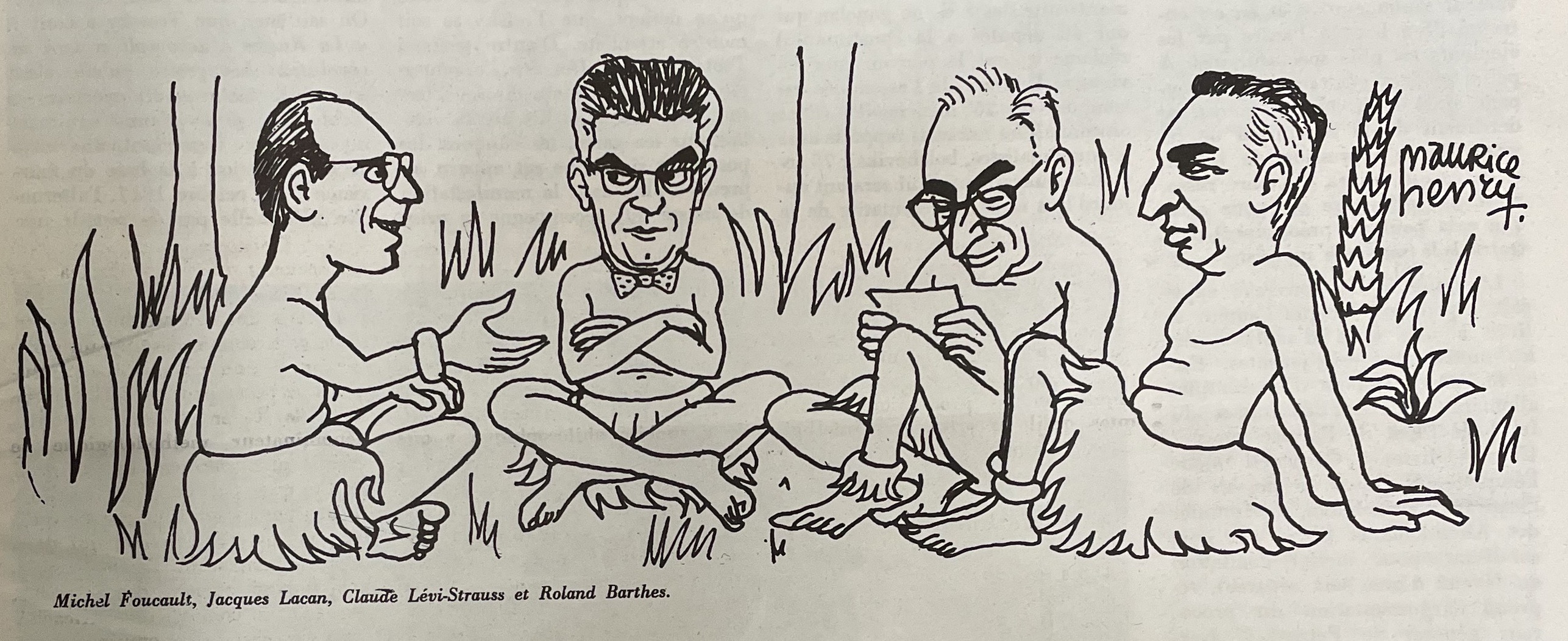
I don’t plan to use this image, but I do mention it, since it’s so iconic, and I thought it was a good one for the more visual media of this blog post. (The illustration is much more famous than the piece on structuralism by François Châtelet which it illustrated.) Foucault is holding forth with Lacan, Lévi-Strauss and Barthes. Someone (but I don’t remember who) said that the only reason Althusser wasn’t included, despite being discussed in the article, was that he was so cloistered in the ENS, no-one knew what he looked like.
Should Foucault have been included in this line-up? That’s the question I try to answer in this chapter.
It’s not a long chapter, but I’ve tried to survey the relation through a few themes: the structural aspects of History of Madness and the first edition of Birth of the Clinic; the archaeology of structuralism in The Order of Things; and then more briefly Foucault’s engagement with linguistics in the 1960s and his discussion of Georges Dumézil especially in some 1970 lectures. The Introduction sets this up in relation to Foucault’s perceived association to French discussions of structuralism and his two most forceful refusals to be so assimilated; while the Conclusion looks at some of the ways he tried to obscure the historical record post-1970 with the revisions to two of his books.
This piece is loosely connected to the Indo-European thought project, but more to the pieces I’ve been writing on Foucault and Dumézil, and the one on Canguilhem, Dumezil and Hyppolite – a series which I see as distinct from the planned Indo-European book.
The Foucauldian Mind is scheduled for 2026, the 100th anniversary of Foucault’s birth. I’ll share more news when it’s available. [Update February 2026: the book has a webpage and is scheduled for late summer 2026]

