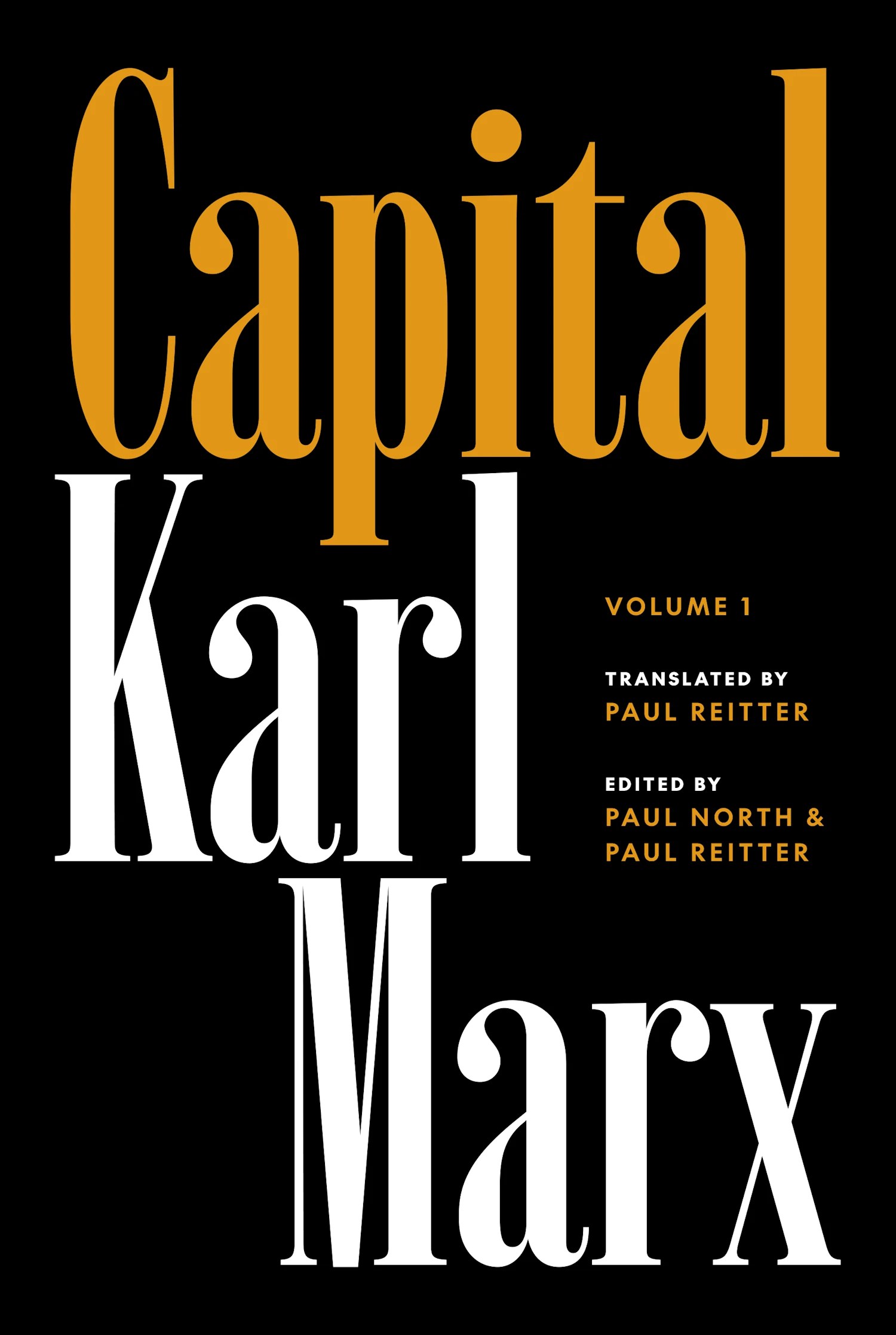
Karl Marx, Capital: Critique of Political Economy, Volume I– trans. Paul Reitter, ed. Paul Reitter and Paul North, preface by Wendy Brown, afterword by William Clare Roberts – Princeton University Press, September 2024
Karl Marx (1818–1883) was living in exile in England when he embarked on an ambitious, multivolume critique of the capitalist system of production. Though only the first volume saw publication in Marx’s lifetime, it would become one of the most consequential books in history. This magnificent new edition of Capital is a translation of Marx for the twenty-first century. It is the first translation into English to be based on the last German edition revised by Marx himself, the only version that can be called authoritative, and it features extensive commentary and annotations by Paul North and Paul Reitter that draw on the latest scholarship and provide invaluable perspective on the book and its complicated legacy. At once precise and boldly readable, this translation captures the momentous scale and sweep of Marx’s thought while recovering the elegance and humor of the original source.
For Marx, our global economic system is relentlessly driven by “value”—to produce it, capture it, trade it, and most of all, to increase it. Lifespans are shortened under the demand for ever-greater value. Days are lengthened, work is intensified, and the division of labor deepens until it leaves two classes, owners and workers, in constant struggle for life and livelihood. In Capital, Marx reveals how value came to tyrannize our world, and how the history of capital is a chronicle of bloodshed, colonization, and enslavement.
With a foreword by Wendy Brown and an afterword by William Clare Roberts, this is a critical edition of Capital for our time, one that faithfully preserves the vitality and directness of Marx’s German prose and renders his ideas newly relevant to modern readers.
(The Routledge description says second edition, but there was one before their first with a different press.)
Territories are more than simply bounded spaces; they reflect the ways in which we think of geographic space. Territoriality, or laying claim to territory, can be seen as the spatial expression of power, with borders dividing those inside from those outside. The book provides an introduction to the concept of territory, the ways in which ideologies and social practices are manifested in space, the deployment of territorial strategies and the geographical outcomes of these.
This revised and updated third edition focuses on both macro-scale examples and those less obvious micro-scale ones, and it explores how territorial strategies are used in the maintaining of power, or as a means of resistance. Throughout the book, key questions emerge concerning geographic space. Who is ‘allowed’ to be in particular spaces and who is excluded or discouraged from being there? How are territorial practices utilized in conflicts concerned with socio-political power and identity and how are ideologies transposed onto space?
Written from a geographical perspective, the book is interdisciplinary, drawing on ideas and material from a range of academic disciplines including, history, political science, sociology, international relations, cultural studies. Theoretical underpinnings are supported by a variety of historical and contemporary examples, drawn from a range of geographic contexts.
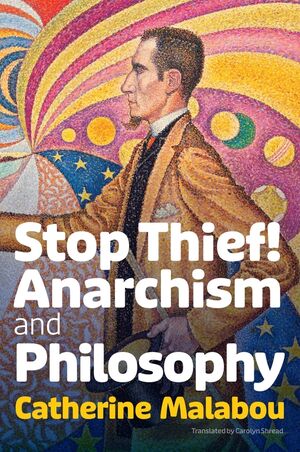
Many contemporary philosophers – including Michel Foucault, Jacques Derrida, and Giorgio Agamben – ascribe an ethical or political value to anarchy, but none ever called themselves an “anarchist.” It is as if anarchism were unmentionable and had to be concealed, even though its critique of domination and of government is poached by the philosophers.
Stop Thief! calls out the plundering of anarchism by philosophy. It’s a call that is all the more resonant today as the planetary demand for an alternative political realm raises a deafening cry. It also alerts us to a new philosophical awakening. Catherine Malabou proposes to answer the cry by re-elaborating a concept of anarchy articulated around a notion of the “non-governable” far beyond an inciting of disobedience or common critiques of capitalism. Anarchism is the only way out, the only pathway that allows us to question the legitimacy of political domination and thereby wfree up the confidence that we need if we are to survive.
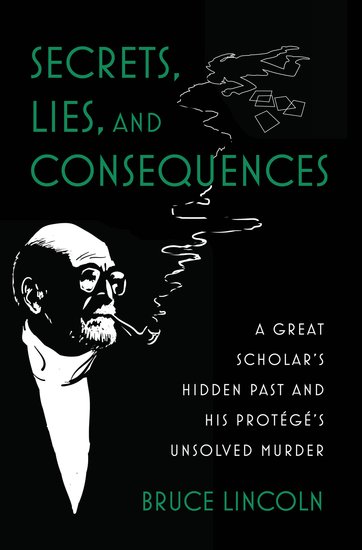
The tale of a legendary scholar, an unsolved murder, and the mysterious documents that may connect them In early 1991, Ioan Culianu was on the precipice of a brilliant academic career. Culianu had fled his native Romania and established himself as a widely admired scholar at just forty-one years of age. He was teaching at the University of Chicago Divinity School where he was seen as the heir apparent to his mentor, Mircea Eliade, a fellow Romanian expatriate and the founding father of the field of religious studies, who had died a few years earlier.
But then Culianu began to receive threatening messages. As his fears grew, he asked a colleague to hold onto some papers for safekeeping. A week later, Culianu was in a Divinity School men’s room when someone fired a bullet into the back of his head, killing him instantly. The case was never solved, though the prevailing theory is that Culianu was targeted by the Romanian secret police as a result of critical articles he wrote after the fall of dictator Nicolae Ceausescu.
What was in those mysterious papers? And what connection might they have to Culianu’s death? The papers eventually passed into the hands of Bruce Lincoln, and their story is at the heart of this book. The documents were English translations of articles that Eliade had written in the 1930s, some of which voiced Eliade’s support for the Iron Guard, Romania’s virulently anti-Semitic mystical fascist movement. Culianu had sought to publish some of these articles but encountered fierce resistance from Eliade’s widow.
In this book, author Bruce Lincoln explores what the articles reveal about Eliade’s past, his subsequent efforts to conceal that past, his complex relations with Culianu, and the possible motives for Culianu’s shocking murder.
This book develops a new theory of territorialism and international legal status of territories. It (i) defines the concept of territory, explaining how territories are created; (ii) redefines the concept of statehood, illustrating that statehood (rather than the statehood criteria) is territorial legal status established in the formal sources of international law; and (iii) grounds non-state territorial entities in the sources of international law to explain their international legal status. This fresh new theoretical perspective has both scholarly and practical importance, providing a tool helping decision-makers and judges in the practical application of international law both internationally and domestically.
Marxist Modernism presents for the first time Gillian Rose’s 1979 lectures on the Frankfurt School, art, and politics. Delivered soon after the publication of her now classic study of Adorno, The Melancholy Science, the lecture series expands upon this work to explore the lives and philosophies of a wider range of Frankfurt School members and affiliates: from Adorno, to Lukács, Brecht, Bloch, Benjamin, and Horkheimer. In particular, Rose discusses their debates concerning various twentieth-century modernist art movements, and outlines the ways in which each theorist developed Marx’s theory of commodity fetishism into a Marxist theory of culture.
Marxist Modernism serves as a comprehensive yet concise and conversational introduction to the Frankfurt School, but it also provides a new resource for one of the twentieth century’s most important philosophers: Gillian Rose. The volume will provide an accessible encounter with Rose’s thought for those not yet acquainted with her formidable work, while provoking a renewed engagement with the Marxist basis of her oeuvre for those who are.
An afterword by the renowned intellectual historian Martin Jay reviews the lectures and contextualises them within the wider reception of the Frankfurt School in the Anglophone world.
There are recordings of lectures on related material available here, which I learned about from Dave Beer’s blog. I’m not sure if this book is a transcription of those exact lectures, but it certainly seems like the same course. Either way, it’s a good development that more of her work is being made available.
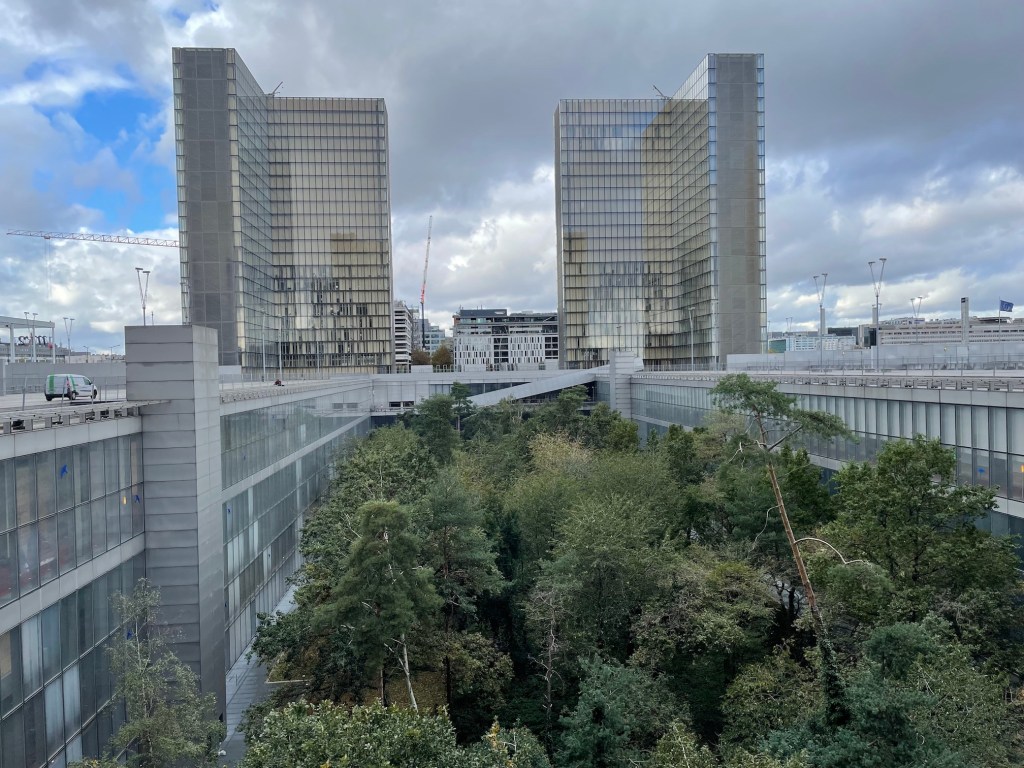
Top row: Ancient India and Iran Trust, Cambridge; Archives Nationales, Pierrefitte-sur-Seine; Bibliothèque nationale de France, Mitterand site. Bottom row: Collège de France, Paris
I’m now back at work full time, though very grateful to be free of teaching and administrative duties, and I am feeling much better and more like myself. I was in Paris for two weeks this month, which was the first trip I’d made there since April, with a couple of planned trips cancelled due to surgery and recovery. It was great to get back, and it felt like a significant step in the recovery.
I was mainly working at the Collège de France with the Dumézil archive. Although before all this I’d been working box by box through the files relating to his publications (and before that, all his surviving courses), on this trip I decided to jump ahead and look at the boxes of correspondence. This was on the thinking that the correspondence might be more interesting, and that I wasn’t sure how often I would be able to get back. If I could only make limited visits, I was thinking, then I’d better look at the most important stuff first. But this trip went without incident, so I do hope I can continue to go through much more of the Georges Dumézil material, at least as an initial pass through. I already knew that a lot of Dumézil’s correspondence was filed with his teaching, year by year, but that’s also the way some of the boxes just of correspondence are organised. There are only two boxes of correspondence filed by correspondent, but letters from those people are also elsewhere in the collection. For me, with Dumézil as one of the key figures I’m interested in, that’s fine, as I just have to take good notes to be able to work out where things are for future visits. But if you were primarily interested in, for example, Stig Wikander, you’d need to look in lots of different places – some of which are not obvious. I found one letter by Foucault in the files which I recognised because of the handwriting, signed fairly illegibly as MF, which I suspect many people would pass by. But it’s really just a brief note from Uppsala complaining about the snow.
I’m fortunate because most of the people I am interested in because they were a contact of Émile Benveniste or Dumézil have their own correspondence filed by sender, and more targeted requests can yield almost everything. So for Harold Bailey or Ignace Meyerson, for example, where I am mostly interested in them because of their correspondence with Benveniste, it’s nearly all in a single file. But sometimes working through things systematically has other benefits: you can find things you didn’t know you were looking for, or discover things in a place that was unexpected. One nice moment in the Dumézil archive was when I came across a copy of a letter and supplementary note that is in typescript and unsigned. From its content and date I recognised it as a letter mentioned in a biography of Marcel Mauss, where the author didn’t give a precise archive reference. I had imagined trying to find the original would take forever in the Hubert-Mauss archives, and then I chanced upon it, almost certainly a copy of what the biographer had seen elsewhere. So the biography helps me to identify its author; but now I’ve seen the whole text, rather than just the bit the biographer quoted.
I made shorter visits to the Richelieu and Mitterand sites of the Bibliothèque nationale as well as to the Archives Nationales. At the BnF archives I wanted to check two things in the Foucault collection relating to Dumézil, and to take a look at some of the correspondence in the Georges Bataille papers. There are two bound volumes of correspondence, both of which are extraordinary. I say a bit about what is there here. There are some other things at the BnF archives which have to wait for another visit – there are a few things in the Aron, Barthes, and Kojève files I’d like to see, and perhaps to look at some more of the Lévi-Strauss papers.
The Mitterand site of the Bibliothèque nationale is great for things I couldn’t find in London. There is a lot more on open shelves here than there is in London, so not everything needs to be ordered from the stores. Some things do though, and equally some are not available in print as a copy has been made. Fortunately this time I didn’t have to fight the microfiche readers, as they have a digital copy. Perhaps the most interesting of these were material relating to the careers of Émile Benveniste and Alexandre Koyré, produced as part of their applications for teaching posts. The Collège de France has quite a bit of archival material relating to Koyré’s failed application for a chair there, about which I might write something at some point. At the Archives Nationales I wanted to look at some of the records of the teaching careers of Benveniste, Dumézil, and Robert Gauthiot. There are varying amounts here, but nearly all interesting. And I was able to look at a file of correspondence which is restricted access, after going through what felt like a rather byzantine set of procedures some months ago. I think I know what I’m doing for other restricted materials there now.
Back in the UK, I went back to the Ancient India and Iran Trust in Cambridge, to look at a few more things in the Harold Bailey papers, and to Oxford, hopefully the last visit to use the Aurel Stein archives. It would be so easy to get caught up in this interesting material – I say a bit about why here. I’m sure I’ll be back in Oxford for other things. Following the Stein lead took me to the Royal Asiatic Society, right next to the High Speed 2 building site near Euston station. They have a large photographic archive from Stein’s expeditions. Many of these photographs are in Stein’s published accounts, but still interesting to see the originals. The Royal Asiatic Society also currently has an exhibition at the Brunei Gallery of SOAS, Extraordinary Endeavours, celebrating their bicentenary. It’s quite interesting if you’re in the area, and is open until mid-December.
As some people will know, the British Library online catalogue and ordering system have been unavailable for a month now, following a ransomware attack. (They are updating a blog with developments.) It’s surprising that this has not received more attention – or, as the joke goes, it’s not surprising librarians kept that quiet. With ordering material from offsite stores not possible, and onsite material only available via paper catalogues and handwritten requests, I only spent a few hours there, working with some of the material on the open shelves of the Asian and African Studies reading room. I also went to see Kenneth Branagh’s King Lear. I’m hardly the first to say this, but it was disappointing. Cut heavily and played quickly, running for a bit less than two hours, it just felt hurried and somewhat lifeless.
I am hoping to get to a lot of US archive collections next year, or maybe early 2025, but I’ve been in touch with a few archives which are further apart where I don’t need to see much, and have generously been sent some scanned material. I’d rather see things in person, of course, but logistically some of it is just too challenging, and I’m hugely grateful for what people will do if you ask nicely.
I have a couple of other London trips in December, though with the British Library still out of action, I’m thinking of which other libraries to use. I have realised just how much I use the BL online catalogue, as a first place to check whether they have something, and adding to the basket or making lists of future things to consult. Worldcat is coming in useful for finding where else might have something – I’m fortunate in having library cards for many of the London university libraries. I am still trying to work on the chapter on Benveniste in the 1930s and 1940s, which is opening up some interesting questions. In particular, I’m doing some reading on Jean de Menasce, who was a student of Benveniste’s and helped get him out of France after the German occupation. I’ve also just finished reading the second volume of Rosemary Lévy Zumwalt’s remarkable biography of Franz Boas, after reading the first part earlier this year. That was mainly for background interest, though there are some useful bits on Claude Lévi-Strauss which connect to the story I’m trying to tell, and I particularly liked the parts about the network of thinkers of which Boas was such a central figure.
Previous updates on this project can be found here, along with links to some research resources and forthcoming publications, including the still-delayed reedition of Georges Dumézil’s Mitra-Varuna. There is a lot more about the earlier Foucault work here. The final volume of the series, The Archaeology of Foucault, is now out worldwide. The special issue of Theory, Culture & Society I co-edited on “Foucault before the Collège de France” is also now published.
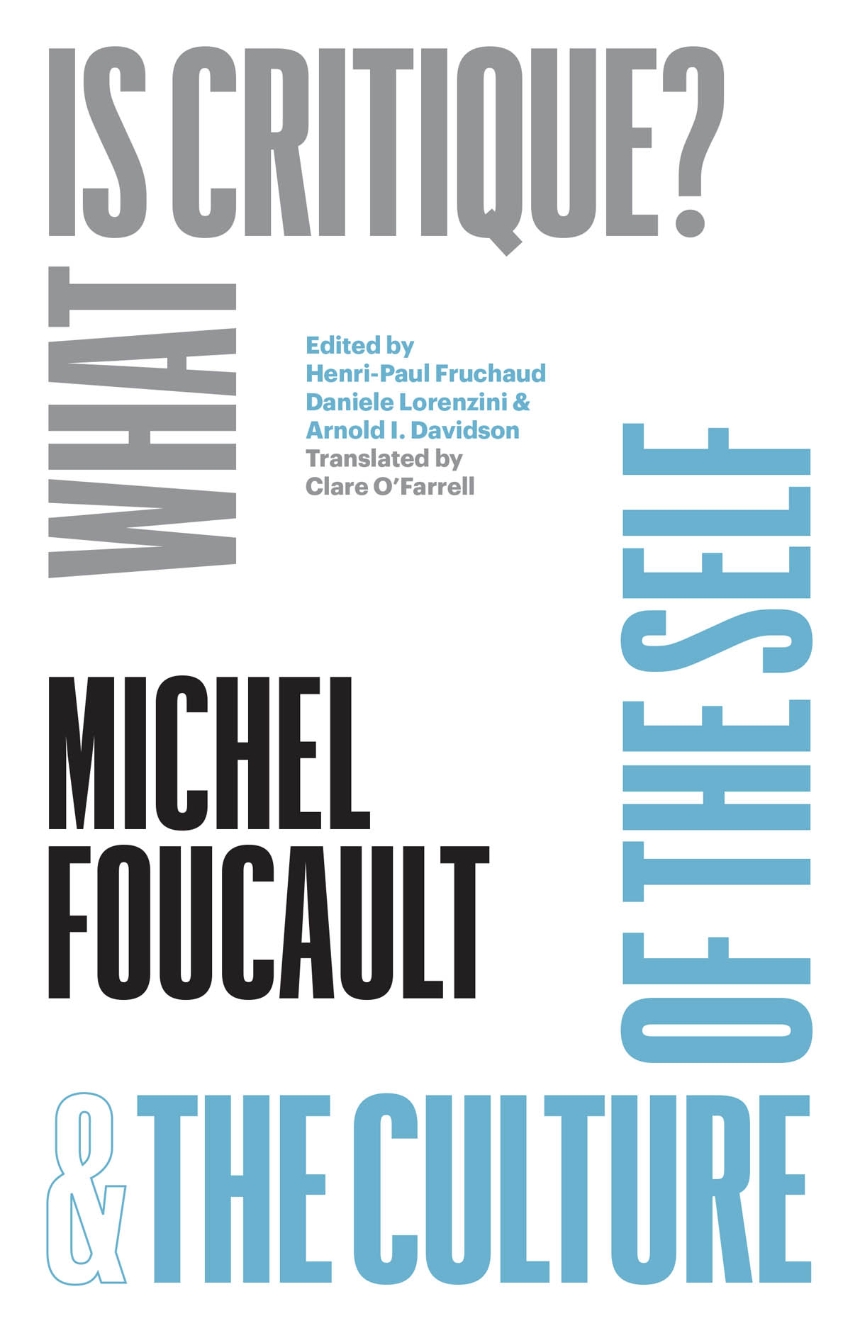
Michel Foucault, What Is Critique? & The Culture of the Self, edited by Henri-Paul Fruchaud, Daniele Lorenzini, and Arnold I. Davidson, translated by Clare O’Farrell, University of Chicago Press, January 2024.
Newly published lectures by Foucault on critique, Enlightenment, and the care of the self.
On May 27, 1978, Michel Foucault gave a lecture to the French Society of Philosophy where he redefined his entire philosophical project in light of Immanuel Kant’s 1784 text “What Is Enlightenment?” Foucault strikingly characterizes critique as the political and moral attitude consisting in the “art of not being governed like this,” one that performs the function of destabilizing power relations and creating the space for a new formation of the self within the “politics of truth.”
This volume presents the first critical edition of this crucial lecture alongside a previously unpublished lecture about the culture of the self and three public debates with Foucault at the University of California, Berkeley, in April 1983. There, for the first time, Foucault establishes a direct connection between his reflections on the Enlightenment and his analyses of Greco-Roman antiquity. However, far from suggesting a return to the ancient culture of the self, Foucault invites his audience to build a “new ethics” that bypasses the traditional references to religion, law, and science.