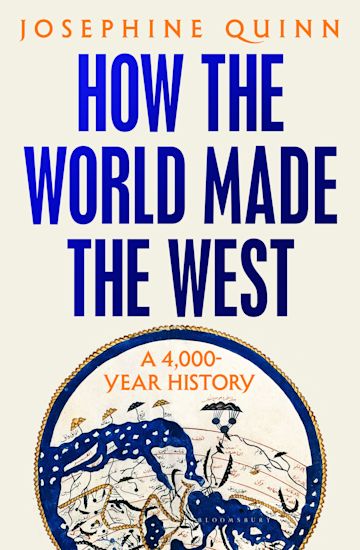
What does history look like without ‘civilisations’? Josephine Quinn calls for a major reassessment of the West and the concepts that define it.
The West, history tells us, was built on the ideas and values of Ancient Greece and Rome, which disappeared from Europe during the Dark Ages and were then rediscovered by the Renaissance. In a bold and magisterial work of immense scope, Josephine Quinn argues that the true story of the West is much bigger than this established paradigm leads us to believe. So much of our shared history has been lost, drowned out by the concept – developed in the Victorian era – of ‘civilisations’.
Quinn reveals a new narrative: one that traces the relationships that built what is now called the West from the Bronze Age to the Age of Exploration, as societies met, tangled and sometimes grew apart. She makes the case that it is contact and connections, rather than distinct and isolated civilisations, that drive historical change. It is not peoples that make history – people do.
Michel Serres, Hermes I: Communication, Translated by Louise Burchill, Introduction by Paul A. Harris, University of Minnesota Press, 2023
Michel Serres is recognized as one of the giants of postwar French philosophy of knowledge, along with Gilles Deleuze, Jacques Derrida, Michel Foucault, and Gilbert Simondon. His early five-volume series Hermes, which appeared in the 1960s and 1970s, was an intellectual supernova in its proposition that culture and science shared the same mythic and narrative structures. Hermes I: Communication marks the start of a major publishing endeavor to introduce this foundational series into English.
Building on the figure of the Greek god Hermes, who presides over the realms of communication and interpretation, Hermes I embarks on a reflection concerning the history of mathematics via Descartes and Leibniz and culminates by way of a Bachelardian logoanalytic reading of Homer, Dumas, Molière, Verne, and the story of Cinderella. We observe a singular poetic philosopher seeking to bridge the gap between the liberal arts and the sciences through a profound mathematical and poetic fable regarding information theory, history, and art, establishing a new way to think about the production of knowledge during the late twentieth century. In these pages, students and scholars of philosophy will discover an extraordinary project of thought as vital to critical reflection today as it was fifty years ago.
The research for the Indo-European thought project has been difficult to confine to a solely French focus. I knew I wanted to begin what will probably be the first chapter with the story of the Mission Paul Pelliot, an expedition to Chinese Turkestan where he plundered the caves of a Thousand Buddhas in Dunhuang and brought back hundreds of manuscripts and other materials to Paris. Émile Benveniste did some of his earliest work on manuscripts from this haul, and tracing the story of Benveniste led me to Robert Gauthiot, and from him to Antoine Meillet and Pelliot. A lot of Benveniste’s initial career was as a successor to Meillet. He helped to revise second editions of at least two of Meillet’s books, he covered some of his teaching at the EPHE, and he taught in his place for two years at the Collège de France when Meillet was ill, before being elected to the chair made vacant by Meillet’s death. It was Pelliot who proposed him.
The manuscripts from Pelliot’s collection needed a range of specialists to interpret them, given the range of languages in which they were written. Sylvain Lévi did some work on Kuchean, and Meillet suggested Gauthiot to work on Sogdian, a language which the German Turfan expeditions had done much to uncover. But the Turfan texts being analysed in Berlin were mainly Manichean, whereas the ones Pelliot had found were often Buddhist. Gauthiot began this work in the early 1910s, but it was interrupted by the war, and Gauthiot died from injuries received in battle. Meillet tried to complete some of his work, but progress slowed considerably until he brought Benveniste on board. Benveniste was only born in 1902, but was working on these manuscripts in the early 1920s, publishing editions of texts with reproductions, transcriptions, translations and commentaries, as well as completing Gauthiot’s work on the grammar of the language.
Pelliot was beaten to the caves by Aurel Stein, a Hungarian-born but naturalised British explorer. While there is, to my knowledge, only one biography of Pelliot, Stein has at least two, by Jeannette Mirsky and Annabel Walker (out of print). He is a major figure in a range of historical accounts of the rediscovery of the Silk Road by Western archaeologists and explorers, a story that is often intertwined with the ‘Great Game’ of rival powers staking out their colonial claims. Stein’s expeditions are indeed epic, four across Central Asia and several in Iran, often retracing the footsteps of historical figures like Marco Polo and Alexander the Great. Stein seems to have been perpetually impatient to get back to the field, though he left a monumental series of publications too. Stein’s collections – again plundered or bought for nominal fees – are huge.
Stein would often write an initial report of each expedition, sometimes delivered as an evening lecture to the Royal Geographical Society in London; then a popular account for a wide audience; and finally a fully academic treatise, usually in multiple volumes, with a range of reproductions, analyses and maps. His first three expeditions to Central Asia were reported in Ancient Khotan, Serindia and Innermost Asia.I’ve only dipped into these so far. Sand-Buried Ruins of Khotan and Ruins of Desert Cathay are the ‘personal narratives’ of the first two expeditions, and are very readable.
The biographies and other accounts seem to tell the story of the expeditions really well, often drawing on the published accounts, but also his massive correspondence. It really was huge, and much of it has survived too, with voluminous letters to his family, friends in India and London, and a wide range of academic contacts. Many of these seem to be a series of reports back from the field. I can totally understand the interest in the more dramatic aspects of his life, but I sense that story has been told.
What I’ve been trying to trace is a few strands of the way he also made use of a legion of scholars to help interpret the finds of his expeditions, in a similar way to Pelliot. It was his contact with Pelliot to begin the cataloguing work that first alerted me to a possible story here. While he and Pelliot were rivals in the field, they were sometime collaborators outside of it, in London and Paris. Pelliot only made one big expedition; Stein was always planning the next, but did follow through on publishing while Pelliot was sometimes erratic. Pelliot also failed to undertake the big task Stein set him, which was to catalogue the Chinese manuscripts he had brought back from Dunhuang. There is an initial report by Pelliot on Chinese and other manuscripts in the British Library archives, but it indicates the plan for a much fuller inventory, with various conditions about payment and possibilities for publication. Two crates of manuscripts were shipped to Paris for Pelliot to begin the work. But Pelliot never delivered the promised report, and there are letters between British Museum staff and Pelliot showing frustration and ultimately asking for the return of material. That was delayed by the war, but it did eventually get back to London.
Stein’s correspondence with Lionel Barnett of the British Museum, now at the British Library, is revealing on this, but also showing that Stein consulted Gauthiot on some of this material. Copies of some of Stein’s letters to Gauthiot are also at the British Library, in the fifth folder of a huge correspondence about the publishing of his detailed scholarly reports – mainly with the publisher and technical correspondence on reproductions, but also with some of the people he consulted. But there is only one letter from Gauthiot there. That letter is acknowledging the receipt of an ‘inscribed stick’, sent via diplomatic mail to Paris for Gauthiot to interpret. Gauthiot’s response is brief and says it is very difficult to decipher. He promises to try harder and report back. But the only other letter there is from his widow, on mourning stationary with a thick black border, returning this item some years later.
There is such a lot of material produced by Stein, including his correspondence but also field reports, notes and reports, that it has taken a lot of work to catalogue this. This is quite apart from the collections he accumulated on his expeditions, which are across London at the British Museum, British Library and the Victoria and Albert Museum, with some in India. Some objects are at the Royal Geographical Society too. The Handbook of the collections just in the UK, edited by Helen Wang and John Perkins has 37 pages listing the various places and collections. With much the material relating to Stein, this is often at a very general level, rather than the detailed work that has been done for some correspondence and most especially for the collection. I knew that a lot of his material was at the Bodleian in Oxford – the Catalogue there is 155 pages, listing material in 393 boxes which stretch for over 43 linear metres – and I requested some of it. At the beginning of the day I thought I needed a day there; at the end of the day I realised I needed at least one more day, but it might be much more. There is some useful correspondence there with Benveniste to whom Stein turned when he needed further assistance. On one occasion Benveniste suggests Stein instead ask Walter Bruno Henning, so I plan to look at those letters too. There is also correspondence with Harold Bailey, and in that instance I know where the other side of the correspondence is, in Cambridge at the Ancient India and Iran Trust. I’ve done some work there with Bailey’s correspondence with Benveniste and Henning. One of the things which is challenging about using correspondence is that often only one side is in a single archive, unless someone happened to keep copies of their own letters. Stein did this sometimes, but not always. So to reconstruct a dialogue, it’s often necessary to go between two different places.
Where are the other side of Stein’s letters? I know there is a lot at the British Academy, which seems to be mainly his correspondence with family members, usually written in German. There are also letters at the Royal Geographical Society, mainly sent by Stein to John Scott Keltie, the secretary of the RGS, which often concern the publication of his reports, but also have some details of what he was finding in the field. The RGS also has some of the typescripts or manuscripts of texts Stein published in The Geographical Journal. The correspondence isn’t in their online catalogue, so I was indebted to the Handbook for alerting me that it existed, and the library staff there for locating it. There is also correspondence at the British Museum, which has its own small archive of material which didn’t get reallocated to the British Library. This mainly concerns correspondence about the British Museum’s collections. But many letters received by Stein are in Budapest, at the Hungarian Academy of Sciences. From the catalogues I’ve seen – a substantial book with a second volume as a supplement – this seems to be where his letters from Gauthiot and Meillet are mainly kept, for instance.
Stein’s letters to Benveniste, as indeed all the letters to Benveniste before the Second World War, seem to be irretrievably lost. When Benveniste fled occupied France for Switzerland, after escaping from a Prisoner of War camp – another story that is going to take some uncovering – he left behind all his papers. His flat was occupied and ransacked, and while some material was saved by friends, much was lost, including preparatory work for books which had to be restarted after the Liberation. I have no idea if there is a Gauthiot archive somewhere. Pelliot and Meillet’s papers will be in Paris.
With much of this, it feels like a jigsaw puzzle, with pieces in lots of different locations, much lost entirely, and with no real idea what the picture I’m trying to reconstruct is. And this is all with the story of one person, who was not intended to be a significant figure in my project at all. I thought Stein would just be of interest as the person who reached Dunhuang before Pelliot, and for whom Pelliot promised to do some cataloguing work. And, as I said, the story of Stein’s expeditions has been told. But perhaps the story of how he put together his reports of those expeditions, the background work which situated him within a wider community of academics across Europe, still has some interest. Helen Wang and Ursula Sims-Williams have done some really valuable work, and I’ve been making use of their specialist analyses alongside the more general accounts of Stein, but I think there is an interesting perspective to add to the story I want to tell about the work in France. It’s also been good to have some archival work in the UK, which I can do as a series of day trips, as I return to work after the period away from the project. I’ll share a more general research update on this project hopefully sometime next week [update 14 is now here].
Despite insoluble contradictions, intense volatility and fierce resistance, the crisis-ridden capitalism of the 21st century lingers on. To understand capital’s paradoxical expansion and entrenchment amidst crisis and unrest, Mute Compulsionoffers a novel theory of the historically unique forms of abstract and impersonal power set in motion by the subjection of social life to the profit imperative. Building on a critical reconstruction of Karl Marx’s unfinished critique of political economy and a wide range of contemporary Marxist theory, philosopher Søren Mau sets out to explain how the logic of capital tightens its stranglehold on the life of society by constantly remoulding the material conditions of social reproduction. In the course of doing so, Mau intervenes in classical and contemporary debates about the value form, crisis theory, biopolitics, social reproduction, humanism, logistics, agriculture, metabolism, the body, competition, technology and relative surplus populations.
Despite the publication date, the open access version is available now.
The book provides a comprehensive and updated introduction to concept of territory in the study of democratic politics. Territory plays a rather marginal role in the traditional conceptions of democracy that in many ways still prevail today. Democratic politics is often analysed from the point of view of its institutions, citizens and voters, while little is said about the territory through which it is expressed – at most it provides a broader perimeter or context of political and institutional action. The book offers, instead, an introductory theoretically-oriented discussion of crucial issues such as the genesis of state-nation, the transformation of democratic citizenship, the current borders’ policies, the rising of territorial populism and the experience of 19-covid pandemic.
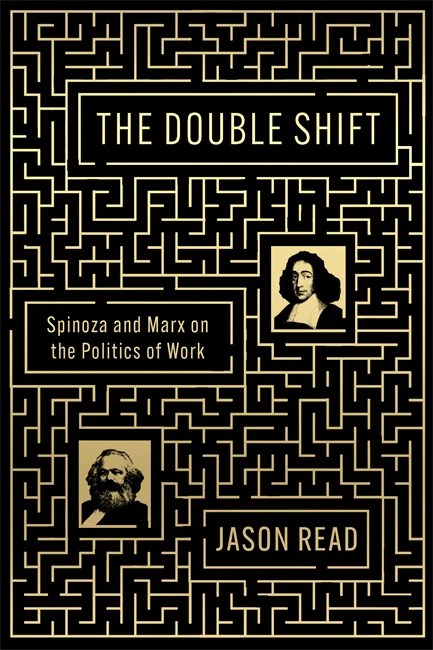
In a world of declining wages, working conditions, and instability, the response for many has been to work harder, increasing hours and finding various ways to hustle in a gig economy. What drives our attachment to work? To paraphrase a question from Spinoza, “Why do people fight for their exploitation as if it was liberation?”
The Double Shift turns towards the intersection of Marx and Spinoza in order to examine the nature of our affective, ideological, and strategic attachment to work. Through an examination of contemporary capitalism and popular culture it argues that the current moment can be defined as one of “negative solidarity.” The hardship and difficulty of work is seen not as the basis for alienation and calls for its transformation but rather an identification with the difficulties and hardships of work. This distortion of the work ethic leads to a celebration of capitalists as job creators and suspicion towards anyone who is not seen as a “real worker.”
The book is grounded in philosophy, specifically Marx and Spinoza, and is in dialogue with Plato, Smith, Hegel, and Arendt, but, at the same time, in examining contemporary ideologies and ideas about work it discusses motivational meetings at Apple Stores, the culture of Silicon Valley, and films and television from Office Space to Better Call Saul
The Double Shift argues for a transformation of our collective imagination and attachment to work.
Part of the Early Modern Literary Geographies series – just an expensive hardback at present
Unpicking the ecopolitics of Shakespeare’s plays at the Stuart court, Shakespeare Beyond the Green World establishes that the playwright was remarkably attentive to the environmental issues of his era. As a court dramatist, he designed his plays to captivate a patron deeply involved in both the conservation and exploitation of a burgeoning empire’s natural resources. Spurred by James’ campaign to unify his kingdoms, the Jacobean Shakespeare ventures beyond the green and pleasant lowlands of England to chart the wild topographies of an expansionist Great Britain: the blasted heath in Macbeth, the caves and mines of Timon of Athens, the overfished North Sea in Pericles, the Welsh mountains in Cymbeline, the Arctic fur country in The Winter’s Tale, the fens in The Tempest, overcrowded London and empty Ulster in Measure for Measure and Coriolanus, and the night in Antony and Cleopatra and King Lear. While these plays often simulate a monarch’s-eye-view of the natural world, they also reveal that Crown policies were fiercely contested from below. In addition to trekking beyond verdant landscapes, Shakespeare Beyond the Green World seeks to mitigate the Anglocentric and anthropocentric bias of the archive by putting the plays into conversation with texts in which the subaltern wild growls back. Combining deep dives into environmental history with close readings of Shakespearean wordplay, original typography, and original performance conditions, this study re-wilds the Renaissance stage. It spotlights Shakespeare’s tendency to humanize beasts and bestialize allegedly godlike monarchs, debunking fantasies of human exceptionalism. By clarifying how the Jacobean plays expose monarchical dominion as ecological tyranny, this study remains scrupulously historicist while reasserting Shakespearean drama’s scorching relevance in the Anthropocene.
Critically re-examines canonical theories of biopolitics in the post-truth context
Argues for a positive role of truth-telling in the democratisation of biopolitical governance
Undertakes a genealogical investigation of the origins of the contemporary post-truth regime in early post-communist politics
Puts forward an innovative theory of the speech act of truth-telling in democratic biopolitics
Draws on familiar examples from contemporary politics such as Vladimir Putin, Donald Trump, Greta Thunberg and Brexit
What makes post-truth politics so difficult to resist is its apparently democratic character that claims to challenge bureaucratic depoliticisation, the rule of experts and the disappearance of alternatives to the hegemonic policy. Sergei Prozorov refutes this interpretation, arguing that the post-truth ideology leads to the degradation of the public sphere that is essential to democratic governance. Rather than enable resistance to expertise-based biopolitical governmentalities, truth denialism dissolves the only framework where their contestation and transformation could take place. In contrast, Biopolitics after Truth argues for a positive role of truth-telling in the democratisation of biopolitical governance.
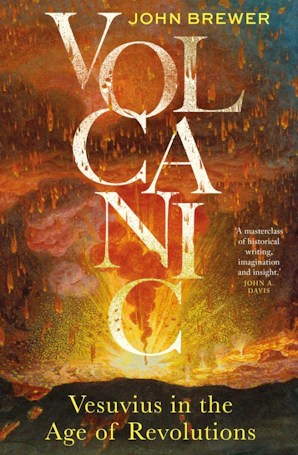
A vibrant, diverse history of Vesuvius and the Bay of Naples in the age of Romanticism
Vesuvius is best known for its disastrous eruption of 79CE. But only after 1738, in the age of Enlightenment, did the excavations of Herculaneum and Pompeii reveal its full extent. In an era of groundbreaking scientific endeavour and violent revolution, Vesuvius became a focal point of strong emotions and political aspirations, an object of geological enquiry, and a powerful symbol of the Romantic obsession with nature.
John Brewer charts the changing seismic and social dynamics of the mountain, and the meanings attached by travellers to their sublime confrontation with nature. The pyrotechnics of revolution and global warfare made volcanic activity the perfect political metaphor, fuelling revolutionary enthusiasm and conservative trepidation. From Swiss mercenaries to English entrepreneurs, French geologists to local Neapolitan guides, German painters to Scottish doctors, Vesuvius bubbled and seethed not just with lava, but with people whose passions, interests, and aims were as disparate as their origins.
Maurice Merleau-Ponty’s work draws our attention to how the body is always our way of having a world and never merely a thing in the world. Our conception of the body must take account of our cultures, our historically located sciences, and our interpersonal relations and cannot reduce the body to a biological given. Normality, Abnormality, and Pathology in Merleau-Ponty takes up Merleau-Ponty’s phenomenology of the body to explore the ideas of normality, abnormality, and pathology. Focusing on the lived experiences of various styles of embodiment, the book challenges our usual conceptions of normality and abnormality and shows how seemingly objective scientific research, such as the study of pathological symptoms, is inadequate to the phenomena it purports to comprehend. The book offers new insights into our understandings of health and illness, ability and disability, and the scientific and cultural practices that both enable and limit our capacity for diverse experiences.