Gabrielle Hecht, Residual Governance: How South Africa Foretells Planetary Futures – Duke University Press, November 2023

Gabrielle Hecht, Residual Governance: How South Africa Foretells Planetary Futures – Duke University Press, November 2023

The Introduction is open access here.
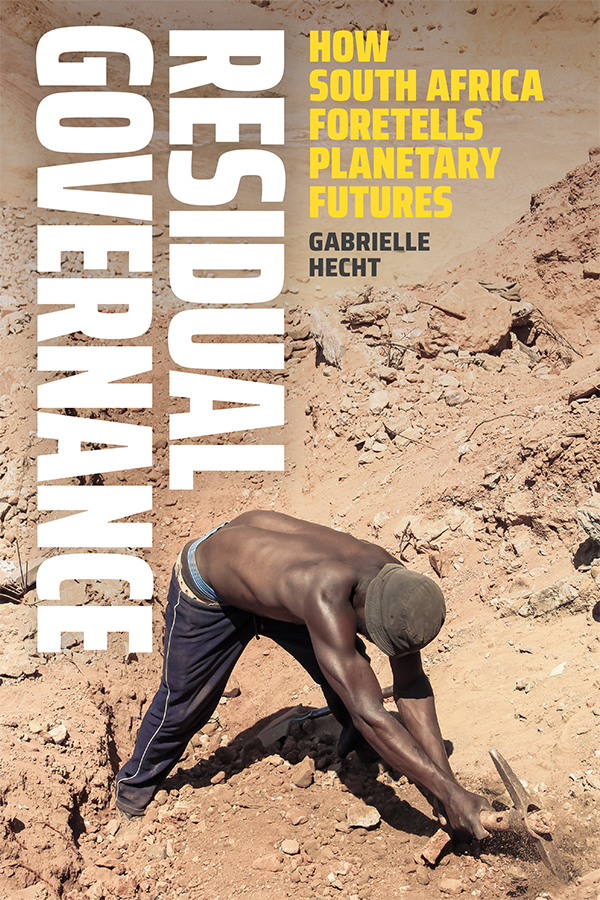
In Residual Governance, Gabrielle Hecht dives into the wastes of gold and uranium mining in South Africa to explore how communities, experts, and artists fight for infrastructural and environmental justice. Hecht outlines how mining in South Africa is a prime example of what she theorizes as residual governance—the governance of waste and discard, governance that is purposefully inefficient, and governance that treats people and places as waste and wastelands. She centers the voices of people who resist residual governance and the harms of toxic mining waste to highlight how mining’s centrality to South African history reveals the links between race, capitalism, the state, and the environment. In this way, Hecht shows how the history of mining in South Africa and the resistance to residual governance and environmental degradation is a planetary story: the underlying logic of residual governance lies at the heart of contemporary global racial capitalism and is a major accelerant of the Anthropocene.
Posted in Uncategorized | Leave a comment

Richard Bourke, Hegel’s World Revolutions – Princeton University Press, October 2023

Richard Bourke, Hegel’s World Revolutions – Princeton University Press, October 2023

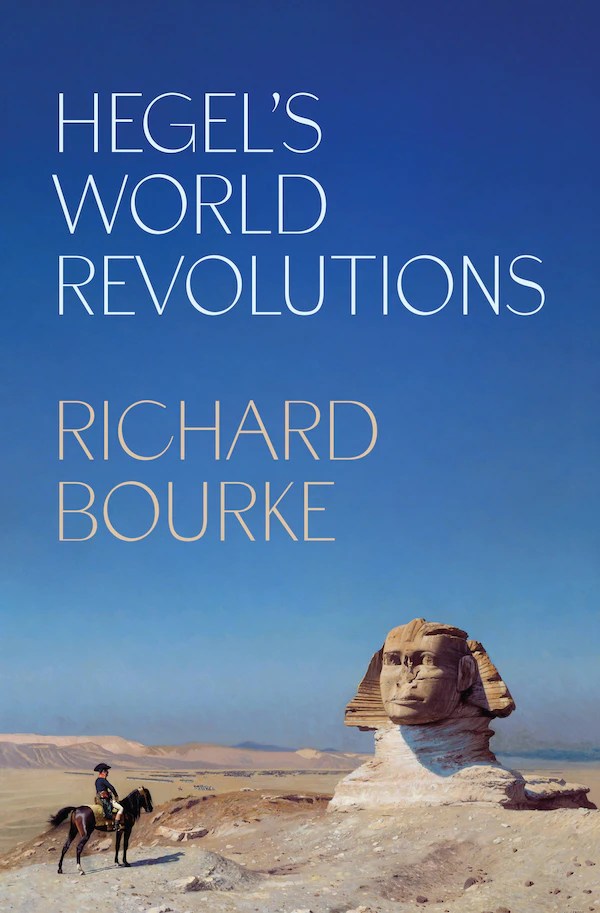
G.W.F. Hegel was widely seen as the greatest philosopher of his age. Ever since, his work has shaped debates about issues as varied as religion, aesthetics and metaphysics. His most lasting contribution was his vision of history and politics. In Hegel’s World Revolutions, Richard Bourke returns to Hegel’s original arguments, clarifying their true import and illuminating their relevance to contemporary society. Bourke shows that central to Hegel’s thought was his anatomy of the modern world. On the one hand he claimed that modernity was a deliverance from subjection, but on the other he saw it as having unleashed the spirit of critical reflection. Bourke explores this predicament in terms of a series of world revolutions that Hegel believed had ushered in the rise of civil society and the emergence of the constitutional state.

Bourke interprets Hegel’s thought, with particular reference to his philosophy of history, placing it in the context of his own time. He then recounts the reception of Hegel’s political ideas, largely over the course of the twentieth century. Countering the postwar revolt against Hegel, Bourke argues that his disparagement by major philosophers has impoverished our approach to history and politics alike. Challenging the condescension of leading thinkers—from Heidegger and Popper to Lévi-Strauss and Foucault—the book revises prevailing views of the relationship between historical ideas and present circumstances.

Update 12 February 2024: Terry Eagleton reviews the book in the London Review of Books.

Posted in Georg Wilhelm Friedrich Hegel | Leave a comment

Marcelo Hoffman, Foucault in Brazil: Dictatorship, Resistance, and Solidarity – University of Pittsburgh Press, February 2024

Marcelo Hoffman, Foucault in Brazil: Dictatorship, Resistance, and Solidarity – University of Pittsburgh Press, February 2024

Philosopher Michel Foucault’s cultural criticism crosses disciplines and is well known as an influence on modern conceptions of knowledge and power. Less well known are the five trips he took to Brazil between 1965 and 1976. Although a coup in 1964 had installed a military dictatorship, Foucault kept his opinion on the Brazilian government largely to himself until October 23, 1975. On that date, he delivered a manifesto at a student assembly in São Paulo expressing his solidarity with students and professors protesting a wave of arrests and torture. This manifesto caught the government’s attention and became the focal point of the dictatorship’s surveillance of Foucault. Foucault in Brazil explores the production of the public antagonism between the philosopher and the dictatorship through a meticulous consideration of each of his visits to Brazil. Marcelo Hoffman connects history, philosophy, and political theory to open new ways of thinking about Foucault as a person and thinker and about Brazil and authoritarianism.

 Brilliant and chock-full of insights and impeccably researched historical portraits, Foucault in Brazil is a luminous, indispensable book in a range of fields, and constitutes a landmark for scholars interested in the French philosopher in the continent and beyond. 

Adam Joseph Shellhorse, Temple University

Foucault in Brazil develops a meticulous and riveting historical account of the philosopher’s trips through that country. Hoffman’s scholarship employs rigorous historical investigation to excavate nothing short of a model of what it can mean to marshal one’s social capital to contest power publicly. This work is outstanding and without peer. 

Kevin Thompson, DePaul University

This beautifully crafted account of Foucault’s political activities in Brazil in the 1970s is a tour de force. Foucault in Brazil not only illuminates rich archival details about the philosopher’s support of Brazilians fighting a military dictatorship but also brings much needed nuance to our understanding of how his distinct philosophical approach to power was driven by concrete acts of political solidarity. 

Lynne Huffer, author of Mad for Foucault

Posted in Michel Foucault | Leave a comment

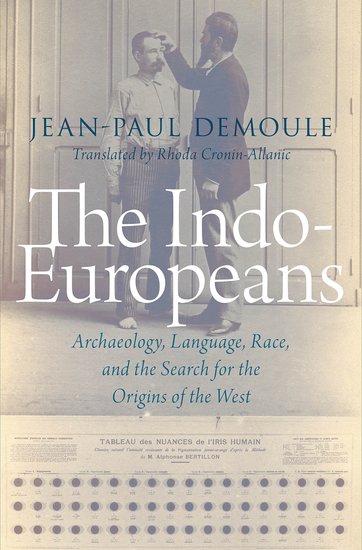
Jean-Paul Demoule, The Indo-Europeans: Archaeology, Language, Race, and the Search for the Origins of the West – Oxford University Press, May/August 2023

Jean-Paul Demoule, The Indo-Europeans: Archaeology, Language, Race, and the Search for the Origins of the West – Oxford University Press, May/August 2023

The OUP site shows a hardback in May 2023, and paperback in August. It is a translation by Rhoda Cronin-Allanic of his French book, Mais où sont passés les Indo-Européens? (2014), which was revised in 2017.

The existence of an Indo-European linguistic family, allowing for the fact that several languages widely dispersed across Eurasia share numerous traits, has been demonstrated for several centuries now. But the underlying factors for this shared heritage have been fiercely debated by linguists, historians, archaeologists, and anthropologists. The leading theory, of which countless variations exist, argues that this similarity is best explained by the existence, at one given point in time and space, of a common language and corresponding population. This ancient, prehistoric, population would then have diffused across Eurasia, eventually leading to the variation observed in historical and modern times. 

The Indo-Europeans: Archaeology, Language, Race, and the Search for the Origins of the West argues that despite its acceptance and use by most researchers from different disciplines, such a model is inherently flawed. This book describes how, beginning in the late eighteenth century, Europeans began a quest for a supposed original homeland, from which a small conquering people would one day spread out, bringing their language to Europe and parts of Asia (India, Iran, Afghanistan). This quest was often closely tied to ideological preoccupations and it was in its name that the Nazi leadership, claiming for the Germans the status of the purest Indo-Europeans (or Aryans), waged genocide. The last part of the book summarizes the current state of knowledge and current hypotheses in the fields of linguistics, archaeology, comparative mythology, and genetics. The culmination of three decades of research, this book offers a sweeping survey of the historiography of the Indo-European debate and poses a devastating challenge to the Indo-European origin story at its roots.

Posted in Uncategorized | Leave a comment

Christopher S. Browning, Nation Branding and International Politics – McGill-Queen’s University Press, October 2023

Christopher S. Browning, Nation Branding and International Politics – McGill-Queen’s University Press, October 2023

Nation branding is regarded as essential for competitiveness among countries, but the idea of branding nations is often derided as lacking seriousness. While nation branding has been on the radar of scholars of marketing, communication, and media studies, as well as political geography for decades, it has only made a small dent into the international relations field.

In Nation Branding and International Politics Christopher Browning argues that international relations should take nation branding seriously. Nation branding not only involves the issues of culture, identity, and status – which are of principal concern to IR – but it is also a different and potentially fruitful way of reconceptualizing statehood. Mobilizing work on ontological security, anxiety, status, and distinction, and grounding the analysis in a broader historical context, Browning finds that nation branding is politically significant, though not necessarily for the reasons its advocates claim. Specifically, the book raises important questions about nation branding’s influence on the constitution of national identity, the reframing of citizenship, and the topography of contemporary geopolitics.

Nation Branding and International Politics considers how status, prestige, and reputation are constructed and maintained in international society, and how, perhaps, this construction and maintenance may be changing – just as the practice of nation branding is changing.

Posted in Uncategorized | 1 Comment

Sara Safransky, The City after Property: Abandonment and Repair in Postindustrial Detroit – Duke University Press, August 2023

Sara Safransky, The City after Property: Abandonment and Repair in Postindustrial Detroit – Duke University Press, August 2023

The Prologue and Chapter 1 are available open access here

In The City after Property, Sara Safransky examines how postindustrial decline generates new forms of urban land politics. In the 2010s, Detroit government officials classified a staggering 150,000 lots—more than a third of the city—as “vacant” or “abandoned.” Analyzing subsequent efforts to shrink the Motor City’s footprint and budget, Safransky presents a new way of conceptualizing urban abandonment. She challenges popular myths that cast Detroit as empty along with narratives that reduce its historical decline to capital and white flight. In connecting contemporary debates over neoliberal urbanism to Cold War histories and the lasting political legacies of global movements for decolonization and Black liberation, she foregrounds how the making of—and challenges to—modern property regimes have shaped urban policy and politics. Drawing on critical geographical theory and community-based ethnography, Safransky shows how private property functions as a racialized construct, an ideology, and a moral force that shapes selves and worlds. By thinking the city “after property,” Safransky illuminates alternative ways of imagining and organizing urban life.

Posted in urban/urbanisation | Leave a comment

Books received – Renou, Althusser, Safransky, Zumwalt, Woodard

Mainly bought second-hand for the Indo-European project, along with Sara Safransky, The City after Property: Abandonment and Repair in Postindustrial Detroit, sent by Duke University Press.

The Rosemary LévyZumwalt book is the first part Franz Boas: The Emergence of the Anthropologist – but the second part  Franz Boas: Shaping Anthropology and Fostering Social Justice was published late last year and is on order.

Posted in Friedrich Nietzsche, Louis Althusser, Mapping Indo-European Thought in Twentieth Century France, Uncategorized, urban/urbanisation | Leave a comment

Michel Foucault, The Japan Lectures: A Transnational Critical Encounter – Routledge, December 2023

Michel Foucault, The Japan Lectures: A Transnational Critical Encounter – Routledge, December 2023

This book makes available, for the first time in English, lectures and interviews that Foucault gave in Japan in 1978, reconstructing their context, and isolating the question of their singular relevance for us today. In these forgotten lectures, in a free and often informal style, Foucault explores, together with his Japanese interlocutors, what it would mean to take up, from outside Europe, the questions he was raising at the time about Revolution and Enlightenment in the traditions of European critical thought. In a series of wide-ranging discussions, on sexuality and its history, non-Christian forms of spirituality, new forms of political movements, and the role of knowledge, power, and truth in them, Foucault examines these questions in relationship to Asia. He had hoped these questions, very much debated at the time in postwar Japan, would be the start of new forms of translation, publication, and exchange. At the heart of the lectures is thus a search for the creation of a new sort of transnational collaboration, recasting the history of European colonialism and opening to a philosophy no longer simply Western, yet to come.

The Japan Lectures thus contribute to the new scholarship in Asian and in translation studies which has long since moved away from earlier “Area Studies”; at the same time, it participates in the new scholarship about Foucault’s own work and itinerary, following the publication of an extraordinary wealth of materials left unfinished or unpublished by his untimely death. In these ways, The Japan Lectures help us to better see the implications of Foucault’s work for philosophy in the 21st century.

I say a bit about the material included in this book, on the basis of pre-publicity, here.

[updated 24 October 2023 with the paperback cover as well as the hardback]

Posted in Michel Foucault | Leave a comment

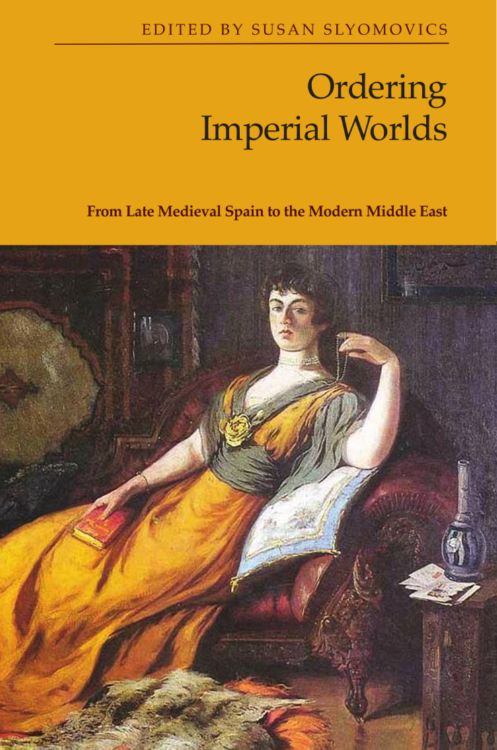
Susan Slyomovics (ed.), Ordering Imperial Worlds: From Late Medieval Spain to the Modern Middle East, Edinburgh University Press, November 2023

Susan Slyomovics (ed.), Ordering Imperial Worlds: From Late Medieval Spain to the Modern Middle East, Edinburgh University Press, November 2023

Studies cross-cultural exchanges across the Mediterranean using new interdisciplinary methodologies

  • An edited volume that provides architectural, literary, historical and visual analyses
  • A strong focus on interpreting archives
  • A work of comparative cultural studies
  • Each chapter opens an original and critical perspective, the book coalescing into a wealth of new ways of thinking about the history of the Islamic world
  • Represents new developments in theories of empire
  • Discusses cases from medieval Spain, Ottoman Empire, colonial North Africa, and France and Algeria based on primary sources

This volume of original essays invites 10 preeminent scholars to think through a rich corpus on cities, empires, images and archaeological sites produced by the distinguished architectural historian Zeynep Çelik. Awarded the prestigious 2019 Giorgio Della Vida medal for excellence in Islamic studies by the University of California, the occasion allowed researchers from various universities, countries and disciplines to reflect on her rich body of work. Inspired by Çelik’s works, chapters travel between Muslim and Christian Spain, the Ottoman Empire and France, Europe and its overseas empire in North Africa, and more.

Posted in Uncategorized | Leave a comment

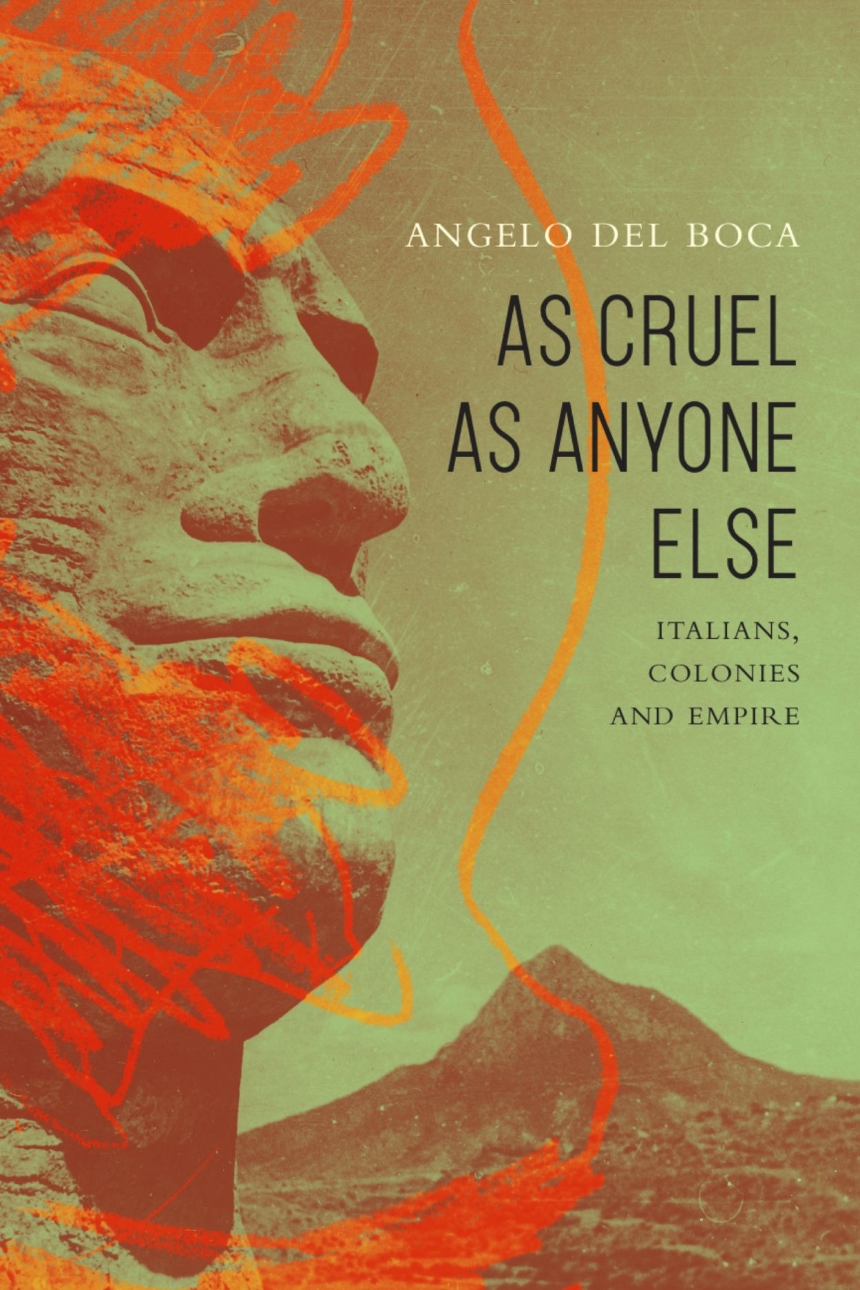
Angelo Del Boca, As Cruel as Anyone Else: Italians, Colonies and Empire – trans. Richard Braude, Seagull, July 2024

Angelo Del Boca, As Cruel as Anyone Else: Italians, Colonies and Empire – trans. Richard Braude, Seagull, July 2024

Reveals a dark chapter in the Italian government’s colonial history that has been largely hidden from view.
 
Between the end of the nineteenth century and over the first half of the twentieth, Italy invaded and occupied the Horn of Africa, Libya, and several other territories. Yet recognition of this history of colonial destruction, racist violence, and genocidal aerial and chemical warfare—carried out not only during the Fascist dictatorship but also under preceding liberal governments—has been consistently repressed beneath the myth that the Italians never truly practiced colonialism.
 
The late journalist, historian, novelist, campaigner, and former Resistance fighter Angelo Del Boca dismantles this myth. He expertly narrates episodes of state violence committed by Italians both abroad—from Ethiopia to Slovenia, from China to Libya—and “at home” during the civil war following Unification in the 1860s or when the anti-Fascist Resistance faced off against the Republic of Salò after 1943. Attentive to the losses and pain suffered by all sides in war, Del Boca deftly demonstrates how such violence was not only a tool of domination but has also been central to creating and shaping an Italian “people.”
 
Drawing on a lifetime of interviews as a special correspondent, decades of work in private and state archives, and his own experiences during the Second World War, Del Boca’s popular and influential work has contributed to overturning views of Italian history. Presenting many historical episodes in English for the first time, As Cruel as Anyone Else provides a key to reading contemporary Italy, its place in international politics, and the disturbing permanence of the far-right within mainstream Italian politics.

Posted in Uncategorized | Leave a comment