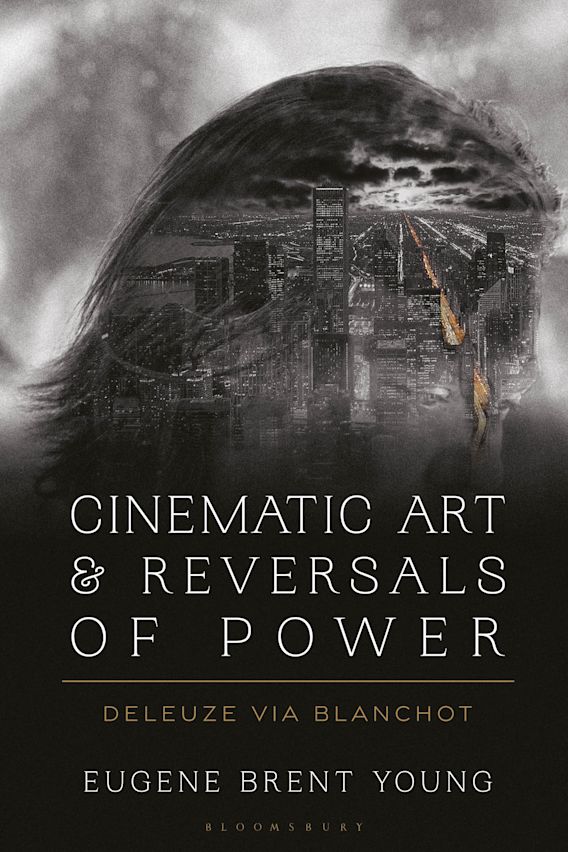
Eugene B. Young, Cinematic Art and Reversals of Power. Deleuze via Blanchot (2022)

Eugene B. Young, Cinematic Art and Reversals of Power. Deleuze via Blanchot, Bloomsbury, 2022

Clare O'Farrell's avatarFoucault News

Eugene B. Young, Cinematic Art and Reversals of Power. Deleuze via Blanchot, Bloomsbury, 2022

Description
Bringing together Deleuze, Blanchot, and Foucault, this book provides a detailed and original exploration of the ideas that influenced Deleuze’s thought leading up to and throughout his cinema volumes and, as a result, proposes a new definition of art.

Examining Blanchot’s suggestion that art and dream are “outside” of power, as imagination has neither reality nor truth, and Foucault’s theory that power forms knowledge by valuing life, Eugene Brent Young relates these to both Deleuze’s philosophy of time and his work with Guattari on art. In doing so, he uses case studies from literature and popular film, including Kafka’s Castle, Villeneuve’s Arrival, and Kubrick’s Eyes Wide Shut.

Providing important new insights for those working in literary and cinematic studies, this book advances a new definition of art as that which reverses…

View original post 192 more words

Posted in Uncategorized | Leave a comment

Kristin Ross’s “The Politics and Poetics of Everyday Life” – Los Angeles Review of Books podcast

Kristin Ross’s “The Politics and Poetics of Everyday Life” – Los Angeles Review of Books podcast

Eric Newman and Kate Wolf speak to the author Kristin Ross about her recent book, The Politics and Poetics of Everyday Life, a collection of essays that examine how everyday life emerges as a vantage point for understanding and transforming our social world. The book represents three decades of Ross’s writing about the everyday in French political, social, and cultural theory and history, including the commune form and current autonomous zones in France, the romance and memory of the May 1968 protests, and the present predicaments both faced and created by the Macron government. Featuring a long interview with the pioneering philosopher Henri Lefebvre, the book also invokes the work of Fredric Jameson, Jacques Ranciere, Emile Zola, and many others, to explore the intersections of political transformation and cultural representation as resources for thinking opposition and liberation in the present.

Details of the book here. Thanks to dmf for the link.

Posted in Uncategorized | Leave a comment

Uwe Wittstock, February 1933: The Winter of Literature – trans. Daniel Bowles, Polity, April 2023

Uwe Wittstock, February 1933: The Winter of Literature – trans. Daniel Bowles, Polity, April 2023

It all happened in a flash. February 1933 was the month in which the fate of German writers, as for so many others, was decided. In a tensely spun narrative, Uwe Wittstock tells the story of a demise which was predicted by some but also scarcely thought possible. He reveals how, in a matter of weeks, the glittering Weimar literary scene gave way to a long, dark winter, and how the net drew ever closer for Thomas Mann, Bertolt Brecht, Else Lasker-Schüler, Alfred Döblin, and countless others.

Monday, January 30: Adolf Hitler is sworn in as Chancellor of Germany. Joseph Roth cannot wait any longer to learn what today’s paper will report. He leaves for the station early in the morning and takes the train to Paris; bidding Berlin farewell comes naturally to him. Meanwhile, Thomas Mann barely spares a thought for politics during the next ten days, focusing instead on his forthcoming speech on Richard Wagner.

Weaving an intimate portrait of the major figures whose lives he follows day by day, Wittstock shows how the landslide of events which immediately followed Hitler’s victory spelled disaster for the country’s literary elite. He resurrects the atmosphere of the times, marked by anxiety for many, by passivity and self-betrayal for some, and by grim determination for others. Who will applaud the new dictator, and who will flee, fearing for their life? 

Drawing on unpublished archival material, this important work is both a meticulous historical narrative and a timely reminder that we must remain vigilant in the face of the forces that threaten democracy, however distant the prospect of totalitarianism may seem.

Posted in Uncategorized | Leave a comment

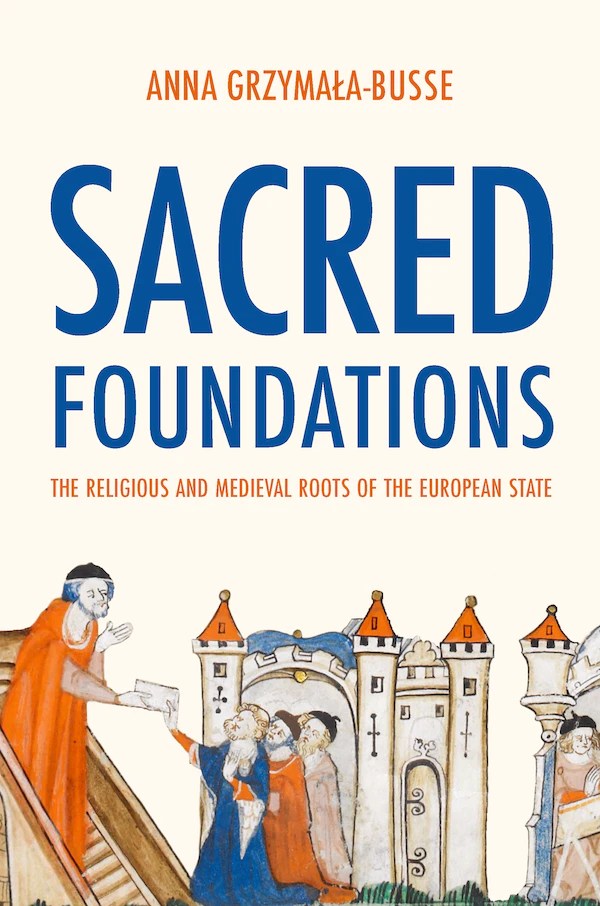
Anna M. Grzymała-Busse, Sacred Foundations: The Religious and Medieval Roots of the European State – Princeton University Press, January 2023

Anna M. Grzymała-Busse, Sacred Foundations: The Religious and Medieval Roots of the European State – Princeton University Press, January 2023

Sacred Foundations argues that the medieval church was a fundamental force in European state formation. Existing accounts focus on early modern warfare or contracts between the rulers and the ruled. In contrast, this major study shows that the Catholic Church both competed with medieval monarchs and provided critical templates for governing institutions, the rule of law, and parliaments.

The Catholic Church was the most powerful, wealthiest, and best-organized political actor in the Middle Ages. Starting in the eleventh century, the papacy fought for the autonomy of the church, challenging European rulers and then claiming authority over people, territory, and monarchs alike. Anna Grzymała-Busse demonstrates how the church shaped distinct aspects of the European state. Conflicts with the papacy fragmented territorial authority in Europe for centuries to come, propagating urban autonomy and ideas of sovereignty. Thanks to its organizational advantages and human capital, the church also developed the institutional precedents adopted by rulers across Europe—from chanceries and taxation to courts and councils. Church innovations made possible both the rule of law and parliamentary representation.

Bringing to light a wealth of historical evidence about papal conflict, excommunications, and ecclesiastical institutions, Sacred Foundations reveals how the challenge and example of powerful religious authorities gave rise to secular state institutions and galvanized state capacity.

Thanks to Adam Kotsko at An und für sich for a discussion – Sacred Foundations and the mechanism of political theology.

Posted in Uncategorized | Leave a comment

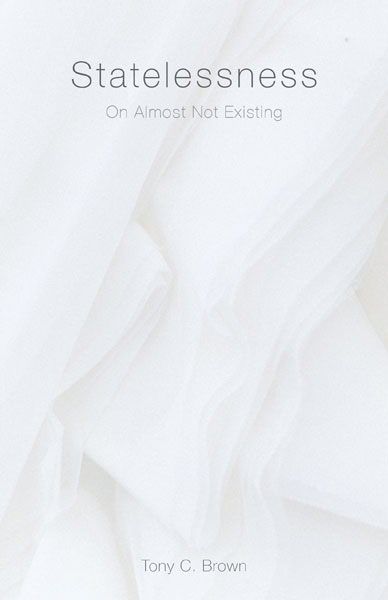
Tony C. Brown, Statelessness: On Almost Not Existing – University of Minnesota Press, November 2022

Tony C. Brown, Statelessness: On Almost Not Existing – University of Minnesota Press, November 2022

Just as the modern state and the citizenship associated with it are commonly thought of as a European invention, so too is citizenship’s negation in the form of twentieth-century diaspora and statelessness. Statelessness sets forth a new genealogy, suggesting that Europe first encountered mass statelessness neither inside its own borders nor during the twentieth century, as Hannah Arendt so influentially claimed, but outside of itself—in the New World, several hundred years earlier. 

Through close readings of political philosophers from Hobbes to Rousseau to Kant, Tony C. Brown argues that statelessness became a central problem for political thought early on, with far-reaching implications for thinking both on the state and on being human. What Europeans thought they saw among the “savages” of the Americas was life without political order, life less than human. Lacking almost everything those deemed clearly human had achieved, the stateless existed in a radically precarious, almost inhuman privation. 

And yet this existence also raised the unsettling possibility that state-based existence may not be inevitable, necessary, or even ideal. This possibility, as Brown shows, prompts the response—as defensive as it was aggressive—that we call Enlightenment political philosophy, which arguably still orders much thinking on being stateless today, including our discourses concerning migrants and Indigenous peoples.

Posted in Uncategorized | 1 Comment

Edgar Landgraf, Nietzsche’s Posthumanism – University of Minnesota Press, September 2023

Edgar Landgraf, Nietzsche’s Posthumanism – University of Minnesota Press, September 2023

While many posthumanists claim Nietzsche as one of their own, rarely do they engage his philosophy in any real depth. Nietzsche’s Posthumanism addresses this need by exploring the continuities and disagreements between Nietzsche’s philosophy and contemporary posthumanism. Focusing specifically on Nietzsche’s reception of the life sciences of his day and his reflections on technology—research areas as central to Nietzsche’s work as they are to posthumanism—Edgar Landgraf provides fresh readings of Nietzsche and a critique of post- and transhumanist philosophies. \

Through Landgraf’s inquiry, lesser-known aspects of Nietzsche’s writings emerge, including the neurophysiological basis of his epistemology (which anticipates contemporary debates on embodiment), his concerns with insects and the emergent social properties they exhibit, and his reflections on the hominization and cultivation effects of technology. In the process, Landgraf challenges major commonplaces about Nietzsche’s philosophy, including the idea that his social theory asserts the rights of “the strong” over “the weak.” The ethos of critical posthumanism also offers a new perspective on key ethical and political contentions of Nietzsche’s writings.

Nietzsche’s Posthumanism presents a uniquely framed introduction to tenets of Nietzsche’s thought and major trends in posthumanism, making it an essential exploration for anyone invested in Nietzsche and his contemporary relevance, and in posthumanism and its genealogy.

Posted in Friedrich Nietzsche, Uncategorized | Leave a comment

Miri Davidson, “Jean Baudrillard Grasped the Symbolic Life of Capital but Lost Track of the Material World”, Jacobin, open access

Miri Davidson, “Jean Baudrillard Grasped the Symbolic Life of Capital but Lost Track of the Material World“, Jacobin, open access

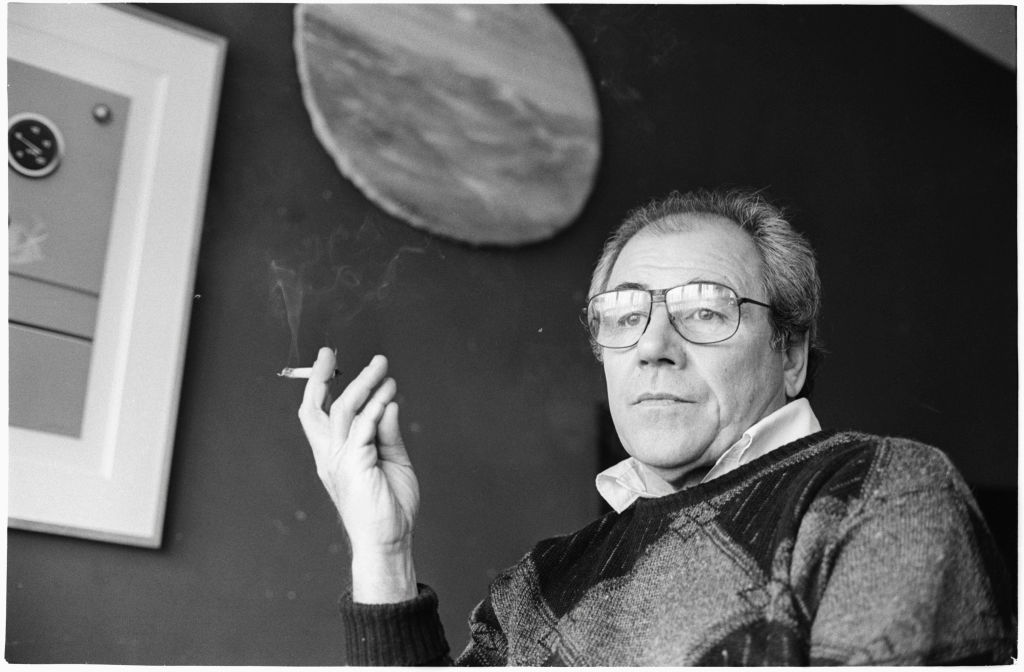
French philosopher and social scientist Jean Baudrillard smokes a cigarette in Paris. (Photo by Sophie Bassouls/Sygma via Getty Images)

French thinker Jean Baudrillard developed a pioneering analysis of symbolism and consumption in modern capitalism with some valuable insights. But he lost sight of the material structures on which capital’s power depends and drifted into a political dead end.

Posted in jean baudrillard | Leave a comment

Judith Revel, Orazio Irrera, Inédit de Michel Foucault : le discours philosophique (2023)

Inédit de Michel Foucault : le discours philosophique – discussion on Radio France with Orazio Irrera and Judith Revel

Clare O'Farrell's avatarFoucault News

Inédit de Michel Foucault : le discours philosophique, Radio France, podcast Samedi 13 mai 2023

Dans un texte inédit, le penseur français fait l’histoire du discours philosophique et l’aborde avec un regard critique.

Avec
Judith Revel Philosophe, traductrice, professeure des universités au département de philosophie de l’université Paris Nanterre, spécialiste de Michel Foucault et directrice du laboratoire Sophiapol

Orazio Irrera éditeur, maître de conférence à Paris 8

Comment la philosophie peut-elle nous aider à appréhender l’actualité ?
Dans un texte inédit rédigé en 1966, Michel Foucault se demande quel est le rôle de la philosophie. Il questionne le développement de la pensée philosophique, s’attarde sur Descartes, Kant et Nietzsche. Pas encore penseur du pouvoir, il esquisse déjà un regard critique et poursuit son travail de penseur de la pensée.

View original post

Posted in Uncategorized | Leave a comment

Gabriel Rockhill, “The Myth of 1968 Thought and the French Intelligentsia: Historical Commodity Fetishism and Ideological Rollback”, Monthly Review, June 2023 (open access)

Gabriel Rockhill, “The Myth of 1968 Thought and the French Intelligentsia: Historical Commodity Fetishism and Ideological Rollback“, Monthly Review, June 2023 (open access)

Like any major social and political movement, the events referred to as those of May 1968 have multiple different aspects and internal contradictions. They cannot be easily summed up in terms of a single significance, and they were themselves the site of class struggles, with various groups vying for power, pushing and pulling in different directions. This is as true of the past as it is of the present, in the sense that the battle over historical meaning continues long after the event itself has passed.

A dialectical approach to ’68 begins with the recognition of the infinite complexity of the events, while also concretely abstracting from them in order to establish a heuristic framework that makes sense of some of their fundamental traits. This frame can be situated at a greater or lesser level of abstraction, allowing for a multiscalar analysis, meaning one that can either cast the event at its most macro level, or hone in on microdevelopments. For such an analysis to function, of course, it requires a coherent relationship between the different scales, so that they can be nested within one another.

Posted in Uncategorized | Leave a comment

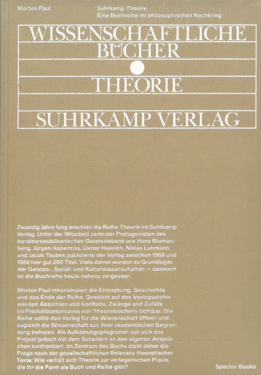
Morten Paul, Suhrkamp Theorie: Eine Buchreihe im philosophischen Nachkrieg – Spector, February 2023

Morten Paul, Suhrkamp Theorie: Eine Buchreihe im philosophischen Nachkrieg – Spector, February 2023

Suhrkamp’s “Theory” series appeared over a period of 20 years, from 1966 to 1986. The publishing house included over 200 titles in the series, including basic texts on the humanities and cultural studies: Kuhn’s ‘The Structure of Scientific Revolutions’, Habermas’s ‘Knowledge and Human Interests’, Althusser’s ‘For Marx’, Mauss’s ‘The Gift’, Bourdieu’s ‘Zur Soziologie der symbolischen Formen’, Searle’s ‘Speech Acts’, Foucault’s ‘The Archaeology of Knowledge’, Knorr-Cetina’s ‘The Manufacture of Knowledge’. With the help of archival records, interviews, and readings, Morten Paul reconstructs the creation of the series against the backdrop of questions relating to the social relevance of theoretical texts. How does theory behave in relation to practice, which supplies it with form as a text, book, or series? How does this form determine the social impact of theory? And why was this series ultimately doomed to failure, given the success of edition suhrkamp and suhrkamp taschenbuch wissenschaft? The book is part of the series Applied Publishing Studies.

Morten Paul, (b. in 1987), wrote his thesis on the “Theory” series in the Suhrkamp Research Group at the German Literature Archive Marbach, obtaining his doctorate at the University of Konstanz.

Posted in Uncategorized | 5 Comments