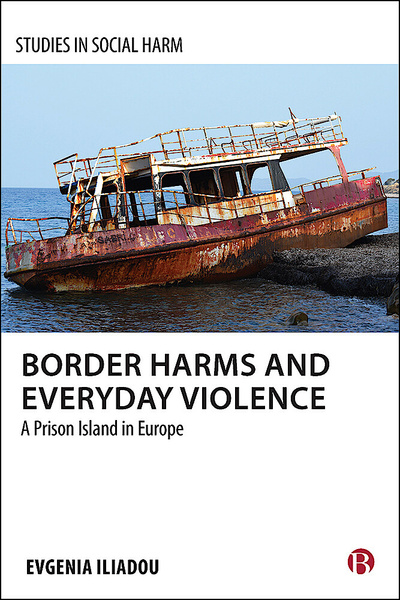
The Greek island of Lesvos is frequently the subject of news reports on the refugee ‘crisis’, but they only occasionally focus on the dire living conditions of asylum seekers already present on the island. Through direct experience as an activist in Lesvos refugee camps and detention centres, Iliadou gives voice to those with lived experiences of state violence.
The author considers the escalation of EU border regime and deterrence policies seen in the past decade alongside their present impacts. Asking why the social harm and suffering border crossers experience is normalized and rendered invisible, the book highlights the collective, global responsibility for safeguarding refugees’ human rights.
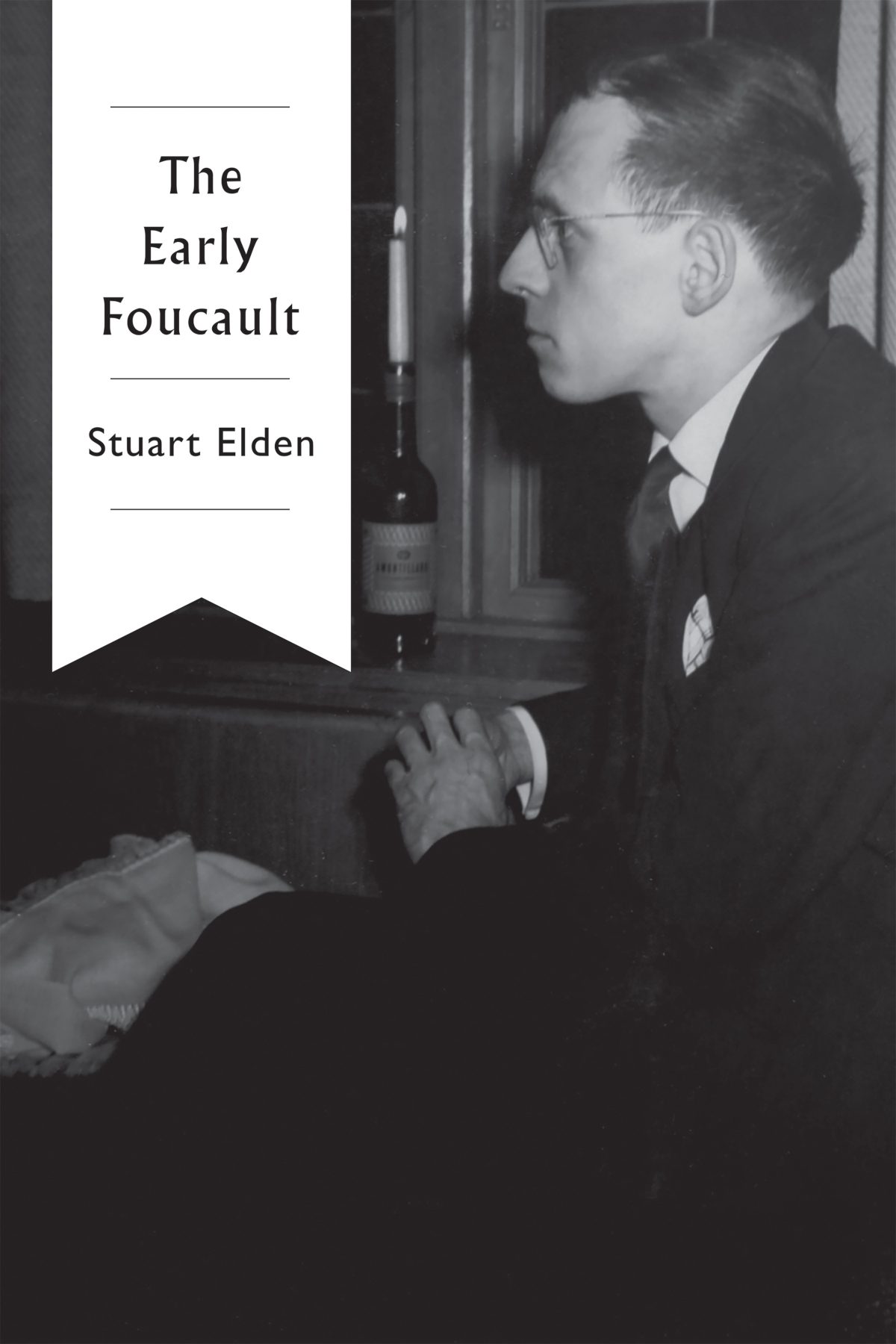
Patrick Gamez has a generous, appreciative and thoughtful review of my 2021 book The Early Foucaultin the Journal of the History of the Behavioral Sciences. It’s in the same issue as my review of Elisabetta Basso’s Young Foucault (here). Both reviews require subscription, unfortunately. A preprint of my review of Elisabetta Basso’s book is here.
Here’s a few bits from the start of the Gamez review:
This is a somewhat belated review of Stuart Elden’s The Early Foucault, the third volume of a now‐completed tetralogy of works providing the most comprehensive intellectual history of Foucault available in English, covering the first major period of his intellectual activity, from his preparation for agrégation at the ENS in 1950 through the writing, submission, and subsequent revisions of his thesis, Folie et déraison, and the accompanying secondary thesis, a translation of and introduction to Kant’s Anthropology from a Pragmatic Point of View.
For Anglophone scholars, partisans, and critics of Foucault, Elden’s work has simply been a gift, demanding gratitude first. This volume is no different, being richly rewarding for those hungry for information about the young Foucault’s intellectual life and, for a book that deals above all in facts about the whos, whats, wheres, and whens, very pleasantly written. While there are a couple of excellent biographies of Foucault, there is nothing that compares to what Elden has provided in terms of detailed research into Foucault’s sources, abandoned writings, academic contacts and conversations—in short, the whole archive of how his thought came to maturity.
And the very last part:
… consider, for comparison, the way in which Paul Rabinow’s division of Foucault’s texts into widely influential readers in the 1990s, focusing on “Power,” “Ethics,” and the grab‐bag of “Aesthetics, Method, and Epistemology” has subtly enforced our most basic framings of Foucault, splitting his work into both methodologically and substantively distinct periods. Despite the fact that Elden has largely respected that framing, the very idea of foregrounding Foucault’s predoctoral work like The Early Foucault does works against it. If this body of work deserves such attention, it must be because of its subterranean influence on his later thought; a profound continuity, despite the surface differences. Indeed, Elden cannot but disrespect arbitrary periodizations, following the reception and revisions of Folie et déraison into the mid‐1960s, bleeding into the archaeological period (Ch. 8). One wonders what sort of Foucault would emerge if we started from a more holistic perspective to begin with. Of course, this is all speculative. Elden’s book will be incredibly valuable not only to researchers and graduate students, but to anyone interested in one of the most important figures in 20th century French thought.
Sovereignty has been at the heart of political philosophy for centuries, and yet it is far from clear what work sovereignty is actually doing in the modern world. Is sovereignty indivisible? Why are some international interventions acceptable but others condemned or resented? Is sovereignty always popular? What role does sovereignty have in a world of international finance, global information exchange, and supranational regulation? Is sovereignty only relevant to some parts of the world or of global relevance? This volume will place the intellectual roots of sovereignty in a conversation with sociological theory and the realities of a globalised world to create a broader context for our contemporary debates.
Capitalism, by the twenty-first century, has brought us an era of escalating, overlapping crisis – ecological, political, social – which we may not survive. In this brilliant, wide-ranging conversation, political philosophers Nancy Fraser and Rahel Jaeggi identify capitalism as the source of the devastation and examine its in-built tendency to crisis. In an exchange that ranges across history, critical theory, ecology, feminism and political theory, Fraser and Jaeggi find that capitalism’s tendency to separate what is connected – human from non-human nature, commodity production and social reproduction – is at the heart of its crisis tendency. These “boundary struggles,” Fraser and Jaeggi conclude, constitute capitalism’s most destructive power but are also the sites where a fighting left movement might be able to halt the destruction and build the non-capitalist future we so desperately need.
A crucial text for students of political theory, economic theory, and social change, Capitalism offers an invigorated critique of twenty-first century capitalism and an incisive study of our current conjuncture.
Update: there is an extended interview with Sebastian Budgen of Verso Books here
It will still be some time before I return to work, as there are medical issues still to be resolved. I’m not returning to the research for my new Indo-European thought project yet, but I will be sharing a few things here and on social media – mainly the work of others that looks interesting.
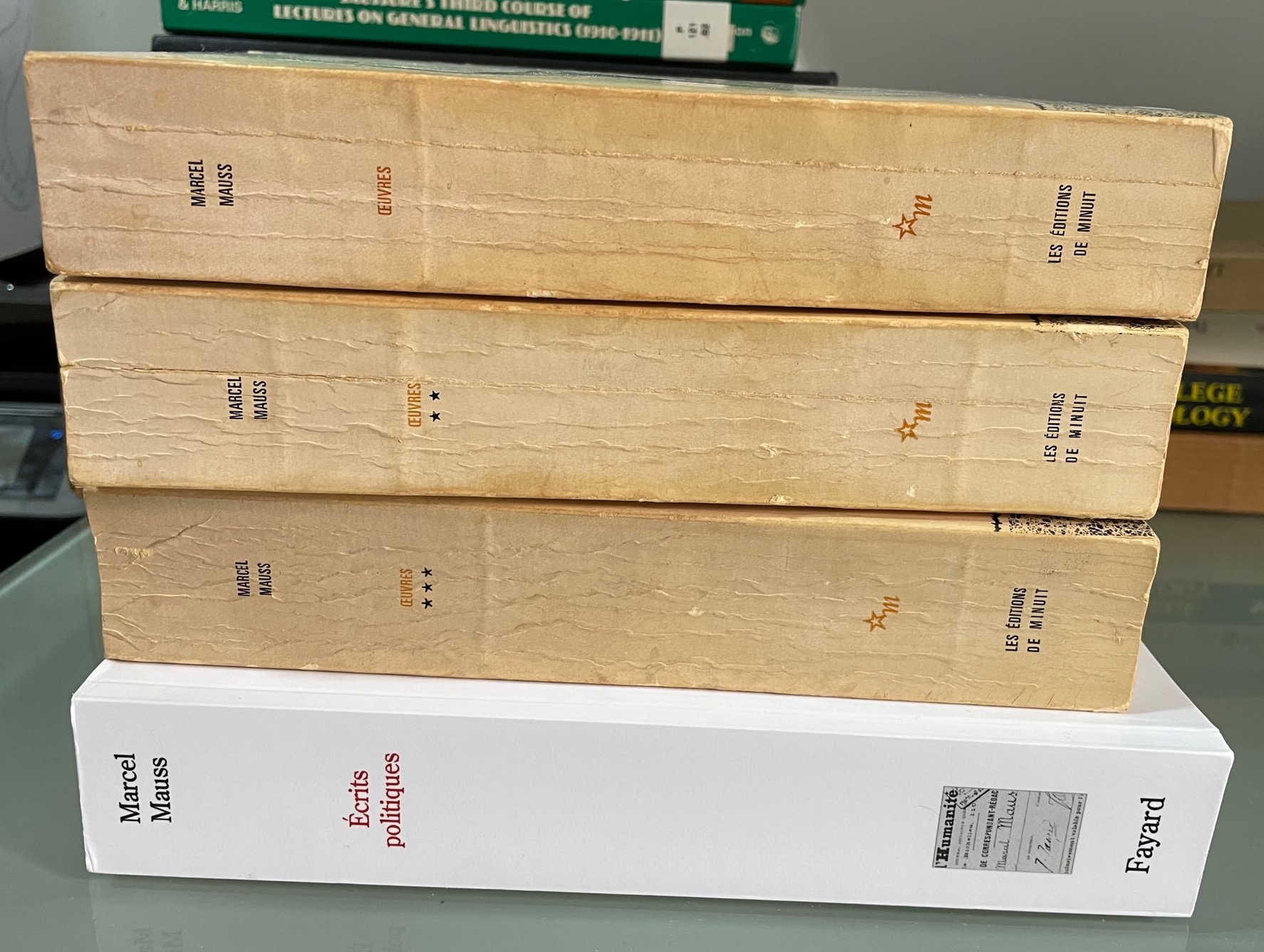
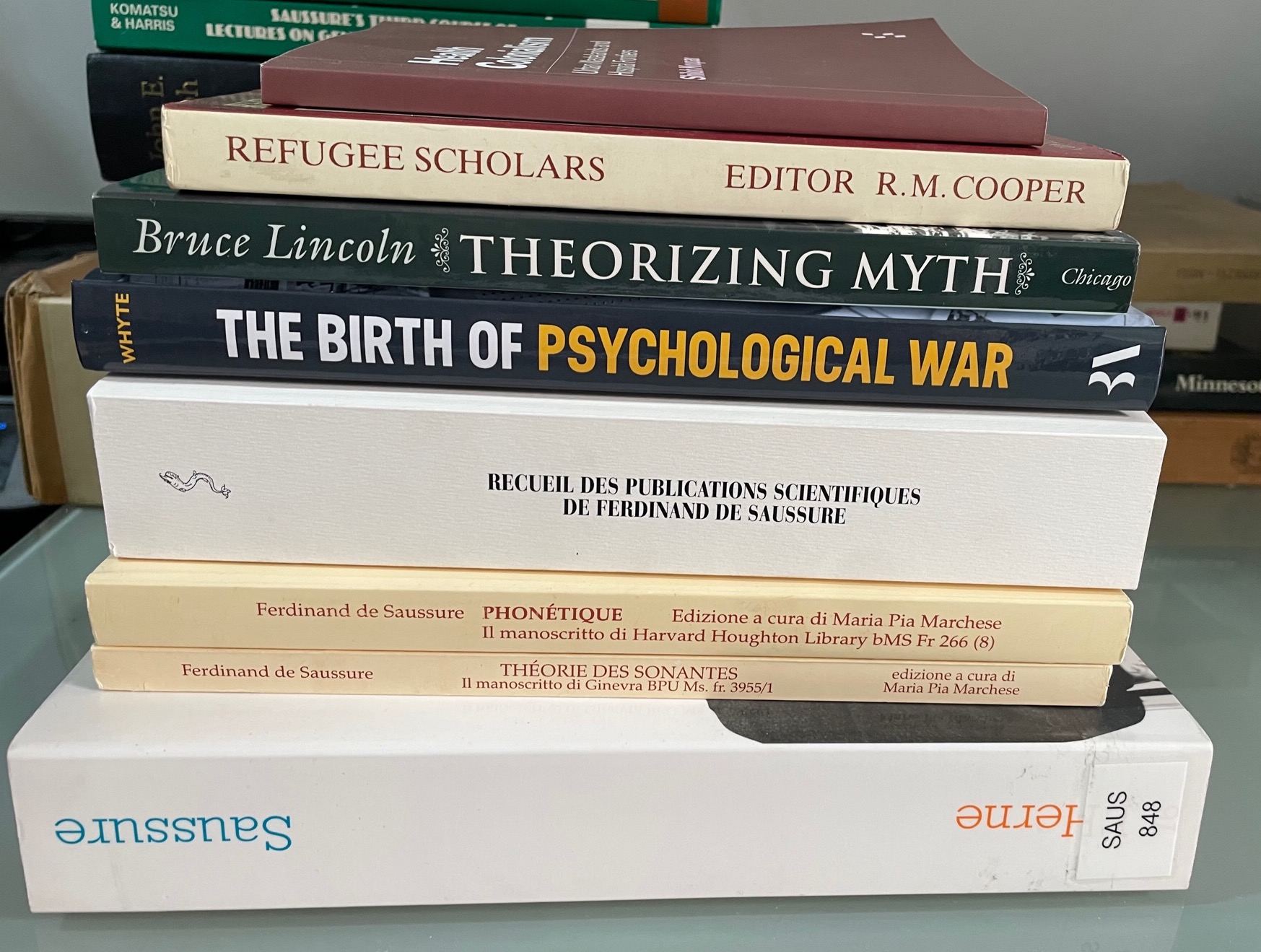
The books which arrived while I was in hospital – mostly ordered before I was admitted.
I was pleased to be able to find a complete set of the Marcel Mauss, Œuvres, along with the Écrits politiques; a few books by or about Saussure, including some of his previously-unpublished manuscripts. Other books here include Jeffrey Whyte’s The Birth of Psychological Warfare, which I read in manuscript, and which is open access as an e-book. There’s also a copy of Shiloh Krupar’s Health Colonialism: Urban Wasteland and Hospital Frontiers (also an open access e-book), Emmanuelle Loyer’s biography of Lévi-Strauss (I’d had the Warwick library copy out for months), and the new René Girard collection, All Desire is a Desire for Being: Essential Writings, edited by Cynthia L. Haven.
The last of these piles has some English translations of Portuguese books, kindly sent by my former PhD, António Ferraz de Oliveira. As it is some time before I’m supposed to be back at work, these are likely to be some of the first things I read from this lot.
A brief health update. Some of you know I’ve been unwell the past couple of weeks.
Very unexpectedly, I had to have open heart surgery on Monday 10 July. Two valves were repaired successfully. I am now recovering well, but not all is yet resolved. I may get to go home soon, though that’s not yet certain. There will certainly be a long period of recovery after that. Thanks for all messages of support I’ve received here and elsewhere. I may not reply, but all are read and much appreciated.
Update 21 July: I’m happy to say I’ve been at home for just over a day and continuing the recovery here.
The last post on Lefebvre’s banned books was one I wrote a few days ago but hadn’t quite finished. I’m posting it now and expect it will be the last substantive post for some time on Progressive Geographies.
I am currently in hospital undergoing some tests and awaiting surgery. The condition is serious but treatable, and I am expected to make a good, though slow recovery.
I’ll hopefully be back before too long. Many thanks for reading this site and hopefully the archive and resources remain useful.
Update June 2025: a revised and expanded version of this post is here.
About twenty years ago, in an essay on Henri Lefebvre, I said that his book on Nietzsche (1939) was on the prohibited ‘Liste Otto’. These were books that had to be removed from sale, and existing copies destroyed, after the German occupation of France. For other reasons now I’ve recently looking at the list – the 1940 version is here – and discover that this is not one of the books on the list. Mea culpa.
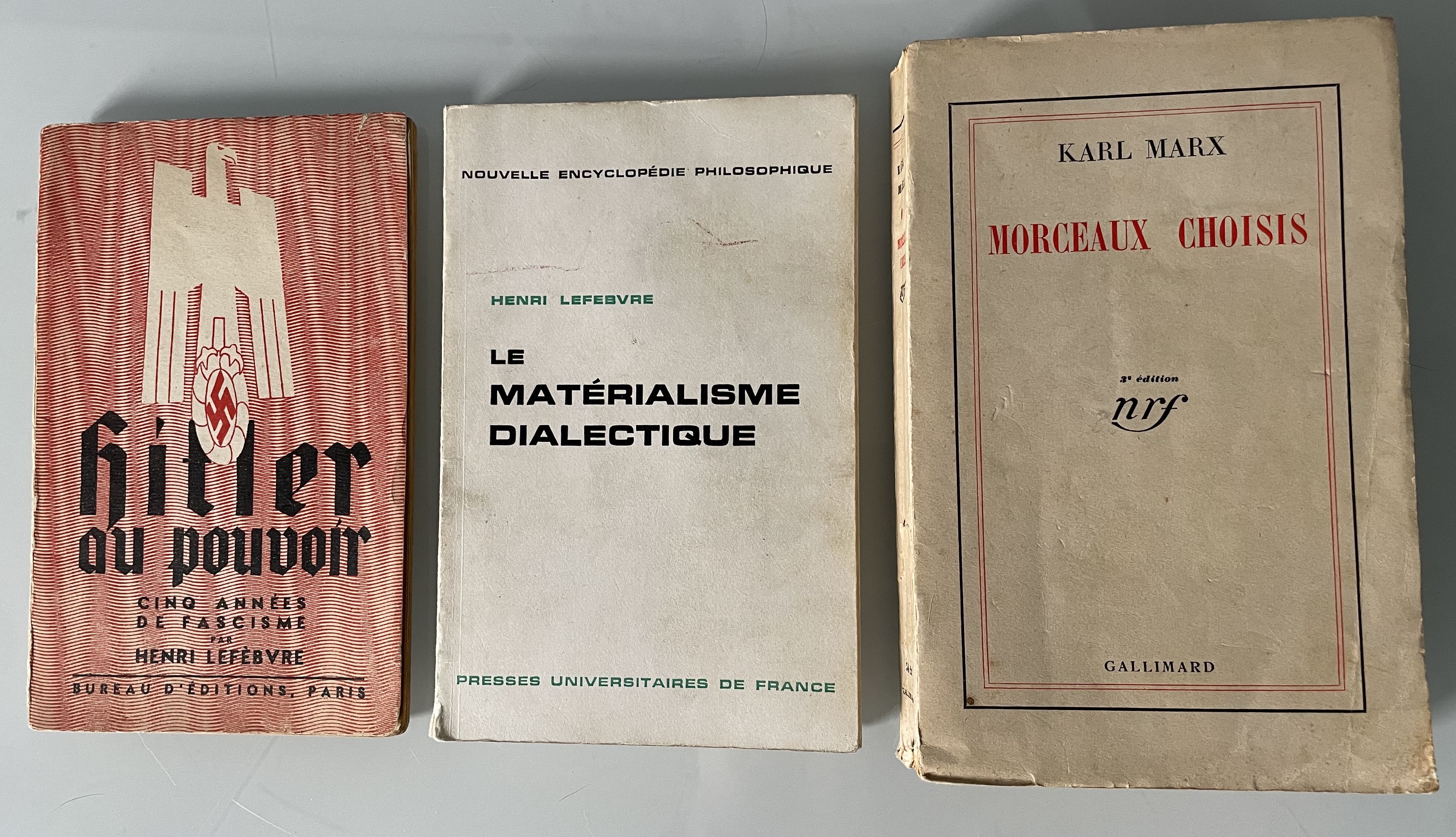
As far as I can tell, only two books written by Lefebvre are on the list – there are various iterations from 1940 and through the occupation. The books are Hitler au pouvoir (1938) and Le Matérialisme dialectique (1940). So too was Cahiers de Lénine sur la dialectique de Hegel (1938) and Karl Marx’s Morceaux choisis (1934), both of which Lefebvre and Norbert Guterman had edited.
Three books that were on the list – Le matérialisme dialectique shown here is a later reprint
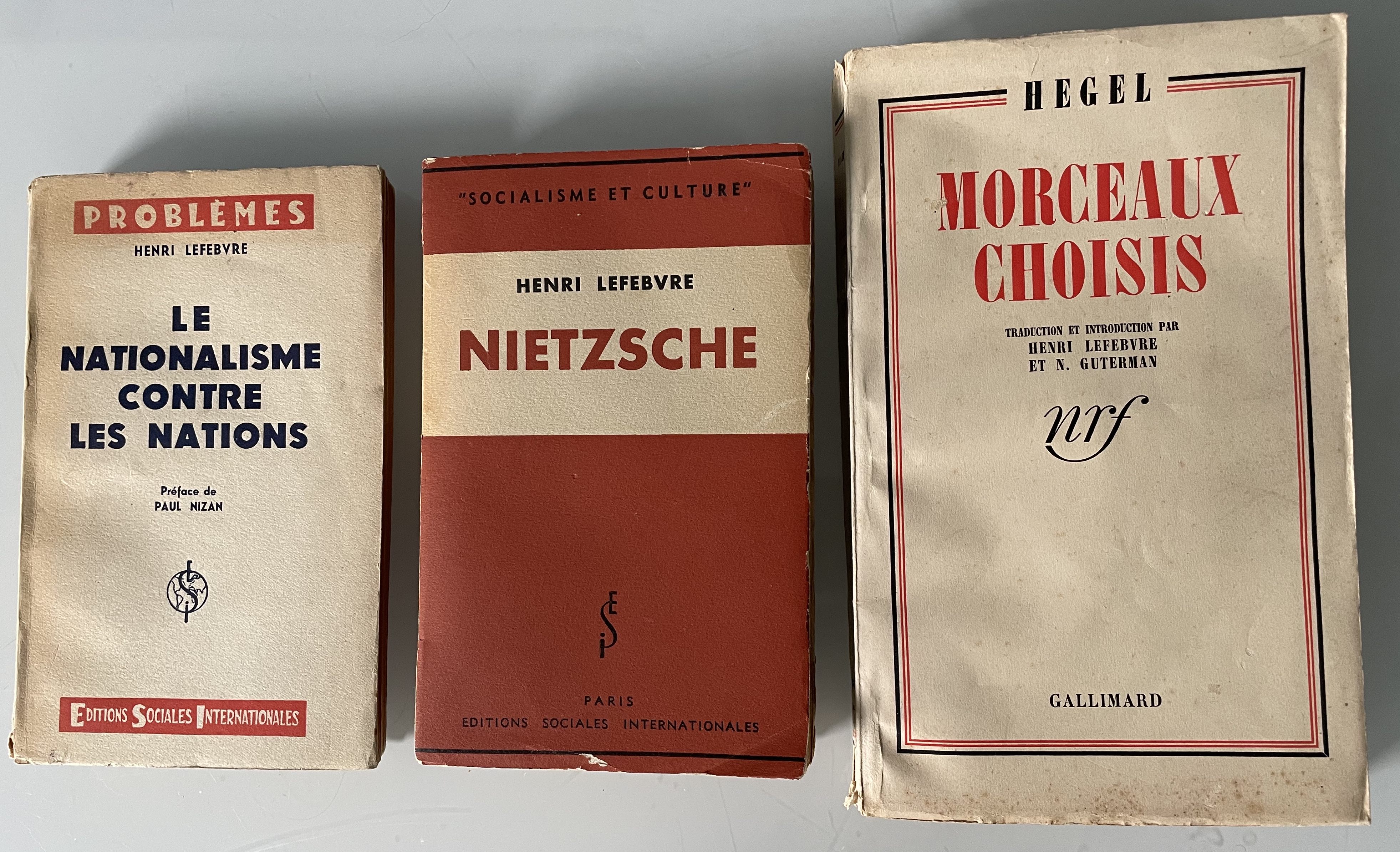
Guterman was Jewish, so this alone would have been enough for inclusion on this list. But Lefebvre’s book on Nietzsche, his Le Nationalisme contre les Nations (1937) and the collection of texts by Hegel he and Guterman had edited (1938) are not on the lists I’ve seen, and nor is their co-authored book La conscience mystifiée (1936).
three books that were not included on the list
There is therefore something of an arbitrary nature of the list – there are obviously reasons why the Nazi occupiers would object to those they did include, but those reasons would also seem to apply to ones they did not. The Nietzsche book, for example, is very much written as a challenge to the fascist appropriation.
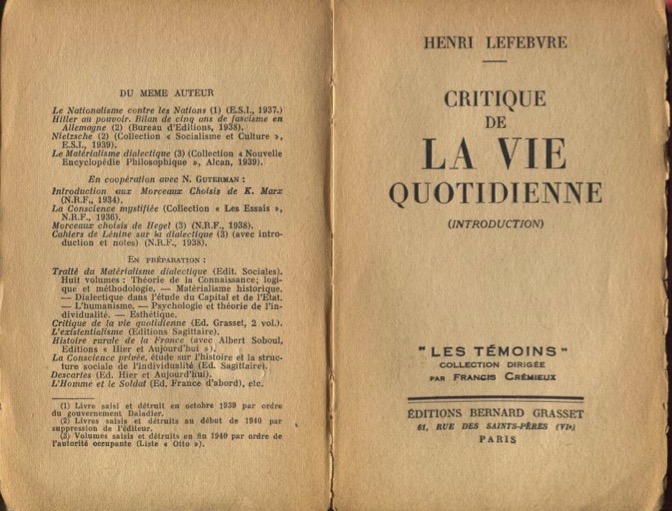
In looking further into this, though, I went back to the original edition of Critique de la vie quotidienne from 1946. On the page ‘Du même auteur’, Lefebvre lists his previous publications.
There he distinguishes three ways his books were suppressed.
seized and destroyed in October 1939 by order of the Daladier government
seized and destroyed at the beginning of 1940 by the publisher
seized and destroyed at the end of 1940 by the occupying authority, Liste ‘Otto’
Interestingly, he says Le Nationalisme was in the first category; Hitler and Nietzsche in the second; Le matérialisme dialectique and the collections on Lenin and Hegel were in the third. From the lists I’ve seen, this isn’t entirely correct either for category three, but it explains why the Nietzsche book was indeed removed from sale shortly after publication, and why copies are so hard to find today. And presumably the ‘Liste Otto’ did not need to proscribe books that were already banned.
The list of books by Lefebvre ‘En préparation’ is also interesting – only a few of these were ever published, but that’s another story, some of which also concerns censorship.
I hope what I’ve reported here is accurate, but happy to receive additions or corrections.
Incidentally, my 2004 book on Lefebvre has long been available as print-on-demand only, and keeps going up in price. Someone has uploaded a version here though… [final link now fixed, apologies]