Jeffrey J. Cohen and Julian Yates, Noah’s Arkive – University of Minnesota Press, June 2023
Most people know the story of Noah from a children’s bible or a play set with a colorful ship, bearded Noah, pairs of animals, and an uncomplicated vision of survival. Noah’s ark, however, will forever be haunted by what it leaves to the rising waters so that the world can begin again.
In Noah’s Arkive, Jeffrey J. Cohen and Julian Yates examine the long history of imagining endurance against climate catastrophe—as well as alternative ways of creating refuge. They trace how the elements of the flood narrative were elaborated in medieval and early modern art, text, and music, and now shape writing and thinking during the current age of anthropogenic climate change. Arguing that the biblical ark may well be the worst possible exemplar of human behavior, the chapters draw on a range of sources, from the Epic of Gilgamesh and Ovid’s tale of Deucalion and Pyrrah, to speculative fiction, climate fiction, and stories and art dealing with environmental catastrophe. Noah’s Arkive uncovers the startling afterlife of the Genesis narrative written from the perspective of Noah’s wife and family, the animals on the ark, and those excluded and left behind to die. This book of recovered stories speaks eloquently to the ethical and political burdens of living through the Anthropocene.
Following a climate change narrative across the millennia, Noah’s Arkive surveys the long history of dwelling with the consequences of choosing only a few to survive in order to start the world over. It is an intriguing meditation on how the story of the ark can frame how we think about environmental catastrophe and refuge, conservation and exclusion, offering hope for a better future by heeding what we know from the past.
Ruth Wilson Gilmore and Dalia Gebrial discuss prison abolition, racial capitalism, and critical geography on the Verso podcast:
On the Verso Podcast this week Ruth Wilson Gilmore and Dalia Gebrial join our host, Eleanor Penny, for an eye-opening discussion that uncovers the intricate logic and connections between the prison system, the modern digital platform, and the transformative potential of abolitionist politics.
Subscribe and listen via the links below, and keep your eyes (and ears!) peeled for upcoming episodes from Nancy Fraser, Robin Kelley and Helen Hester.
Philipp Felsch’s book Wie Nietzsche aus der Kälte kam [How Nietzsche came in from the cold] was mentioned at the workshop on translation and the archive yesterday. It’s a study of the two Italian editors and translators of Nietzsche, Colli and Montinari.
On looking for more detail today, I discover that there is an English translation in progress for Polity Books.
There is an interview with Felsch at the Journal of the History of Ideas blog, by Isabel Jacobs (part I, part II).
György Lukács’s History and Class Consciousness, the book that has won him enthusiastic supporters and bitter enemies, was published 100 years ago. To mark the occasion, a collection of German and Russian reviews of and essays about the book (and the Lenin booklet published a year later) from the 1920s has been published on the website of the Lukács Archive International Foundation: https://www.lana.info.hu/en/lukacs/writings-about-lukacs/history-and-class-consciousness-in-the-debates-of-the-twenties/
Présentation
Des calculs de probabilité aux troubles de la personnalité, des électrons à la maltraitance des enfants, de la logique de l’induction aux fous voyageurs, l’éventail des objets abordés par Ian Hacking peut sembler déroutant. Cependant, dans toutes ses recherches, à l’intersection de la philosophie et de l’histoire des sciences, il s’attache à examiner, en toutes leurs nuances et variétés, le rôle joué par l’expérimentation dans les sciences de la nature et la spécificité des « espèces humaines » comme objets des sciences humaines et sociales. Les textes réunis dans ce volume – dont certains publiés pour la première fois ici en français – montrent que les différents aspects de la production philosophique de Ian Hacking s’entre-répondent et dessinent ensemble un portrait complexe…
In the 1949-50 academic year, Claude Lévi-Strauss gave the Fondation Loubat lectures at the Collège de France. Although he was trying to get elected to a chair there at this time, and giving a guest series of lectures was often a prelude to that, he was unsuccessful. He did not take up his chair there in Social Anthropology until 1959.
The Loubat lectures are generally given the title of “L’expression mythique de la structure sociale”, “The Mythic Expression of Social Structure”. The lectures might have had an expanded title – i.e. Oliver Jacquot‘s brief history of the Loubat lectures suggests “L’expression mythique de la structure sociale chez les populations indigènes de l’Amérique [… among the Indigeneous Populations of America]”. Lévi-Strauss’s EPHE page gives a more specific focus in a description: “Analyse structurale du thème du Glouton dans la mythologie de l’Amérique du Nord [Structural Analysis of the theme of the Wolverine in North American mythology]”.
Of course, these reports are not entirely contradictory – an initial title given might have been quite general, then a focus on North America given the remit of the Fondation, and then a concentration on a specific myth as Lévi-Strauss developed the work.
That sense is supported by the fullest published discussion of the lectures of which I am aware – a letter to Roman Jakobson, 27 January 1950. The letter has only been published in French, but a large part is quoted and translated in Emmanuelle Loyer’s excellent biography of Lévi-Strauss.
I have chosen to focus on the theme of the wolverine [glouton] in North America, of which I am trying to provide a structural analysis. This entails studying the connections between 1) the traits of the figure (gluttony [gloutonnerie], clownishness, obscenity, scatology, cannibalism, beggary, etc.); 2) the sociological level at which it is expressed in each culture (collective behaviour, individual vocation, ritual personification, folkloric theme, mythical theme, etc.), 3) the relation between the ‘territory’ defined by these two axes and the rest of the social structure.
In a part of the letter not quoted by Loyer, Lévi-Strauss says to Jakobson: “Anyway, this will be the next book I write next summer [De toute façon, cela fera un prochain livre que je rédigerai l’été prochain]”.
But he didn’t develop the lectures into the book he mentions. In the 1950s, Lévi-Strauss published his long introduction to Marcel Mauss; Tristes Tropiques; and the first volume of Structural Anthropology, as well as shorter pieces and lectures. But these particular lectures were not published. There is a discussion of the animal called the wolverine in La pensée sauvage in 1962, but nothing like as developed an argument as suggested here.
The online inventaire of the fonds Claude Lévi-Strauss does not indicate a place where they could be – the listing of Collège de France courses begins with his chair there, other teaching records or conferences seem to be dated and placed elsewhere. I’ve asked a couple of people who work on Lévi-Strauss and know these archives, and they have said there is no trace of the lectures.
As this is almost a decade before he was elected to a chair at the Collège de France, there is also no record in the otherwise very useful Paroles données/Anthropology and Myth collection.
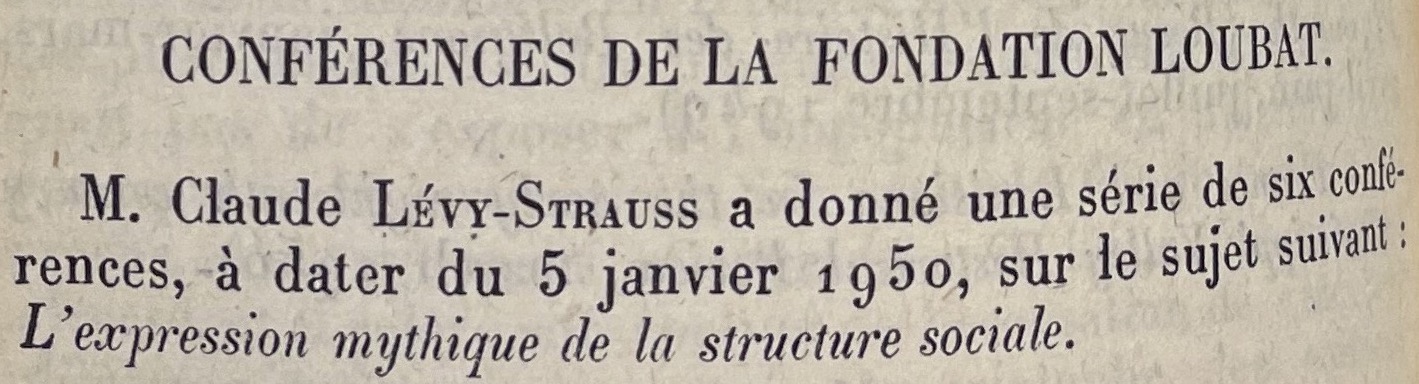
There is however a file of correspondence relating to the lectures, and a brief summary, in the Collège de France archives. It expands on the points in the letter to Jakobson, and is the fullest description of the lectures that seems to exist. I think this summary was written for the Collège de France Annuaire, but it wasn’t used. Instead, the Annuaire published just this very brief notice – which even manages to misspell Lévi-Strauss’s name.
excerpt from the Annuaire du Collège de France, 50, p. 246 [with misspelling of Lévi-Strauss’s name]
The summary Lévi-Strauss wrote was never published. The rejection for a chair in 1949-50 perhaps helps to explain why he never wrote up the lectures and – at least as far as we can tell – did not even keep the manuscripts.
Alexandre Koyré’s Introduction à la lecture de Platon; the Eliade-Pettazzoni correspondence and Richard Evans’s biography of Eric Hobsbawm, all bought second-hand, along with Kostas Axelos, The Game of the World and Michel Foucault, Le discours philosophique, kindly sent by the publishers.
Disturbing Development in the Jim Crow South documents how Black employees of the cooperative extension service of the USDA practiced rural improvement in ways that sustained southern Black farmers’ lives and livelihoods in the early decades of the twentieth century, resisting the white supremacy that characterized the Jim Crow South.
Mona Domosh details the various mechanisms—the transformation of home demonstration projects, the development of a movable school, and the establishment of Black landowning communities—through which these employees were able to alter USDA’s mandates and redirect its funds. These tweakings and translations of USDA directives enabled these employees to support poor Black farmers by promoting food production, health care, and land and home ownership, thus disturbing a system of plantation agriculture that relied on the devaluing of Black lives.
Through the documentation of these efforts, Domosh uncovers an important and previously unknown episode in the long history of international development that highlights the roots of liberal development schemes in the anti-Black racism that constituted plantation agriculture and illustrates how racist systems can be quietly and subtly resisted by everyday people working within the confines of white supremacy.
A seminar on the book is being held online tomorrow – 16 May 2023 (details here; registration here). Apologies for the lack of notice.
A panel discussion of Disturbing Development in the Jim Crow South (2023) by Mona Domosh, involving: Archie Davies (Queen Mary University of London) LaToya E. Eaves (University of Tennessee, Knoxville) Morgan P. Vickers (University of California, Berkeley)
Hardback only at the moment, but paperback forthcoming.
In this book, Mairéad Hanrahan examines the shifts in political focus in Genet’s writing, from the intimate fantasies of the early novels to the struggle for emancipation of the Palestinians in the posthumously published Un Captif amoureux. She argues that his texts have always been centrally concerned with power relations, challenging from the very beginning the opposition that traditionally confines the political to the public sphere. Genet’s writing has always been political — but Hanrahan argues also that it was never solely political. On the contrary, a tension always existed for him between the poetic and the political.
Genet’s changing focus from the personal to the public is explored via the shifts in his practice of genre. Analysing how genre and politics are inextricably involved in Genet’s writing, Hanrahan highlights a core paradox in its evolution. This writer who remained constant over the course of his life in his opposition to hegemonic power relations grappled throughout his work with the suspicion that his art may serve to shore up the very structures he unreservedly contests. Yet his writing also testifies, in both what it says and what it does, to the idea that literature is fundamentally at odds with the social order of the world.