Henri Hubert and Marcel Mauss, Correspondance(1897-1927), eds. Rafael Faraco Benthien, Christophe Labaune and Christine Lorre – Classiques Garnier, 2021
This volume significantly increases the corpus of the writings of Marcel Mauss and Henri Hubert, by making public letters exchanged during thirty years, a testimony of a “working twins” relationship crossed by the Dreyfus affair, politics, the Great War and the construction of sociology.
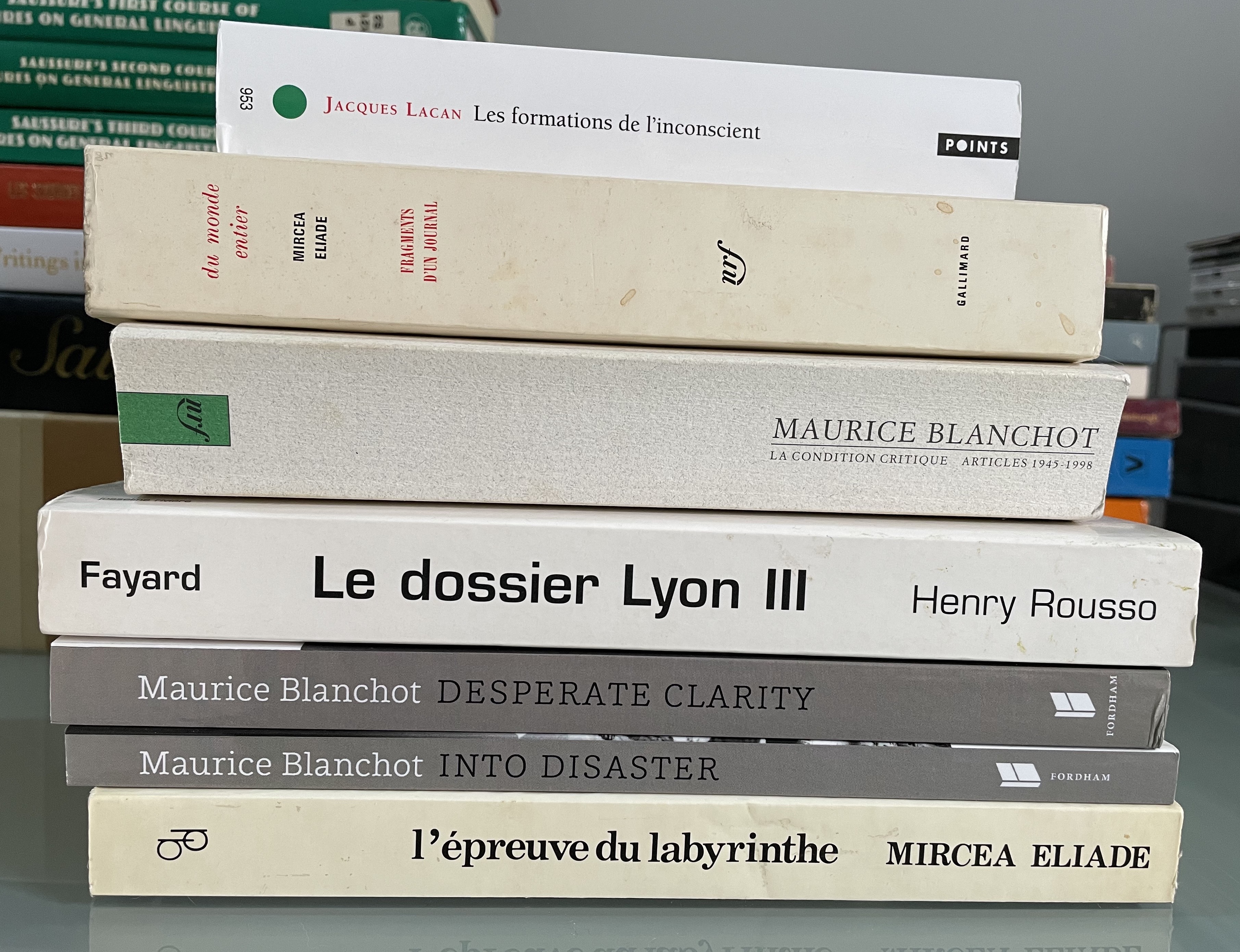
Apart from the most-recent Lacan seminar to appear in the Points series, all bought second-hand. All connected to the Indo-European thought project in some way.
Offers in English for the first time philosopher Cornelius Castoriadis’s earliest surviving lectures on the ancient Greeks
Includes renowned scholar Pierre Vidal-Naquet’s essay, “’Castoriadis and Ancient Greece’” (1999), which provides an introduction and memorial to Castoriadis’s research
Includes Castoriadis’s previously untranslated, substantive essay, “’Political Thought’” (1979), which presages many of the key themes in the seminars
Includes Castoriadis’s thematic reports on his teaching in the 1980-1984 seminars
Includes an “Editors’ Introduction” plus extensive editorial commentary on the seminars and an Analytic Table of Contents provided by the academic editor of the French edition of the volume (from 2004)
Includes a “Foreword” by the translator, which highlights key terms in the seminars
This book collects 12 previously untranslated lectures by Castoriadis from 1982 to 1983. Castoriadis focuses on the interconnection between philosophy and democracy and the way both emerge within a self-critical imaginary already in development in the work of early Greek poets and Presocratic philosophers.
Providing an overview of the political and ethical philosophy of Martha Nussbaum, this book presents the ideas of this significant philosopher and shows how her thought, while rooted in the traditions of classical philosophy, illuminates a number of current, controversial issues. The book takes a chronological approach and aims to show how Nussbaum’s thought has continually grown and developed. It takes the reader through her views on ethics, political philosophy, feminism and women’s rights, LGBT issues, animal rights, religious tolerance and accommodation, contemporary politics, and global justice. It also explores contested areas of her thought, such as the extent to which she is a perfectionist liberal, challenges to her view that religion merits special accommodations, utilitarian objections to the capabilities approach, criticisms of her brand of liberal feminism, and cosmopolitan objections to her nation-state-based liberal conception of global justice. Each chapter focuses on a book from a different stage of her career, starting with her first book, The Fragility of Goodness and ending with her most recent, The Cosmopolitan Tradition.
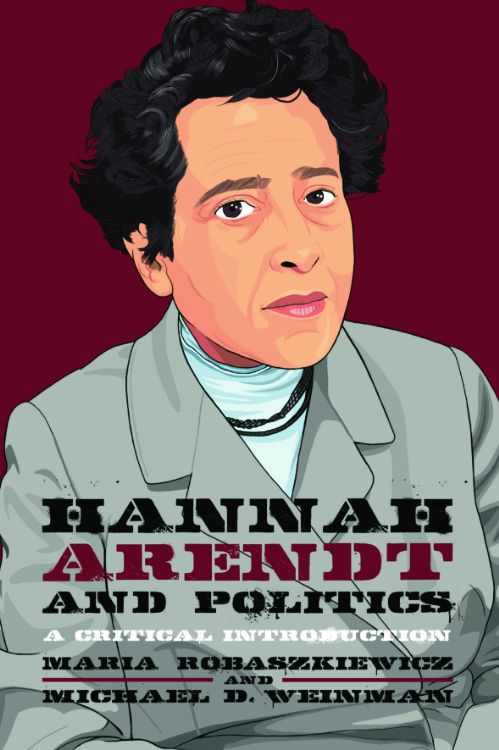
Maria Robaszkiewicz, Michael Weinman, Hannah Arendt and Politics – Edinburgh University Press, January 2023
Hannah Arendt has been classified as a critical theorist, a phenomenologist, an anti-feminist, a feminist ally, a democratic theorist, a republican theorist, a Heidegerrian, and a nostalgic Hellenophile. This book responds to these perspectives in two ways. First, we recognize that one can legitimately derive all these positionings from one or another of her writings; second, we insist nevertheless and precisely because all these approaches play some role in her work that her readers ought to follow her own claim that she ‘does not belong to any club’. Instead, we introduce her works as exercises in political thinking, treating her as a dialogue partner, whose judgments and opinions remain open for reflection and discussion.
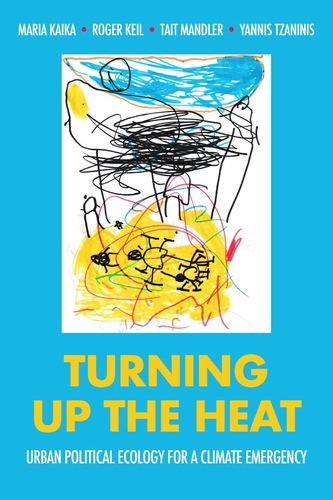
Since its emergence in the 1990s, the field of Urban Political Ecology (UPE) has focused on unsettling traditional understandings of the ‘city’ as entirely distinct from nature, showing instead how cities are metabolically linked with ecological processes and the flow of resources. More recently, a new generation of scholars has turned the focus towards the climate emergency. Turning up the heat seeks to turn UPE’s critical energies towards a politically engaged debate over the role of extensive urbanisation in addressing socio-environmental equality in the context of climate change.
The collection brings together theoretical discussions and rigorous empirical analysis by key scholars spanning three generations, engaging UPE in current debates about urbanisation and climate change. Engaging with cutting edge approaches including feminist political ecology, circular economies, and the Anthropocene, case studies in the book range from Singapore and Amsterdam to Nairobi and Vancouver. Contributors make the case for a UPE better informed by situated knowledges: an embodied UPE that pays equal attention to the role of postcolonial processes and more-than-human ontologies of capital accumulation within the context of the climate emergency. Acknowledging UPE’s rich intellectual history and aiming to enrich rather than split the field, Turning up the heat reveals how UPE is ideally positioned to address contemporary environmental issues in theory and practice.
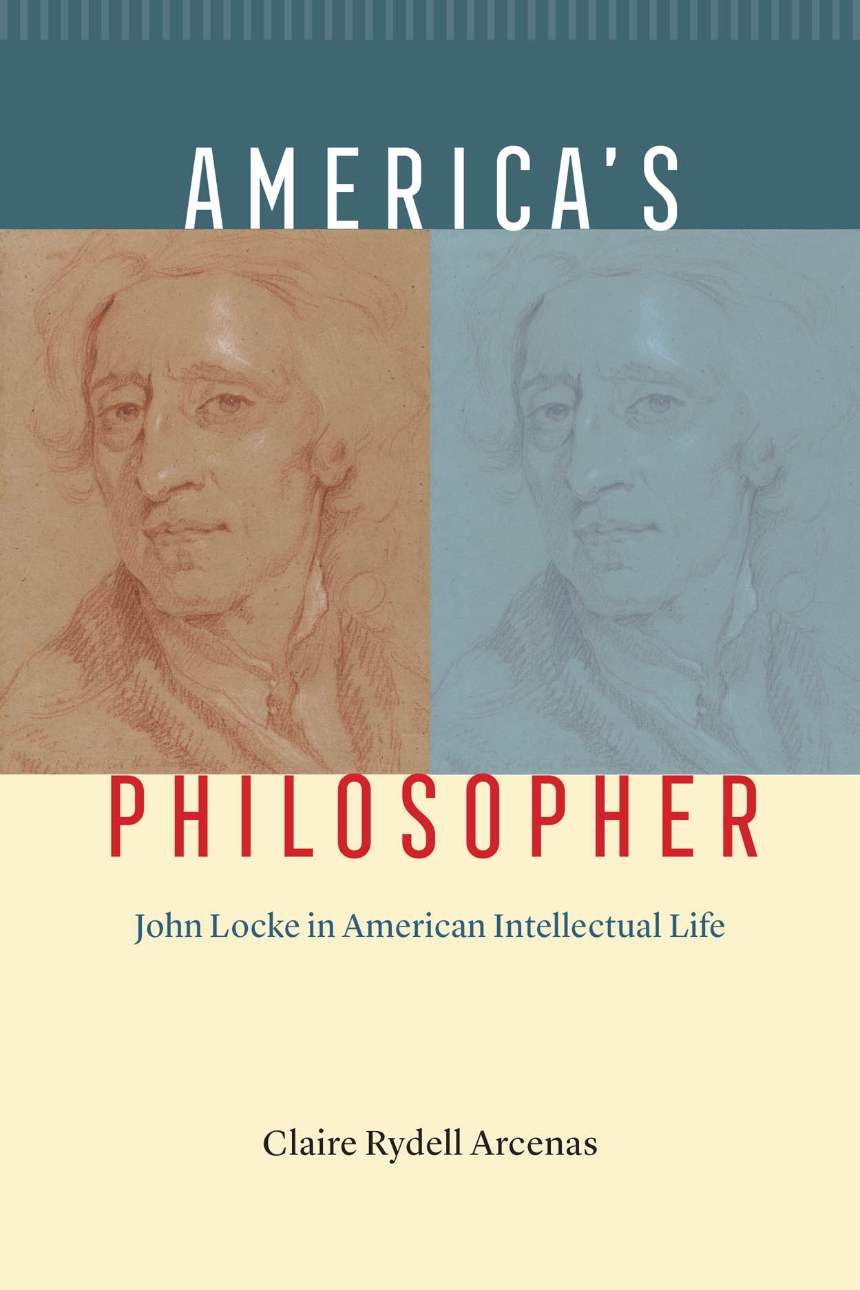
The influence of polymath philosopher John Locke (1632–1704) can still be found in a dizzying range of fields, as his writings touch on issues of identity, republicanism, and the nature of knowledge itself. Claire Rydell Arcenas’s new book tells the story of Americans’ longstanding yet ever-mutable obsession with this English thinker’s ideas, a saga whose most recent manifestations have found the so-called Father of Liberalism held up as a right-wing icon.
The first book to detail Locke’s trans-Atlantic influence from the eighteenth century until today, America’s Philosopher shows how and why interpretations of his ideas have captivated Americans in ways few other philosophers—from any nation—ever have. As Arcenas makes clear, each generation has essentially remade Locke in its own image, taking inspiration and transmuting his ideas to suit the needs of the particular historical moment. Drawing from a host of vernacular sources to illuminate Locke’s often contradictory impact on American daily and intellectual life from before the Revolutionary War to the present, Arcenas delivers a pathbreaking work in the history of ideas.
Just an expensive hardback at present, unfortunately.
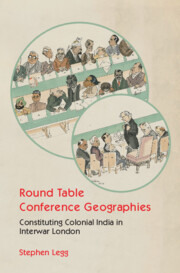
Round Table Conference Geographies explores a major international conference in 1930s London which determined India’s constitutional future in the British Empire. Pre-dating the decolonising conferences of the 1950s–60s, the Round Table Conference laid the blueprint for India’s future federal constitution. Despite this the conference is unanimously read as a failure, for not having comprehensively reconciled the competing demands of liberal and Indian National Congress politicians, of Hindus and Muslims, and of British versus Princely India. This book argues that the conference’s three sessions were vital sites of Indian and imperial politics that demand serious attention. It explores the spatial politics of the conference in terms of its imaginary geographies, infrastructures, host city, and how the conference was contested and represented. The book concludes by asking who gained through representing the conference as a failure and explores it, instead, as a teeming political, social and material space.
Michel Foucault, Le Discours philosophique, edited by Daniele Lorenzini and Orazio Irrera – Gallimard/Seuil/EHESS, May 2023
This is a previously unpublished manuscript, probably from 1966, written after The Order of Things and before or alongside early work on what became The Archaeology of Knowledge.
Starting to appear in online bookstores, with title page and table of contents shared online:
Spoiler alert — Table des matières du Discours philosophique, to be published in May 2023 pic.twitter.com/FDZ40NHYr1
Audio recording of Michel Foucault and Richard Sennett discussing Sexuality and Solitude. The date there is given as 1979, but I think this was actually in November 1980.
The edited transcript was published in 1981 in the London Review of Books It is translated into French in Dits et écrits and reprinted in Essential Works volume I, though without Sennett’s remarks.
I’ve added this to my list of audio and video recordings of Foucault (that list is hard to keep uptodate as things are removed or links change).
In 1979, sociologist and NYIH founder Richard Sennett, and philosopher Michel Foucault, discussed the connections between the history of sexuality and self consciousness. In this episode from the Vault, the two discuss their research and, by extension, the underpinnings of the idea of solitude.