Kristi Sweet, Kant on Freedom, Nature, and Judgment: The Territory of the Third Critique – Cambridge University Press, January 2023 [and open access Introduction]

Kristi Sweet, Kant on Freedom, Nature, and Judgment: The Territory of the Third Critique – Cambridge University Press, January 2023

Another expensive hardback, but looks interesting…

[update: the Introduction is available open access]

Kant’s Critique of Judgment seems not to be an obviously unified work. Unlike other attempts to comprehend it as a unity, which treat it as serving either practical or theoretical interests, Kristi Sweet’s book posits it as examining a genuinely independent sphere of human life. In her in-depth account of Kant’s Critical philosophical system, Sweet argues that the Critique addresses the question: for what may I hope? The answer is given in Kant’s account of ‘territory,’ a region of experience that both underlies and mediates between freedom and nature. Territory forms the context in which purposiveness without a purpose, the Ideal of Beauty, the sensus communis, genius and aesthetic ideas, and Kant’s conception of life and proof of God are best interpreted. Encounters in this sphere are shown to refer us to a larger, more cosmic sense of a whole to which both freedom and nature belong.

Argues that the question to which the third Critique speaks is: for what may I hope

Treats historically dismissed sections of the text as central to Kant’s project

Presents two seemingly disparate sections of Kant’s third Critique as part of a unified project of completing his critical system

Update October 2025: NDPR review by Lara Ostaric

Posted in Immanuel Kant, Uncategorized | 7 Comments

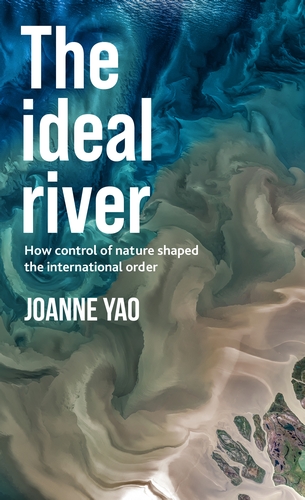
Joanne Yao, The Ideal River: How Control of Nature Shaped the International Order – Manchester University Press, March 2022 and New Books Network discussion

Joanne Yao, The Ideal River: How Control of Nature Shaped the International Order – Manchester University Press, March 2022

Just an expensive hardback at the moment, unfortunately.

Environmental politics has traditionally been a peripheral concern for international relations theory, but increasing alarm over global environmental challenges has elevated international society’s relationship with the natural world into the theoretical limelight. IR theory’s engagement with environmental politics, however, has largely focused on interstate cooperation in the late twentieth century, with less attention paid to how the eighteenth- and nineteenth-century quest to tame nature came to shape the modern international order.

The ideal river examines nineteenth-century efforts to establish international commissions on three transboundary rivers – the Rhine, the Danube, and the Congo. It charts how the Enlightenment ambition to tame the natural world, and human nature itself, became an international standard for rational and civilized authority and informed our geographical imagination of the international. This relationship of domination over nature shaped three core IR concepts central to the emergence of early international order: the territorial sovereign state; imperial hierarchies; and international organizations. The book contributes to environmental politics and international relations by highlighting how the relationship between society and nature is not a peripheral concern, but one at the heart of international politics.

There is a discussion at the New Books Network with Stentor Danielson. Thanks to dmf for the links.

Posted in Uncategorized | 1 Comment

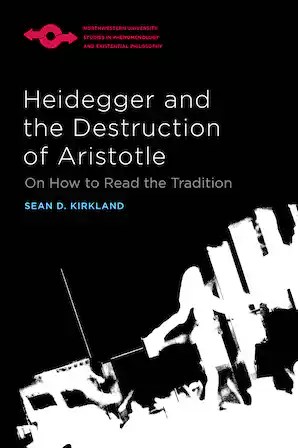
Sean D. Kirkland, Heidegger and the Destruction of Aristotle: On How to Read the Tradition – Northwestern University Press, July 2023

Sean D. Kirkland, Heidegger and the Destruction of Aristotle: On How to Read the Tradition – Northwestern University Press, July 2023

A bold new conception of Heidegger’s project of Destruktion as a method of interpreting history

For Martin Heidegger, our inherited traditions provide the concepts through which we make our world intelligible. Concepts we can also oppose, disrupt, and even exceed. First, however, if Western philosophy is our inheritance, we must submit it to Destruktion—starting with Aristotle. Heidegger and the Destruction of Aristotle: On How to Read the Tradition presents a new conception of Heidegger’s “destruction” as a way of reading.

Situated between Nietzschean genealogy and Derridean deconstruction, this method uncovers in Aristotle the most vital originating articulations of the Western tradition and gives us the means to confront it. Sean D. Kirkland argues this is not a rejection of the past but a sophisticated and indeed timely hermeneutic tool—a complex, illuminating, and powerful method for interpreting historical texts at our present moment. Acknowledging the historical Heidegger as a politically compromised and still divisive figure, Kirkland demonstrates that Heideggerian destruction is a method of interpreting history that enables us to reorient and indeed transform its own most troubling legacies.

“This is an astonishing book. Short but to the point, it profoundly challenges ingrained assumptions about Destruktion in Heidegger’s early thought and the role that concept fulfills in fundamental texts of philosophy. Sean D. Kirkland is uniquely qualified to tackle this topic, which is an obvious lacuna in the research on Heidegger, and the insightfulness and originality of this work positions him as one of the preeminent scholars of his generation on the subject.” —Dimitris Vardoulakis, author of Spinoza, the Epicurean: Authority and Utility in Materialism

Posted in Martin Heidegger | Leave a comment

Some bibliographical questions about Roland Barthes [with some answers]

Some bibliographical questions about Roland Barthes. Any answers much appreciated – and with the first three will hopefully interesting to others; the final one is more a remark (or, as the cliché goes, more of a comment than a question).

[Update: I had some very useful answers to these questions, or suggestions of people to ask, from Lisa Downing, Bernard Dionysius Geoghegan, Sunil Manghani, Oliver Davis and Naomi Waltham Smith. In particular, Patrick ffrench and @BelseyMemorial provided a lot of useful information. I’ve shared all of this below.]

1. Barthes’s Collège de France courses seem to be complete in French, and all are translated into English [How to Live Together, The Neutral and The Preparation of the Novel], but some of his EPHE courses are edited in French, i.e. Le Discours amoureux, but far from all. As far as I know, none of the EPHE courses are translated. Some of the courses are out of print in French, possibly because they are being gradually reprinted in the Seuil Points series. Any plans for more courses in French and/or translations of what we have already?

[Update: As well as Le Discours amoureux, seminars from the EPHE on Sarrasine de Balzac (1967-68 and 1968-69) and Le Lexique de l’auteur (1973-74) have been published.

Other seminars have been discussed, but not published. Apparently there are no plans to translate those that are published.

Barthes’s 1966-67 seminar Recherches sur le discours de l’Histoire is discussed and part-presented in Maria O’Sullivan, “Roland Barthes: genèse d’un séminaire inédit“, Avant-Dire, 133-64. This contains some of Barthes’s notes in facsimile and transcription.

There is a useful discussion of Barthes’s 1964-69 seminars on rhetoric – Claudia Amigo Pino, “The Rhetorical Mission: Barthes’s Seminars from 1964 to 1969“, Barthes Studies 5, 2019, 53-71]

2. At least some lecture courses have been edited twice – once on the basis of manuscripts and later with the addition of material from recordings. That’s certainly the case with La préparation du roman. The English translations with Columbia University Press are based on the former. Are there plans to update the translations?

[Update: the English translator of The Preparation of the Novel, Kate Briggs, discusses the updated French edition in an essay: “Augmentation infinie de la mayonnaise: On the New Edition of Roland Barthes’s La Préparation du roman“, Barthes Studies 7, 2021, 49-64. This is a great analysis of the difference between the written and transcribed texts, with reflections on lecturing and translating. It indicates that she “would love to see the new edition translated into English”, but does not indicate that this is being done. It also, persuasively to my mind, shows why the two French editions should be consulted, and that the new one does not make the old one “obsolete”. The same would therefore be the case with a new translation. “Crucially, what we don’t have in the new edition, what is missing, along with (Natalie) Léger’s original editor’s introduction and the materials for the seminars, are precisely the notes. We no longer have Barthes’s notes qua preparatory notes” (p. 61)]

3. Is there a comprehensive list of translations of short pieces by Barthes, ideally keyed to the Oeuvres complètes? It’s easy enough to find translations of books, but not always of articles. I’m looking for the sort of thing Richard Lynch has done with Foucault, or I did with Georges Bataille or Ludwig Binswanger. I can reference things just in French, but if there is a translation I’d like to consult and reference that too.

[Update: there is a comprehensive bibliography, doing exactly what I was looking for. Neil Badmington, “Roland Barthes in English: A Guide to Translations“, Barthes Studies 7, 2021, 149-223. ]

4. Why did nobody tell me that Barthes discusses territory in Comment Vivre Ensemble/How to Live Together? Most of it is based on animal ethology, but there are some interesting parts.

While I discuss Barthes in relation to Foucault in my books on Foucault, I started going back to some of his work because of his appreciation for the work of Émile Benveniste, who is part of my new project on Indo-European thought in twentieth-century France.

Posted in Emile Benveniste, Georges Bataille, Ludwig Binswanger, Mapping Indo-European Thought in Twentieth Century France, Michel Foucault, Roland Barthes, Uncategorized | 2 Comments

Don Munro, Marx’s Theory of Land, Rent and Cities – Edinburgh University Press, 2022 (hardback and open access e-book)

Don Munro, Marx’s Theory of Land, Rent and Cities – Edinburgh University Press, 2022 (hardback and open access e-book)

Note that adding the pdf to a basket doesn’t work; but if you scroll down the page there are links to the ePub and pdf in the last Contents/About the Author/Open Access tab. The direct links are

Marx’s Theory of Land, Rent and Cities – Ebook (ePub)

Marx’s Theory of Land, Rent and Cities – Ebook (PDF)

Examines how the control of land affects production, profit, prices and inequality in today’s cities

  • For the first time, this book brings together all of Karl Marx’s writings on land, rent and the landed property class
  • Shows how Marx’s studies of cities in indigenous, ancient, Asiatic, feudal, capitalist and communist modes of production help explain the differences between contemporary cities in the Global North and Global South
  • Provides insights into the causes of the problems facing many of today’s cities including rampant urban property development, the financialisation of land, land grabbing, urban governance, megacities and climate change
  • Fills a gap in Marxist political economic theory by showing the importance Marx always placed on land as an explanation of capitalist (and other modes of production) and not just on capital and labour

Bringing together Marx’s original writings on land, rent and the landed property class, this book applies them to contemporary cities in the Global North and Global South. The book shows how landed property, and not just labour and capital, directly affects urban economic development, the built environment, urban governance and the quality of life of people living in cities. It also shows how land, rent and class transform cities in different ways depending on the indigenous, Asiatic, feudal, capitalist or other modes of production that mould the form and substance of cities. Presenting a new comparative approach, this book provides novel insights into the origins of, and solutions to, many of today’s urban problems including urban enclosures, exclusive property development, the financialisation of land, land grabbing, and climate change.

Posted in Karl Marx, Uncategorized | Leave a comment

New translations of Alternatives à la prison (2022)

Different editions and translations of Foucault’s 1976 lecture on alternatives to the prison. The text was translated into English in 2009 in Theory, Culture and Society by Couze Venn. https://journals.sagepub.com/doi/10.1177/0263276409353775

Clare O'Farrell's avatarFoucault News

New translations of Alternatives à la prison (2022)

The lecture given by Foucault on alternatives to prison in 1976 at the University of Montreal was published and commented on in Foucault in Montreal (2021) published by Éditions de la rue Dorion. A shortened version of this book was published, in France, by Éditions Divergences. This latest version is now available in Italian: Alternative alla prigione (Editions Neri Pozza, 2022) and in Brazilian Portuguese: “Alternativas” À prisão (Editora Vozes, 2022)

https://ruedorion.ca/foucault-a-montreal/
https://www.editionsdivergences.com/livre/alternatives-a-la-prison
https://neripozza.it/libri/alternative-alla-prigione
https://www.livrariavozes.com.br/alternativasaprisao6557134850/p

View original post

Posted in Uncategorized | Leave a comment

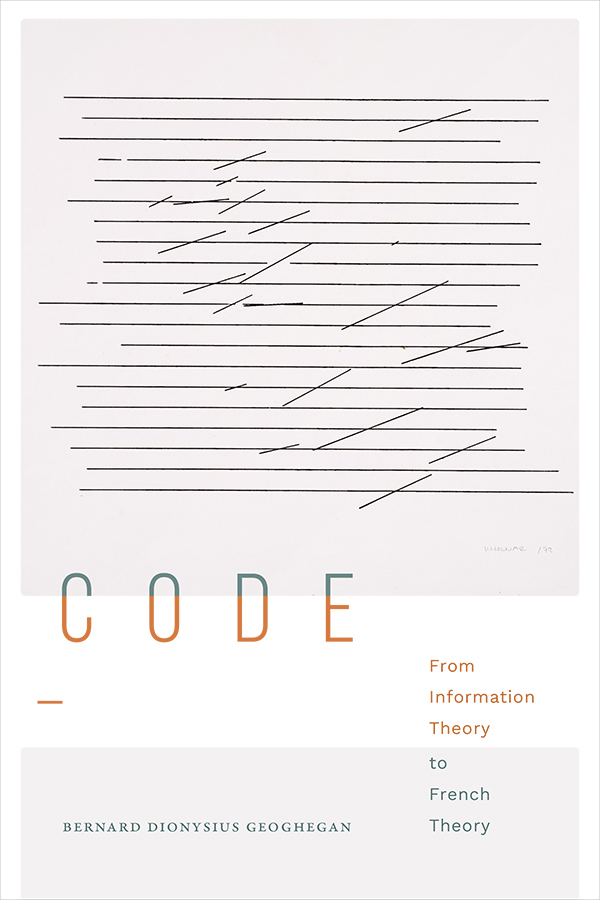
Bernard Dionysius Geoghegan, Code: From Information Theory to French Theory – Duke University Press, January 2023

Bernard Dionysius Geoghegan, Code: From Information Theory to French Theory – Duke University Press, January 2023

The Introduction is open access here

[update: there is a review at The Duke Reader; and a discussion on the New Books network]

In Code Bernard Dionysius Geoghegan reconstructs how Progressive Era technocracy as well as crises of industrial democracy and colonialism shaped early accounts of cybernetics and digital media by theorists including Norbert Wiener, Warren Weaver, Margaret Mead, Gregory Bateson, Claude Lévi-Strauss, Roman Jakobson, Jacques Lacan, Roland Barthes, and Luce Irigaray. His analysis casts light on how media-practical research forged common epistemic cause in programs that stretched from 1930s interwar computing at MIT and eugenics to the proliferation of seminars and laboratories in 1960s Paris. This mobilization ushered forth new fields of study such as structural anthropology, family therapy, and literary semiology while forming enduring intellectual affinities between the humanities and informatics. With Code, Geoghegan offers a new history of French theory and the digital humanities as transcontinental and political endeavors linking interwar colonial ethnography in Dutch Bali to French sciences in the throes of Cold War-era decolonization and modernization. 

“In a wide-ranging recontextualization of cybernetics and related disciplines, Bernard Dionysius Geoghegan’s Code unearths new and compelling connections between the human sciences and regimes of technocratic control in the United States from the 1930s through the 1970s. This is the kind of book that upends standard intellectual histories, making it essential reading for everyone from deconstructionists to historians of postwar communication theories. Highly recommended.” — N. Katherine Hayles, author of Postprint: Books and Becoming Computational

“After reading this original and fascinating book, you will never look at key thinkers of the twentieth century in the same way. Bernard Dionysius Geoghegan shows how information theory, game theory, and cybernetics developed in the United States in the 1940s and 1950s played a key role in shaping the ideas of Claude Lévi-Strauss, Roland Barthes, and others who wanted to bring scientific methods to the study of culture. Today, when humanities are again strongly influenced by new techno paradigms (AI, data science), the archeology of ‘techno-humanities’ for the first time revealed in Code is particularly relevant.” — Lev Manovich, author of Cultural Analytics

“Before there was poststructuralism, there was cybernetics. In this comprehensive, highly original history, Bernard Dionysius Geoghegan weaves the two worlds back together and reveals French Theory’s long-forgotten debt to Cold War America. If you thought Foucault freed us from The Man, this book will make you think again, hard.” — Fred Turner, author of The Democratic Surround: Multimedia and American Liberalism from World War II to the Psychedelic Sixties

Posted in Uncategorized | Leave a comment

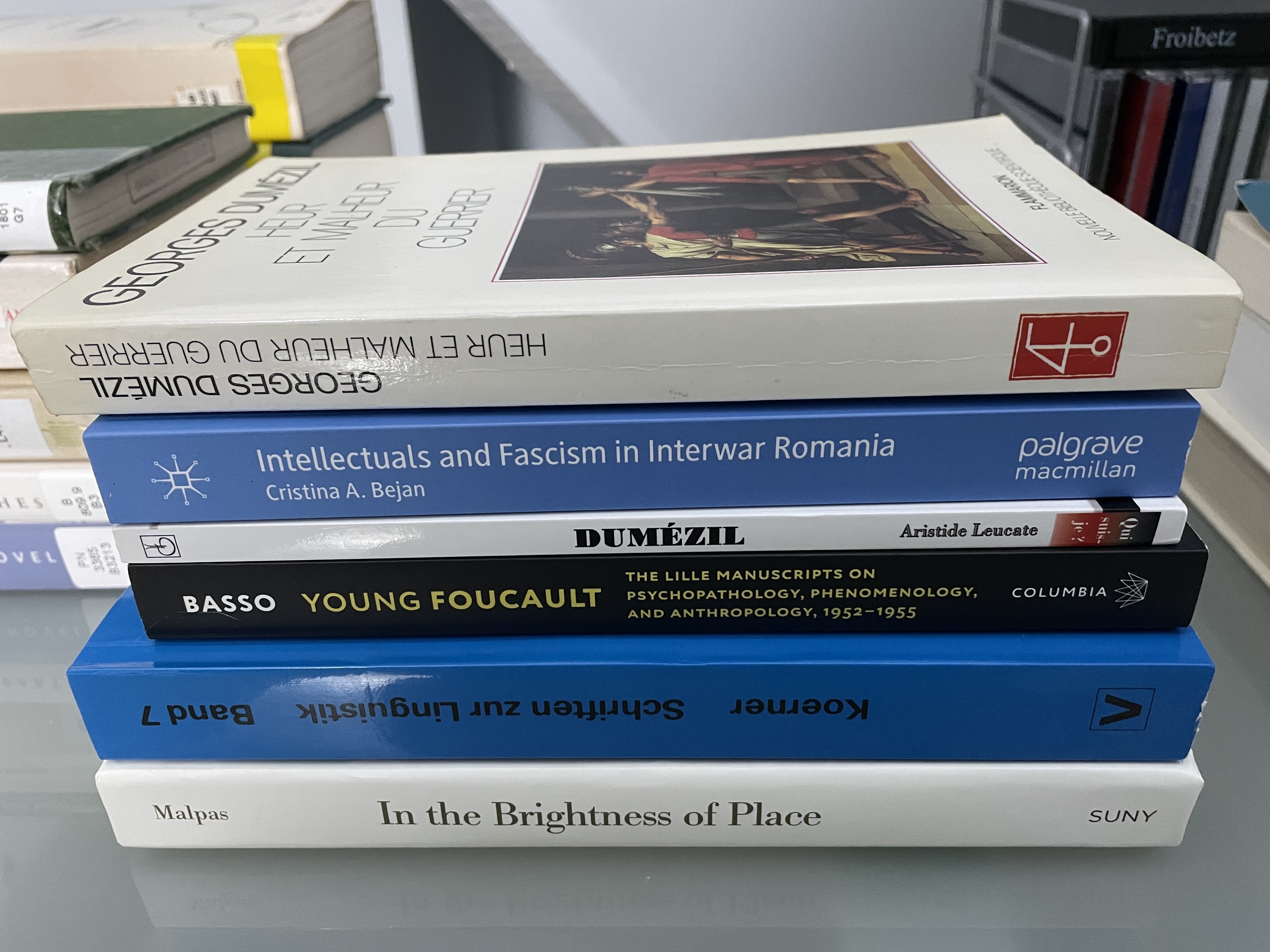
Books received – Dumézil, Bejan, Leucate, Basso, Koerner, Malpas

A copy of Georges Dumézil, Heur et Malheur du guerrier; Cristina Bejan, Intellectuals and Fascism in Interwar Romania: The Criterion Association; Aristide Leucate’s recent short study of Dumézil; Elisabetta Basso, Young Foucault: The Lille Manuscripts on Psychopathology, Phenomenology, and Anthropology, 1952–1955; E.F.K. Koerner, Ferdinand de Saussure: Origin and Development of his Linguistic Thought in the Western Studies of Language (which strangely has the series on the spine); and Jeff Malpas, In the Brightness of Place: Topological Thinking In and After Heidegger.

I’ve read Koerner and Bejan’s excellent books, but asked for these in recompense for review work since I will be turning to them a lot for work on Saussure and Eliade. I’ve agreed to write a review of Young Foucault, and I wrote an endorsement for In the Brightness of Place. Dumézil’s book goes through different editions, each substantially different – this is the 1985 edition, later reprinted in the Champs Flammarion series. For a comparison of the editions, see here.

Posted in Ferdinand de Saussure, Georges Dumézil, Jeff Malpas, Mapping Indo-European Thought in Twentieth Century France, Martin Heidegger, Michel Foucault, Mircea Eliade | Leave a comment

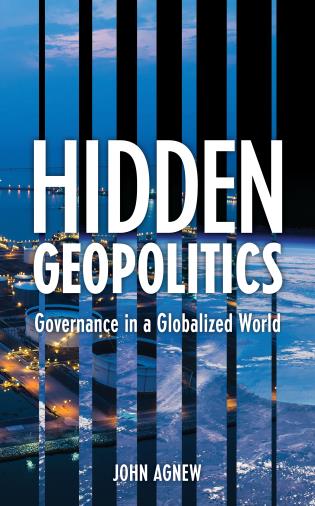
John Agnew, Hidden Geopolitics: Governance in a Globalized World – Rowman & Littlefield, July 2022

John Agnew, Hidden Geopolitics: Governance in a Globalized World – Rowman & Littlefield, July 2022


Geopolitics is not dead, but nor does it involve the same old logic of a world determined by physical geography in a competition between Great Powers. Hidden Geopolitics recaptures the term to explore how the geography of power works both globally and nationally to structure and govern the workings of the global political economy. Globalization, far from its antithesis, is tightly wound up in the assumptions and practices of geopolitics, relating to the scope of regulatory authority, state sponsorship, and the political power of businesses to operate worldwide. Agnew shows how this “hidden” geopolitics and globalization have been vitally connected. He focuses on three moments: the origins of contemporary globalization in the policies pursued by successive US governments and allies after 1945 and its continued relevance even as the US role in the world changes; the close connection between geopolitical history and status of different countries and their relative capacities to exploit the possibilities and limit the costs of globalization; and new regulatory and standard-setting agencies which emerged under the sponsorship of major geopolitical powers but have grown in power and authority as the dominant states have become limited in their ability to manage the explosion of transnational transactions on their own.

Agnew argues that it is time to move on from the narrow inter-imperial cast of geopolitics and the foolish policy advice it produces. The old perspective on geopolitics has taken on new life with the rise of national-populist movements in Europe and the United States and the reinvigoration of territorial-authoritarian regimes in Russia and China. Notwithstanding this trend, we must see the contemporary world through the lens of these complex, “hidden” geopolitical underpinnings that Agnew seeks to expose.

Hidden Geopolitics rejects simplistic dichotomies between state and non-state actors, between geopolitics and globalization. It is a nuanced and helpful exploration of ways to analyze and grapple with an ever more complex world.
— Anne-Marie Slaughter, Bert G. Kerstetter ’66 University Professor Emerita of Politics and International Affairs, Princeton University

I have been a strong proponent of taking territory seriously in the contemporary world. But that does not mean that we should ignore the ways in which territorial arrangements and the networks, flows, and assemblages associated with globalization are intertwined. Hidden Geopolitics makes a compelling case for their interpenetration. Drawing on different facets of his rich scholarly oeuvre, John Agnew has developed an account of remarkable historical and geographical depth that offers telling insights into how often-underappreciated geographical extensions of power have shaped, and continue to shape, the world in which we live.
— Alexander B. Murphy, University of Oregon

At the moment the news is simultaneously filled with both the ‘Great Power’ ambitions of Russia to re-gain a sphere of influence lost since the Cold War, as well as the importance of the SWIFT banking transfer network in the West’s subsequent choking off of the Russian economy. Agnew’s treatise on hidden geopolitics, existing between the national and the global, could not be more timely in thinking through contemporary geopolitics.
— Jason Dittmer, University College London

Timely and incisive, Agnew once again rethinks the field of geopolitics by turning attention away from analysing traditional actors – such as the territorial nation state – to consider instead the wealth of agents and processes involved in global capital flows. Hidden Geopolitics provides a conceptual toolkit to understand the geographical implications of offshore financing and associated illicit and licit flows of money. It will be an essential text for student and researcher alike, advancing our geographical and historical understanding of the making of the world in the 21st century.
— Alex Jeffrey, University of Cambridge

This book is an erudite and broad-ranging exploration of the interplay between logics of the territorial state and globalization in varied forms and contexts. John Agnew convincingly argues that our failure to recognize how “territorial determinism” and a “world of flows” coexist has undermined progress toward understanding and managing global political economy. Hidden Geopolitics points toward new realms of interdisciplinary research and should be pre-requisite reading for those seeking to lead states, firms, and varied regulatory agencies in the 21st century.
— Alexander C. Diener, University of Kansas

Hidden Geopolitics is an intellectual tour de force. Agnew brings a distinguished career of critical thinking about space and power to deciphering how contemporary world politics actually works. What we think of as geopolitics — territorial struggles between great powers — obscures the hidden and routine deployments of power over space by a great variety of non-state actors. Geopolitics and globalization are not opposites but entwined co-productions. In case studies of US border politics, Chinese narratives, US federalism and credit-rating agencies, Agnew exposes the hidden ways in which geopolitics actually works to produce the messy, turbulent and unjust world politics we experience every day.
— Gerard Toal, Virginia Tech, Washington D.C.

John Agnew could not have written a more timely and important book. Writing in the midst of a violent invasion of Ukraine by Russia, we need to understand not just the brutal logics of spatial expansionism and the domination of place but also the hidden and messy entanglements of finance, culture, business, energy, and electoral politics.
— Klaus Dodds, Royal Holloway University of London; author of Border Wars

Posted in John Agnew, Uncategorized | 1 Comment

Gathering: The Heidegger Circle Annual – call for papers

Gathering: The Heidegger Circle Annual – call for papers

Posted in Martin Heidegger | Leave a comment