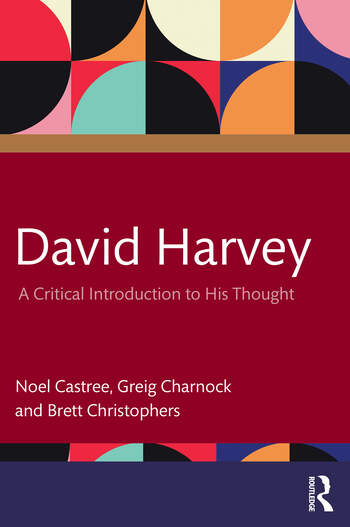
David Harvey is among the most influential Marxist thinkers of the last half century. This book offers a lucid and authoritative introduction to his work, with a structure designed to reflect the enduring topics and insights that serve to unify Harvey’s writings over a long period of time.
Harvey’s writings have exerted huge influence within the social sciences and the humanities. In addition, his work now commands a global readership among Left political activists and those interested in current world affairs. Harvey’s central preoccupation is capitalism and the impacts of its growth-obsessed, contradictory dynamics. His name is synonymous with key analytical concepts like ‘the spatial fix’ and ‘accumulation by dispossession’. This critical introduction to his thought is an essential companion for both new and more experienced readers. The critique of capitalism is one of the most important undertakings of our time, and Harvey’s work offers powerful tools to help us see why a ‘softer’ capitalism is insufficient and a post-capitalist future is necessary.
This book is an important resource for scholars and graduate students in geography, politics and many other disciplines across the social sciences and humanities.
“An indispensable guide to the life and work of one of the greatest Marxist intellectuals of his generation. The authors provide a far-reaching overview of Harvey’s intellectual project and the way it has developed over time, which allows the reader to build a much deeper relationship with Harvey’s oeuvre than that they might gain by reading a few key texts from within a specific discipline – much in the same way that Harvey’s familiarity with Marx has made his Introduction to Capital the most popular accompaniment to Marx’s work.”
Grace Blakeley, author of Stolen: How to save the world from financialisation
“I arrived at the Johns Hopkins University in 1997. By 1999 I was co-teaching a graduate seminar with David Harvey on Gramsci and Keynes. I went in there as a recovered Marxist. I came out having recovered my Marxism. That’s what Harvey will do to you.”
Mark Blyth, Brown University, USA, author of Austerity: The History of a Dangerous Idea and co-author of Angrynomics
“No living intellectual has done more to reinvigorate Marxism than David Harvey. True to its spirit, he has insisted on the unbreakable link between scientific research and political practice. Here, for the first time, we have a survey of Harvey’s entire oeuvre – but not a mere summary or for-dummies: Castree, Charnock and Christophers engage critically with all the issues swirling through his work, down to the question of how to change the world. In wonderfully accessible prose, they catch a genius in motion, always attuned to the latest developments in capitalism. This will be a book to chew on, for Harvey aficionados and newcomers alike, and for everyone grappling with the unbearable contradictions of this world order.”
Andreas Malm, Lund University, Sweden, author of Fossil Capital,The Progress of the Storm, and How to Blow Up a Pipeline
Emerging infectious disease outbreaks have transformed the very nature of urban life worldwide, even as the extent and experience of pandemics are shaped by the planetary urban condition. Pandemic Urbanism critically investigates these relationships in a world faced with its first pandemic on a majority urban planet.
The authors reveal the social and historical context of recent infectious disease events and how they have variously transformed the urban fabric. They highlight the important role played by socio-ecological processes associated with the global urban periphery – suburban or post-suburban zones and hinterland areas of “extended” urbanization – changing mobility patterns, and new forms of urban governance and pandemic response. The book develops novel insights for post-pandemic urban governance and planning grounded in the quest for social and spatial justice. In doing so, it reveals a paradox at the heart of pandemic urbanism: urban life enables contagion to spread easily, yet at the same time offers unique possibilities to contain and respond to disease outbreaks.
Multidisciplinary in approach and written by experts in the field, this book is an invaluable primer on the origins, pathways, and management of infectious disease.
“This ground-breaking contribution to the field of urban epidemiology will be of lasting significance for our understanding of the post-COVID city.” Matthew Gandy, University of Cambridge
“With a sophisticated grasp of urban theory, astute historical sensibilities, and a shrewd eye for paradoxical outcomes, the authors of this timely book show how urbanization processes have produced and been transformed by infectious disease transmission. There are powerful lessons for rectifying the disastrous decisions of the past by embracing new forms of city-making.” Diane E. Davis, Harvard University
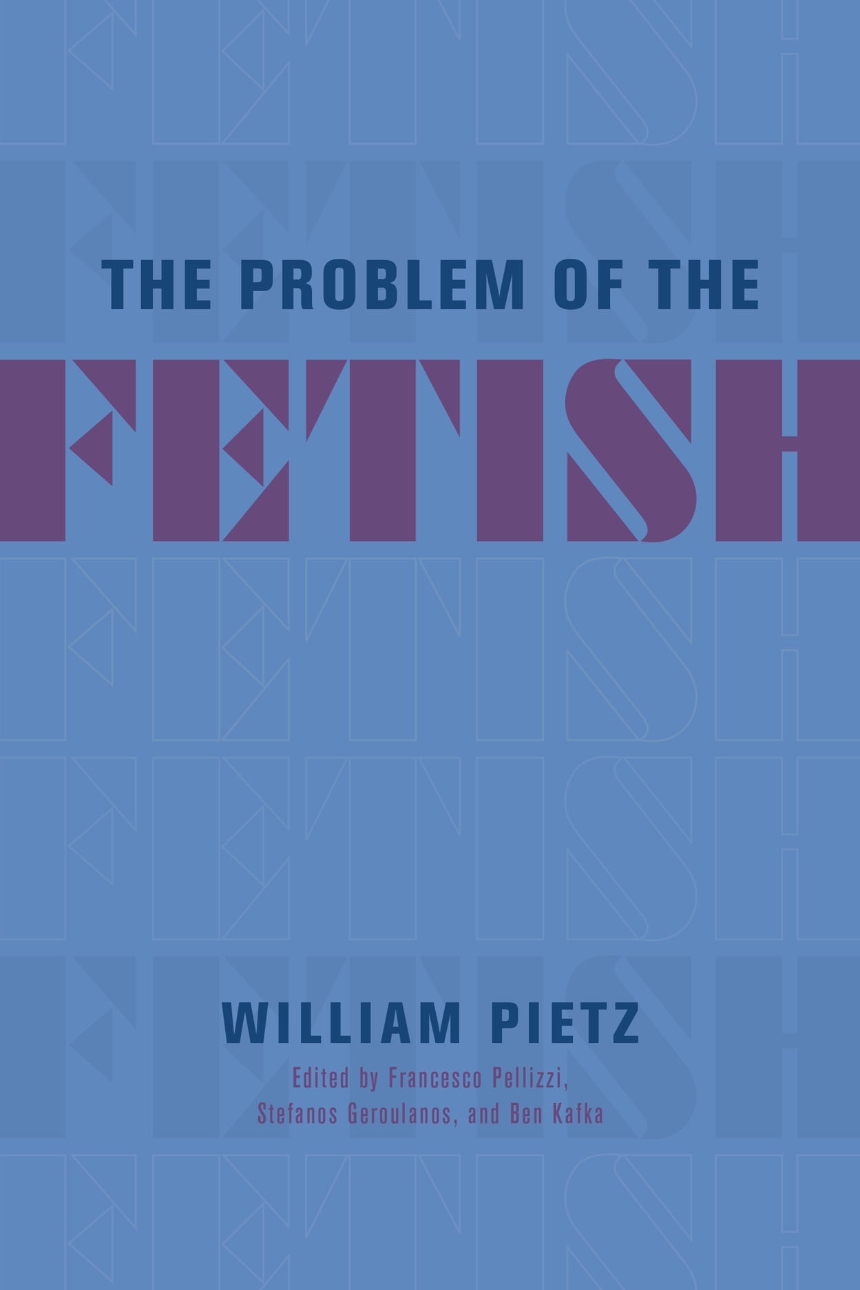
William Pietz, The Problem of the Fetish, edited by Francesco Pellizzi, Stefanos Geroulanos, and Ben Kafka – University of Chicago Press, November 2022
A groundbreaking account of the origins and history of the idea of fetishism.
In recent decades, William Pietz’s innovative history of the idea of the fetish has become a cult classic. Gathered here, for the first time, is his complete series of essays on fetishism, supplemented by three texts on Marx, blood sacrifice, and the money value of human life. Tracing the idea of the fetish from its origins in the Portuguese colonization of West Africa to its place in Enlightenment thought and beyond, Pietz reveals the violent emergence of a foundational concept for modern theories of value, belief, desire, and difference. This book cements Pietz’s legacy of engaging questions about material culture, object agency, merchant capitalism, and spiritual power, and introduces a powerful theorist to a new generation of thinkers.
A philosophical treatment of play in the twentieth century
Appeals to a potentially broad audience including those interested in thinking through globalisation today
The magnum opus of an influential French-Greek intellectual whose contemporaries and influences include Derrida, Deleuze and Lefebvre
Approaches philosophy in a systematic as well as fragmentary manner
Anticipates the key term of contemporary Heideggerian scholarship (German Irre, French errance) and confronts it through play
A French reprint of Le Jeu du Monde was published by Les Belles Lettres in January 2018
Kostas Axelos traces his thinking on the world deployed as play from Heraclitus through to the culmination of metaphysical philosophy with Nietzsche, Marx and Heidegger.
At the heart of Kostas Axelos’s ambitious and pioneering system, this encyclopaedia of fragments has long exercised a powerful influence in French thought on play, game and world. Axelos could not have asked for more sympathetic, attentive and poetic translators in Clemens and Monz. His anglophone readers and interlocuters await.– Stuart Elden, University of Warwick
Kostas Axelos (1924–2010) was a Greek-French philosopher and translator. A specialist in Heraclitus, Karl Marx and Martin Heidegger, as well as in Friedrich Hölderlin and Stéphane Mallarmé, he taught and researched at the Sorbonne, as well as at the Centre National de la Recherche Scientifique and at the École Pratique des Hautes Études. The Game of the World is his magnum opus, and as yet only the third English translation from his vast and important body of work.
Justin Clemens is Associate Professor in Culture and Communication at the University of Melbourne. He has published extensively on psychoanalysis, contemporary European philosophy and Australian art and literature. His recent books include What is Education? edited with A.J. Bartlett and The Afterlives of Georges Perec edited with Rowan Wilken.
Hellmut Munz teaches Digital Media at RMIT University, Melbourne. He is the author of The Game of Confusion. Kostas Axelos examined his PhD.
Hardback and e-book only at the moment, but paperback sometime in the future. Subscribers to David’s substack The Fragment can access a 50% discount code.
Update February 2024: the paperback is now available.
We are living in algorithmic times.
From machine learning and artificial intelligence to blockchain or simpler newsfeed filtering, automated systems can transform the social world in ways that are just starting to be imagined.
Redefining these emergent technologies as the new systems of knowing, pioneering scholar David Beer examines the acute tensions they create and how they are changing what is known and what is knowable. Drawing on cases ranging from the art market and the smart home, through to financial tech, AI patents and neural networks, he develops key concepts for understanding the framing, envisioning and implementation of algorithms.
This book will be of interest to anyone who is concerned with the rise of algorithmic thinking and the way it permeates society.
This interdisciplinary volume explores the relationship between history and a range of disciplines in the humanities and social sciences: economics, political science, political theory, international relations, sociology, philosophy, law, literature and anthropology. The relevance of historical approaches within these disciplines has shifted over the centuries. Many of them, like law and economics, originally depended on self-consciously historical procedures. These included the marshalling of evidence from past experience, philological techniques and source criticism. Between the late nineteenth and the middle of the twentieth century, the influence of new methods of research, many indebted to models favoured by the natural sciences, such as statistical, analytical or empirical approaches, secured an expanding intellectual authority while the hegemony of historical methods declined in relative terms. In the aftermath of this change, the essays collected in History in the Humanities and Social Sciences reflect from a variety of angles on the relevance of historical concerns to representative disciplines as they are configured today.
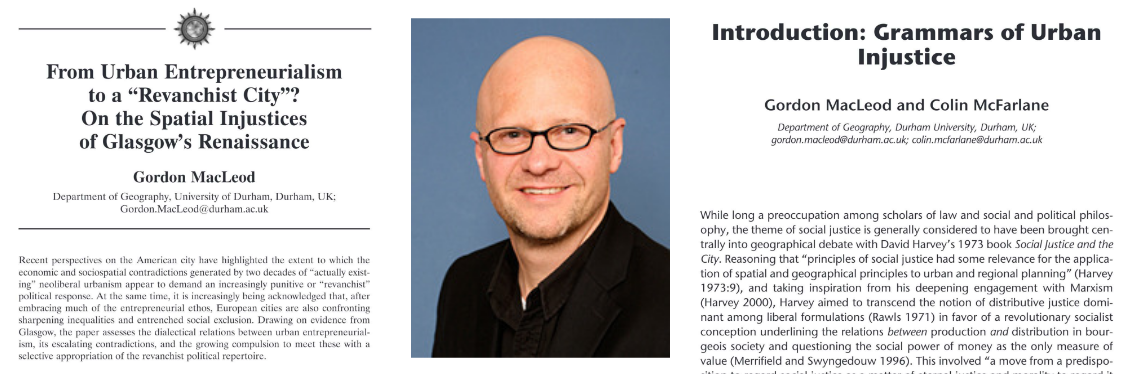
The Editorial Collective and the broader Antipode community have been deeply saddened to learn of the untimely death of Gordon MacLeod. Gordon was a singular voice in critical geography who was a good friend to Antipode and responsible for publishing a number of key articles in the journal. In tribute we have made his contributions to the journal free to view. They demonstrate both key aspects of his contribution to the discipline and his broader political engagement and energy.
As his Antipode contributions demonstrate, his work was animated by an incisive theoretical rigour which was put to work to make sense of particular situations and contexts. The passion with which he did this comes through strongly in his classic analysis of the inequalities of Glasgow’s urban renewal, an article which unfortunately remains all too prescient twenty years on. A deep commitment to questions of social justice informed his works, as the “Grammars of Urban Injustice” Symposium that he co-edited with his friend and colleague Colin McFarlane makes clear. His conviction that working towards social justice involved challenging entrenched spatial inequalities has left us an important body of work with which to continue that struggle.
Stuart Elden and Adam David Morton, as editors of On the Rural, have assembled a strange, slightly lumpy set of conference presentations, chapters, scholarly essays, and even a review essay of another text into a volume that illustrates a key arc in the intellectual life of Henri Lefebvre: his slow journey from a focus on agrarian and peasant concerns to a focus on the urban. In the end, I think the book reveals more to today’s urban scholars than to its ruralists. Yet, precisely where the text fits in the canon surrounding Lefebvre’s writing is hard to definitively articulate because of how his work 1 has been extended by Anglophone scholars since the 1990s. This is a worthwhile book, but I think it will leave some audiences cold and others uneasy about the implications it has for the past thirty years of scholarship building on Lefebvre in translation.
Elden and Morton’s lengthy introduction serves as an excellent interpretive orientation to the text—which is good, because this amalgamation absolutely requires one. The introduction is eloquent, readable, and usefully knits the various texts together, pro- viding essential historic and scholarly context for the chapters that follow. At a high level, the book is organized largely chronologically from the late 1940s to the early 1960s, with two exceptions: the introduction to From the Rural to the Urban, which sits at the beginning of this volume but was initially published in French in 1969; and The Marxist-Leninist Theory of Ground Rent, positioned in the middle of the volume but first published in French [actually Spanish, SE] in 1964. I will return to the latter of these in a moment.
And the end of Gallemore’s review:
In closing, a few words of caution are in order. First, Lefebvre can be a very frustrating writer, even with the help of a carefully curated translation and a very clear introductory essay from the volume’s editors. I suspect that for most readers (certainly including myself), multiple readings will be necessary for the ideas in these essays to be of use or inspiration. On the other hand, it is certainly a testimony to the depth of these materials that they reward multiple readings. Second, as the editors note in their introduction, Lefebvre’s analysis of gender is almost nonexistent and, where present, relatively superficial. The same is generally true for issues of race. In short, for those wishing to go beyond a fairly strict class analysis of agricultural transitions to capitalism, it will be absolutely necessary to put Lefebvre in dialogue with other authors. Third, while the empirical detail present in some of these essays is quite impressive and sheds light on Lefebvre as a sociologist and historian, it may be a bit irrelevant to those not already interested in European agricultural history. Still, as existence proofs of some of Lefebvre’s claims, even these sections can be interesting. This is particularly the case for the final essay in the volume, which provides a detailed history of the complex institutional struggles over land control in the area sur- rounding a village in the Pyrenees, illustrating the complex ways past institutional choices impinge on current practices.
In short, On the Rural is likely to intrigue readers with a diverse set of interests, but they will be best served to approach the volume with a clear idea of what they hope to get out of it, alongside a recognition that getting something out of it may require some fairly careful textual work. It is a valuable contribution to the body of Lefebvre’s work available in English translation.