Special Issue: Genealogy, The Monist (2022)

special issue of The Monist on Genealogy edited by Daniele Lorenzini

Clare O'Farrell's avatarFoucault News

Genealogy. Advisory Editor: Daniele Lorenzini
The Monist, Volume 105, Issue 4, October 2022

CONTENTS

Articles
Genealogy, Evaluation, and Engineering
Matthieu Queloz
Genealogy as Meditation and Adaptation with the Han Feizi
Lee Wilson
Dripping with Blood and Dirt from Head to Toe: Marx’s Genealogy of Capitalism in Capital, Volume 1
Amy Allen
Psychology, Physiology, Medicine: The Perspectivist Interpretation of Nietzsche’s Genealogy of Morality
Daniel R. Rodrıguez-Navas
Is Heidegger’s History of Being a Genealogy?
Sacha Golob
On Moral Unintelligibility: Beauvoir’s Genealogy of Morality in the Second Sex
Sabina Vaccarino Bremner
Reason Versus Power: Genealogy, Critique, and Epistemic Injustice
Daniele Lorenzini
Vindicating Reasons
Guy Longworth

View original post

Posted in Uncategorized | Leave a comment

David Harvey, A Companion to Marx’s Grundrisse – Verso, February 2023

David Harvey, A Companion to Marx’s Grundrisse – Verso, February 2023

Update: editor Sebastian Budgen discusses the book here.

When leading scholar of Marx, Roman Rosdolsky, first encountered the virtually unknown text of Marx’s Grundrisse – his preparatory work for his masterpiece Das Capital – in the 1950s in New York Public Library, he recognized it as “a work of fundamental importance,” but declared “its unusual form” and “obscure manner of expression, made it far from suitable for reaching a wide circle of readers.”

David Harvey’s Companion to Marx’s Grundrisse builds upon his widely acclaimed companions to the first and second volumes of Capital in a way that will reach as wide an audience as possible. Marx’s stated ambition for this text – where he was thinking aloud about some of possible metamorphoses of capitalism – is to reveal “the exact development of the concept of capital as the fundamental concept of modern economics, just as capital itself is the foundation of bourgeois society.” While respecting Marx’s desire to “bring out all the contradictions of bourgeois production, as well as the boundary where it drives beyond itself,” David Harvey also pithily illustrates the relevance of Marx’s text to understanding the troubled state of contemporary capitalism.

Posted in David Harvey, Karl Marx, Uncategorized | 1 Comment

Jeff Malpas, In the Brightness of Place: Topological Thinking In and After Heidegger – SUNY Press, September 2022

Jeff Malpas, In the Brightness of Place: Topological Thinking In and After Heidegger – SUNY Press, September 2022

The work of Jeff Malpas is well-known for its contribution to contemporary thinking about place and space. In the Brightness of Place takes that contribution further, as Malpas develops it in new ways and in relation to new topics. At the same time, the volume also develops Malpas’ distinctively topological approach to the work of Martin Heidegger. Not limited simply to a reading of the topological in Heidegger, In the Brightness of Place also takes up the idea of topology after Heidegger, showing how topological thinking provides a way of rethinking Heidegger’s own work and of rethinking our own being in the world.

“Malpas has long been the leading figure in debates about Heidegger, philosophy and place. Building on that pioneering work, In the Brightness of Place represents an important contribution to several fields, most obviously around place, geography and landscape, but also to literature. The opening chapter on Heidegger’s notorious ‘Black Notebooks’ is particularly impressive. It treats them seriously—philosophically, politically, biographically—and shows how they can shed light on important issues in the reading and assessment of Heidegger.” — Stuart Elden, author of The Early Foucault

“In this magisterial book, Jeff Malpas lucidly sets forth the full span of Heidegger’s later thought. He draws the curtain on a broader vista than one might ever have imagined, ranging from meditations on the “other beginning” and the ‘turning’ to rethinking emotion and reason. He shows how what might otherwise appear to be a scattered multiplicity of topics gravitates around place understood as a deeply coherent core of Heidegger’s mature work. He demonstrates not just the plausibility of this core but just how unrefusable it is when taken seriously. The result is a triumph not only in Heidegger scholarship but in building a case for ‘the essentially placed character of being.’ The author’s luminous prose—which draws on many sources, not only philosophical (ranging from Hume and Kant to Arendt and Benjamin) but poetic and historical—conveys to us a profound truth of the human condition: to be is to be in place.” — Edward S. Casey, author of The World on Edge and Turning Emotion Inside Out

Posted in Edward Casey, Jeff Malpas, Martin Heidegger, Uncategorized | Leave a comment

Marci Baranski, The Globalisation of Wheat: A Critical History of the Green Revolution – University of Pittsburgh Press, November 2022

Marci Baranski, The Globalisation of Wheat: A Critical History of the Green Revolution – University of Pittsburgh Press, November 2022

In The Globalization of Wheat, Marci R. Baranski explores Norman Borlaug’s complicated legacy as godfather of the Green Revolution. Winner of the Nobel Peace Prize in 1970 for his role in fighting global hunger, Borlaug, an American agricultural scientist and plant breeder who worked for the Rockefeller Foundation, left a legacy that divides opinions even today. His high-yielding dwarf wheat varieties, known as miracle seeds, effectively doubled and tripled crop yields across the globe, from Kenya to India and Argentina to Mexico due to their wide adaptation. But these modern seeds also required expensive chemical fertilizers and irrigation, both of which were only available to wealthier farmers. Baranski argues that Borlaug’s new technologies ultimately privileged wealthier farmers, despite assurances to politicians that these new crops would thrive in diverse geographies and benefit all farmers. As large-scale monocultures replaced traditional farming practices, these changes were codified into the Indian wheat research system, thus limiting attention to traditional practices and marginal environments. In the shadow of this legacy, and in the face of accelerating climate change, Baranski brings new light to Borlaug’s role in a controversial concept in agricultural science.

In this highly original work, Marci Baranski challenges a key claim of twentieth-century scientific ingenuity: wide adaptation. Wide adaptation was needed to make wheat a global crop and launch the Green Revolution of the 1960s. Yet, Baranski asks, what if the research was wrong? What if Norman Borlaug was wrong? Her book is a must-read for anyone interested in knowing how and why the science of the Green Revolution, flawed though it was, continues to garner attention and followers today. Gabriela Soto Laveaga, Harvard University

This well-researched, well-written, and important book establishes Marci Baranski as one of the best of the new generation of historians of science. The Globalization of Wheat not only peels back the layers of politics behind the Green Revolution’s ‘miracle seeds’ but shows how those events brought about a distorted notion of what we should value in seeds. This is a vital contribution to the ongoing rethinking of this famous episode in agricultural history.Glenn Davis Stone, author of The Agricultural Dilemma: How Not to Feed the World

Posted in Uncategorized | Leave a comment

Karl Marx, Critique of the Gotha Program – new translation, PM Press, October 2022

Karl Marx, Critique of the Gotha Program – new translation, PM Press, 2022

There is also a discussion of the book, today, 15 September 2022, 5.30pm Chicago time.

Marx’s Critique of the Gotha Program is a revelation. It offers the fullest elaboration of his vision for a communist future, free from the shackles of capital but also the state. Neglected by the statist versions of socialism, whether social democratic or Stalinist that left a wreckage of coercion and disillusionment in their wake, this new annotated translation of Marx’s Critique makes clear for the first time the full emancipatory scope of his notion of life after capitalism. An erudite new introduction by Peter Hudis plumbs the depth of Marx’s argument, elucidating how his vision of communism, and the transition to it, was thoroughly democratic. This definitive edition also includes an afterword by Peter Linebaugh and other supplementary materials. At a time when the rule of capital is being questioned and challenged, this volume presents Marx at his most liberatory, offering an essential contribution to a philosophically grounded alternative to capitalism, rather than piecemeal reforms.

Praise

“This is a compelling moment for a return to Marx’s most visionary writings. Among those is his often-neglected Critique of the Gotha Program. In this exciting new translation, we can hear Marx urging socialists of his day to remain committed to a truly radical break with capitalism. And in Peter Hudis’s illuminating introductory essay we are reminded that Marx’s vision of a society beyond capitalism was democratic and emancipatory to its very core. This book is a major addition to the anti-capitalist library.”
—David McNally, Cullen Distinguished Professor of History, University of Houston, and author of Global Slump and Monsters of the Market

“In their penetrating account of Marx’s famous hatchet job on the nineteenth-century left, Hudis and Anderson go to the heart of issues haunting the left in the twenty-first century: what would a society look like without work, wages, GDP growth, and human self-oppression.”
—Paul Mason, writer for New Statesman and author of Postcapitalism: A Guide to Our Future

“This new edition of Marx’s Critique of the Gotha Program, with an illuminating introduction by Peter Hudis, confirms that to re-translate is not only to re-animate old questions in the body of new words, but is also to propel writing towards contemporary exigencies. Arcing across times, the then of a first articulation connects to the now of hindsight and to the unwritten terms of an open future. While the delusions of real existing state socialism have dispelled, confusions around the role of the state in an emancipating society persist. In this short metatext, Marx’s snappish commentaries and his forensic dissections of weasel words and hollow phrases reveal how language matters, because it conveys and betrays ideology, policy and underlying standpoints. Translation works with this malleability of language. Meaning turns on a dime: political orientation can be realigned, if the slogan evinces exactitude, acknowledging history and horizons of possibility. We should learn, through this book, to read closer, better, and in dialogue.
—Esther Leslie, professor of political aesthetics, Birkbeck College, University of London, and author of Walter Benjamin

Critique of the Gotha Program is a key text for understanding Marx’s vision of an emancipated society beyond capitalism. With an excellent introduction by Peter Hudis, this new translation is both timely and important. Returning to Marx’s pathbreaking essay can give new direction to the political struggles of our time.”
—Martin Hägglund, Yale University, author of This Life

“This new translation of Marx’s Critique of the Gotha Program includes an introductory essay by Peter Hudis, which points to Marx’s distinction between value, that is, the socially-necessary time required to produce a commodity, and labor itself, that is, the actual number of hours a worker engages in. He provides a provocative and useful critique of Lenin’s conception of the transition to socialism, and of subsequent Marxist-Leninist and social democratic conceptions of a socialist society. This raises questions about the nature of both labor and value in a society in which both have been transformed by technology. Nevertheless Hudis’ analysis provides a clarifying and useful critique of both social democratic and Marxist-Leninist conceptions of socialism/communism.”
—Barbara Epstein, professor in the History of Consciousness Studies Department, University of California, Santa Cruz, and author of Political Power and Cultural Revolution

“The Critique of the Gotha Program is one of Marx’s great strategic texts, often cited but little read. At a time when the questions of transition and of the forms of organization to exit capitalism are so urgent, this new edition should be saluted. Elaborated by the Marxist-Humanist tendency, it makes a valuable contribution, thanks to the way it situates Marx’s Critique in historical perspective.”
—Isabelle Garo, editing committee, Grande édition des Oeuvres de Marx et Engels, Paris

“The proletarian revolution implies the end of the state. . . . In this period the objective is not simply to destroy the state . . . but to let society as a whole—the transformed society—take over the functions previously performed by the state.”
—Henri Lefebvre

“The old Protestant ethics of work was resurrected among German workers in secularized form. The Gotha Program already bears traces of this confusion, defining labor as ‘the source of all wealth and all culture.’ Smelling a rat, Marx countered that ‘…the man who possesses no other property than his labor power’ must of necessity become ‘the slave of other men who have made themselves the owners…’ However, the confusion spread, and soon thereafter Josef Dietzgen proclaimed: ‘The savior of modern times is called work.’”
—Walter Benjamin

“The primitive idea of freedoms essentially guaranteed by Law and State is annulled precisely by the grandiose final aim of communism, now already visible to us. It will be replaced by future forms of consciousness in the ‘new life’ of the ‘higher phase of communist society.’”
—Karl Korsch

“Marx had worked out his whole theory of human development in Capital and in the organizational document, The Critique of the Gotha Program—because his principle, a philosophy of revolution, was the ground also of organization. In a word, it was not only the state which Marx held must be destroyed, totally uprooted. He showed that the proletarian organization likewise changed form. . . . This, history shows, was not understood by the first post-Marx Marxists.”
—Raya Dunayevskaya

Posted in Uncategorized | 1 Comment

Peter Brown, Journeys of the Mind: A Life in History – Princeton University Press, June 2023

Peter Brown, Journeys of the Mind: A Life in History – Princeton University Press, June 2023

The end of the ancient world was long regarded by historians as a time of decadence, decline, and fall. In his career-long engagement with this era, the widely acclaimed and path-breaking historian Peter Brown has shown, however, that the “neglected half-millennium” now known as Late Antiquity was in fact crucial to the development of modern Europe and the Middle East. In Journeys of the Mind, Brown recounts his life and work, describing his efforts to recapture the spirit of an age. As he and other scholars opened up the history of the classical world in its last centuries to the wider world of Eurasia and northern Africa, they discovered previously overlooked areas of religious and cultural creativity as well as foundational institution-building. A respect for diversity and outreach to the non-European world, relatively recent concerns in other fields, have been a matter of course for decades among the leading scholars of Late Antiquity.

Documenting both his own intellectual development and the emergence of a new and influential field of study, Brown describes his childhood and education in Ireland, his university and academic training in England, and his extensive travels, particularly in the eastern Mediterranean and the Middle East. He discusses fruitful interactions with the work of scholars and colleagues that include the British anthropologist Mary Douglas and the French theorist Michel Foucault, and offers fascinating snapshots of such far-flung places as colonial Sudan, mid-century Oxford, and pre-revolutionary Iran. With Journeys of the Mind, Brown offers an essential account of the “grand endeavor” to reimagine a decisive historical moment.

Posted in Michel Foucault, Peter Brown, Uncategorized | 1 Comment

‘Indo-European Thought in Post-War France’, Warwick Seminar for Interdisciplinary French Studies, 31 May 2023

I’ll be giving a paper on the new project to the Warwick Seminar for Interdisciplinary French Studies on 31 May 2023. The seminar will be online, and open to all. More details nearer the time.

It’s difficult to know what I’ll be in a position to say that far ahead, especially since the project hasn’t yet really begun. But here’s the abstract:

Indo-European Thought in Post-War France

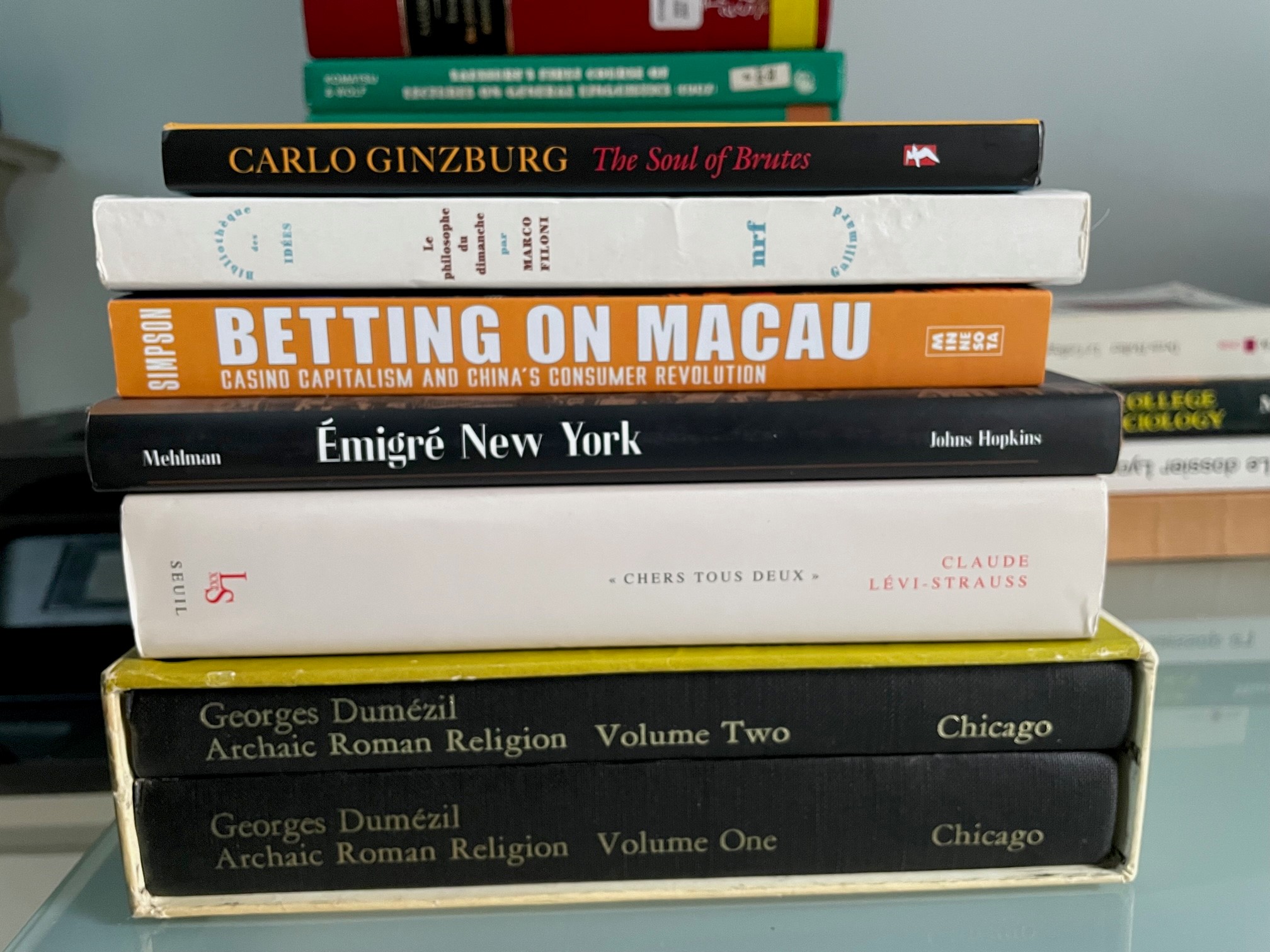
This talk will report on preliminary work on a new research project on Indo-European thought in twentieth-century France. It will particularly focus on the post-war period when Georges Dumézil was elected to the Collège de France, Émile Benveniste regained his chair there after his war-time exile in Switzerland, and Mircea Eliade held visiting positions when unable to return to Romania.

This was a period when Dumézil completed his Jupiter Mars Quirinus and Les Mythes Romains series, and published a revision of his book Mitra-Varuna; Benveniste wrote a comparative study of Indo-European nouns; and Eliade started to publish his first books in French, including Traité d’histoire des religions

Using published texts, reports of teaching, memoirs, and some archival sources, the talk will try to situate the intellectual relations between these and other figures, especially in light of a post-war reckoning about political positions.

Stuart Elden is Professor of Political Theory and Geography at the University of Warwick. He has recently completed a four-part intellectual history of Foucault’s entire career. He is currently funded by a Leverhulme Major Research Fellowship on Indo-European thought in twentieth-century France.

Posted in Uncategorized | Leave a comment

Nicholas Blomley, Territory: New Trajectories in Law – Routledge, September 2022

Nicholas Blomley, Territory: New Trajectories in Law – Routledge, September 2022

This book introduces readers to the concept of territory as it applies to law while demonstrating the particular work that territory does in organizing property relations. 

Territories can be found in all societies and at all scales, although they take different forms. The concern here is on the use of territories in organizing legal relations. Law, as a form of power, often works through a variety of territorial strategies, serving multiple legal functions, such as attempts at creating forms of desired behaviour. Landed property, in Western society, is often highly territorial, reliant on sharply policed borders and spatial exclusion. But rather than thinking of territory as obvious and given or as a natural phenomenon, this book focuses particularly on its relation to property to argue that territory is both a social product, and a specific technology that organizes social relations. That is: territory is not simply an outcome of property relations but a strategic means by which such relations are communicated, imagined, legitimized, enforced, naturalized and contested.

Accessible to students, this book will be of interest to those working in the areas of sociolegal studies, geography, urban studies, and politics.

Posted in Nicholas Blomley, Territory | 1 Comment

William M. Hawley, Shakespeare’s Theory of International Relations: Diplomacy, Romance, and Aesthetics – Cambridge Scholars, August 2022

William M. Hawley, Shakespeare’s Theory of International Relations: Diplomacy, Romance, and Aesthetics – Cambridge Scholars, August 2022

This book treats William Shakespeare’s romances as international relations (IR) theory plays depicting paths to peace abroad, showing that the playwright sounds the depths of human emotions and resolves diplomatic crises threatening entire populations overseas. Remarkably, Shakespeare vindicates Renaissance concepts of IR classical realism, as well as our modern definitions of IR realism, defensive realism, and constructivism. These late plays reveal the playwright at the height of his aesthetic powers, for, by virtue of his art, his antagonistic state actors restore frayed international alliances and reap the benefits of a renewed sense of universal well-being.

Sample material available here.

Posted in William Shakespeare | Leave a comment

Shifting landscapes of the medieval world – University of Cambridge, 13-15 September 2022

I’ve posted about the seminar series before, but this project now has a final conference.

Convenors

  • Miranda Griffin (MMLL, University of Cambridge)
  • Máire Ní Mhaonaigh (ASNC, University of Cambridge)

Keynote Speakers

Introduction

Although the word ‘landscape’ entered English in the sixteenth century, the concept of the land as it shapes and is shaped by human activity is much, much older. Much more than a backdrop to narrative, much more than a passive object of knowledge, much more than patches of space to be allocated and appropriated, landscape is revealed as playing an active part in narrative, power, and knowledge. A focus on landscape allows us to ask questions about the division between culture and nature; the boundaries between countries and cultures; the agency of the nonhuman and more than human; the role of the supernatural and the imagination in shaping history; and the ethics of landscape management, naming, and ownership.

This seminar series and follow-on conference comes at a time in which we are all, individually and collectively, rethinking our relationship to the spaces we live in and with, and our responsibility to them: we therefore anticipate a dynamic and stimulating series of conversations.

Themes

Our conference focuses on reading medieval landscapes in their multiple manifestations. We will explore themes emerging in the series of preceding seminars, as well as broadening the discussion to include aspects of other dimensions, spatial, temporal and theoretical.

Broad-ranging conceptually focussed papers, as well as explorations of specific case studies are welcomed, addressing the multifarious ways in which landscapes in the Middle Ages were read then and now. Issues addressed will include (but not be limited to):

  • the importance of shared cultural concerns in understanding landscapes;
  • the continual reconfiguration of landscapes through time and space;
  • the centrality of land in their conceptualisation;
  • the local and the cosmos;
  • the rural and urban;
  • the sacred and profane.

Methodologies will be informed by history and archaeology, texts and theory, languages and literatures, ecocriticism and ecologies, disability studies and onomastics (to name but some approaches).

One aim will be to illuminate the relationship between humans of the past and their environment in complementary ways. Another will be an interrogation of the affordances of different kinds of landscapes. The importance of various perspectives, simultaneous and continuous, will also be to the fore, included those occluded, deliberately erased and obscured. In discussing these and other subjects critically and in an open, nuanced manner, we seek to open up new ways of thinking about the shifting landscapes of the medieval world.

For information on topics discussed in the seminar series, see the blog posts on the various sessions.

Posted in Uncategorized | Leave a comment