Stuart Hall’s Bibliography (1957-2015) by Catherine Hall, Bill Schwarz and Nick Beech
The project for a bibliography that would capture the breadth and depth of Stuart Hall’s work was initiated by Catherine Hall and Bill Schwarz in the wake of Stuart’s death in 2014. I was honoured to be invited by them to prepare the bibliography—initially with a view to including this with the volumes of Hall’s work, published by Duke University Press under their general editorship. I began work on the bibliography in April 2014 and it was largely completed by November of that year. By then it was clear that the scale of the bibliography, and its utility for anyone working with Hall’s ideas, mitigated against publication in its full form. In discussion, Catherine, Bill and I agreed that publication in the most open and accessible form possible was desirable. Larry Grossberg suggested that the bibliography should be released online, through the Stuart Hall Foundation. We hope that this can become a fully serviceable, online resource for all those who are interested in Hall’s prolific output.
The following bibliography substantially adds to any previously published. I have included all the publicly available material that I could find, using the British Library, London; the Centre for Contemporary Cultural Studies Archive, Cadbury Research Library, University of Birmingham; UNESCO Digital Archive, Paris; BBC Genome, online; the Raphael Samuel Archive, Bishopsgate Institute, London; and Stuart Hall’s private papers. As a result, the full scope of Hall’s writings can be seen for the rst time—including poetry, short fiction, interviews, journalism, literary criticism and much else—spanning 60 years of continuous production.
As well as expected political, cultural, and academic writing, I have tried to capture Hall’s teaching material, radio and television broadcasts, major public lectures and seminars, and contributions to public enquiries.
This collection seeks to illustrate the state of the art in territoriological research, both empirical and theoretical. The volume gathers together a series of original, previously unpublished essays exploring the newly emerging territorial formations in culture, politics and society.
While the globalisation debate of the 1990s largely pivoted around a ‘general deterritorialisation’ hypothesis, since the 2000s it has become apparent that, rather than effacing territories, global connections are added to them, and represent a further factor in the increase of territorial complexity. Key questions follow, such as: How can we further the knowledge around territorial complexities and the ways in which different processes of territorialisation co-exist and interact, integrating scientific advances from a plurality of disciplines? Where and what forms does territorial complexity assume, and how do complex territories operate in specific instances to be studied in-depth? Which technological, political and cultural facets of territories should be tackled to make sense of the life of territories? How and by what different or combined methods can we describe territories, and do justice to their articulations and meanings? How can the territoriological vocabulary relate to contemporary social theory advancements such as ANT, the ontological turn, the mobilities paradigm, sensory urbanism, and atmospheres research? How can territorial phenomena be studied across disciplinary boundaries? Territories, Environments, Politics casts a fresh perspective onto a number of key contemporary socio-spatial phenomena. Refraining from the attempt to ossify territoriology into some disciplinary straightjacket, the collection aims to illustrate the scope of current territoriological research, its domain, its promises, its theoretical advancements, and its methodological reflection in the making.
Scholars interested in social research will find in this collection a rich and imaginative theoretical-methodological toolkit. Students in human geography, anthropology and sociology, socio-legal studies, architecture and urban planning will find Territories, Environments, Politics of interest.
As I’ve mentioned before, as part of the next big project, I am working on a new English edition of Georges Dumézil’s book Mitra-Varuna: An Essay of Two Indo-European Representations of Sovereignty. The book was published in 1940, and in a second edition in 1948. It was translated by Derek Coltman for Zone books in 1988. It’s been long out of print, though available online, and second-hand copies can be found, though can be rather expensive. I initially approached Zone, but they decided against doing a new edition, so I contacted Hau Books, who have done some reeditions of classic texts, including by Marcel Mauss and Émile Benveniste – the former a teacher and the latter a close colleague of Dumézil. They were the obvious fit, were enthusiastic about the idea and bought the rights.
Update 24 Sept 2022: pre-order details for the book are here
I am producing a comparative edition of the 1940 and 1948 texts, using the existing translation of the 1948 text, adding all the variants in endnotes, or for the two longest passages, appendices. These translations are, at the moment, mine, though they are a bit clunky at present.
To produce the text, I began with the existing English translation. I ran a scan through OCR, which helped get a basis to work with. Unfortunately there are a lot of diacritics, which creates problems, and it didn’t recognise Greek characters, so chunks were largely garbage. So I had to re-key all the Greek, and the transcribed Sanskrit was a mess (Ś became $ for example, some letters became other letters and punctuation, etc.). I then checked the transcription word by word with the printed book of the translation. There were a lot of things that weren’t quite right, especially around line and page breaks. But this was probably quicker than typing the whole text.
Some time back I’d done a comparison of the first and second editions of the French – with long days at the Warburg Institute Library, which has a fairly rare copy of the 1940 edition. I used this to produce a marked up photocopy of the second edition (which I do have a copy of). I used that to check the text I had, marking any anomalies, though I found very few mistakes in the translation. The main task was putting the first edition variants into endnotes, originally in French and then my translation. I then checked the whole thing to the first edition, just in case I’d missed changes. There were a couple of very small ones, but I’d done a reasonably careful job.
The next task was the references. Dumézil’s references are often abbreviated, some of which he explains, some of which he assumes readers will just know. With the modern texts he references, these are in French, English, German, Italian, Swedish, Norwegian and possibly some I’m forgetting. Tracking these down took quite a bit of work – first figuring out what he meant, and then finding a copy. He often abbreviates monographs not by the title, but by the series they were in, which I found confusing. Journal articles are rarely given titles, but more often journal names, often abbreviated. He uses ‘M.’ both as an initial and for ‘Monsieur’, which created some errors in the translation. The original English translator just copied the references from the second edition, didn’t expand abbreviations, and certainly didn’t check things or (usually) provide English equivalents. I don’t really blame Coltman for this, but I wanted to sort it. A lot of older, out of copyright books are available online, but by no means all, and old journal coverage on jstor, Gallica, etc. is often patchy. The Warburg Library helped enormously with this, as did the British Library rare books room.
So I was checking, completing and often correcting Dumézil’s references. He makes enough mistakes to make this worthwhile, but of course it is challenging and slow. He’s better than Canguilhem, Foucault and Lefebvre, but that isn’t saying much. One long passage he quotes in his own French translation of a German text, but the reference he gives is wrong. To make it worse, it’s in a multi-volume Encyclopaedia – it takes up most of two sides of a bookcase at the Warburg. Fortunately it was at least in the same volume, it was just that the column number was wrong. That was a couple of hours of work to find – trying to guess what the German was from his French (or the English translation of his French) wasn’t working well, so I ended up scanning the text for the Latin bits quoted.
Only a handful of the secondary references have defeated me thus far. I’ve been doing this online, at Warwick and London. There are some which a trip to Cambridge or Oxford might resolve, though I might save these up for when it’s more worthwhile to do a trip – it’s a bit of a trek just to check bibliographical details or that the quote is on the page he says it is. Some things are in France, so I can hopefully resolve now I am in Paris for a few days. Others seem, at least from Worldcat, to be much further afield. In time I might share the really challenging ones here to see if anyone can help.
Dumézil also makes a lot of references to his own texts – a few in the first edition to early books, and many more in the second edition to his studies of the 1940s. I have copies of nearly all of these, and a pdf of one I don’t have, so I could check these easily. They are nearly all correct, but one wasn’t, again meaning this was worthwhile.
His classical, religious and mythological references are another whole challenge. He doesn’t indicate the editions he used, but just gives the book, chapter, verse/section references. I checked a few and found a couple of mistakes, all copied over into the English, so decided I needed to verify them all. I’m not going to give modern English references, which would only be of use to those with the same editions as me, but rather aim to verify that the reference is indeed to the correct place. If the title, book, chapter, etc. is accurate anyone should be able to find it, if they have access to any decent edition (some of the poorer ones don’t use the standard codes, unfortunately…) With the Norse material he makes a lot of use of the Poetic Edda, which is fairly easy to check, though he often refers to it by titles of sections (either in Old Norse or French), without indicating this is the source. Some readers will already know this; but I suspect the majority wouldn’t. Some of the sagas he mentions were not immediately obvious. He also discusses Saxo Grammaticus’s History of the Danes, originally written in Latin, which he also writes about at length elsewhere.
There are relatively few references to texts about the Greeks, and those were simple to verify. But there are a tonne of references to texts in Greek about the Romans, and obviously loads of Latin texts used. There are a few references to Appian, Polybius, the Aeneid and Servius’s commentary, Varro, Pliny, Caesar, Tacitus and a lot to Livy. There are lots to Ovid’s Fasti, and to some Roman legal codes. I read a lot of these texts when I was writing The Birth of Territory, and have copies of many of them in translation.Some were to authors I don’t remember working with before, like Aulius Gellius, Valerius Maximus and Dionysius of Halicarnassus. Most of these are not too challenging to check, and for odd references I used digital versions of the Loeb bi-lingual editions. All his references to Pliny’s Natural History match the right book in the Loeb, but not the section – I suspect this is because of a different arrangement or division in the edition he used. With that I’ve put the more common reference in the text and noted what he gave in the endnotes. He makes really extensive use of Plutarch, especially Romulus, Numa, and the Roman Questions. These are all available in the Loeb, which I could have done online again, but instead spent a few hours in the Warwick library to go through them. He quotes some passages in Greek, though with errors, so I’ve corrected those.
The very big challenge was the references to Indian texts. Some of these are to the Rg Veda hymns but there are also ones to commentaries and codes. The Rg Veda references are not in the abridged edition I have, though there are versions online which allowed me to check the places were correct. The complete OUP translation looks like the one for me to check and possibly use more extensively in future, but Warwick doesn’t have a copy. The other texts were more of a challenge, as I needed to find editions that are complete, but that I can navigate. Some of the texts don’t seem to be translated in full in English, French or German. It’s not just that I don’t read Sanskrit, but I don’t even know the alphabet, or even my way round the texts, editions, abbreviation codes. I’m not sure how much English translations keep the same divisions as the French, or the original. While Dumézil certainly read Sanskrit, I’m not sure he always used it. He sometimes made use of whatever the French or German standard reference was at the time, some of which were translations. In places he seems to be relying on collections of passages, or other authors’ references, but he doesn’t always specify where. There are other references to the Welsh and Irish texts he brings in towards the end of the book, but here he usually references a modern English or French edition, and at least knowing the alphabet helps with working out what he meant. He was learning Welsh and Irish at the time he was working on this book, as he says in the preface. it’s pretty humbling to see the breadth of his scholarship, even if I am infuriated by the sketchiness of his references. I’ve just realised that I’m the same age as he was when he did the second edition.
So, why do all this work? I’ve found a few errors in his references, more for the contemporary authors than the classical ones, at least so far, which is one reason. If I could check it, but don’t, then that’s an error perpetuated. So I hope this edition of the text will be more user-friendly for its readers – there are some seriously recondite sources in places, and I couldn’t always work out what he was meaning without a bit of hunting around. And that’s as someone who has worked on French theory for decades, and did at least work on Greece and Rome for earlier research. And I’ve read a lot more of his work too. I’m not sure what most of this book’s readers would make of it. I really hope that this edition will remove some of the obstacles, so that people can appreciate the ideas. One minor thing I’m doing is moving some of his longer in-text references to the footnotes. I hope this makes the body text a bit more readable. The footnotes will also include his notes to the second edition, where he adds references and commentary: they are endnotes in the original English edition, but footnotes in the French. So the main pages of the new edition will be almost all Dumézil; the endnotes almost all my apparatus. There are a several places where I expand his abbreviations in footnotes, but those will I think be marked (or possibly done silently if the work is uncontroversial.) In all this I hope the reader will find on the page almost all they need to understand GD, and the endnotes all the scholar needs to understand the second edition’s changes and explain some of his more obscure references. That’s the plan at this point, which Hau have approved in principle.
But probably the main reason to do all this, for me, is how much I learn in doing this. It’s partly in the work of reading and rereading an interesting text, seeing how Coltman translated it, and the ideas it discusses. You really do understand a text very differently by translating or editing it. But also I’ve begun to understand who Dumézil was reading, what journals were his go to references, who must have been sending him obscure offprints, who their supervisors or students were, some pretty shocking actions during the war of some of these people and so on. I’m also getting a sense of how Dumézil was reading, piling on references in places, skirting round things at others, indicating preliminary thoughts, revising some of his ideas, returning to them. This book was a development from lecture courses, as were some of his other books. He’s explicit that this book, like others of this period, is released more as an instalment of work in progress, rather than waiting for the point he could sum it all up. He would do something more of the latter kind with his monumental, three-volume Mythe et épopée published later in his career, between 1968 and 1973.
I am writing an Introduction to this edition, which is part-drafted, but most of that’s ahead of me. I’m now down to about twenty references still to check or resolve, which given I began with hundreds feels like good progress. I’m hoping I can get that down to single figures with access to Paris’s libraries over the next few days. I’m on leave this term, and grateful to be able to do this work.
The article requires subscription, but if you don’t have access, email Mark for a copy
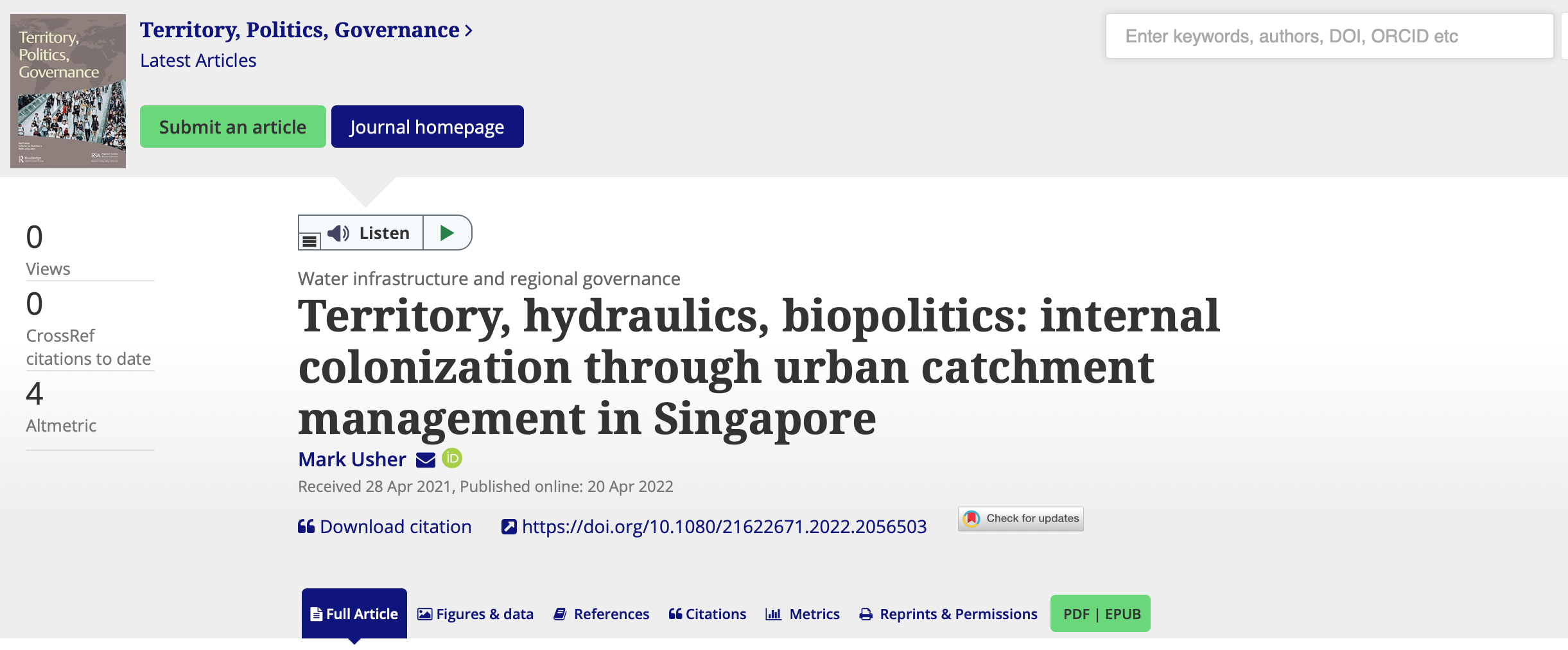
On separating from Malaysia in 1965, the People’s Action Party (PAP) sought to rapidly transform Singapore into a modern, industrialized nation-state. This was deemed essential if Singapore, a small island-nation, were to survive as an independent country. Nation-building would be reliant on territorial integration, entailing the industrialization and subordination of the rural periphery by a modernizing urban core, a process referred to as internal colonization. Territorial integration was critical in Singapore as the British had focused its efforts on the port city, leaving much of the island undeveloped. While there has been significant academic interest in both land and water scarcity in Singapore, rarely are they addressed together, which, as this paper argues, is necessary to understand the wider territorialization process. This paper reveals how the gradual expansion of catchment area into different regions of the island, through reservoir construction and anti-pollution measures, facilitated, legitimized and depoliticized the comprehensive restructuring of the domestic economy, urban renewal and gentrification, and resettlement of the population. The case is made for a political ecology of the state that historicizes and politicizes territory by revealing its forgotten, contested, physical geography. The importance of internal colonization to Michel Foucault’s thinking on power is also underlined.
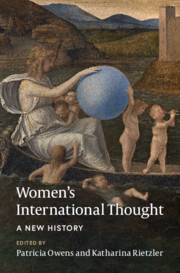
This first anthology of women’s international thought explores how women transformed the practice of international relations, from the early to middle twentieth century. Revealing a major distortion in current understandings of the history and theory of international relations, this anthology offers an alternative ‘archive’ of international thought. By including women as international thinkers it demonstrates their centrality to early international relations discourses in and on the Anglo-American world order and how they were excluded from its history and conceptualization. Encompassing 104 selections by 92 different thinkers, including Anna Julia Cooper, Margaret Sanger, Rosa Luxemburg, Judith Shklar, Hannah Arendt, Merze Tate, Susan Strange, Lucy P. Mair and Claudia Jones, it covers the widest possible range of subject matter, genres, ideological and political positions, and professional contexts. Organized into thirteen thematic sections, each with a substantial introductory essay, the anthology provides intellectual, political and biographical context, and original arguments, showing women’s significance in international thought.
‘This majestic volume demands superlatives. It is not just the first anthology of women’s international thought, and the largest anthology of international thought ever compiled: it is by far the most critical and original such collection and the one most likely to explode and re-order its field. A milestone achievement.’ David Armitage, Harvard University
‘This groundbreaking and robust collection powerfully showcases the richness and complexity of women’s international thought. It achieves the impressive feat of capturing women’s diverse ideas on the most urgent issues of the past – and present. This anthology will transform how we write and think about intellectual history and international relations.’ Keisha N. Blain, University of Pittsburgh
‘When is a discomforting challenge a gift? When it makes you rethink your assumptions in ways that excite you, invigorate you! This is precisely what Owens’ and Reitzler’s surprising history of international political thinking does. Having read this remarkable book, I now wonder why I’ve never realized that Black feminist Anna Julia Cooper was an international theorist or that Simone Weil’s writings were so pertinent to today’s international debates? Pulling back the curtain on these intellectual politics of exclusion is energizing.’ Cynthia Enloe, Clark University
‘This extraordinary anthology has been a long time coming. A stellar team has brought us the evidence and confirmation of women’s critical voices in the history of international thought. There are names we occasionally come across, and others that have been hidden from view for too long. This volume will change the history of international thought, it must.’ Glenda Sluga, HEC European University Institute and University of Sydney
With its diversity of possible Umwelten or environments for living things, Jakob von Uexküll’s Umwelt theory has been hailed by many readers as the first step toward an innovative, pluralistic conception of nonhuman life. But what is generally ignored is its structural conservatism, its identitarian logic in which everything should remain in its place and nothing should mix, and its proximity to Nazi ideology and politics. By turning the spotlight on these neglected aspects, Uexküll’s Surroundings opens up a new perspective on Uexküll’s Umwelt theory.
… As Foucault tells the story, he turned to pagan antiquity because he needed to break from the secondary accounts he had initially relied upon. Foucault scholarship has long grappled with the choice Foucault made to return to much older material, initially based on the published books and a few traces of teaching or shorter publications. Now, with the publication and translation of all his late lecture courses in Paris, as well as lectures or short courses delivered elsewhere, there is much more material available. In Foucault’s Seminars on Antiquity, Paul Allen Miller, Carolina Distinguished Professor of Classics and Comparative Literature at the University of South Carolina, discusses his final five courses in detail. The result is a convincing and nuanced study of Foucault’s engagement with classical texts…
At the Risk of Thinking: An Intellectual Biography of Julia Kristeva(Bloomsbury, 2020) is the first biography of Julia Kristeva–one of the most celebrated intellectuals in the world. Alice Jardine brings Kristeva’s work to a broader readership by connecting Kristeva’s personal journey, from her childhood in Communist Bulgaria to her adult life as an international public intellectual based in Paris, with the history of her ideas. Informed by extensive interviews with Kristeva herself, this telling of a remarkable woman’s life story also draws out the complexities of Kristeva’s writing, emphasizing her call for an urgent revival of bold interdisciplinary thinking in order to understand–and to act in–today’s world.
Discussed at the New Books Network with August Baker. Thanks to dmf for the link.
Characterized by shared, self-managed access to food, housing, and the basic conditions for a creative life, the commons are essential for communities to flourish and protect spaces of collective autonomy from capitalist encroachment. In a narrative spanning more than three centuries, Against the Commons provides a radical counterhistory of urban planning that explores how capitalism and spatial politics have evolved to address this challenge.
Highlighting episodes from preindustrial England, New York City and Chicago between the 1850s and the early 1900s, Weimar-era Berlin, and neoliberal Milan, Álvaro Sevilla-Buitrago shows how capitalist urbanization has eroded the egalitarian, convivial life-worlds around the commons. The book combines detailed archival research with provocative critical theory to illuminate past and ongoing struggles over land, shared resources, public space, neighborhoods, creativity, and spatial imaginaries.
Against the Commons underscores the ways urbanization shapes the social fabric of places and territories, lending particular awareness to the impact of planning and design initiatives on working-class communities and popular strata. Projecting history into the future, it outlines an alternative vision for a postcapitalist urban planning, one in which the structure of collective spaces is ultimately defined by the people who inhabit them.
Updated with the book’s two endorsements:
Against the Commons rewrites the history of capitalist urbanization since the eighteenth century by focusing on the role of planning in struggles around social reproduction. This fresh and exciting book is an invitation to scholars, students, and practitioners in planning, architecture, and urban studies to rethink the past and the future of urbanization.
Łukasz Stanek, University of Manchester
Against the Commons is one of the most important, original, and radical contributions to planning theory and history in the past fifty years. While Álvaro Sevilla-Buitrago offers a sharply critical perspective on the project of planning under capitalism, he also provides an inspiring call for new forms of collective self-management that protect, extend, and empower the commons.