During the late nineteenth century concerns about international commercial rivalry were often expressed in terms of national provision for training and education, and the role of universities in such provision. It was in this context that the modern university discipline of economics emerged. The first undergraduate economics program was inaugurated in Cambridge in 1903; but this was merely a starting point.
Constructing Economic Science charts the path through commercial education to the discipline of economics and the creation of an economics curriculum that could then be replicated around the world. Rather than describing this transition epistemologically, as a process of theoretical creation, Keith Tribe shows how the new “science” of economics was primarily an institutional creation of the modern university. He demonstrates how finance, student numbers, curricula, teaching, new media, the demands of employment, and more broadly, the international perception that industrializing economies required a technically-skilled workforce, all played their part in shaping economics as we know it today. This study explains the conditions originally shaping the science of economics, providing in turn a foundation for an understanding of the way in which this new language transformed public policy.
Discussion 14 December 2021, 5pm – details and registration here
Update: the stream of this discussion will be here
Cat Moir’s 2020 book Ernst Bloch’s Speculative Materialism: Ontology, Epistemology, Politics (Historical Materialism Books, Brill & Haymarket Books) situates Bloch’s philosophy in the context of historical and contemporary debates about utopianism, science, and the theoretical and practical tasks of Marxism. Bloch’s project of a speculative materialism was famously dismissed by Jürgen Habermas as naïve and outdated. By reconstructing it and bringing it into conversation with current work in new materialism and ecological Marxism, Moir demonstrates its relevance for illuminating questions of agency and the human-nature relation that concern us today.
This online roundtable discussion broadcast by Historical Materialism brings together respondents with a wide range of relevant expertise to discuss the issues raised by Moir’s book with the author.
Philosophy and the Rise of Fascism: A Symposium on Lukács’s Destruction of Reason
Join us for a three-day online symposium on György Lukács’s 1954 work, The Destruction of Reason, one of the most important works of philosophy in the 20th century.
Presenters Mariana Teixeira, Freie Universität Berlin Vanessa Wills, George Washington University Dirk Moses, University of North Carolina at Chapel Hill Adrian Johnston, University of New Mexico Daniel Lopez, Jacobin Magazine Ishay Landa, Open University of Israel Margit Köves, Delhi University Carl Sachs, Marymount University Tijana Okić, Scuola Normale Superiore
Hosted by Study Groups On Psychoanalysis and Politics Verso Books Deakin University
Organized by Daniel Tutt, Study Groups on Psychoanalysis and Politics Matthew Sharpe, Deakin University
As the last update on this book said, I was able to make a trip to Paris over reading week. I spent most of the time at the BNF working on archival materials related to The Archaeology of Knowledge. There is a manuscript on philosophical discourse, probably written in 1966, which seems to be an abandoned book project; a complete early draft of what became the book; and substantial fragments of another draft. The record is incomplete, and there are a lot of question marks around dating and sequence, but this is more preparatory material than any other of Foucault’s published books, with the exception of the second and third volumes of the History of Sexuality. In that case, this seems to be because Foucault was in hospital and unable to destroy these draft materials. I discuss those in Foucault’s Last Decade.
Some parts of the Archaeology materials are already published, with the introduction to one draft in Cahier de l’Herne, and the Introduction to the other draft in Les Études philosophiques along with a piece on Homer in La NRF. A forthcoming volume from Vrin will include more material, and the philosophical discourse text is being edited, along with a lecture course from Tunisia, for a volume in the EHESS/Seuil/Gallimard series of early courses and manuscripts. Those books are still a way off, so while I’m working with what is published, for the most part I’m reliant on the archive itself.
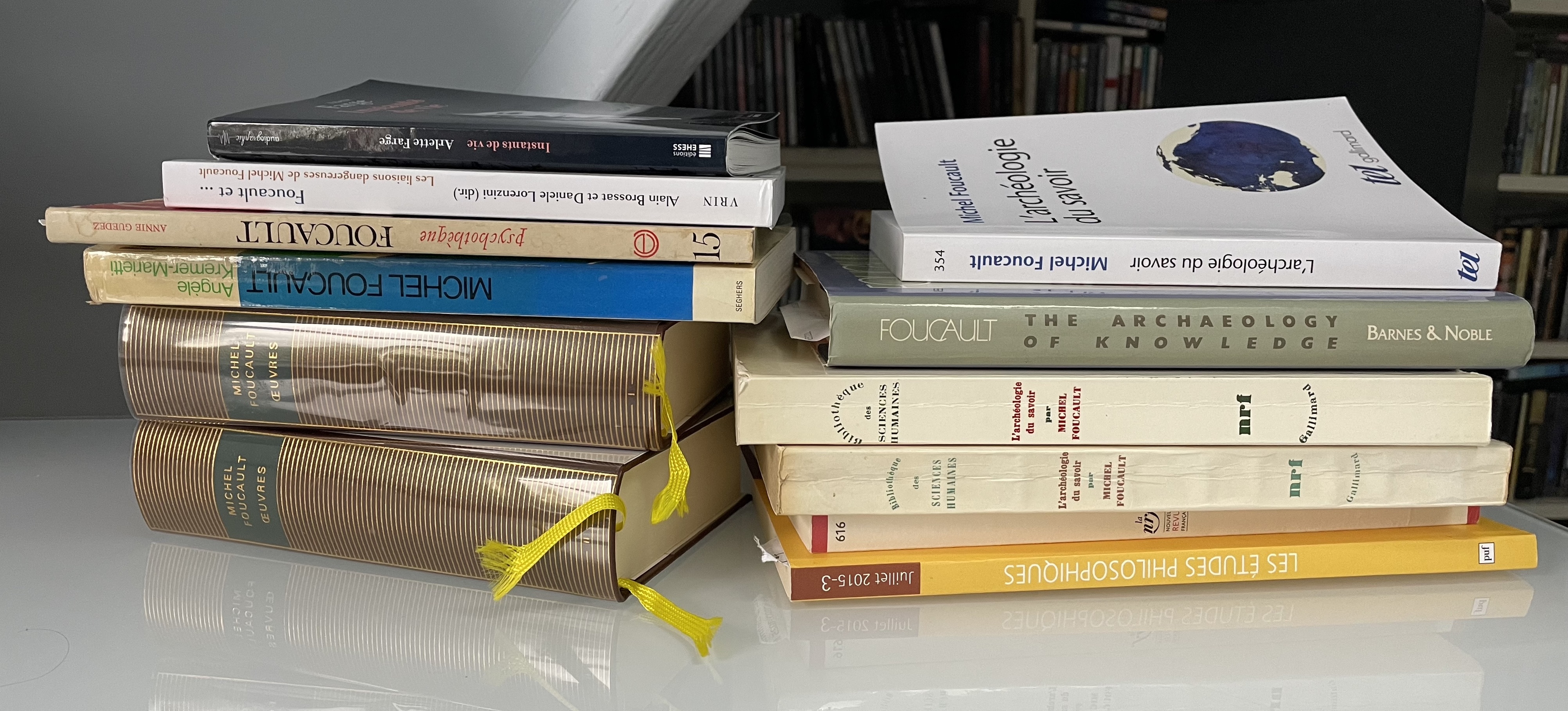
Martin Rueff edited two of the pieces mentioned above, and also edited the text of the book itself for its inclusion in the Pléiade Œuvres. His long text on the book in Œuvres, and the notes to the edited parts of the drafts are helpful, though I disagree with one of his claims. He also mentions that when L’archéologie du savoir went out of print in 1975, the reprint edition was slightly edited by Foucault. I didn’t know this before, and so I’ve now got to compare that to the 1969 edition. It’s a bit frustrating that the comparison wasn’t done for Œuvres, but then it wasn’t done properly for two other texts in that collection which exist in substantially distinct versions, so perhaps unsurprising. Some additional changes were introduced for the Tel reprint of L’archéologie du savoir, but since those were not made or authorised by Foucault, that’s less of a concern, and in any case they seem very minor.
It would be great to be able to say, with confidence, that this manuscript precedes that one, which leads to this one, and then the book. But that does not seem possible on the basis of the evidence available. Rather, it seems that there was simultaneous writing or editing of texts, that some intermediate versions were destroyed or lost, and that the arrangement of material in the archive does not necessarily reflect how Foucault left material in the late 1960s. While some manuscripts have page numbers, others do not, and their order isn’t clear. Foucault moved to Tunisia and back in this period too, which could have led to some textual confusion. Whatever else, there was certainly a version that was delivered to Gallimard, probably typed, and that would suggest a preceding manuscript, neither of which appear in the archive. But I’m now in a position to write the section on The Archaeology of Knowledge itself, which is the last major task for this chapter.
I also spent some time with the ‘intellectual notebooks’ of Foucault. While the majority of papers in the archive are on separate sheets of paper, grouped in folders or in folded sheets, these are school style cahiers, filled with writing – drafts of published texts, unpublished ideas, plans, reading notes, lists, more aphoristic entries, etc. An excerpt from one is in the Sexuality volume edited by Claude-Olivier Doron, who uses them in his notes and context to the text too, and they are occasionally referenced by Foucault’s other editors. Foucault often used the same notebook for two different purposes, writing from the start on one topic, and upside down from the back on another. They begin with notes on Birth of the Clinic and Raymond Roussel in the early 1960s, and run until the 1980s. Unlike almost everything else in the archive, Foucault puts dates before entries, though not always the year. I wish I’d had access to these when I did the research for Foucault’s Last Decade and Foucault: The Birth of Power. There is so much more material available now than when I wrote those books. But the notebooks are certainly a really helpful resource for this book on the 1960s, and so I concentrated on those on this trip.
Right at the end of my visit I looked at a couple of other boxes, including an older one which is a mix of different things. It includes parts of another course from Tunisia, and some material which possibly relates to a Vincennes course. I’d looked at this one before, but wanted to revisit it now I’d drafted sections on those periods.
There is also yet another fonds of material, newly deposited and not yet catalogued, and I took a look at some of the material in here. It is fascinating and helps to resolve definitively something I’d been troubled with concerning the provenance of one published text (see here). In brief, the Buffalo version of the ‘What is an Author?’ lecture is very different from the one published. The version in Textual Strategies is a different translation of the Paris lecture, with some cuts and a bit of supplementary material from Buffalo. Unfortunately that’s the version in widest circulation in English, reprinted without the important editorial indications in the original English version. But the entire Buffalo lecture is not yet published.
Doing this work also helped to add some precision to some of the claims I’m making elsewhere in this book. This fonds also has a lot of correspondence, of which I looked at the material from universities and other institutions, including a couple of letters to Foucault about overdue library books. Much of the material dates from the early 1980s, shortly before Foucault’s death, so is outside the time period I’m now working on. But there is a lot of useful detail here about some things I discuss in my other Foucault books. There are some indications of what Foucault would have done in the 1984-85 academic year, had he lived.
I also wanted to look at a few boxes of material relating to the early courses on sexuality, though I didn’t have time. This is not essential given those courses are now published, but there is other material in those boxes which I would have liked to see, though that’s on a different period and more for interest than necessity. But I squeezed a lot into this trip, and have a ton of notes to drawn on as I rework and add to the manuscript.
I had hoped that I would be able to get back to Paris for one more visit, perhaps in mid-December or early January. But the Richelieu site of the BnF is going through renovation work – it’s been a building site all the years I’ve been going there – and the manuscripts room is closed from mid-January to early-March. Before that, the fonds I am using are being moved, and are unavailable from mid-November. I didn’t know this until I made this trip. I was already trying to squeeze in as much as I could, with a concern that travel might be more challenging in the winter if covid cases rise. As it was, this trip was just in time before the closure.
The two main chapters that still need work are the ones on sexuality, and on madness and medicine. I’ve already co-authored a review essay on the sexuality courses with Alison Downham Moore in Theory, Culture and Society (open access here; Alison’s video abstract here). For these chapters I have a lot of notes, and some finished text. But I think I can rework these without further archival work, and hopefully any new secondary sources I want to read can be found in UK libraries, so I hope to make progress on these chapters in the last part of term and the Christmas break. Submitting the manuscript in early 2022 still seems possible.
Previous updates on this book are here. The Early Foucault was published by Polity in June 2021, and updates for its writing are here. A list of the resources on this site relating to Foucault – bibliographies, audio and video files, some textual comparisons, some short translations, etc. – can be found here. The earlier books in this series are Foucault: The Birth of Power and Foucault’s Last Decade, both available from Polity.
Literary Geography provides an introduction to work in the field, making the interdiscipline accessible and visible to students and academics working in literary studies and human geography, as well as related fields such as the geohumanities, place writing, and geopoetics.
• provides an overview of literary geography as an interdiscipline which combines aims and methods from human geography and literary studies
Emphasising the long tradition of work with literary texts in human geography, this volume:
• explains how and why literary geography differs from spatially-oriented critical approaches in literary studies
• reviews geographical work with literary texts from the late 19th century to the present day
• includes a glossary of key terms and concepts employed in contemporary literary geography
Accessible and clear, this comprehensive overview is an essential guide for anyone interested in learning more about the history, current activity, and future of work in the interdiscipline of literary geography.
Renowned French thinker Sylvère Lotringer, a lodestar in the twin galaxies of literary criticism and cultural theory, died on November 8 at the age of eighty-three following an illness. Beginning in the 1970s, Lotringer reshaped the American literary scene through the journal Semiotext(e), which he began publishing while teaching at Columbia University. The journal evolved into an independent publishing house of the same name, which through its English translations of their texts introduced American readers to such French giants of philosophy as Jean Baudrillard, Gilles Deleuze and Félix Guattari, Michel Foucault, Jean-François Lyotard, and Paul Virilio.
[…]
In November of 1975, a French literary scholar at Columbia University by the name of Sylvère Lotringer, along with a student, John Rajchman, organized a four-day colloquium that was intended to bring together a wave of avant-garde French theorists with various…
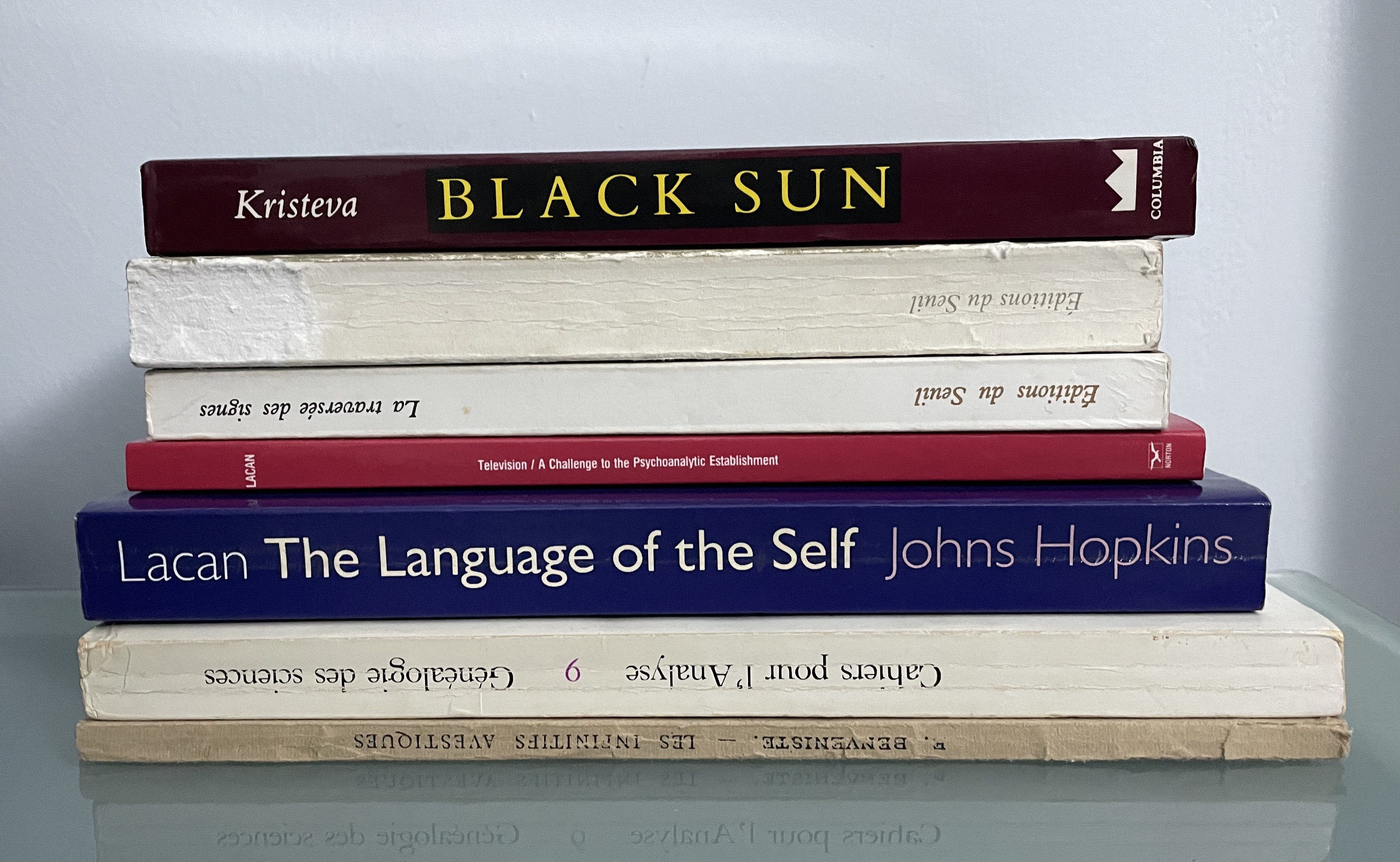
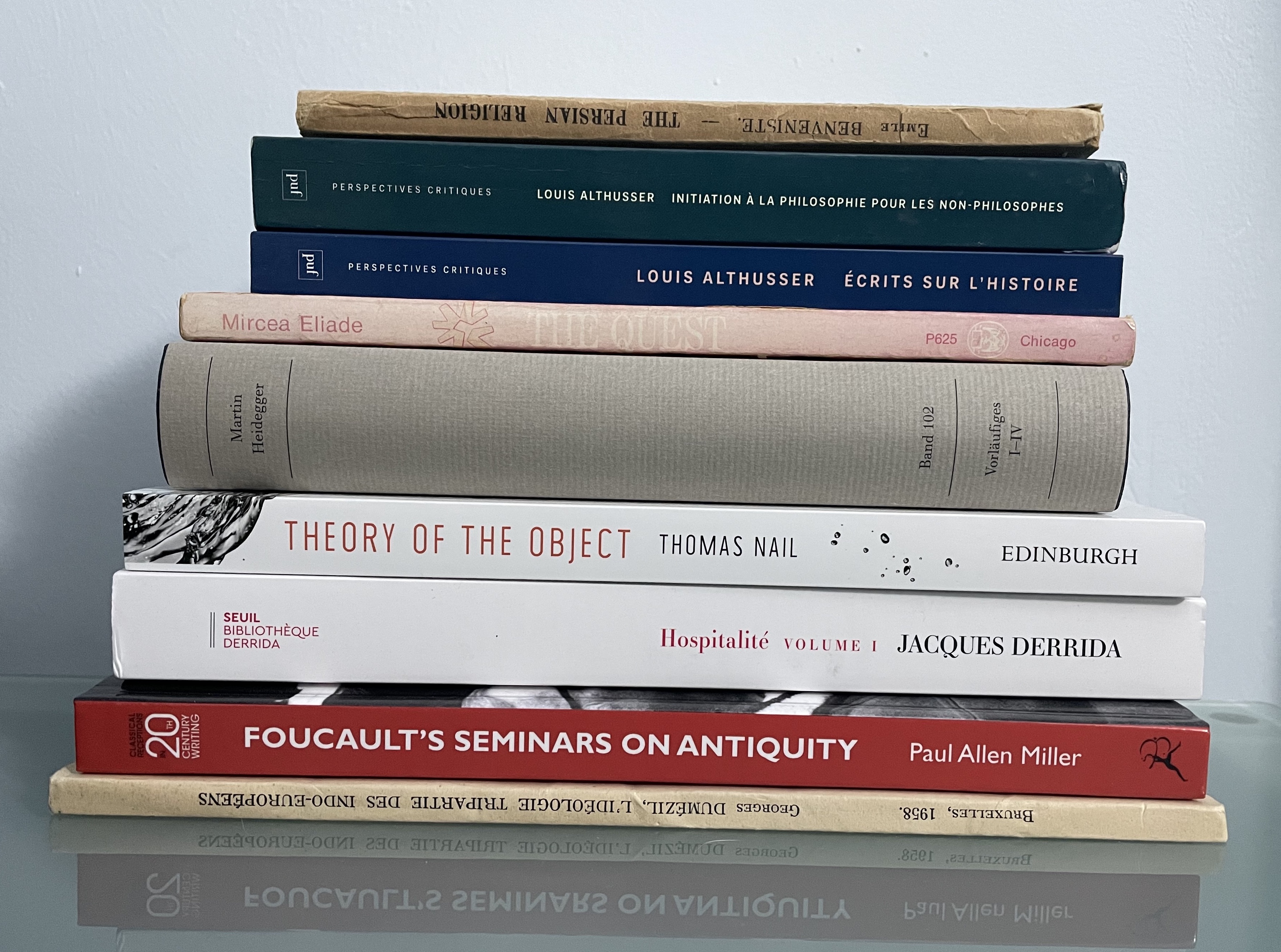
Mostly bought second-hand, but also Thomas Nail, Theory of the Object and Paul Allen Miller, Foucault’s Seminars on Antiquity, both sent by the publishers, and the most recent of Derrida’s seminars and Heidegger’s notebooks.
What is the role of critical theory today and who is it for? What kind of maps can theory provide in the context of entrenched capitalist crisis? These are some of the questions posed by this Theory in Crisis seminar series.
In this session, Engin Isin will give a talk titled ‘Planetary Movements: Willing, Knowing, Acting’:
Multiple but resonant social movements marked the beginning of the 21st century with several emergent qualities. There are far too many to mention here but even though the international congresses of working peoples, suffragette, anti-slavery, anti-colonial, anti-war, anti-racist, feminist, queer, trans, indigenous, and environmental movements, world social forums, migration movements, and sanctuary movements have all made indelible marks on the 19th and 20th centuries, the 21st century movements from No one is Illegal to Idle No More or from The Narmada Bachao Andolan resistance to Black Lives Matter, Rhodes Must Fall, and Extinction Rebellion signify qualities of a planetary politics. The naming of the present as the planetary either as a period or condition must proceed with an understanding of the emergent qualities of these movements.
Planetary movements intersect with each other: solidarity between oppressed, dispossessed, and displaced peoples and movements against sexual, racial, national and class domination. Planetary movements resist domination of peoples by peoples, species by species and planets by planets. Planetary movements are also not international, global, or transnational movements. The planetary is not a scale but a stage of politics. The planet earth, its peoples, its species, and its relation to other planets play out on a different stage.
This lecture is an invitation to interpret these movements as ‘planetary movements’ through twelve propositions organised into three parts: willing, knowing, and acting.
Vehicles, their infrastructures, and the environments they traverse are fundamental to the movement of migrants and states’ attempts to govern them. This volume’s contributors use the concept of viapolitics to name and foreground this contested entanglement and examine the politics of migration and bordering across a range of sites. They show how these elements constitute a key site of knowledge and struggle in migratory processes and offer a privileged vantage point from which to interrogate practices of mobility and systems of control in their deeper histories and wider geographic connections. This transdisciplinary group of scholars explores a set of empirically rich and diverse cases: from the Spanish and European authorities’ attempts to control migrants’ entire trajectories to infrastructures of escort of Indonesian labor migrants; from deportation train cars in the 1920s United States to contemporary stowaways at sea; from illegalized migrants walking across treacherous Alpine mountain passes to aerial geographies of deportation. Throughout, Viapolitics interrogates anew the phenomenon called “migration,” questioning how different forms of contentious mobility are experienced, policed, and contested.
Contributors. Ethan Blue, Maribel Casas-Cortes, Julie Y. Chu, Sebastian Cobarrubias, Glenda Garelli, Charles Heller, Sabine Hess, Bernd Kasparek, Clara Lecadet, Johan Lindquist, Renisa Mawani, Lorenzo Pezzani, Ranabir Samaddar, Amaha Senu, Martina Tazzioli, William Walters