Looks interesting, but a shame about the prohibitive price.
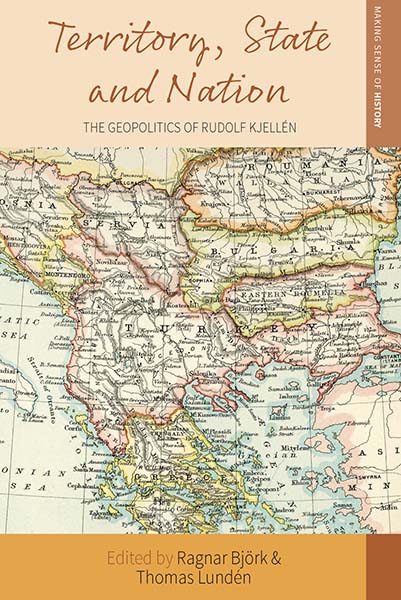
Rudolf Kjellén, regularly referred to as “the father of geopolitics,” developed in the first decade of the twentieth century an analytical model for calculating the capabilities of great-power states and promoting their interests in the international arena. It was an ambitious intellectual project that sought to bring politics into the sphere of social science. Bringing together experts on Kjellén from across the disciplines, Territory, State and Nation explores the century-long international impact, analytical model, and historical theories of a figure immensely influential in his time who is curiously little-known today.
“With an engaging critical perspective on classical geopolitics, the contributions to this volume illuminate both the historical and theoretical contributions of Kjellén and his pivotal role in the development of the field as a sub-discipline of political science.” • Geoff Sloan, University of Reading
In A Philosophy for Communism: Rethinking Althusser, Panagiotis Sotiris undertakes a reading of the work of the French philosopher centered upon his deeply political conception of philosophy. Althusser’s endeavour is presented as a quest for a new practice of philosophy that would enable a new practice of politics for communism, in opposition to idealism and teleology. Sotiris’s central claim is that Althusser remained a communist in his philosophy throughout the trajectory of his thought, from the crucial interventions of the 1960s to his writings on aleatory materialism. This argument is based on a careful reading of the tensions and dynamics running through Althusser’s work, as well as his dialogue with other thinkers. Particular attention is paid to crucial texts by Althusser that remained unpublished until relatively recently.
Invigorating and timely, this book provides a thorough overview of the geographies of cosmopolitanism, an ethical and political philosophy that views humanity as one community. Barney Warf charts the origins and developments of this line of thought, exploring how it has changed over time, acquiring many variations along the way.
Antonio Gramsci is widely celebrated as the most original political thinker in Western Marxism. Among the most central aspects of his enduring intellectual legacy is the concept of subalternity. Developed in the work of scholars such as Gayatri Spivak and Ranajit Guha, subalternity has been extraordinarily influential across fields of inquiry stretching from cultural studies, literary theory, and postcolonial criticism to anthropology, sociology, criminology, and disability studies. Almost every author whose work touches upon subalterns alludes to Gramsci’s formulation of the concept. Yet Gramsci’s original writings on the topic have not yet appeared in full in English.
Among his prison notebooks, Gramsci devoted a single notebook to the theme of subaltern social groups. Notebook 25, which he entitled “On the Margins of History (History of Subaltern Social Groups),” contains a series of observations on subaltern groups from ancient Rome and medieval communes to the period after the Italian Risorgimento, in addition to discussions of the state, intellectuals, the methodological criteria of historical analysis, and reflections on utopias and philosophical novels. This volume presents the first complete translation of Gramsci’s notes on the topic. In addition to a comprehensive translation of Notebook 25 along with Gramsci’s first draft and related notes on subaltern groups, it includes a critical apparatus that clarifies Gramsci’s history, culture, and sources and contextualizes these ideas against his earlier writings and letters. Subaltern Social Groups is an indispensable account of the development of one of the crucial concepts in twentieth-century thought.
Scion of a distinguished line of Talmudic scholars, Jacob Taubes (1923–1987) was an intellectual impresario whose inner restlessness led him from prewar Vienna to Zurich, Israel, and Cold War Berlin. Regarded by some as a genius, by others as a charlatan, Taubes moved among yeshivas, monasteries, and leading academic institutions on three continents. He wandered between Judaism and Christianity, left and right, piety and transgression. Along the way, he interacted with many of the leading minds of the age, from Leo Strauss and Gershom Scholem to Herbert Marcuse, Susan Sontag, and Carl Schmitt. Professor of Apocalypse is the definitive biography of this enigmatic figure and a vibrant mosaic of twentieth-century intellectual life.
Jerry Muller shows how Taubes’s personal tensions mirrored broader conflicts between religious belief and scholarship, allegiance to Jewish origins and the urge to escape them, tradition and radicalism, and religion and politics. He traces Taubes’s emergence as a prominent interpreter of the Apostle Paul, influencing generations of scholars, and how his journey led him from crisis theology to the Frankfurt School, and from a radical Hasidic sect in Jerusalem to the center of academic debates over Gnosticism, secularization, and the revolutionary potential of apocalypticism.
Professor of Apocalypse offers an unforgettable account of an electrifying world of ideas, focused on a charismatic personality who thrived on controversy and conflict.
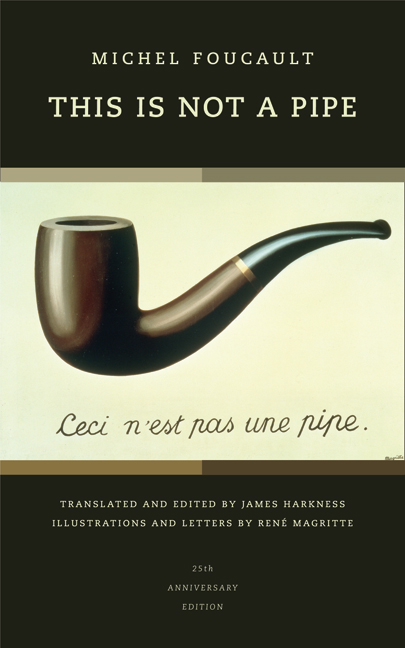
Foucault’s text on René Magritte, “Ceci n’est pas une pipe”, was published first in French in 1968 (reprinted in Dits et écrits as text 53), and then in a revised and expanded form as a book in 1973. The 1973 book was translated as This is not a Pipe by James Harkness in 1981. When Essential Works collection translated selections from Dits et écrits in volume 2, it included a translation of the 1968 text, for which the Harkness text was used as the basis, even though it was a translation of the 1973 version. This made sense – the texts were similar enough. But the Essential Works translation follows the Harkness too closely, and while it recognises the major edits, it misses several smaller points where the two French texts differ.
It is perhaps especially problematic when the revised text changes some instances of similitude to ressemblance, or vice versa, with Foucault writing a new paragraph which explains how he differentiates the terms (in the book French p. 61; English p. 44). But the English translation of the 1968 text does not always recognise what Foucault originally wrote, which leads to a confusing read.
For most readers, the 1973 text, either in French or English, should be the reference, since this was the expanded and revised version. But an anglophone reader wanting to see what Foucault published in 1968 cannot rely on Essential Works.
The order I’ve presented these examples follows the order the texts were written/translated. But note Essential Works is supposed to be a translation of the 1968 text; while Harkness translates the 1973 book.
Example 1
1968 article: Sept discours dans un seul énoncé. Mais il n’en fallait pas moins pour abattre la fortresse où la ressemblance était prisonnière de l’affirmation (Dits et écrits I, 648).
1973 book: Sept discours dans un seul énoncé. Mais il n’en fallait pas moins pour abattre la fortresse où la similitude était prisonière de l’assertion de ressemblance (Ceci n’est pas une pipe, 71).
Harkness translation: Seven discourses in a single statement – more than enough to demolish the fortress where similitude was held prisoner to the assertion of resemblance (This is Not a Pipe, 49).
Essential Works: Seven discourses in a single statement – more than enough to demolish the fortress where similitude was the prisoner of the assertion of resemblance (Essential Works II, 200).
Essential Works clearly follows Harkness, with a minor amendment, which means its translation is partly of the 1973 sentence, even though it is supposed to be a translation of the 1968 text. What Foucault actually said in 1968:
Seven discourses in a single statement [énoncé] – more than enough to demolish the fortress where resemblance was the prisoner of the affirmation.
Example 2
1968 article: Le second principe pose l’équivalence entre le fait de la similitude et l’affirmation d’un lien représentatif (DE I, 643)
1973 book: Le second principe qui a longtemps régi la peinture pose l’équivalence entre le fait de la ressemblance et l’affirmation d’un lien représentatif (42)
Harkness: The second principle that long ruled painting posits an equivalence between the fact of resemblance and the affirmation of a representative bond (34)
Essential Works: The second principle posits an equivalence between the fact of resemblance and the affirmation of a representative bond (EW II, 195)
In other words, Essential Works has recognised the 1973 text added a brief phrase, which it rightly omits, but missed the change of similitude to ressemblance. It is supposed to be a translation of the 1968, and should have ‘similitude’.
Example 3
1968 article: Séparation rigoureuse entre signes linguistiques et éléments plastiques; équivalence de la similitude et de l’affirmation (DE I, 650)
1973 book: Séparation entre signes linguistiques et éléments plastiques; équivalence de la ressemblance et de l’affirmation (77)
Harkness: Separation between linguistic signs and plastic elements; equivalence of resemblance and affirmation (53)
Essential Works: Rigorous separation between linguistic signs and plastic elements: equivalence of resemblance and affirmation (EW II, 201)
Essential Works misses the important change again, even though it recognises that ‘rigorous’ is present in 1968 and not in 1973.
These are far from the only changes between 1968 and 1973. Those changes are very extensive. But these are three important small ones which are unrecognised in Essential Works. There are other more minor examples of things where Essential Works follows the 1973 text (and Harkness’s translation) instead of the 1968 text of which it claims to be a translation.
Update 26 July 2021: There is another translation of Foucault’s text, by Richard Howard, as “Ceci n’est pas une pipe“, October 1, Spring 1976, 6-21. At the time of writing it is open access. This is a translation of the 1968 text, even though it is dated to 1963, and includes the two letters from Magritte, which only appear in the 1973 book version.
There are lots of other resources on this site relating to Foucault – bibliographies, audio and video files, some other textual comparisons, some short translations, etc. They are listed here.
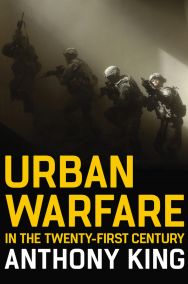
Over the last two decades, warfare has migrated into cities. From Mosul to Mumbai, Aleppo to Marawi, the major military battles of our time have taken place in densely populated urban areas. Why has this happened? What are the defining characteristics and the military and political implications of urban warfare today?
Leading sociologist Anthony King answers these critical questions through close analysis of recent urban battles and their historical antecedents. Exploring the changing typography and evolving tactics of the urban battlescape, he shows that whilst some methods used in urban battle are not new, operations in cities have become highly distinctive. Today, urban warfare has coalesced into gruelling micro-sieges, which extend from street level – and below – to the airspace high above the city – as combatants fight for individual buildings, streets, and districts. At the same time, digitalized social media and information networks have communicated these battles to global audiences across the urban archipelago, with these spectators often becoming active participants in the fight.
A timely reminder of the costs and the horror of war and violence in cities, this book offers an invaluable interdisciplinary introduction to urban warfare in the new millennium for students of international security, urban studies, and military science.
The work of the prolific political theorist and geographer Stuart Elden merits further engagement by literary historians of early modernity, in particular anyone interested in matters of geography and hydrography, space, place, nation, empire, mapping, policing, and resistance. Which is quite a lot of us. Shakespearean Territories is Elden’s third book-length exploration of territory as a key term for interrogating the long histories of biological and geopolitical convergences—or what Elden calls “the spatial extent of sovereignty.” Territory, he argues, is not mere political background, nor should we understand it simply as the site or product of inter- and intra-national contestations—as the place where de-territorialization and re-territorialization happen. Rather, argues Elden, territory is a process that is continually negotiated through a range of historically contingent practices and techniques designed to measure, manage, and master land. The first book in his unofficial trilogy, Terror and Territory (2009), is focused on the post–Cold War period, in particular the War on Terror, while the second, The Birth of Territory(2013), takes a longer view, tracing back to classical antiquity the emergence of territory as a contested geopolitical/biopolitical category. As its title suggests, the focus of Shakespearean Territories is narrower, but in its unraveling of the many ways in which territory is envisaged in Shakespeare’s work it is as conceptually capacious as the earlier books. [continues here]